Summary
Analysis score
Average of the criteria rated below
Value for money: strong ratings, but bare-body trade-offs
Design: compact SDS format with jobsite-friendly details
Battery and runtime: strong XR ecosystem, but plan for spares
Durability and reliability: long market life, solid feedback
Performance: 2.1J impact and real-world masonry drilling
What the DCH273N-XJ actually offers
Pros
- Good balance of power and size: 2.1J impact energy in a compact ~2 kg body
- Strong user satisfaction with 4.7/5 rating from 1,400+ reviews
- Fully compatible with DEWALT 18V XR batteries and ecosystem
Cons
- Sold as bare unit, so batteries and charger add significant cost if you’re not already on XR
- Not ideal for heavy demolition or very large-diameter drilling compared with higher-joule SDS tools

Specifications
View full product page →| Brand | DEWALT |
A compact SDS hammer drill that contractors actually buy
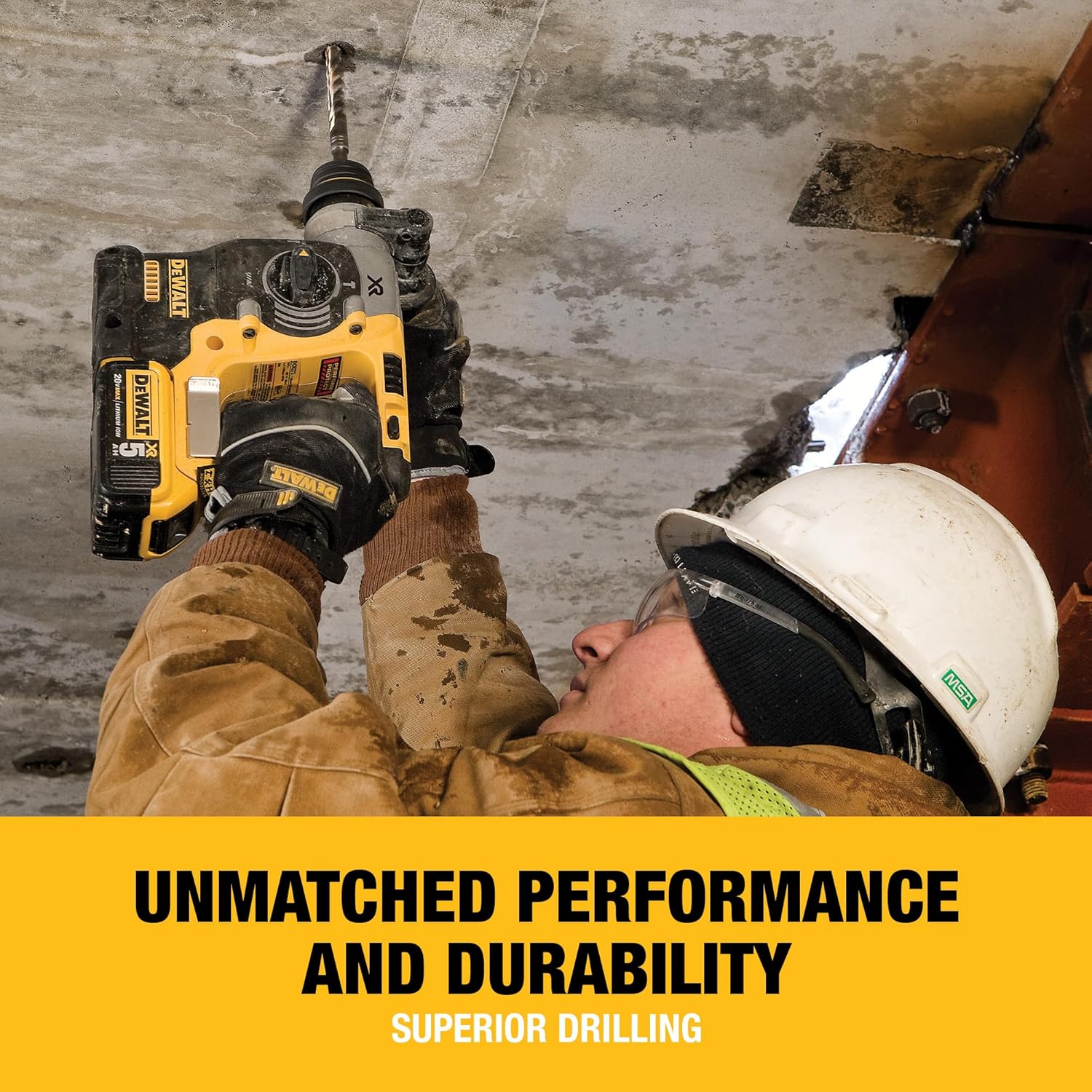
The DEWALT DCH273N-XJ is one of those cordless SDS-Plus hammer drills you see a lot on sites and renovation jobs. It runs on the 18V XR platform, uses a brushless motor, and is sold here as a bare unit (no battery, no charger). On paper, it’s aimed at people who already have DEWALT XR batteries and want a lighter, cordless solution for drilling into concrete, brick and block. With an average of 4.7/5 from more than 1,400 Amazon reviews, buyers are clearly not treating it as a niche product.
What stands out immediately is the balance between compact size and claimed performance: only about 2 kg for the tool, 2.1J impact energy, and the ability, according to the spec sheet, to drill over 90 holes of 10 mm x 80 mm in one charge with a suitable battery. That’s not demolition-hammer power, but it’s clearly meant as a serious masonry drill for anchors and fixings, not a DIY toy.
Among the comments, several verified buyers highlight that it “knocks holes in walls very easily” and describe it as a good masonry drill rather than just a general-purpose drill/driver. Others sum it up in a few words: “great strong tool”, “quality product”. There are also hints about limitations: one user says it’s “very powerful but get spare batteries”, which lines up with the fairly high-demand nature of SDS hammer drilling on an 18V pack.
In my opinion, if you look at the specs and the feedback together, the DCH273N-XJ sits in that sweet spot: compact and cordless, but still serious enough for regular anchor work in concrete and brick. It’s not going to replace a corded SDS-Max for heavy chiselling, and it doesn’t try to. The real question is whether the price of the bare body, plus batteries if you don’t already own them, lines up with the performance and durability people expect from DEWALT.
Value for money: strong ratings, but bare-body trade-offs
The exact price isn’t displayed here, but given the market position and the fact that it’s a bare body, the DCH273N-XJ usually sits in the professional mid-range rather than budget territory. The big argument for value is the combination of: 2.1J impact energy, compact 2 kg weight, brushless motor, and a huge pool of positive reviews. Being ranked in the top 5 hammer drills on Amazon UK with a 4.7/5 average score is not something you see on very poor-value products.
However, because this is sold without batteries or charger, the value question depends heavily on your situation. If you already own several 18V XR batteries, the DCH273N-XJ is an attractive way to add SDS-Plus capability without paying for another kit of chargers and packs. You’re essentially just paying for the tool body and the side handle, and you benefit from the claimed runtime of over 90 holes per charge with the batteries you already have.
If you don’t have any XR batteries, it’s a different story. You’ll need to add at least one 4–5Ah pack and a charger, which can quickly push the total into the price range of corded SDS kits or even more powerful cordless combos from various brands. One buyer’s advice to “get spare batteries” is a good reminder: for serious work, one pack often isn’t enough, especially if you’re drilling in concrete for a few hours.
In my opinion, the value is very good for existing DEWALT XR users who need a masonry drill that is lighter and more convenient than a corded SDS, but still capable of frequent anchor work. For someone starting from scratch with no XR gear, the bare-body format and the added battery cost make the equation less straightforward; you’ll have to decide whether the DEWALT ecosystem, the positive reliability feedback, and the compact format justify the investment over a cheaper corded SDS or a full kit from another brand.
Design: compact SDS format with jobsite-friendly details
On paper, the design focus is compactness and ergonomics. The dimensions are about 15.75 x 11.81 x 7.87 cm with a listed weight of 2 kg for the bare tool. For an SDS-Plus hammer capable of 24 mm holes in concrete, that’s relatively light and short, which should help in overhead work and tight spaces. Several reviews describe it as a “great lightweight / medium weight masonry drill”, which lines up with the specs: not featherweight, but clearly more manageable than old corded SDS models.
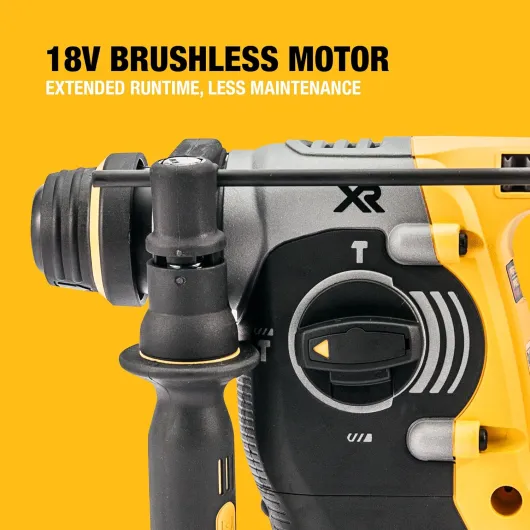
The classic DEWALT yellow/black colour scheme is there, and the drill includes a multi-position side handle and a belt hook built into the body. The side handle is important on this kind of tool for control and safety, especially when the bit jams in concrete. The belt hook, while it sounds basic, can make a real difference moving around a site or up a ladder with anchors and plugs in hand. Buyers call out the tool as “solid” and “original Dewalt device”, which suggests the fit and finish match what people expect from the brand.
The drill integrates a bright LED with a delay feature, aimed at improving visibility in darker areas and keeping the light on briefly after the trigger is released. That’s fairly common now, but still useful when working inside cabinets, basements, or low-light stairwells. The body is described as compact and ergonomic; with the brushless motor and electronic clutch, there’s no need for oversized housings, which helps keep the front-to-back length in check.
In my opinion, the design is very much “jobsite practical” rather than fancy. You get the important controls and modes (drill, hammer drill, hammer only), a side handle that can be rotated, and a straightforward trigger with an electronic clutch to protect your wrist and the gearbox. There’s no mention of a depth stop rod in the included components, which is a small minus if you rely heavily on exact anchoring depth, although many pros have separate stops or rely on tape on the bit. Overall, the design looks honest: compact, simple, and focused on making SDS drilling less of a chore.
Battery and runtime: strong XR ecosystem, but plan for spares
This version of the DCH273, the DCH273N-XJ, is sold as a bare unit. That means there is no battery or charger in the box; you get only the drill, the side handle, and the belt hook. The spec sheet lists 5 Amps and 5 Ah, but that refers to a typical battery that users pair with the tool, not an internal battery. It is fully compatible with DEWALT’s 18V XR lithium-ion packs, which is one of its big selling points: if you’re already in the XR ecosystem with 5Ah or higher batteries, you can just clip one on and go.
DEWALT’s description of the XR batteries emphasises extended cycle life, low self-discharge, performance monitoring, and dust and moisture resistance. In practice, buyers of this tool often mention that they are long-time DEWALT users and appreciate being able to share batteries across multiple tools. One verified review does add a realistic note: “Very powerful but get spare batteries.” That’s a good summary of cordless SDS reality: hammer drilling in concrete is energy-hungry, and even with efficient brushless motors, you don’t escape physics.
The brand claims the drill can deliver more than 90 holes (10 mm x 80 mm) per charge with a suitable battery. On paper, that’s very decent for an 18V machine, especially given the 2.1J impact energy. But that figure will depend heavily on the hardness of the material, the condition of the bit, and the capacity of the battery used. In softer block or brick with a fresh 5Ah pack, that claim looks realistic; in very hard concrete with a tired battery, you’ll obviously get less.
In my opinion, the battery story here is straightforward: if you already own several XR packs (ideally 4Ah or 5Ah and up), the DCH273N-XJ integrates very cleanly into your kit. If you don’t, you need to budget for at least one, ideally two, decent-capacity batteries plus a charger, which can significantly raise the entry cost. For professional use or renovation projects, having at least two 5Ah packs would be wise, especially if you plan on using the hammer drill alongside other XR tools during the same day.
Durability and reliability: long market life, solid feedback
The DCH273N-XJ has been available since March 2015, which is a long time for a power tool model to stay relevant. Combined with a 4.7/5 average rating from around 1,400+ reviews, that strongly suggests that the tool holds up reasonably well in real jobsite and DIY environments. Buyers describing it as a “quality product” and “original Dewalt device, solid, works well” reinforce that impression: it’s not a new, unproven design but a workhorse that has been circulating for years.
On the engineering side, several features point toward durability. The brushless 18V motor means no carbon brushes to wear out, less heat, and generally fewer maintenance operations over the tool’s life. The XR batteries it uses are marketed as having performance monitoring and protection against dust and moisture, which is important when drills are thrown into vans, used in renovation dust, and exposed to occasional splashes. The electronic clutch also plays a role in protecting the transmission from abuse when the bit jams.
Another aspect is user fatigue, which indirectly affects how long a tool is used in harsh ways. The Perform & Protect system with a vibration rating of 6.6 m/s² is claimed to be best-in-class at launch. Lower vibration means the user is more likely to use proper technique for longer, rather than forcing the tool or gripping it excessively tightly, both of which can shorten tool life. While reviews don’t give precise numbers, the general tone from buyers is that it’s comfortable enough for regular use and that it “gets the job done” in masonry without complaints about constant failures.
In my opinion, there is nothing on the spec sheet that screams “fragile” or “cut down to save costs”. Plastic and metal construction is standard for this segment, and the tool’s long presence in professional kits speaks in its favour. As with any cordless SDS, the main long-term wear points are likely to be the chuck, the internal hammer mechanism, and the batteries themselves. If you already trust DEWALT XR for other tools, this model seems to be in the same reliability bracket. If you’re extremely rough on gear or need maximum robustness for demolition, you might still combine it with a heavier corded or SDS-Max tool for the worst jobs.
Performance: 2.1J impact and real-world masonry drilling
The main performance figure here is the 2.1J impact energy. For an 18V SDS-Plus hammer, that’s in the solid mid-range. It’s clearly above what a typical hammer drill/driver can do in concrete, but a bit below the most aggressive SDS-Plus models that go over 3J. DEWALT states that the DCH273N-XJ is intended for drilling anchors and fixing holes in concrete, brick and masonry from 4 mm to 24 mm diameter. That covers most common plug and anchor sizes used in construction, HVAC, and electrical work.
One strong claim on the spec sheet is the ability to drill more than 90 holes of 10 mm x 80 mm per charge with a suitable XR battery. That’s a very concrete indicator: for someone installing anchors all day, that would cover a fair amount of work before swapping batteries. A review calling it a “good masonry drill” that “knocks holes in walls very easily block, brick etc” matches this positioning. It’s not pitched as a multi-material all-rounder first, but as a masonry tool that can handle repetitive drilling without bogging down.
The maximum rotational speed of around 1,060–1,100 rpm is on the lower side compared to pure drill/drivers, but that’s normal for SDS-Plus hammers, which rely more on impact energy than on high rpm. The electronic clutch is there to deliver consistent torque and protect the internal gears if the bit jams. In practice, that should limit sudden wrenching of the wrist and reduce tool damage, although reviews don’t go into technical detail on this point.
In my opinion, the performance is tuned around reliability and comfortable daily use rather than bragging rights. The tool is not the highest-joule SDS-Plus on the market, but it doesn’t need to be for 90% of anchor and plug work. The 4.7/5 average from a large number of buyers suggests that for typical block, brick and standard concrete, it gets the job done efficiently. If your main need is heavy chiselling or large-diameter core drilling, you’ll probably want a more powerful SDS or SDS-Max. For general building, trades, and serious DIY, this one looks well-calibrated.
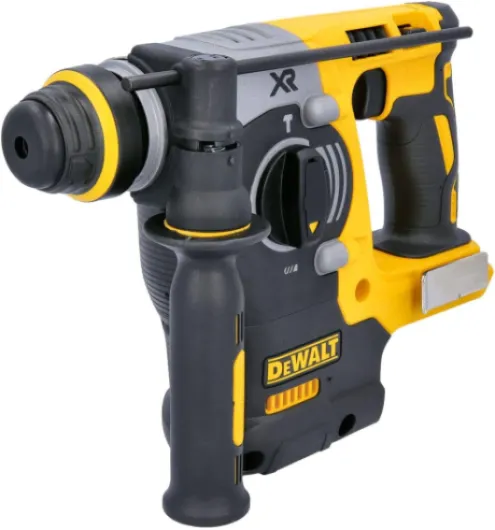
What the DCH273N-XJ actually offers
This model is a 24 mm SDS-Plus rotary hammer in the DEWALT 18V XR range. The 24 mm figure is the maximum recommended drilling diameter in concrete, which already tells you the intended job: anchors, fixings and medium-size holes rather than core drilling. The tool has three main modes according to buyers: drill only, hammer drilling, and hammer only. That makes it usable for light chiselling (chasing small channels, removing tiles) in addition to straightforward drilling.
Power-wise, DEWALT lists 2.1 joules of impact energy and a maximum speed in the 1,060–1,100 rpm range depending on which spec line you read. That puts it squarely in the compact professional class, not in the heavy-duty SDS-Max category, but clearly above simple hammer-drill/driver combos. The brand also pushes its Perform & Protect vibration control, with an advertised 6.6 m/s² vibration level, which is comparatively low for an SDS-Plus hammer and should, on paper, reduce fatigue during longer drilling sessions.
The tool is sold here as a bare unit ("N" version), meaning: no battery, no charger. Included in the box are a multi-position side handle and a built-in belt hook. It is compatible with the DEWALT XR lithium-ion battery ecosystem, and the specs and marketing text heavily insist on extended cycle life, low self-discharge and protection from dust and moisture. The listed amperage and capacity (5A / 5Ah) refer to a typical battery pairing, not something physically inside this body.
The DCH273N-XJ has been on the market since 2015 and still ranks high in the hammer-drill category on Amazon (top 5 in hammer drills, around 9,000 overall in DIY & Tools). In my opinion, that kind of longevity plus a large review base suggests a mature product that trades on reliability more than on flashy new features. You’re not looking at the newest generation, but at a platform that trades on a proven 18V XR ecosystem and widely available spares and accessories.
Pros
- Good balance of power and size: 2.1J impact energy in a compact ~2 kg body
- Strong user satisfaction with 4.7/5 rating from 1,400+ reviews
- Fully compatible with DEWALT 18V XR batteries and ecosystem
Cons
- Sold as bare unit, so batteries and charger add significant cost if you’re not already on XR
- Not ideal for heavy demolition or very large-diameter drilling compared with higher-joule SDS tools
Conclusion
Analysis score
The DEWALT DCH273N-XJ looks like a solid choice for anyone who needs a compact but capable SDS-Plus hammer drill and is already invested in the 18V XR ecosystem. On paper, the 2.1J impact energy, 24 mm max drilling capacity in concrete, and claimed 90+ 10mm x 80mm holes per charge make it very suitable for anchors and fixings in brick, block and standard concrete. The brushless motor, electronic clutch, and Perform & Protect vibration control suggest a focus on durability and user comfort rather than headline-grabbing specs.
The public feedback backs this up: a 4.7/5 rating from well over a thousand reviews, with buyers regularly calling it a strong, quality masonry drill that does its job without fuss. The tool is relatively light at around 2 kg, includes a multi-position side handle and belt hook, and the LED with delay is a nice everyday convenience. The main caveats are predictable: as a bare unit, it becomes truly attractive only if you already own XR batteries, and for heavy, continuous work you should plan on at least one spare battery, ideally more.
In my opinion, this drill suits professionals and serious DIYers who want a cordless SDS they can actually rely on for regular masonry work, not just occasional holes. If you mostly work near power outlets, or if you need maximum power for demolition or big core bits, a corded SDS or a higher-joule cordless model might be a better fit. For most anchor and fixing tasks, though, the DCH273N-XJ offers a convincing balance of performance, comfort, and long-term user satisfaction.