Summary
Analysis score
Average of the criteria rated below
Value for money compared to the big brands
Compact bullet format and simple mounting
Realistic expectations for the 5200 mAh battery
Weather resistance and build over the long run
Image quality, motion detection and connectivity in real use conditions
What this HITELLARCAM camera actually offers
Pros
- Good feature set for the price: 2K video, full‑color night vision, spotlight, siren, two‑way audio and AI motion detection
- Battery‑powered with reported multi‑week autonomy and simple, fully wireless installation
- Free cloud storage (SD quality) plus microSD support up to 256 GB, reducing or avoiding subscription fees
Cons
- Free cloud tier limited to SD quality, HD requires a paid plan
- Battery is not removable and needs periodic recharging, which can be inconvenient for high mounts
- Lesser‑known brand, with some uncertainty about very long‑term app and cloud support compared to major ecosystems

Specifications
View full product page →| Brand | HITELLARCAM |
A budget 2K camera that’s climbing the charts
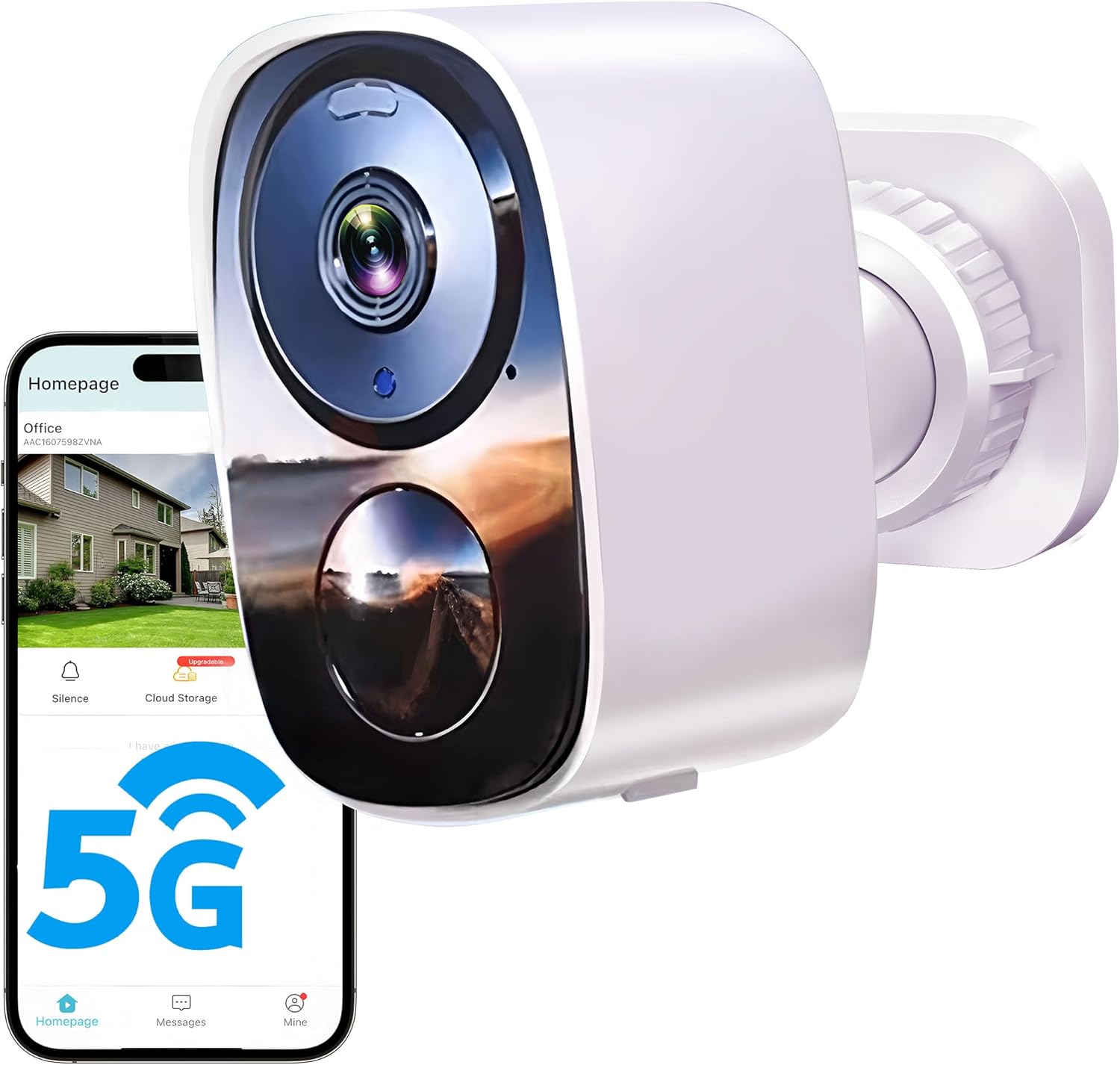
The HITELLARCAM CB54W is clearly trying to attack the big brands where it hurts: price and recurring fees. It’s a compact 2K battery-powered camera with Wi‑Fi, advertised 1–6 months of battery life, IP66 weatherproofing, and a mix of features usually seen on more expensive models: AI motion detection, spotlight, siren, two‑way audio, Alexa support, and both free cloud storage and microSD recording. On top of that, it supports both 2.4 GHz and 5 GHz Wi‑Fi, which is still not standard in this category.
On paper, it targets people who want simple home or RV surveillance: indoor or outdoor, no drilling for power, and no subscription obligation. The camera is very light (about 0.34 kg) and fairly small (2.25 x 2.25 x 3.32 inches), so it fits easily under an eave or in a corner without drawing too much attention. With an advertised 2K resolution (2304 effective video resolution at 30 fps) and full‑color night vision up to about 8 meters, the goal is clear: provide enough detail to identify faces and plates at short range.
Among the published reviews, the tone is mostly positive: 4.4/5 from around 3,100 ratings is solid for a no‑name (or little-known) brand going up against Ring, Blink, and others. Several verified buyers highlight the simple installation, the usable app, decent motion detection, and the fact that the manufacturer actually offers some free cloud storage instead of forcing a paid plan from day one. A few comments also underline that the camera feels well built for the price, even if the housing is just ABS plastic.
It’s not perfect though. The battery life claim of “up to 6 months” depends heavily on motion triggers and settings, and the free cloud plan is limited to SD quality, with HD locked behind a paid tier. In my opinion, this is a pragmatic, low‑cost option: good for those who want basic, flexible security without committing to an ecosystem, less ideal for people who want deep smart‑home integration or enterprise‑grade reliability.
Value for money compared to the big brands
The standout point here is clearly the value proposition. Multiple reviewers explicitly say this camera is a “great value for the price” and compare it favorably to more famous brands. One buyer mentions owning two Ring cameras but trying this HITELLARCAM model “to save some money” and being “shocked” by how easy it was to set up and use, with picture quality and app behavior that met their needs. Another highlights the combination of affordable price, clear video, good build feel, and simple wireless installation as reasons they “highly recommended” it.
On top of the purchase price, the economic angle includes storage costs. This camera offers free cloud storage with 3‑day retention (as one reviewer notes) at SD quality, plus local microSD support up to 256 GB. HD cloud recording requires a paid plan, but at least there is a no‑fee option that still backs up recent footage off‑site. Several buyers appreciate having the microSD option to avoid monthly fees entirely, especially those who dislike being locked into subscriptions. Compared with many mainstream cameras that essentially require a subscription to be useful, this is a real financial advantage over time.
The feature set is also decent for the money: 2K resolution, full‑color night vision, spotlight, siren, AI motion detection, dual‑band Wi‑Fi, two‑way audio, Alexa compatibility, and IP66 sealing. In my opinion, that’s a fairly complete package in this segment. Of course, the brand is less known than Ring or Arlo, which may worry some buyers about long‑term app maintenance and cloud service reliability. But the high number of reviews and the 4.4/5 average suggest that, at least for now, the product is being actively sold and supported, with 24/7 customer support advertised.
Overall, I see the value for money as strong: you trade the prestige and ecosystem integration of a big brand for a lower entry cost, some free cloud storage, and flexible local recording. It’s not the cheapest camera on the market and not the most advanced either, but the balance of features, performance, and total cost looks attractive for budget‑conscious users who still want 2K resolution and wireless convenience.
Compact bullet format and simple mounting
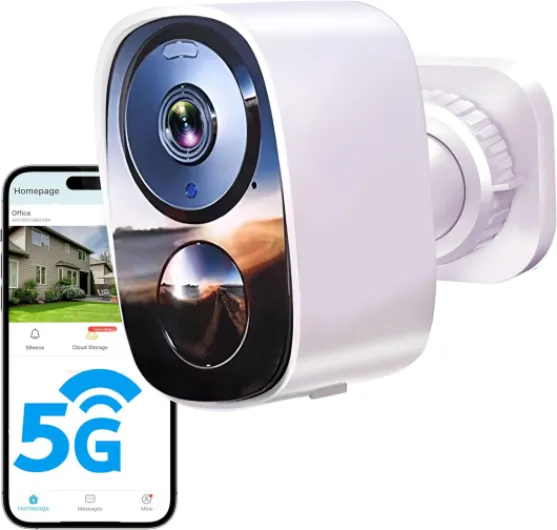
The CB54W uses a classic bullet form factor: a small rectangular/square body (the brand calls it square shape) with a lens and LEDs on the front, mounted on a stand that screws into a wall or other surface. At roughly 2.25 x 2.25 x 3.32 inches and 12 ounces, it’s compact enough to tuck under an eave, on a fence post, or inside a room without being too bulky. Several buyers mention that installation is “super easy” and “completely wireless”, which fits with the simple screw‑in wall mount and battery‑powered design. Included in the box are the stand, mounting screws, and an instruction manual.
The color variant here is White-2.4G&5G, so it’s a white housing that will blend reasonably well with most exterior trims and indoor walls. The body is made of ABS plastic, which is standard at this price: not premium metal, but light and cheap to produce. Reviews say the camera “feels well made” for the cost, which suggests the casing doesn’t feel flimsy, even if it’s still plastic. The IP66 waterproof and dustproof rating indicates it should resist rain and dust jets, making it suitable for outdoor use on a wall or under partial exposure.
From a usability standpoint, the design focuses on flexibility rather than aesthetics. The stand allows wall mounting and some adjustment to cover the desired angle. Buyers who used it for RVs and homes mention that the wide angle is enough to monitor larger areas like a yard or driveway. There’s no mention of a magnetic mount or quick‑release plate, so moving it frequently might require unscrewing the mount or at least loosening it, but the small size and weight limit the hassle.
In my opinion, the design is functional and straightforward: light, discreet, and easy to mount. It’s not a decorative object, but that’s not the goal here. The main trade‑off is that ABS plastic and a simple mount won’t have the same long‑term robustness as heavier, metal‑bodied pro cameras. For typical home use, though, the form factor looks practical: you can place it almost anywhere the Wi‑Fi signal reaches, with no power cable to route.
Realistic expectations for the 5200 mAh battery
The CB54W is powered by a 5200 mAh battery, with the brand advertising a range of 1–6 months of battery life depending on settings and usage. They even share some engineer data: with the camera fully charged and motion detection triggered 100 times per day, it can reportedly run for about 60 days. At a lower trigger frequency, they claim the battery life can theoretically extend up to 6 months. This kind of transparency is useful, because many cameras only quote the “up to” figure without any context.
In the Amazon comments, several verified buyers talk about battery behavior. One user says they used the camera heavily for about two weeks, “playing around with all its features”, and the battery was still at 86%. Another mentions getting about a week per full charge in very cold outdoor conditions, which usually drain batteries faster. These reports suggest that, in moderate conditions and with average motion activity, multi‑week autonomy is realistic, while the upper 6‑month claim looks more like a best‑case scenario with low activity and aggressive power saving.
There is no removable battery mentioned, so recharging likely means taking the camera down or at least plugging a cable into it at its mounted location. For some people, that’s a minor inconvenience a few times a year; for others, especially if the camera is high up or hard to reach, it can be annoying. On the other hand, the absence of a power cable makes installation simpler and avoids drilling or running wires through walls, which many buyers appreciate.
In my opinion, the battery setup fits the target audience: homeowners and renters who want a cable‑free camera and are ready to recharge every few weeks or months. It’s important to understand that heavy motion, continuous recording, or frequent live viewing will cut into battery life. If you need 24/7 continuous recording or hate the idea of climbing a ladder to recharge, a wired or solar‑powered model might be more suitable. But for typical motion‑based home monitoring, this 5200 mAh pack and the reported autonomy look decent for the price.

Weather resistance and build over the long run
From a durability standpoint, the HITELLARCAM CB54W is built around an ABS plastic shell with an IP66 waterproof and dustproof rating. IP66 means it should withstand strong water jets and dust ingress, making it suitable for outdoor mounting in rainy or dusty environments. The housing material is not metal, but ABS is common in budget cameras: light, reasonably impact‑resistant, and cheap to manufacture. Buyers describing the product say it “feels well made” for the price, which suggests the casing doesn’t give a hollow toy‑like impression.
The camera is designed for both indoor and outdoor use, with a night vision range of about 8 meters and an operating context that includes cold weather. One reviewer mentions using it outside in “very cold temps” and reports that it still functions normally, including the rechargeable battery, which is often the weak point in low temperatures. That doesn’t guarantee performance in extreme climates over years, but it’s a positive sign that the electronics and sealing can handle at least some winter conditions without failing immediately.
Mounting is via a screw‑in stand with included screws. This is a simple, proven system, but the long‑term robustness will depend on how well the mount is tightened and what it’s attached to (wood, brick, siding). There’s no mention of tamper‑resistant screws or anti‑theft features, so, like most consumer cameras, it can probably be removed with basic tools if someone is determined. For most home users, the deterrent effect of a visible camera plus spotlight and siren is more important than physical theft resistance.
In my opinion, the durability is adequate for home and light outdoor use but not geared toward industrial or high‑vandalism environments. The IP66 rating and ABS casing should handle rain and dust, and early reviewers using it outside seem satisfied. However, if you live in an area with extreme heat, heavy hail, or a high risk of physical damage, a more rugged, metal‑bodied camera might be a safer choice. For most typical suburban or RV scenarios, this one looks like it can hold up reasonably well, especially considering the budget positioning.
Image quality, motion detection and connectivity in real use conditions
On the performance side, the camera advertises 2K video (maximum webcam image resolution listed at 1440 pixels, effective video resolution 2304) at 30 fps, with “Night Color” technology and full‑color night vision up to about 8 meters. Several reviewers say the picture is “clear”, “great”, and “very clear” for both day and night, which suggests that the 2K resolution and the built‑in LED illumination do their job for typical home distances. One buyer using it outdoors in cold temperatures reports that picture quality remains good, which is reassuring for those in harsher climates.
Motion detection is handled by built‑in AI motion detection with instant alerts to the app. Reviews describe the motion detection as “works well” and “very sensitive”, with quick notifications when enabled. The brand recommends a detection distance of 5–8 meters, which is standard for this type of compact camera. One user even wonders whether it detects sound as well, which shows that the motion system is active enough to raise questions but not confusing to the point of constant false alarms. The AI mention usually implies some filtering of movement types, though there are no deep details on human/vehicle detection granularity.
Connectivity is one of its strong points. The camera supports both 2.4 GHz and 5 GHz Wi‑Fi, while many budget devices stick to 2.4 GHz only. A reviewer notes “WiFi range is excellent”, with the camera mounted about 70 feet from the router, still providing a good signal and no loss of quality. That’s not a lab measurement, but it gives a rough idea that the antennas and radio are at least competent. The app is often described as “surprisingly good yet simple”, “easy to use and intuitive”, and “super user friendly”, which matters a lot because a weak app can ruin the experience even if the hardware is fine.
In my opinion, the overall performance profile is solid for the price bracket: clear 2K image, decent night vision range, responsive motion alerts, and stable Wi‑Fi even at moderate distances. It’s not a high‑end CCTV system with advanced analytics or PoE reliability, but for typical home and RV surveillance, the balance looks convincing. The main limitation is that the free cloud storage is SD quality only, so if you rely on the cloud for evidence, you either accept lower resolution or pay for the HD tier, which partially offsets the low purchase price.
What this HITELLARCAM camera actually offers
On paper, the HITELLARCAM CB54W is a fairly complete bullet‑style camera. It records in 2K (around 2304p effective resolution) at 30 frames per second, with an advertised wide‑angle view that several buyers say is generous enough to cover a driveway or front yard. It uses Wi‑Fi for connectivity (no Ethernet), and unlike many budget models, it supports both 2.4 GHz and 5 GHz bands, which can help with congestion issues in urban environments. The control method is via a mobile app, and it also integrates with Amazon Alexa as a controller type, so you can theoretically pull up the feed on compatible screens.
The camera is fully wireless from a power standpoint: it runs on an internal 5200 mAh rechargeable battery. The manufacturer talks about 1–6 months of autonomy depending on motion detection frequency and recording mode. Engineer data quoted by the brand mentions about 60 days if motion is triggered 100 times per day, which gives at least some reference point. There is no wired power option mentioned, so this is primarily for those who really want a cable‑free setup and are ready to recharge from time to time.
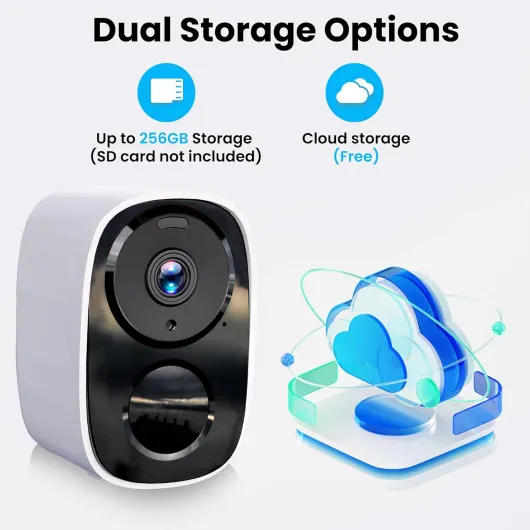
For storage, the device combines two approaches: free cloud storage and local recording on microSD (up to 256 GB, card not included). The free cloud plan is clearly limited: only SD quality recordings, with higher definition available in paid plans. Several reviews still see this as a plus, because many competing low‑cost cameras offer no free cloud at all. The camera also supports MPEG‑4 video encoding, which is fairly standard and easy to handle on most devices if you pull footage locally.
In terms of functions, the spec sheet lists AI motion detection, instant alerts on the phone, two‑way audio with microphone and speaker, a spotlight and siren alarm, and “Night Color” low‑light technology, meaning full‑color night vision using built‑in LEDs, rather than just infrared black‑and‑white. Recommended motion detection distance is 5–8 meters, and the night vision range is about 8 meters as well. In my opinion, the feature list is dense for this segment: it covers the basics (motion alerts, remote view), plus a few extras (siren, spotlight, dual‑band Wi‑Fi) that usually show up on more expensive models.
Pros
- Good feature set for the price: 2K video, full‑color night vision, spotlight, siren, two‑way audio and AI motion detection
- Battery‑powered with reported multi‑week autonomy and simple, fully wireless installation
- Free cloud storage (SD quality) plus microSD support up to 256 GB, reducing or avoiding subscription fees
Cons
- Free cloud tier limited to SD quality, HD requires a paid plan
- Battery is not removable and needs periodic recharging, which can be inconvenient for high mounts
- Lesser‑known brand, with some uncertainty about very long‑term app and cloud support compared to major ecosystems
Conclusion
Analysis score
The HITELLARCAM CB54W positions itself as a practical, low‑cost alternative to the big security brands, and the mix of specs and public feedback backs that up quite well. You get a 2K wireless camera with full‑color night vision, AI motion detection, spotlight and siren, two‑way audio, and both 2.4 GHz and 5 GHz Wi‑Fi. The 5200 mAh battery is realistically a multi‑week solution, possibly stretching to a couple of months in moderate conditions, and buyers seem generally satisfied with how long it holds up between charges. IP66 weatherproofing and ABS construction make it suitable for typical outdoor use, and the compact size simplifies placement around a home or RV.
The biggest strength, in my opinion, is the value equation: clear video, simple app, dual‑band Wi‑Fi, and a free cloud plan plus microSD support at a budget‑friendly price. The 4.4/5 average from over 3,000 ratings indicates that most users feel they got their money’s worth. On the downside, the free cloud tier is limited to SD quality, long‑term durability of a lesser‑known brand is always a question mark, and recharging a non‑removable battery may annoy those who mount the camera in hard‑to‑reach spots.
This camera suits people who want straightforward, mostly maintenance‑free surveillance without wiring or mandatory subscriptions: homeowners, renters, and RV owners who are fine with motion‑based recording and occasional recharging. Those who should probably skip it are users who need continuous 24/7 recording, tight integration with a larger smart‑home ecosystem, or industrial‑grade robustness. For everyday home security at a controlled cost, it looks like a solid, no‑nonsense option.