Summary
Analysis score
Average of the criteria rated below
Value for money compared to pricier gooseneck kettles
Design focused on pour control and countertop looks
Stainless steel body, cork handle, and basic plastic base
Longevity, switch issues, and real-world wear reports
Boiling speed and pour control: how it behaves in daily use reports
What the Bodum Melior actually offers on paper
Pros
- Controlled gooseneck pour that users say rivals pricier kettles
- Stainless steel body with cork handle and knob that hold up well over time
- Compact, lightweight design with quick boiling and automatic shut-off
Cons
- No variable temperature, keep-warm function, or audible boil alert
- Plastic base and short power cord give a budget feel

Specifications
View full product page →| Brand | Bodum |
A popular budget gooseneck for coffee drinkers
The Bodum 27oz Melior Gooseneck Electric Kettle sits in an interesting spot: it’s clearly aimed at pour-over and coffee enthusiasts, but its price and simple spec sheet keep it in the budget category. With a 0.8 L (27 oz) capacity, stainless steel body, and a basic on/off base with auto shut-off, it doesn’t try to compete with high-end variable-temperature kettles. Yet it still manages a 4.4/5 average from more than 12,000 Amazon ratings, which suggests it does the core job well for most buyers.
What stands out right away is the focus on controlled pouring rather than features. There’s no variable temperature, no keep-warm mode, no app, nothing fancy. The brand pushes the slim gooseneck spout and ergonomic cork handle as the main arguments, clearly targeting people who make pour-over coffee or want precise tea pours rather than just blasting hot water into a mug.
Among the published reviews, several buyers compare it directly to more expensive models like Fellow Stagg or Hario kettles. The consensus in those comments is that, on performance for the price, the Bodum holds up surprisingly well: it boils reasonably fast, the pour is controlled enough for coffee, and the overall design looks good on a countertop. The trade-offs show up on details like the basic plastic base, short cord, and lack of sound alert when boiling is done.
In my opinion, this kettle is best seen as an entry-level gooseneck that leans on a decent spec sheet and huge user base rather than premium materials or advanced controls. If you just want accurate pouring and quick boiling without paying for features you might never use, it looks like a solid candidate. If you want precision temperature control or more capacity, it will likely feel limited.
Value for money compared to pricier gooseneck kettles
On value, the Melior looks like a no-frills but capable option. It often sells at a fraction of the price of premium gooseneck kettles like the Fellow Stagg EKG, which can be three to five times more expensive. You don’t get variable temperature, a digital display, or a heavy metal base, but according to several reviewers who own both, you still get a controlled pour and reliable boiling. One coffee-enthusiast buyer flat-out calls it “the best cheap gooseneck you’ll find” for getting the job done in an office or home setup.
Where it delivers value is on the core function-to-price ratio: stainless steel body, decent cork handle, auto shut-off, and a gooseneck that actually behaves like it should. For people who mainly drink pour-over coffee or tea and just need boiling water, paying extra for variable temperature or advanced UI might not make sense. This kettle skips all those extras and keeps the cost down, while still looking nicer than many generic plastic electric kettles.
The trade-offs are clear: basic plastic base, shorter cord, no audible alert, no keep-warm, and a capacity that’s modest at 0.8 L. For households that make big rounds of tea or want to set a specific temperature for different drinks, the Melior will feel limited and maybe even frustrating. In that case, spending more upfront on a feature-rich kettle might actually be better value long term because it matches your needs more closely.
In my opinion, the sweet spot for this kettle is someone who: wants a gooseneck for proper pour-over technique, doesn’t care about exact temperature control, and prefers not to spend big money on a secondary appliance. If you fit that profile, the price-to-performance balance looks strong. If your expectations lean toward premium feel, advanced controls, and long-term heavy-duty durability, this model is more of a budget compromise than a perfect solution.
Design focused on pour control and countertop looks
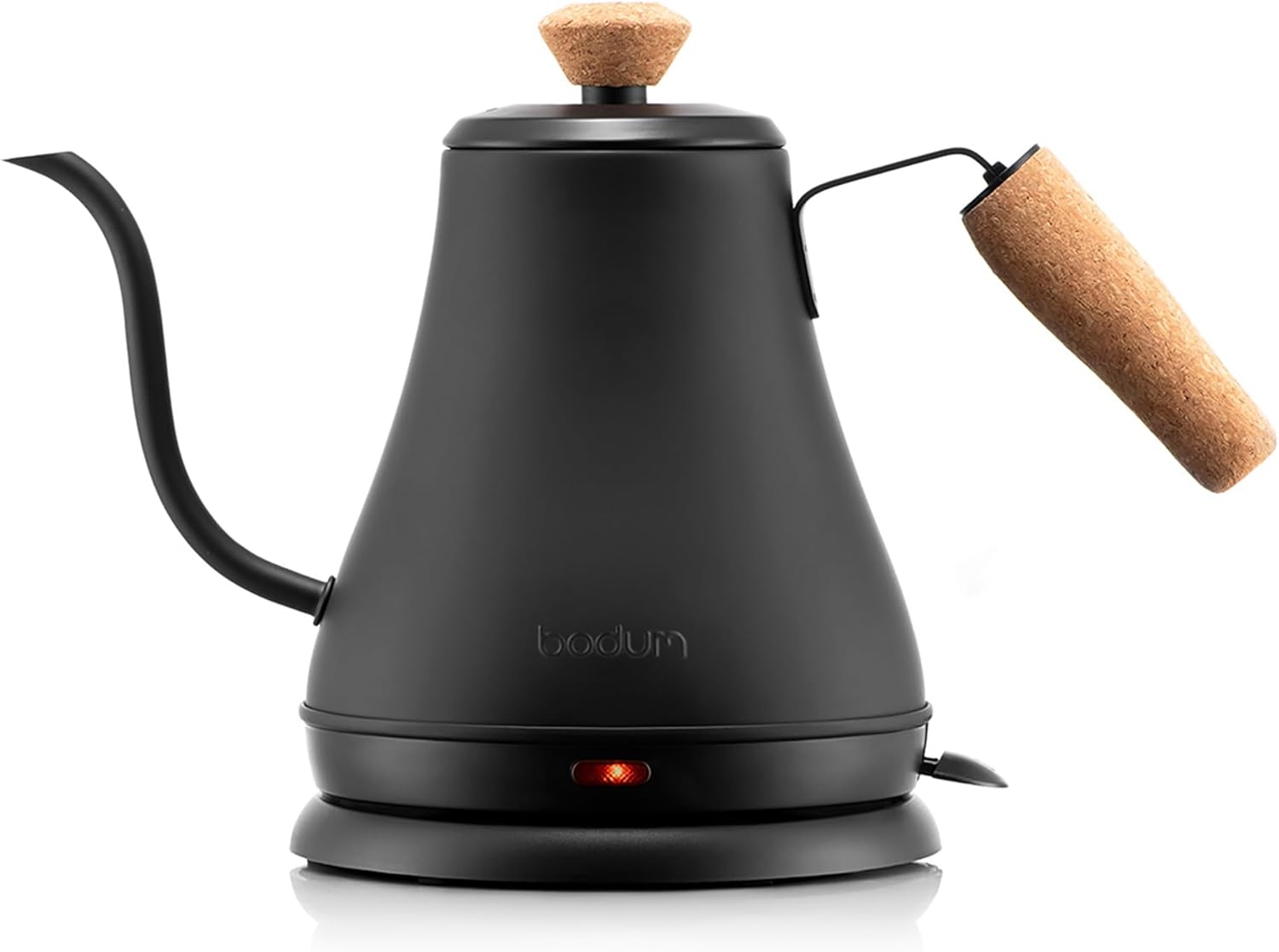
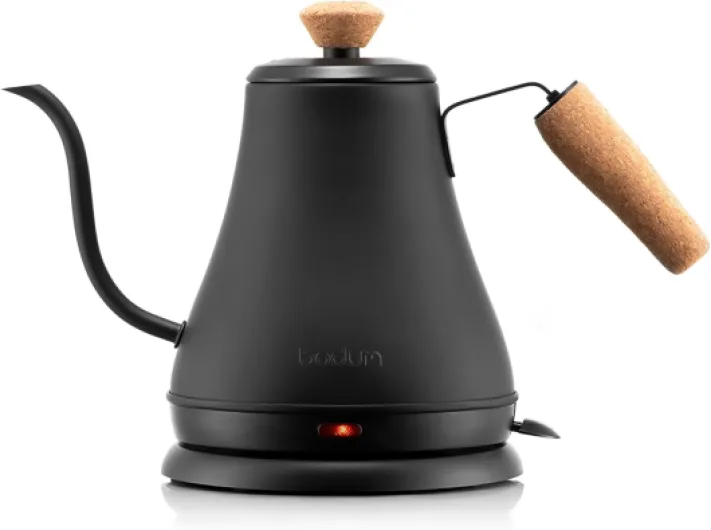
The design of the Bodum Melior clearly targets people who care about controlled pouring and aesthetics more than raw capacity or feature overload. The gooseneck spout is slim and long, which is exactly what you want for pour-over: it lets you direct the stream precisely over the coffee bed instead of dumping water in a big rush. Several Amazon reviewers highlight how nicely it pours, calling out a steady stream that doesn’t dribble and feels similar to more expensive kettles in that regard.
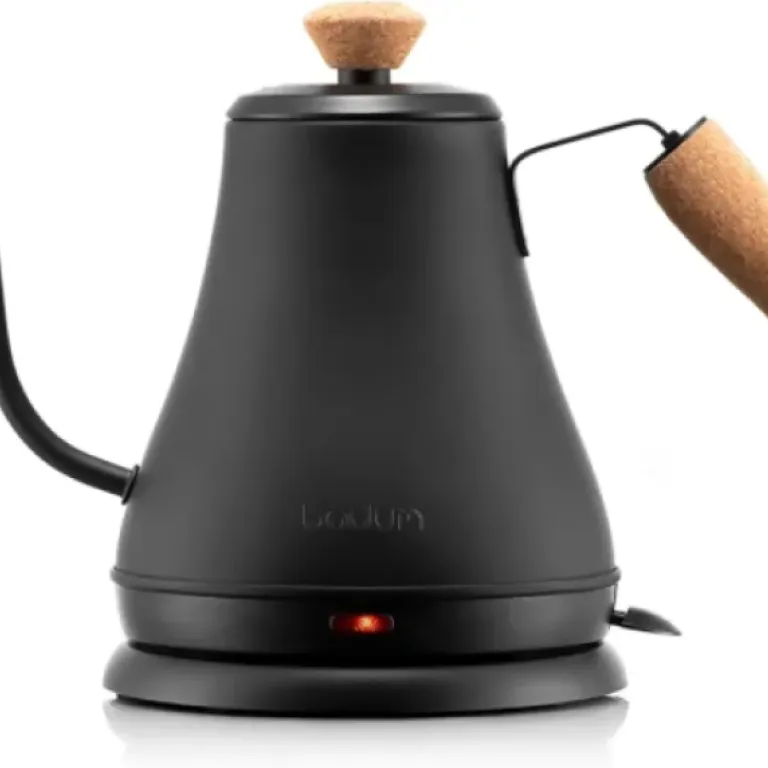
On the visual side, the matte black finish on stainless steel gives it a clean, modern look that matches a lot of coffee setups. Buyers regularly call it “cute” or “adorable” and mention that it looks good enough to leave on the counter. This might sound secondary, but for many people who assemble a pour-over station with a grinder, dripper, and scale, matching gear does matter. The small footprint also means it doesn’t dominate the space.
The base is intentionally simple: just a round plastic platform with an on/off toggle and a light ring on the side. Some users find the light placement a bit confusing, since it’s not directly on the switch. That means at a quick glance, you might not immediately see whether it’s running or finished if you’re looking from the wrong angle. There’s also no sound cue at the end of the boil, which multiple reviews mention. The only feedback is the click when the switch flips off and the light goes out, so you need to be a little attentive.
In my opinion, the design is functional but minimal. The kettle itself looks higher-end than the base, which does come across as basic plastic and slightly wobbly according to one detailed review. If you want a premium-feeling dock with metal or heavier construction, you’ll probably see this as a compromise. But if your priorities are a good-looking pot, precise spout, and small footprint, the design checks the right boxes, especially for the price bracket.
Stainless steel body, cork handle, and basic plastic base
On materials, the Melior is a mix of durable and budget choices. The main kettle body is stainless steel, which is standard for electric kettles and generally a good sign for longevity and food safety, as long as the internal seams and welds are done properly. There are no glass walls or visible plastic inside the water chamber mentioned, which many buyers prefer for hot-water appliances.
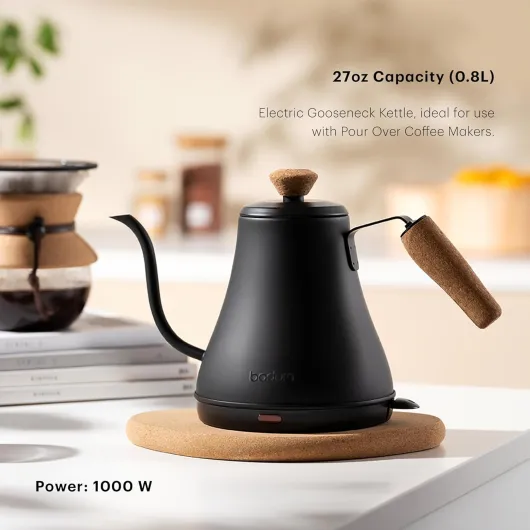
The standout element is the cork handle and lid knob. Bodum markets this as natural and sustainable, and many reviewers actually mention how much they like the feel of the cork. One buyer notes that after four months it still looked like new, and another long-term user updated their comment after more than a year saying the cork was still in good condition. At this price level, that’s a decent sign that the material choice isn’t just cosmetic. One more critical review does say the cork feels a bit flimsy and might eventually need replacing, but that comment also admits this is acceptable for a low-cost kettle.
The base, on the other hand, is plastic and fairly light, which some users perceive as cheap. One detailed reviewer compares the overall feel to more premium kettles like the Fellow Stagg and clearly points out that the base and switch feel less solid. At the same time, they accept it as a logical compromise given the lower price. The cord is also reported as short, which is common for safety reasons but can be annoying if your outlet placement is not ideal.
In my opinion, the material mix makes sense: metal where it counts, cheaper plastic where most people tolerate it, and cork to give it a bit of character and insulation. It’s not trying to compete with all-metal, heavy-duty bases or thick handles you’d find on kettles costing several times as much. For someone prioritizing stainless steel contact with water and a handle that stays cool, the materials look decent. If you want a tank-like build and premium feel everywhere, you’ll likely find this one a bit light and basic.
Longevity, switch issues, and real-world wear reports
Durability is where the large number of reviews becomes useful. There are several long-term user comments that give a sense of how the Melior holds up. One buyer reports using it almost daily for four years; in their case, the kettle boiled water reliably and was easy to clean, but the switch finally broke without a clear cause. They still call it a decent purchase given that lifespan, which suggests expectations should be set at “several years of service” rather than lifetime hardware.
Another detailed reviewer has been using the kettle multiple times per day for over a year and later updated their comment after more than two years of regular use. They report that the kettle is still working well, with no rust inside and the cork handle and knob still intact. They do mention that on a handful of occasions, they saw water droplets under the kettle near the switch area. Their explanation is that repeatedly restarting the kettle to maintain boiling likely caused steam and condensation around the shut-off mechanism, which then produced a few drops of water. They frame this as pushing the kettle beyond what it’s really designed for rather than as a fundamental leak.
Outside of those specific cases, many reviews simply say that the kettle just does its job over months or years: it boils, shuts off, and the cork doesn’t crumble quickly. There are isolated mentions of a slightly wobbly base or concern about the long-term strength of the cork, but nothing that looks like a widespread failure pattern. Cleaning limescale with standard descaling products appears straightforward, and the stainless steel interior seems to tolerate that well.
In my opinion, the Melior’s durability is good but not bulletproof. You’re dealing with a plastic base, a mechanical switch, and cork parts in a budget product. Expecting premium, decade-long durability like some high-end kettles is optimistic. But if you’re okay with the idea that a sub-$50 electric kettle might realistically last three to five years of daily use before something like the switch gives out, the real-world reports are reassuring. The stainless steel body and lack of complicated electronics probably help keep major issues limited.
Boiling speed and pour control: how it behaves in daily use reports
Performance-wise, two things matter most for this kind of kettle: how fast it boils and how well it pours. Several buyers say the Melior heats water “really fast” or “quickly and quietly.” One in-depth reviewer timed it at about 5.5 minutes to boil a full 0.8 L of room-temperature water. That’s not record-breaking, but it’s reasonable for the capacity and typical of small electric kettles without ultra-high wattage claims.
On the pour, comments are generally very positive. Users highlight an excellent, steady stream that doesn’t break up or dribble, even when pouring from a height. One reviewer who also owns a Fellow Stagg EKG and a Hario gooseneck says the Bodum’s pour rate is closer to the Hario: faster and more practical for general use, while still controlled enough for pour-over coffee. The same person notes that the Fellow is slower and more delicate, which some coffee purists like, but can feel tedious when you just want to fill a French press or make tea.
There are a few mentions of leaking or water around the lid/steam vent, but these are mostly tied to overfilling or getting water into the center tube when filling. One buyer says they initially had leaking from the top, but solved it by avoiding water in that middle section. Another review mentions that Bodum appears to have updated the steam valve piece from plastic to metal, which they believe makes it more foolproof. Overall, the complaints don’t point to a systematic design flaw so much as a kettle that doesn’t like being filled beyond the max line.
In my opinion, if you respect the max fill mark and treat it as a 0.8 L kettle, not a 1.0 L one, the performance looks solid for everyday coffee and tea. It’s not a high-tech, ultra-precise tool, but for getting water up to boil quickly and pouring with a good level of control, the user feedback is largely positive. The lack of temperature control is the main limitation from a performance standpoint, especially if you brew delicate teas or lighter roasts that benefit from specific temperatures below boiling.
What the Bodum Melior actually offers on paper
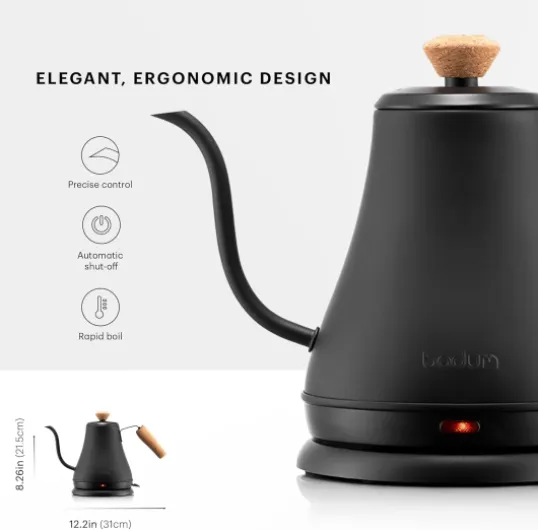
The Melior Gooseneck is a 0.8 liter / 27 oz electric kettle designed mainly for pour-over coffee. It runs on a simple base with an on/off switch and automatic shut-off. No temperature selection, no digital display, no keep-warm. On paper, that means fewer things to break, but also fewer options if you’re picky about exact brewing temperatures for green tea or different coffee roasts.
The body is made from stainless steel with a matte black finish, and the handle and lid knob are cork. The cork is highlighted as natural and sustainable, and multiple reviews say it stays in good shape over months of use, which is not always a given at this price. The kettle is cordless when lifted from the base, so you can pour freely without worrying about the cable, which is standard but still worth noting.
With a 2.1 lb weight and compact dimensions (about 11.3" x 6.9" x 3.8"), it’s a small-footprint kettle that should fit fine on most counters or even in a small office corner. Capacity-wise, 0.8 L is enough for one big Chemex, a couple of large mugs, or several smaller pour-overs, but it’s not designed for serving a crowd. If you routinely make tea or coffee for four or five people at once, you’ll probably find yourself refilling it.
In terms of safety and convenience, the spec sheet mentions automatic shut-off and a simple power light around the base. Some buyers do point out that there’s no audible alert when the water is ready and the light position isn’t super intuitive, so if you want clear feedback from across the room, this model is pretty bare-bones. Overall, on paper, it’s a straightforward, single-purpose kettle: boil water, pour with control, and that’s it.
Pros
- Controlled gooseneck pour that users say rivals pricier kettles
- Stainless steel body with cork handle and knob that hold up well over time
- Compact, lightweight design with quick boiling and automatic shut-off
Cons
- No variable temperature, keep-warm function, or audible boil alert
- Plastic base and short power cord give a budget feel
Conclusion
Analysis score
The Bodum Melior 27oz Gooseneck Kettle is a straightforward, budget-friendly tool for people who mainly care about controlled pouring and quick boiling. The spec sheet is simple: 0.8 L capacity, stainless steel body, cork handle, auto shut-off, and that’s basically it. Public reviews back up the idea that it delivers on those basics: it boils in a reasonable time, the gooseneck gives a steady, controllable stream, and the cork handle holds up better than you might expect at this price.
It’s not without compromises. The plastic base and short cord feel cheap to some buyers, there’s no temperature control or keep-warm mode, and there’s no sound when boiling is done. Durability reports are generally positive but realistic: several years of regular use seem common, with the occasional switch failure or minor condensation issue when the kettle is pushed beyond simple boil-and-stop cycles. If you want a premium-feeling, feature-rich kettle with perfect ergonomics and advanced controls, this isn’t it.
In my opinion, this kettle makes the most sense for coffee and tea drinkers who want a proper gooseneck without spending a lot. It’s a good fit for small kitchens, office desks, or as a starter kettle for someone getting into pour-over. People who should probably skip it are those who need precise temperature settings, larger capacity, or a heavier, more luxurious build. For what it costs, though, it looks like a solid, practical choice that gets the job done for most users.