Summary
Analysis score
Average of the criteria rated below
Value for money: efficiency now vs. electricity later
Compact design, simple controls and quiet airflow
Build, compressor design and how the brand handles failures
Energy use, operating modes and real-world efficiency
What the AEOCKY RHEA‑001 actually offers on paper
Moisture removal: how well it handles basements and large rooms
Pros
- High capacity (up to 80 pints/day) with low 280 W power draw for strong efficiency
- Quiet operation for its size, often described as white noise in reviews
- 3-year coverage on the unit and generally responsive customer support
- Compact footprint with casters and hidden handle for easier placement and movement
Cons
- Small 1.45-gallon tank fills quickly at high humidity, pushing you toward continuous drainage
- Isolated reports of early failure mean you should keep warranty details handy
- Only one listed fan speed and a small bucket may limit flexibility for some users

Specifications
View full product page →| Brand | AEOCKY |
An 80‑pint basement dehumidifier that leans hard on efficiency
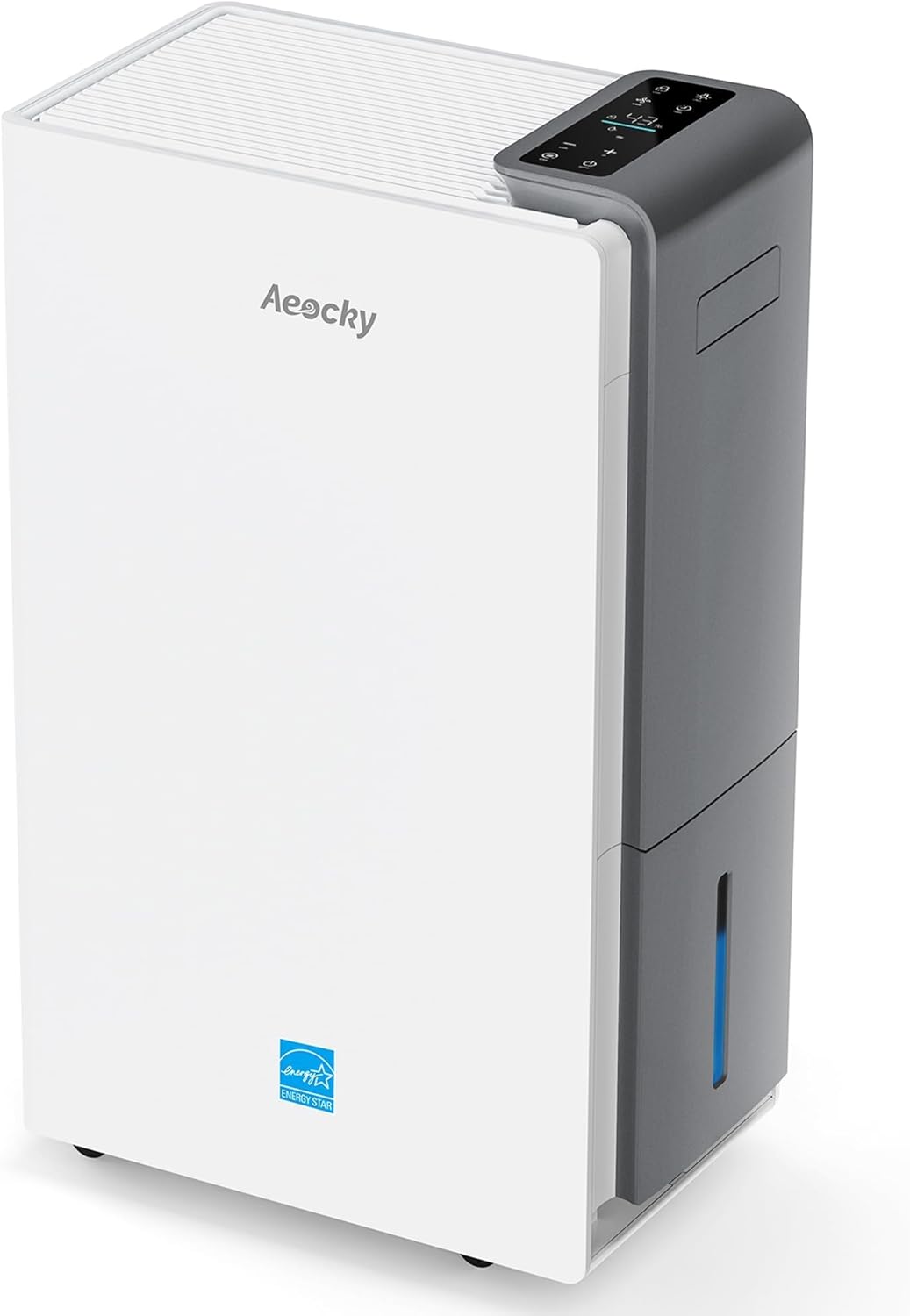
The AEOCKY RHEA‑001 is positioned as a high-capacity home dehumidifier that tries to stand out with two main arguments: strong moisture removal for large spaces up to 4,500 sq.ft and very low power draw (280 W) for an 80‑pint/day class unit. On paper that combination is not so common. It also carries a “Most Efficient Energy Star 2025” label, which is currently one of the toughest efficiency badges for this type of device. With an Amazon average of 4.5/5 from roughly 3,900 reviews, buyers seem broadly satisfied so far.
What comes back again and again in the comments is a mix of quiet operation, clear controls and visible energy savings compared with older dehumidifiers. Several people mention replacing big-name models that pulled twice the wattage, and they are surprised that this 280 W machine can keep basements at 45–55% relative humidity without running 24/7. That lines up with the spec sheet, which highlights a newer “rotor compressor” design instead of a classic piston compressor.
The flip side is that AEOCKY chose a small 1.45‑gallon tank for an 80‑pint/day capacity. Multiple buyers note that in a really damp basement, the bucket fills quickly and needs to be emptied several times a day unless you use the included drain hose. In my opinion, that’s the main practical compromise you accept for the compact footprint and lighter weight.
Overall, this looks like a high‑capacity, power‑efficient dehumidifier aimed at basements, older homes and large rooms where humidity is a constant headache and the electric bill matters. It is not perfect, but between the specifications, the warranty and the tone of most reviews, it comes across as a serious option if you’re tired of loud, power‑hungry units from older generations.
Value for money: efficiency now vs. electricity later
Value with a dehumidifier is not just about the sticker price; it’s about how much it costs to run over several years. Here, the RHEA‑001 clearly focuses on the “total cost of ownership” angle. With a 280 W draw and an Energy Star Most Efficient 2025 label, it sits among the more frugal large-capacity units. For people who run their dehumidifier for many hours a day, especially in summer, those savings add up quickly. One buyer who compared it to their older 540 W unit saw daily consumption drop by several kWh, which, depending on local rates, can mean noticeable monthly savings.
The brand itself claims up to 50% better efficiency than non–Energy Star products and up to $1,000/year saved in an extreme 24/7 scenario. That figure is obviously optimistic, but it illustrates the idea: even if actual savings are half or a quarter of that claim, you’re talking about hundreds of dollars over the dehumidifier’s life. Paired with a 3‑year coverage that exceeds many competitors, the financial argument is strong if you value low operating costs and some warranty padding.
On the compromise side, there are a few cost-cutting choices. The 1.45‑gallon tank is quite small for an 80‑pint/day unit, so in very humid conditions, you either accept frequent emptying or commit to using the drain hose full-time. If you were hoping to avoid any hose setup, that’s a real limitation. There is also only one fan speed listed in the specs, even though modes adjust behavior; some buyers might miss having explicit low/med/high fan control.
In my opinion, value is best for people who will actually benefit from the high capacity and efficiency: owners of damp basements, older houses, or large open-plan areas where a dehumidifier runs many hours in the season. If you only need occasional dehumidification in a small room, a cheaper, lower-capacity unit would make more sense. But for a 4,500 sq.ft rating, quiet operation, low wattage and strong user feedback, the RHEA‑001 looks like good value for money, especially if electricity costs are a concern and you’re willing to set up continuous drainage.
Compact design, simple controls and quiet airflow
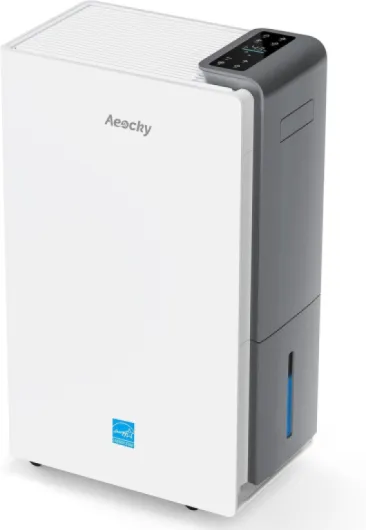
Visually and structurally, the RHEA‑001 goes for a tall, slim white tower design rather than the squat, bulky shape many 70–80 pint units use. At about 24 inches tall and under 9 inches deep, it can sit against a wall and take up less floor area, which several buyers appreciate compared with older, wider models. AEOCKY claims the rotor compressor design saves around 50% of internal space versus a piston compressor, and that seems plausible given the dimensions for this capacity class.
The control interface is frequently described in reviews as easy to read and straightforward. There’s a digital humidity readout that shows current RH, touch buttons for mode selection and humidity adjustment, and status lights. The multi-color ambient light is not just for looks; according to the description, it helps you quickly gauge humidity at a glance (for example, one color when it’s too high, another when it’s in the target range), which can be handy in a dark basement. Older users in their 70s mention they had no trouble with setup or reading the display, which is a good sign that the layout is not overcomplicated.
For mobility, the unit comes with factory-installed swivel casters and a hidden handle, so there is no separate wheel kit to mount. Buyers say the size and weight make it manageable to move around, especially compared with heavier, older units. The hidden handle is more discreet than a big protruding grip but still lets you drag the unit from room to room or between floors if needed.
Noise-wise, AEOCKY advertises 44 dB at the lowest fan speed, with a design that uses a plastic-sealed AC motor and what they call a “large-size biomimetic Archimedes Wind Tunnel.” In everyday terms, the goal is more airflow at lower RPMs so the fan doesn’t whip as loudly. Buyers regularly describe the sound as "super quiet" or "like white noise", and at least one mentions that the compressor is almost inaudible compared to the fan. In my opinion, if quiet operation is high on your list, this model looks solid in its category, especially next to older dehumidifiers that often sound like small jet engines.
Build, compressor design and how the brand handles failures
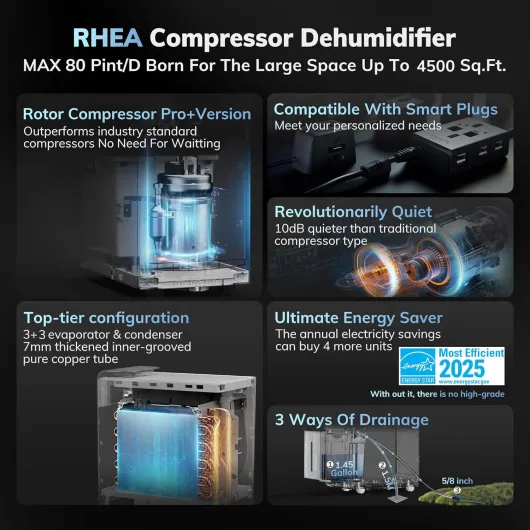
Durability is always a sensitive topic with dehumidifiers because they often run for long hours in tough environments. On paper, AEOCKY leans heavily on the compressor and coil design to argue for longer life. They highlight the use of pure copper tubing with internal threading rather than aluminum tubes, plus “3+3” row evaporator and condenser blocks and hydrophilic aluminum fins. The stated logic is that better materials and more surface area reduce compressor cycling and mechanical stress, which should extend lifespan beyond three years of normal use. They also back the product with a 3-year coverage for the unit, which is better than the 1-year coverage still common in this category.
The compressor itself is a rotor (rotary) type rather than a piston. Rotary compressors are generally more compact and can be quieter, with fewer vibration points, which may help longevity if properly engineered. AEOCKY also claims fewer start-stop cycles due to higher efficiency, again suggesting less wear. Of course, that’s theory; what matters is how units hold up in real homes over time. Among customer comments, there is at least one case where a buyer reports that their unit stopped working after not quite a year, possibly due to shipping damage that only showed up later. They contacted support, went through some basic checks and photo sharing, and the company offered a free replacement, explaining that shipment issues can sometimes shorten life.
This kind of anecdote cuts both ways: on one side, it shows that not every unit is perfect and that early failures can happen, which is unfortunately common across dehumidifier brands. On the other side, it suggests that AEOCKY’s support is willing to honor the warranty and send a replacement without turning it into a long fight. Several other buyers also mention prompt replies from customer service, though they don’t all go into detail about the issues.
In my opinion, the combination of better-than-average materials, rotary compressor, and 3-year coverage makes the durability picture reasonably reassuring for the price bracket, but it’s not bulletproof. If you want a dehumidifier you’ll run hard for years, this model looks like a solid bet as long as you keep proof of purchase and are ready to lean on the warranty if you draw a bad unit. There are isolated reports of failure, but not enough pattern in the public comments to call it a widespread problem at this stage.
Energy use, operating modes and real-world efficiency
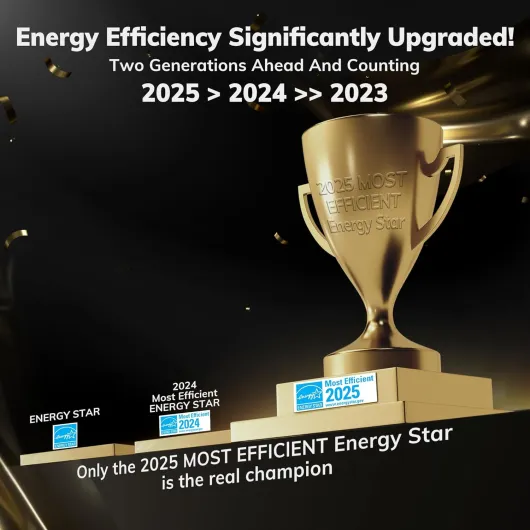
From a performance standpoint, the standout figure is 280 watts of power draw for an 80‑pint/day dehumidifier. Many older 70–80 pint units sit in the 500–700 W range. One buyer who measured their previous Hisense unit mentions it using around 540 W and 10.5 kWh per day in a basement, while the AEOCKY uses roughly 6 kWh/day when running constantly and about 4 kWh/day in Auto mode once humidity stabilizes. That’s a substantial drop and backs up the Energy Star “Most Efficient 2025” label.
AEOCKY claims that compared to non–Energy Star models, this unit can improve efficiency by up to 50% and save up to $1,000 per year if it runs 24/7 all year. That upper number assumes a very heavy-duty, continuous-use scenario and relatively high electricity prices, so I’d treat it as a best case, not a typical outcome. Still, even if the real saving is half of that, it’s significant over several years. The 3+3 evaporator/condenser structure, pure copper tubes and hydrophilic aluminum fins are all classic engineering choices to push heat-exchange efficiency and reduce how long the compressor needs to run.
The operating modes help you dial performance to your needs:
- Auto Mode tries to keep humidity around a mid-range comfort band, cycling on and off.
- Constant Humidity lets you set a precise RH target (40–80%).
- Continuous keeps the compressor running regardless of the target, useful when drying out a soaked space.
- Smart Drying presumably adjusts fan/compressor activity dynamically based on sensors.
- Sleep Mode lowers fan speed and should reduce noise for bedroom use.
Another interesting detail is cold-weather performance. Many compressor dehumidifiers struggle and frost up below 65°F. AEOCKY claims operation down to 42°F thanks to better defrost sensors and the compressor design. That doesn’t turn it into a full replacement for a desiccant unit in an unheated garage, but for cool basements that hover in the 50s or low 60s, it should stay functional where cheaper models might constantly freeze and defrost. In my opinion, the performance package is one of the strong points here: good moisture removal, low wattage, and enough smart behavior to avoid wasting power once the space is under control.
What the AEOCKY RHEA‑001 actually offers on paper
On the spec sheet, the RHEA‑001 is a compressor dehumidifier rated for spaces up to 4,500 sq.ft. The advertised capacity is 80 pints per day at 95°F and 95% RH, and 56 pints/day in a more typical basement scenario of 86°F and 80% RH. That’s high-end residential territory, roughly equivalent to the larger models from brands like Frigidaire or Hisense, but packed into a relatively slim body (14.45"D x 8.66"W x 24.09"H) and about 31–36 lbs depending on which weight figure you look at.
The power draw is listed at 280 watts, which is low for this capacity. One detailed buyer comparison mentions an old unit pulling about 540 W and around 10.5 kWh/day, versus this AEOCKY running the same basement in the 4–6 kWh/day range depending on mode. That’s a strong indicator that the efficiency claim is not just marketing. The unit supports several operating modes: Auto, Constant Humidity, Continuous, Smart Drying and Sleep, with humidity control from 40% to 80% and a timer, plus child lock and fan control.
Included in the box, according to the listing and reviews, are a drain hose, a garden-hose adapter stored in the tank, and a quick start guide. That means you can choose: either rely on the small internal bucket (1.45 gallons) or set up continuous drainage to a floor drain or sink. Several buyers specifically praise the clear, transparent hose because you can see the water flow and confirm it’s draining correctly.
On the feature side, AEOCKY pushes a few extra angles: no 24‑hour wait after delivery because of the rotor compressor design, a multi-color ambient light around the display for quick humidity feedback, and an auto restart / power-off memory, which lets it resume settings after an outage and play nicely with smart plugs. Add a 3‑year coverage on the unit and safety certifications (ETL, RoHS), and you get a product that, on paper, aims to be a long-term, efficient workhorse for damp basements and large living spaces.
Moisture removal: how well it handles basements and large rooms
The core job of any dehumidifier is simple: pull moisture out of the air and keep relative humidity in a healthy range. On that front, this model is rated for up to 80 pints/day under very humid conditions and 56 pints/day in a typical damp basement. Those are strong numbers for a home unit and should be enough for most basements, even in older houses with moisture issues. Several buyers mention starting at 60% or higher humidity and seeing the space drop into the 45–50% range in a matter of days, which lines up with the advertised capacity.
One review describes a 1930s home basement with a dirt floor where the RHEA‑001 was installed. The owners say the unit brought humidity down steadily, the bucket filled multiple times per day in the first weeks (which they expected given how damp the space was), and the automatic shutoff worked when the tank was full. Another buyer with a 1950s house reports going from 60% to 45% RH over several days and notes that everything in the basement stopped feeling moist. These kinds of comments suggest that, in real households, the machine is capable of stabilizing humidity at levels that prevent mold, musty smell and rust.
The multiple modes are also relevant to effectiveness. In Auto mode, the unit aims to keep humidity in a mid-range band (roughly 50–55%), which one owner found more efficient than forcing it to 40% constantly. When they tried 40%, the dehumidifier ran nearly nonstop and still hovered around 47–50%, because that’s often the practical limit for a large, open basement with ongoing moisture sources. When they switched to Auto, the unit cycled on and off, maintained comfortable humidity and dropped its energy use. That’s a good illustration of how using the modes as intended can strike a better balance between dryness and power consumption.
On the downside, the 1.45‑gallon tank is undersized for this capacity, so in heavy use, you are almost pushed toward continuous drainage. Several reviews basically say continuous drain is the way to go if your basement is really wet, otherwise you will be walking to the sink multiple times a day. In my view, the actual moisture removal performance looks strong for the category, but you need to plan your drainage properly to get the most out of it without constant bucket duty.
Pros
- High capacity (up to 80 pints/day) with low 280 W power draw for strong efficiency
- Quiet operation for its size, often described as white noise in reviews
- 3-year coverage on the unit and generally responsive customer support
- Compact footprint with casters and hidden handle for easier placement and movement
Cons
- Small 1.45-gallon tank fills quickly at high humidity, pushing you toward continuous drainage
- Isolated reports of early failure mean you should keep warranty details handy
- Only one listed fan speed and a small bucket may limit flexibility for some users
Conclusion
Analysis score
The AEOCKY RHEA‑001 positions itself as a high-capacity, energy-efficient dehumidifier for basements and large homes, and both the spec sheet and the bulk of buyer feedback support that positioning. You get 80‑pint/day class performance, a 4,500 sq.ft coverage claim and a very low 280 W power draw, wrapped in a compact, relatively light chassis with quiet operation. Reviews consistently mention humidity dropping into the 45–55% range in older, damp basements, and several owners highlight clear reductions in energy use compared with older brands they replaced.
It’s not flawless. The small 1.45‑gallon bucket is the main practical drawback: in a really wet basement, continuous drainage is almost mandatory unless you want to empty the tank multiple times per day. There are also isolated reports of early failure, though the 3‑year coverage and responsive support described in at least one case soften that risk. In my opinion, this model makes the most sense for people who will run a dehumidifier heavily and care about the electric bill and noise level as much as raw drying power.
If you have a large or chronically damp basement, an older home, or a whole floor that needs consistent humidity control, the RHEA‑001 looks like a strong candidate: efficient, quiet, and reasonably backed by the brand. If you only need light-duty drying or hate the idea of setting up a drain hose, you might be better off with a cheaper, smaller-capacity unit with a bigger tank. For its intended use case, though, the balance of performance, efficiency and price justifies a solid rating.