Summary
Analysis score
Average of the criteria rated below
Value for money: where this lens makes the most sense
Design and handling: light, basic, and a bit old-school
Build quality and long-term reliability
Image quality and autofocus: good in the middle, weaker at 300mm
What this 75-300mm actually offers
How well it does the job for portraits, sports, and wildlife
Pros
- Very low price for a 75–300mm telephoto zoom
- Good image quality and pleasant background blur between about 75–200mm
- Lightweight, compact and compatible with all Canon EF-mount DSLRs
Cons
- Noticeable softness and chromatic aberrations towards 300mm, especially with cropping
- No image stabilization and basic, noisy autofocus motor
- Rotating, extending front element and somewhat loose zoom feel less practical and less refined

Specifications
View full product page →| Brand | Canon |
A long zoom for cheap: what’s the real deal?
The Canon EF 75-300mm f/4-5.6 III is one of those lenses almost every Canon DSLR owner has seen bundled in kits or suggested as a first telephoto. It covers a long 75-300mm range, works on any Canon EF-mount DSLR (full-frame or APS-C), and is sold at a very low price for this focal length. On paper, it promises portraits, wildlife and sports without blowing the budget. The big question is how much compromise comes with that low cost.
Public reviews are largely positive: an average of 4.7/5 from several thousand ratings is not trivial. Still, when you read the comments in detail, you quickly see a pattern: people are happy for the price, but nobody confuses this with Canon’s pro L glass. The strengths seem to be reach, decent portrait performance at the short end, and accessibility for beginners. The weaknesses show up at the long end of the zoom, in autofocus behavior and in the absence of image stabilization.
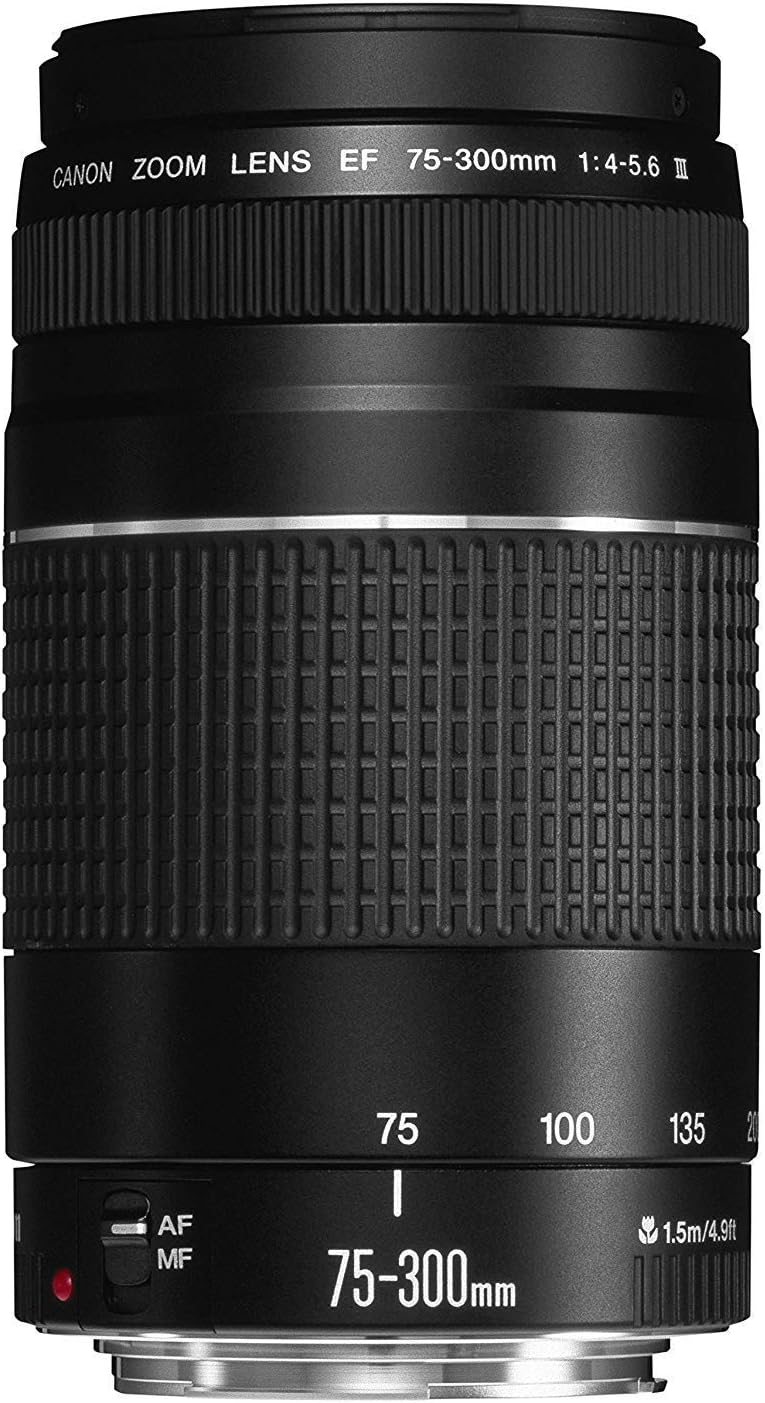
On the spec sheet, there is nothing fancy: no image stabilization, no ultrasonic motor, a variable f/4-5.6 aperture, 13 elements in 9 groups, and a minimum focus distance of 4.9 ft. It’s a straightforward telephoto zoom designed to be inexpensive rather than packed with advanced features. That said, several buyers insist it can produce pleasing results if you know its limits and work around them, especially by staying in the 75–200mm range and avoiding heavy cropping at 300mm.
In my opinion, this lens is best viewed as a learning tool and a casual-use zoom rather than a serious investment for demanding wildlife or sports work. It opens the door to long focal lengths for not much money, and the reviews suggest that for family events, basic wildlife shots and portraits, it gets the job done. But anyone hoping to lean on it at 300mm for tight, highly detailed images will probably hit its limits pretty quickly.
Value for money: where this lens makes the most sense
Value is clearly the strong point here. The Canon EF 75-300mm f/4-5.6 III sits in the very low end of telephoto pricing, and that’s reflected in multiple reviews. One buyer mentions picking it up used for around $100 and calls it “overall great value, absolutely worth the buy.” Another gives it 5 stars with the simple verdict: “For the price? It’s outstanding!” The high overall Amazon rating (4.7/5 with several thousand reviews) also suggests that most owners feel they got their money’s worth, even if they’re aware of its optical and feature compromises.
In terms of what you get for that money, the main deliverable is reach. Going from a standard 18–55mm kit zoom to 300mm opens up a lot of framing possibilities: tighter portraits, compressed backgrounds, and the ability to capture distant subjects. On paper, you’re sacrificing image stabilization, a fast constant aperture, and premium build quality. For someone just stepping into telephoto shooting, those trade-offs can be acceptable. If you rarely shoot in low light and mainly want daytime outdoor shots, the lack of IS and slower aperture are manageable with some care on shutter speed.
Where the value equation shifts is when you start comparing it to slightly more advanced options, like Canon’s stabilized 70-300mm lenses or brighter third-party zooms. Those alternatives cost more but bring real-world benefits: better sharpness at the long end, image stabilization, faster and quieter autofocus, and often better build. For a user who quickly gets serious about sports or wildlife, paying extra for these advantages can make a big difference. Several reviewers hint at this, describing the 75-300mm III as something that “will only wet your palette and invoke a thirst for more.”
In my opinion, the value is strong for beginners and casual users who want to experiment with telephoto photography without spending much. It’s less attractive for enthusiasts who already know they want reliable 300mm performance and are willing to invest more. If you buy this lens with a clear understanding that it’s an inexpensive way to learn and play, the cost-to-fun ratio is good. If you see it as a long-term main lens for demanding telephoto work, the initial savings might feel less impressive once you start bumping into its limitations and considering an upgrade.
Design and handling: light, basic, and a bit old-school
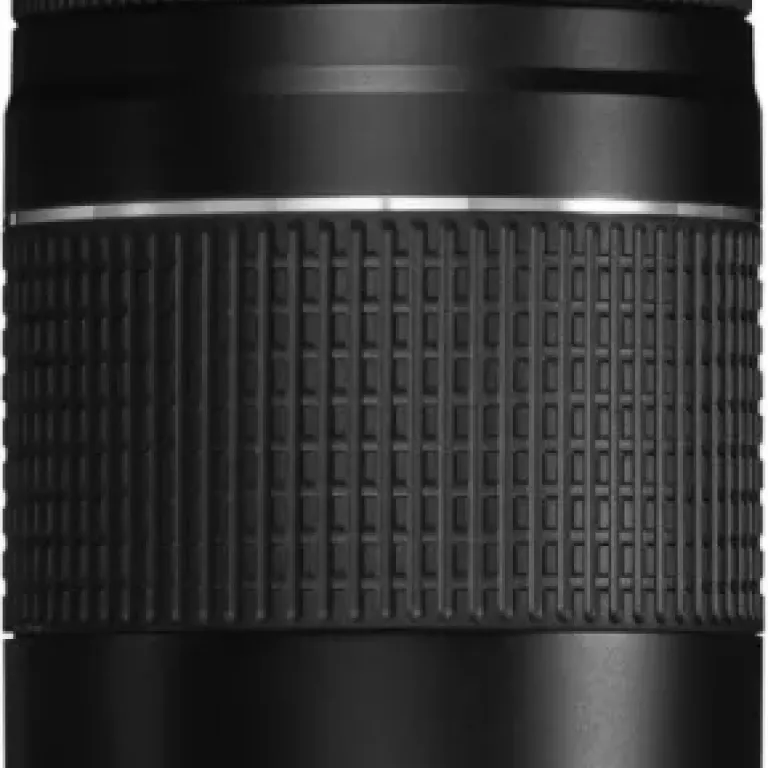
Design-wise, the EF 75-300mm f/4-5.6 III sticks to a very classic Canon look: a black barrel, a broad zoom ring, and a narrower focus ring. There’s a small silver ring near the front element that Canon added as a cosmetic change on this generation. The dimensions (4.8 x 2.8 x 2.8 inches) keep it relatively compact for a 300mm-capable lens, and several reviewers note that it feels noticeably heavier than the typical 18–55mm kit zoom but still very manageable. At about 1.06 lb, it should balance reasonably well even on lighter entry-level DSLR bodies.
One recurring theme in the Amazon comments is that the zoom action is not especially smooth. Some buyers describe a bit of play or looseness in the zoom ring, and one review explicitly calls the zooming “not very smooth.” That lines up with what you’d expect from an inexpensive, all-plastic zoom mechanism: functional, but not silky. The focus ring is described as a bit more precise, but this is not a lens aimed at heavy manual-focus work. The front element extends significantly when zooming and focuses by rotating, which gives the whole lens a somewhat old-school feel compared to modern internal-focusing designs.
The lack of image stabilization also influences how the design will be perceived in real use. There’s no dedicated IS switch because there is no stabilizer hardware inside; the only main switches you’ll see on the barrel are for AF/MF. Buyers who come from stabilized kit lenses sometimes underestimate how much they relied on that feature. Several comments underline that to get sharp results at the long end, you really need to think about shutter speed, grip, or support. The lens design itself offers no help in that area.
In my opinion, the design is typical Canon budget gear: nothing fancy, but serviceable. The rotating front is a clear downside if you rely on polarizers, and the zoom ring behavior sounds a bit rough compared to mid-range options. On the other hand, the relatively light weight and compact length for 300mm make it less intimidating than the big white telephotos, which is probably reassuring for beginners and casual users who just want an affordable way to zoom in more than their kit lens allows.
Build quality and long-term reliability
On paper, the Canon EF 75-300mm f/4-5.6 III is built with a typical entry-level construction: mostly plastic barrel, no weather sealing, and a relatively simple internal layout. Canon backs it with a 1-year warranty, which is standard for this class. There’s no mention of special ruggedization or metal mounts in the spec summary, so it’s safe to assume this is not designed for heavy professional abuse, but for normal hobbyist use. Despite that, the sheer number of positive reviews and the long time it has been on the market suggest that outright failures are not a widespread complaint.
In the Amazon comments, buyers generally describe the build as “fairly well built for the price” or “about par for the course” for an entry-level lens. There are mentions of some play in the zoom ring and the front element extending and rotating “like crazy” when focusing or zooming, which can give an impression of flimsiness, but those remarks are more about feel than about parts breaking. No recurring pattern of cracked barrels, loose mounts, or electronics dying early stands out in the public feedback, which is reassuring given the number of units likely sold over many years.
The moving, extending front section does introduce more mechanical complexity than an internal zoom, and in theory that could be a point of wear if the lens is knocked around a lot. However, people using it for casual photography — family events, vacations, backyard wildlife — rarely subject their gear to the same stress as full-time sports or nature photographers. In that kind of environment, this type of construction usually holds up reasonably well as long as it is not dropped or exposed to heavy dust and moisture. The lack of weather sealing means it is better to avoid rain, sandstorms, and similar conditions.
In my opinion, durability is acceptable but nothing more. This looks like a lens that will last several years for a careful amateur, especially if it mostly lives in a bag and comes out for specific occasions. It is not the kind of robust tool you’d want to drag through harsh environments day after day. If you treat it as what it is — a low-cost telephoto — and don’t expect pro-level ruggedness, the risk/reward balance seems reasonable, especially given the modest purchase price.
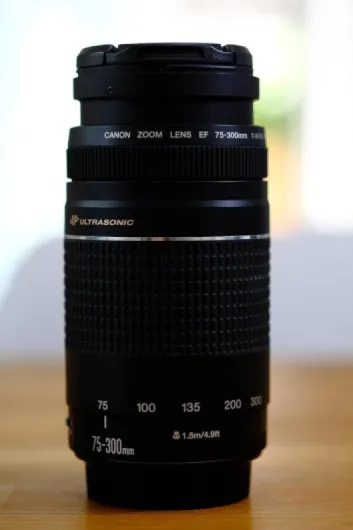
Image quality and autofocus: good in the middle, weaker at 300mm
Performance is where the compromises of this lens really show up. The general pattern in the reviews is consistent: image quality is quite decent between 75 and about 200mm, especially for portraits and casual telephoto work, but sharpness and contrast drop off towards 300mm, particularly if you crop heavily. One buyer who paid around $100 used highlights that 75–200mm is the “sweet spot” of the lens, and that at 75mm f/4 they got portraits with pleasing background blur. This lines up with the typical behavior of low-cost telephoto zooms: the optical design is more comfortable in the mid-range than at maximum reach.
At 300mm, several comments mention softness, especially when images are cropped significantly for bird or wildlife photos. One reviewer describes their bird shots at 300mm as “very unsharp the second you crop,” and notes that the only good results they obtained at that focal length came when they were physically very close to the subject, allowing only minimal cropping. That doesn’t mean 300mm is unusable, but it suggests that if your goal is small, distant wildlife with heavy cropping, this lens is not ideal. Stopping down to f/8 reportedly helps a bit, but doesn’t fully correct the softness and chromatic aberrations at the long end.
Autofocus is driven by a DC motor instead of Canon’s faster USM. Reviews describe it as noisy and not especially fast, but generally accurate in decent light. One user notes that the lens “won’t focus if you have a total blur” in the frame and recommends pre-focusing manually so the AF has something to lock onto. That’s a common behavior on older, basic AF systems. In good light and at shorter focal lengths, AF seems acceptable for casual use. In lower light or near 300mm, you should not expect pro-level tracking on fast-moving subjects.
In my opinion, the performance picture is clear: this is a lens that can produce nice images, but within boundaries. For portraits, kids playing, and larger wildlife at moderate distances, especially between 75 and 200mm, it looks like a solid step up in reach from a kit lens. For serious birding, sports from the sidelines, or anything where you want tack-sharp details at 300mm with room to crop, the optical limits and AF behavior will likely feel underwhelming. Used as a learning tool and with realistic expectations, it seems to deliver decent results; pushed beyond that, its budget nature shows quickly.
What this 75-300mm actually offers
The Canon EF 75-300mm f/4-5.6 III is a full-frame EF-mount telephoto zoom, compatible with all Canon EOS DSLRs, from older Rebel bodies up to full-frame models. On APS-C cameras, the 75-300mm range behaves like roughly 120–480mm equivalent, which is a very long reach for the money. The maximum aperture is f/4 at 75mm, closing to f/5.6 at 300mm, which is typical for budget telephoto zooms and means you are not getting especially bright optics. The optical formula of 13 elements in 9 groups is shared with the slightly higher-end USM version, but here autofocus is driven by a simpler DC motor.
Physically, the lens is relatively compact for its range: about 4.8 inches long and 2.8 inches in diameter, with a weight around 1.06 lb (16.8 oz). Filter size is 58mm, which matches a lot of Canon’s basic lenses, so filters are usually affordable. The zoom system is of the rotating type, and the front element extends and rotates while zooming and focusing. Several reviewers mention this as a practical annoyance if you like using polarizing filters, since the rotation can throw off the polarization angle each time you refocus.
There is no image stabilization on this version, and that is one of the key points to understand. At 300mm, the classic rule of thumb would suggest a shutter speed of at least 1/300s to limit motion blur from hand shake, often even faster on high-resolution cameras. Multiple buyers insist that handholding at the long end is possible but risky at slower speeds and that a tripod, monopod or at least a high ISO and good technique are highly recommended.
From a positioning standpoint, this lens sits clearly in Canon’s entry-level lineup. It is often sold as an add-on or part of cheap kits, and that shows in the feature set: no weather sealing, no IS, no fast constant aperture, no advanced coatings promoted in the marketing. In my opinion, that’s not necessarily a problem as long as you’re realistic: you are paying mainly for reach and compatibility with Canon DSLRs, not for cutting-edge performance or premium build quality.
How well it does the job for portraits, sports, and wildlife
Effectiveness here means a simple question: can this lens let people capture the kind of images they bought it for? The answer, judging from the comments, is largely yes — as long as expectations are kept in check. Several buyers give it 5 stars and call it a “great lens for the money” or “outstanding for the price.” One reviewer mentions using it for portraits at 75mm f/4 and being very happy with the background blur and overall look. Another says it is perfectly suited for someone who wants to sit on a porch and take pictures of birds, deer and other wildlife at a distance, without getting too deep into photography as a hobby.
At the same time, more advanced users point out its limits. One detailed review explains that while portraits and medium-distance subjects work well, the lens quickly shows weakness when you rely heavily on the 250–300mm range and then crop. For bird photography, the user reports that good results required being very close to the birds, often in a popular park where animals are used to humans. That suggests that the lens can be effective for wildlife, but only if you are able to get within a relatively short distance; it doesn’t compensate for poor access or far-away subjects.
For sports, comments are a bit more reserved. The focal length is certainly long enough to frame a soccer game or a kid’s sporting event from the sidelines, and some reviewers explicitly mention grandparents or parents shooting children’s games as a good use case. However, the combination of f/5.6 at 300mm, no image stabilization, and basic autofocus means that fast action in low light is not its territory. Daytime games and slower-paced activities are realistic; indoor sports or late-afternoon matches will stretch it.
In my opinion, the lens is quite effective for casual telephoto needs: portraits, outdoor family events, zoo animals, and wildlife where you can get reasonably close. It becomes less effective as soon as you require high keeper rates in demanding conditions (fast birds in flight, indoor sports, distant wildlife). As a starter tool to see whether telephoto photography appeals to you, it does the job. As a long-term solution for serious work, it’s more of a stepping stone that will quickly highlight the benefits of faster or stabilized lenses.
Pros
- Very low price for a 75–300mm telephoto zoom
- Good image quality and pleasant background blur between about 75–200mm
- Lightweight, compact and compatible with all Canon EF-mount DSLRs
Cons
- Noticeable softness and chromatic aberrations towards 300mm, especially with cropping
- No image stabilization and basic, noisy autofocus motor
- Rotating, extending front element and somewhat loose zoom feel less practical and less refined
Conclusion
Analysis score
The Canon EF 75-300mm f/4-5.6 III is a straightforward budget telephoto zoom that does exactly what its spec sheet suggests: it gives you a long focal range for very little money, with basic construction and no advanced features. Public reviews show that many owners are satisfied, especially beginners who mainly use it between 75 and 200mm for portraits, family events and casual wildlife. In that zone, image quality can be quite pleasing, with decent sharpness and background blur. The lens is light enough to carry around, works on all Canon EF-mount DSLRs, and is easy to throw in a bag as an occasional-use telephoto.
The downsides are equally clear. At 250–300mm, sharpness and contrast drop, heavy cropping hurts quickly, and chromatic aberrations become more visible. The absence of image stabilization and the basic DC autofocus motor limit its usefulness for fast action and low light. The rotating, extending front element and somewhat rough zoom action remind you constantly that this is an entry-level product. For serious birders, sports shooters, or anyone who wants consistently crisp results at 300mm, there are better — but more expensive — options.
In my opinion, this lens is best for new DSLR users, budget-conscious hobbyists, and relatives who want to zoom in on kids’ games or backyard wildlife without diving deep into photography gear. If you already know you care about telephoto quality and plan to shoot a lot at 300mm, it makes more sense to save for a stabilized or higher-grade alternative. Used with realistic expectations, though, the EF 75-300mm f/4-5.6 III offers solid value and a simple way to explore the telephoto world.