Summary
Analysis score
Average of the criteria rated below
Value for money: strong feature set if the price stays reasonable
Design: classic low-profile disc focused on practicality
Battery and runtime: long sessions with auto-recharge and resume
Build quality, reliability and support signals
Real-world performance signals from buyers and specs
What the MONSGA MS1 offers in plain terms
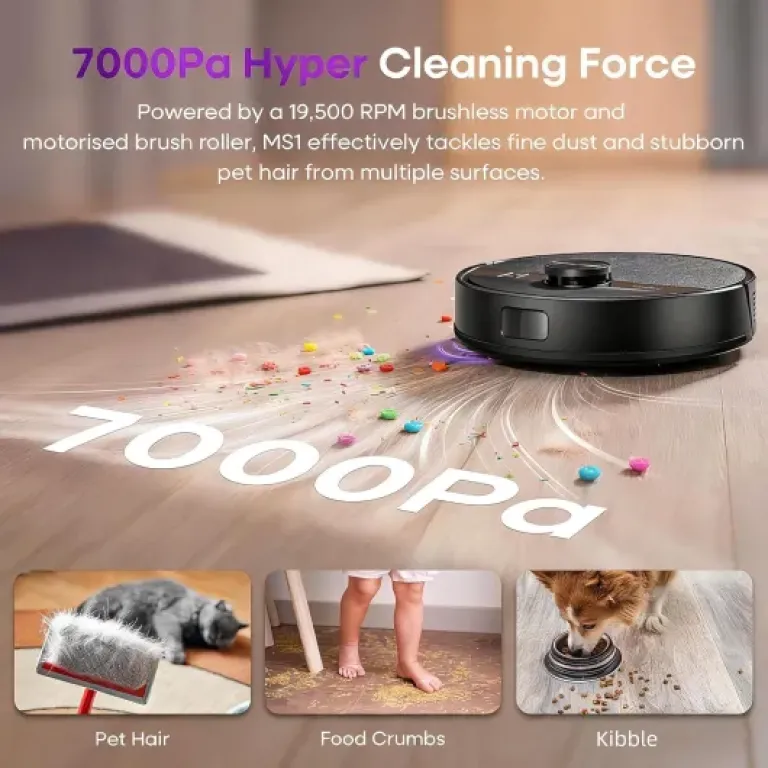
Cleaning effectiveness: strong suction and structured coverage
Pros
- Strong cleaning package on paper: 7000Pa suction, 3 suction levels, automatic carpet boost
- LiDAR navigation with 5 editable maps, no-go zones and virtual walls for precise control
- Long quoted runtime (up to 180 minutes) with auto-recharge and resume, suitable for larger homes
Cons
- No self-emptying dock, so the 340 ml dustbin needs regular manual emptying
- Mopping is maintenance-level only and struggles with sticky or dried stains compared to manual mopping

Specifications
View full product page →| Brand | MONSGA |
A robovac aimed at people who want power and control, not gadgets
The MONSGA MS1 is clearly aimed at people who are tired of basic bump-and-go robots and want something that actually covers the whole house in a structured way. On paper, it mixes several things that usually do not show up together at this price point: a quoted 7000Pa suction level, LiDAR navigation with 5 editable maps, and a 3-in-1 approach (sweeping, vacuuming, mopping). With a 4.8/5 average from more than 500 Amazon reviews, buyers seem broadly satisfied, especially with cleaning power and mapping.
The brand pushes a pretty aggressive spec sheet: 180 minutes of runtime, 55 dB noise level, automatic recharge and resume, plus an app that lets you draw no-go zones and virtual walls. Several published reviews highlight that it handles pet hair and everyday dust well, and they insist on the mapping accuracy compared to their older robots that relied on random patterns or magnetic strips. This gives a good idea of who this model is for: people who want to automate daily floor care, including pet owners.
It is important to stay grounded though. This is still a mid-range robot vacuum without self-emptying dock, and the mopping system is a standard water tank with cloth, not a scrubbing station. A few buyers point out that sticky stains still need manual attention and that the mop is more for maintenance than deep cleaning. So the MS1 is not a replacement for a classic vacuum plus a thorough mop session, it is more a way to keep the floors under control between those bigger jobs.
In my opinion, the interest of this model lies in the mix of strong suction, long runtime and serious navigation, combined with a relatively quiet noise figure. On paper, it looks like a solid daily helper for flats and houses up to roughly 180–200 m², for people who want to schedule cleaning and forget about it, as long as they accept emptying the bin and rinsing the mop pad regularly.
Value for money: strong feature set if the price stays reasonable
The MS1 sits in a segment where you can find anything from very basic random robots to high-end models with self-emptying docks and advanced scrubbing mops. What stands out here is the combination of features: LiDAR navigation with 5 editable maps, 7000Pa suction, 180-minute runtime, 3-level water control for mopping, and a quoted noise level of 55 dB. On paper, that package is closer to what some more expensive brands offer. Several buyers explicitly mention "great value for money" and say they would buy the same make again, which is a strong hint that the price-performance ratio feels fair to them.
There is no self-emptying base, which is one of the big convenience features of the higher price brackets. If someone wants to avoid emptying the dustbin manually every couple of days, they will probably need to look at a different category and pay more. The mop is also basic: no rotating pads or hot-water wash, just a standard tank and cloth. Reviews are clear that for sticky messes you still need manual wiping. So part of the value story is accepting those limits: you save money by skipping the fancy docking hardware and advanced mopping, but you still get solid everyday vacuuming and maintenance mopping.
Another element of value is the flexibility of control: app, remote, voice, and top button. For shared households, the app’s multi-user support is a real plus, letting everyone trigger or stop cleaning without hunting for a single remote. Buyers highlight the ease of setup and the usefulness of no-go zones and room scheduling, which are functions sometimes reserved for pricier robots. The fact that mapping, zoning and custom room modes are all available at this level makes the MS1 more competitive.
In my opinion, if the selling price is in the mid-range band (where many LiDAR robots without self-emptying docks sit), the MS1 represents good value. You trade away the convenience of automatic bin emptying and advanced mopping, but you gain strong suction, long runtime, quiet operation, and serious mapping tools at a cost that several buyers judge as fair. If the price drifts too high, it starts to compete with models that add self-empty docks or more polished ecosystems, but as things stand, the feedback suggests that most owners feel they got a good deal for what the robot actually delivers.
Design: classic low-profile disc focused on practicality
Visually, the MS1 sticks to the classic robot vacuum formula: a black circular body with a LiDAR turret on top. The 32 cm diameter is fairly standard and should let it pass between chair legs and around table bases without too much drama, as long as the clearances are reasonable. The 9.65 cm height is a bit taller than some ultra-slim models, because of the LiDAR module, so it might not fit under very low sofas or cabinets. That is the usual trade-off: you gain precise navigation and mapping but lose a few millimetres of clearance compared to camera-only or random robots.
The top hosts the LiDAR dome and a basic button for quick-start cleaning. This means that even without the app or remote, you can still trigger a run with a simple press. Around the edges, it likely follows the common setup: bumper at the front for contact detection, side brush (not explicitly listed but standard in this category) to pull debris into the suction path, and charging contacts at the rear for docking. Since the product weight is 4.38 kg, it is not ultra-light, but that is normal for a robot with a motor advertised at 550W and a battery able to last up to 180 minutes.
Buyers do not talk much about flashy aesthetics; they mostly describe it as a "great little helper" and a "premium product" in terms of how it feels built rather than how it looks. Several reviews mention that it navigates around furniture efficiently once the map is created, which suggests the shape and sensor placement are doing their job. The black colour is neutral and should blend in most interiors, but it will also show dust and fingerprints more than a lighter finish, so occasional wiping will be needed if you care about appearance.
In my opinion, the design is deliberately low-key. There is no attempt at being a decor piece; it aims at being a tool. The key point is the LiDAR tower and the overall footprint, which look reasonable for typical European flats and houses. If someone has a lot of ultra-low furniture, they might need to measure the gap before buying, but for most layouts the shape and size seem well balanced between coverage, sensor placement and everyday practicality.
Battery and runtime: long sessions with auto-recharge and resume
The MS1 is advertised with a runtime of up to 180 minutes, or roughly three hours, on a single charge. The brand claims that this is enough to cover about 2000 square feet (around 185 m²) in one go, which would suit most flats and a good number of houses. Published reviews tend to support this order of magnitude: one user says it runs about 2–3 hours and manages to finish cleaning their entire apartment on one charge. Of course, actual runtime will depend on the suction level, the number of obstacles, and how many carpets it encounters, but on paper this is clearly in the "long runtime" category for a robot vacuum.
The other important piece is how the robot handles low battery. The MS1 automatically returns to its charging dock when the battery runs low, then resumes cleaning where it left off once recharged. That "resume" function is crucial in larger homes, because it avoids re-cleaning the same areas and wasting time. The product description explicitly states "no repeated zones, no wasted time", which matches the logic of LiDAR-based mapping with saved paths. For users, this means you can launch a whole-home clean without worrying too much about whether the battery will last; if it does not, it should simply pause, recharge, and finish later.
The voltage is listed at 19 V, which is typical for this type of product. There is no separate mAh figure for the battery pack in the data, but given the runtime and power claims, it is likely a reasonably sized lithium-ion pack. There are no published reviews talking about early battery failure or sudden drop in autonomy, at least among the comments quoted here. However, long-term behaviour beyond the first months obviously cannot be guessed from the spec sheet alone; as with any battery-powered device, some capacity loss over time is to be expected.
In my opinion, the MS1’s battery setup looks comfortable for most use cases: daily whole-floor cleaning in medium to large flats, and at least floor-by-floor cleaning in bigger houses. Combined with the auto-recharge-and-resume logic, it limits user intervention. The only real unknown is how the battery will age after a year or two of heavy use, but that applies to nearly all robot vacuums unless they have a long track record. Still, for someone who wants to run the robot once or twice a day, the numbers suggest it should keep up without frequent mid-run interruptions.
Build quality, reliability and support signals
Durability is always tricky to judge early, but a few indicators help. The MS1 has a 4.8/5 average rating from 511 Amazon reviews, which usually means there is no widespread failure pattern showing up in the comments. One buyer explicitly says the unit "appears to be very well built and feels like a premium product" and that they are optimistic it will last, to the point of considering a second unit. While that is subjective, it shows that at least some owners find the plastics and assembly reassuring rather than flimsy.
The brand backs the MS1 with a 2-year full warranty and emphasises "real humans" in customer support, with 24/7 availability. They mention helping with rare glitches, lost parts, and how-to questions. That kind of messaging is easy to write, but the absence of angry reviews about support in the snippets quoted here is at least a neutral sign. The fact that buyers mention they would purchase the same make again suggests that they did not run into catastrophic reliability problems in the early phase.
From a design standpoint, the brushless motor is a positive point for longevity. Brushless motors generally have fewer wear parts than brushed ones and tend to last longer with more stable performance. The LiDAR sensor is a more delicate component, but it is widely used across many brands now, and there is no specific mention of failures or misalignment in the reviews cited. Consumables like brushes, filters, and mop cloths will need periodic replacement; availability of those parts is not detailed in the spec list, so checking that separately would be smart if you plan to keep the robot for several years.
In my opinion, the MS1 looks decent on durability and support: a solid rating, comments that talk about a quality feel, and a 2-year warranty that covers the usual timeframe where early defects appear. It is not a long-established big-name brand with decades of track record, so there is always a bit more uncertainty compared to the most famous players. But nothing in the published feedback screams "fragile" or "unreliable", and the warranty plus support claims help reduce the risk for buyers willing to try a less known brand.
Real-world performance signals from buyers and specs
Looking at both the specifications and the user feedback, the MS1’s performance profile is quite clear: strong suction, controlled noise, and efficient pathing. The 7000Pa claim is supported indirectly by multiple reviews saying the suction is "pretty strong", "way better" than expected for a robot of this size, and able to pick up various small debris without leaving much behind. One buyer specifically mentions not having run into hair tangling issues so far, which suggests the brush and airflow design cope reasonably well with typical household hair, at least in the first weeks or months.
Noise is another point where the MS1 seems to hold up. The spec sheet lists 55 dB, which is low compared to many competitors. Buyers echo this: one says they sometimes "totally didn’t notice it’s running" while working from home, another runs it at night without finding it annoying. The product description even compares it to a quiet conversation. Of course, perception of noise is subjective, but between the figure and the comments, it is fair to say that this robot should be more discreet than many models that sound like a small vacuum cleaner roaring around the house.
Navigation performance comes out well in the reviews. Several users insist that mapping was quick and did not need to be redone, and that the robot follows logical paths instead of bouncing randomly. The ability to save five maps makes it suitable for multi-level homes; you can carry it to a different floor, select the corresponding map, and send it off. Also, the presence of spot, zone, and room modes means you can tailor its behaviour: quick clean in one area, deeper pass on the kitchen, or full-house auto mode. The possibility to assign different cleaning modes to different rooms (stronger suction in high-traffic areas, quieter in bedrooms) reinforces that sense of control.
From a connectivity point of view, the app, voice control, and remote appear to work as advertised. Reviews mention easy setup via QR code and Wi-Fi, and they like the fact that you can set schedules and no-mop zones. In my opinion, this is where the MS1 feels like a modern robot: you are not stuck with a single auto mode, you can really program a cleaning routine that matches your habits. It is not the most advanced ecosystem on the market, but for the price bracket it hits a good balance between performance, options, and complexity.
What the MONSGA MS1 offers in plain terms
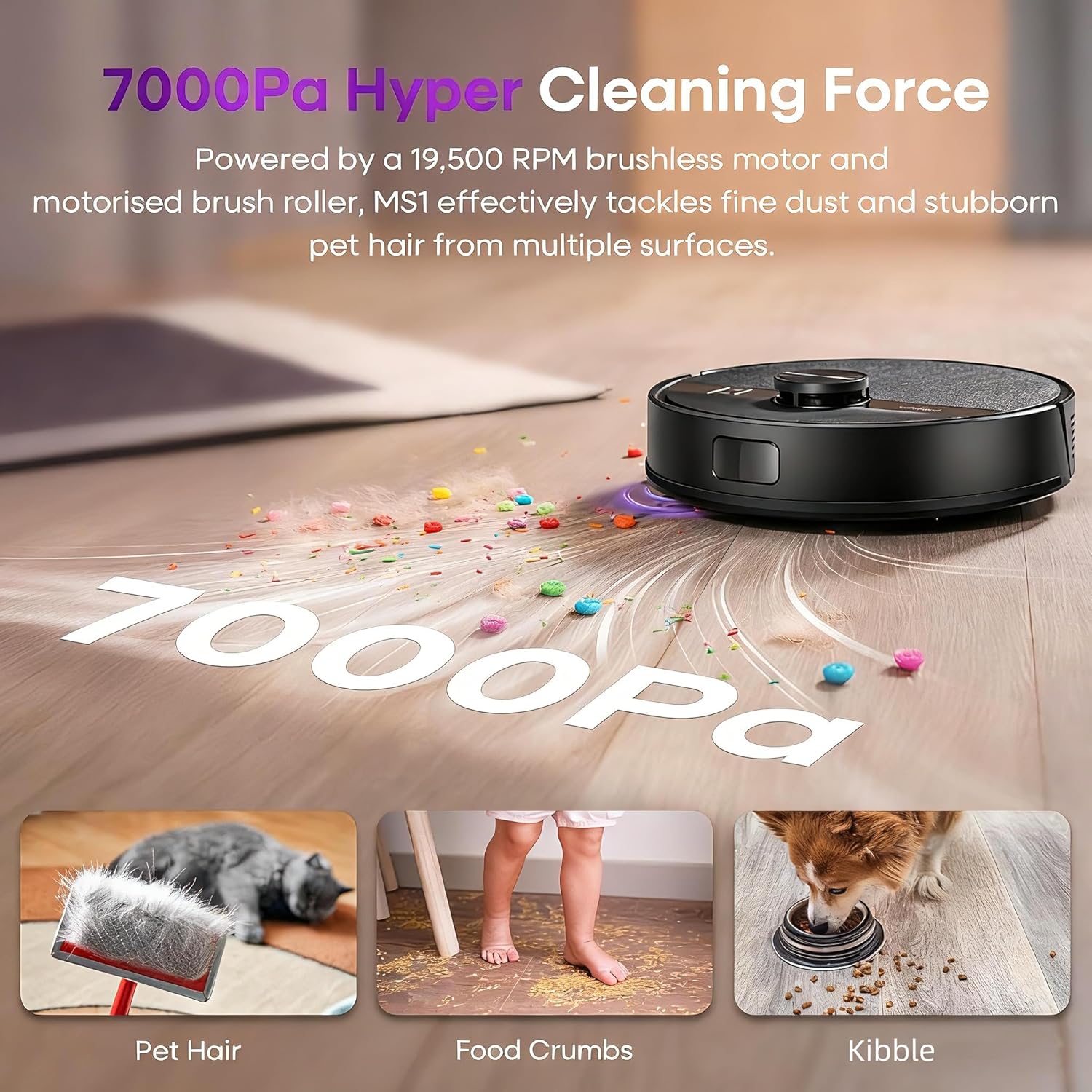
The MONSGA MS1 is a round robot vacuum cleaner with integrated mopping function. It is about 32 x 32 cm with a height of 9.65 cm and a weight of 4.38 kg. The brand advertises a 7000Pa suction power driven by a 550W brushless motor spinning at 19,500 rpm, with three selectable suction levels. It combines that with a 340 ml dustbin and a 270 ml water tank for mopping. This capacity is fairly standard for robots without self-emptying docks and should be enough for a medium-sized home before needing to be emptied or refilled.
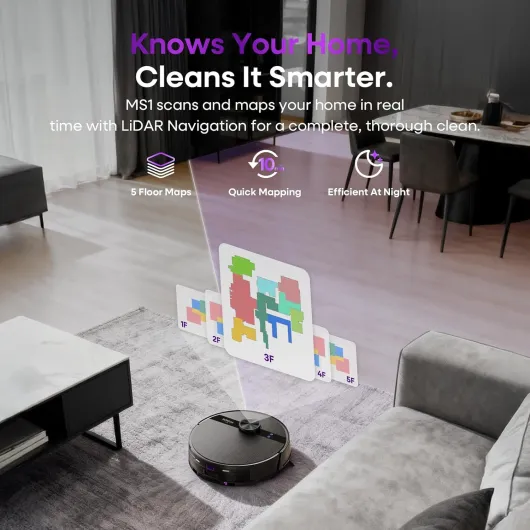
Navigation is handled by a 360° LiDAR sensor, which allows the robot to map up to five floors or areas and store them in memory. The app then lets you edit these maps: split or merge rooms, define no-go zones, set virtual walls, and trigger zone cleaning or room-by-room cleaning. According to several reviews, this mapping is quick and accurate, and the robot tends to move in straight, systematic paths rather than wandering randomly. One buyer even mentions that they used to rely on magnetic strips with a previous robot and found these virtual barriers much easier to manage.
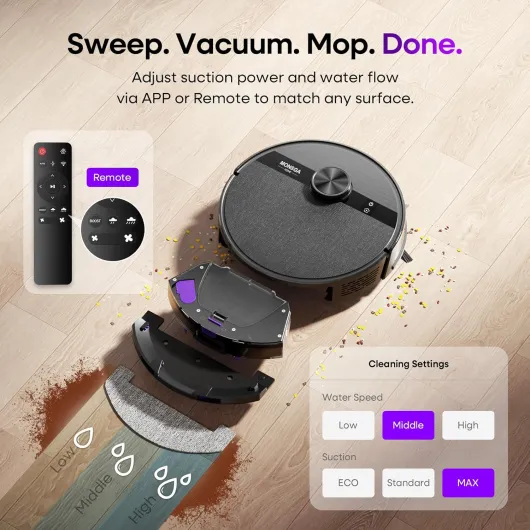
On the connectivity side, the MS1 can be controlled via smartphone app, voice assistants (Amazon Echo and Google Home are listed as compatible), a physical remote, or a button on top of the robot. The app allows scheduling, mode selection (auto, room select, zone, spot), and adjustment of water flow for mopping. The brand also highlights multi-user control, so different household members can use the app from their own phones. Reviews generally describe the app as simple to set up, with QR code pairing and Wi-Fi connection taking only a few minutes.
Overall, this is not a hyper-advanced ecosystem with self-emptying or docking that washes the mop, but rather a relatively straightforward robot that leans on three pillars: strong suction, LiDAR navigation, and flexible control methods. In my view, that clarity of purpose is a good thing: you know what you are paying for, and it lines up with what most people want a robot vacuum to do on a daily basis.
Cleaning effectiveness: strong suction and structured coverage
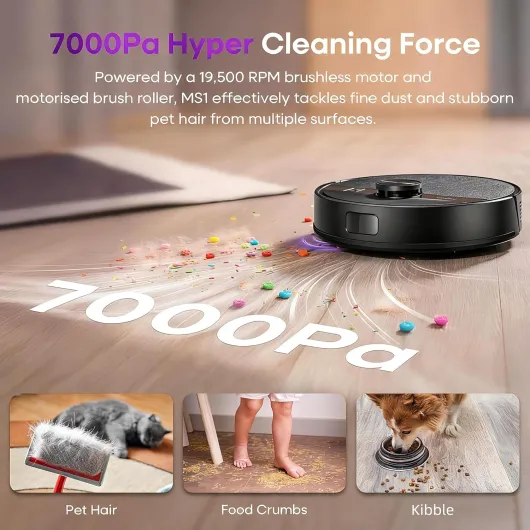
The main selling point of the MONSGA MS1 is its cleaning power coupled with LiDAR navigation. The brand advertises 7000Pa of suction, which is high on paper for a robot vacuum in this category. Several Amazon buyers confirm that it "picks up all bits and hair" and handles pet hair on hard floors and carpets without drama. One user mentions that it collects far more dust and dirt than they expected, which suggests that the combination of suction and brush system is doing a decent job on everyday messes like crumbs, dust, and hair.
Navigation and coverage are another strong area. The LiDAR system maps a floor in about ten minutes according to the product description, then the robot follows straight-line paths. Reviews repeatedly highlight the mapping accuracy and the convenience of virtual walls and no-go zones. A buyer who had older robots with magnetic strips finds the MS1 much easier to configure, since you can block areas from the app instead of placing physical barriers every time. Another review notes that if you place the robot in a new room, it does a quick scan with the laser, cleans, and then adds that space to the map for future runs.
For carpets, the robot is advertised with automatic floor recognition: it increases suction when it detects a rug to pull out embedded dirt. Buyers report that it works well on low-pile carpets, which matches the spec sheet that lists "low-pile carpet" as a recommended surface. There is no mention of high-pile or shag carpets, so expectations should stay realistic: it is likely to manage entry mats and standard rugs but not deep fluffy carpets. The three suction levels let you adapt noise and power depending on whether you clean tiles, hardwood, or rugs.
The mopping function is more modest but still useful. Several users say it "keeps the floors looking fresh between deeper cleans" and "works surprisingly well" for daily maintenance. At the same time, one review clearly states that for sticky or dried stains you still need to wipe manually first, and another notes that it is not a replacement for a manual deep mop. That is consistent with the hardware: a 270 ml water tank and a cloth dragged behind the vacuum. It is great to remove light marks and dust film, but it will not scrub like a human with a mop and bucket.
Overall, in my opinion, the MS1 looks strong for vacuuming daily dirt on hard floors and low-pile carpets, with the mop acting as a bonus maintenance feature rather than a miracle cleaner. The systematic navigation and zoning tools are what really push its effectiveness: fewer missed spots, fewer random passes, and a better chance of actually covering the entire floor plan regularly.
Pros
- Strong cleaning package on paper: 7000Pa suction, 3 suction levels, automatic carpet boost
- LiDAR navigation with 5 editable maps, no-go zones and virtual walls for precise control
- Long quoted runtime (up to 180 minutes) with auto-recharge and resume, suitable for larger homes
Cons
- No self-emptying dock, so the 340 ml dustbin needs regular manual emptying
- Mopping is maintenance-level only and struggles with sticky or dried stains compared to manual mopping
Conclusion
Analysis score
The MONSGA MS1 positions itself as a practical, power-focused robot vacuum with proper navigation rather than a gadget overloaded with gimmicks. On paper, it checks a lot of boxes: 7000Pa suction, LiDAR mapping with 5 editable maps, 180 minutes of runtime, relatively quiet 55 dB operation, and a 3-in-1 sweep/vacuum/mop setup. The Amazon reviews back this up with a 4.8/5 average from over 500 ratings, and many comments praise its ability to handle pet hair, daily dust, and mixed hard floor plus low-pile carpet setups.
It is not perfect. The mopping function is clearly for maintenance, not deep cleaning, and there is no self-emptying dock. People who want the absolute minimum of interaction will probably prefer a more expensive ecosystem. The brand is also less known than the biggest players, so there is a bit more uncertainty about long-term parts availability, even if the 2-year warranty and positive comments on build feel are reassuring. Still, the combination of strong suction, long runtime, accurate mapping, and flexible control (app, voice, remote) makes it a solid daily helper in my view.
Overall, the MS1 looks well suited for: medium to large homes with mostly hard floors and some low-pile carpets; pet owners who want to reduce hair build-up; and users who appreciate map editing and no-go zones without paying for a high-end dock. People who should probably skip it: those with lots of thick carpets, those who expect the mop to replace manual scrubbing, or anyone absolutely set on self-emptying convenience. If the selling price sits in the expected mid-range, the value for money is good and the MS1 deserves a serious look.