Summary
Analysis score
Average of the criteria rated below
Value for money: mid-range features with some trade-offs
Design and layout: compact footprint, dual zones, and glass racks
Everyday usability: space, access, and living with it in your home
Build quality and long-term reliability: better than mini units, but not flawless
Cooling performance and noise: mostly solid, but some buzzing complaints
What this 32-bottle dual-zone cooler actually offers
Pros
- Dual-zone compressor cooling for separate red and white wine temperatures
- Compact freestanding design with claimed 32-bottle capacity and LED display
- Many long-term owners report quiet operation and better reliability than small thermoelectric units
Cons
- Some reports of electrical buzzing or noticeable compressor noise
- Customer service feedback is mixed, with at least one unresolved issue mentioned
- Capacity and comfort drop if you use many non-standard, larger bottles

Specifications
View full product page →| Brand | Wine Enthusiast |
A compact dual-zone wine fridge that actually keeps its cool?
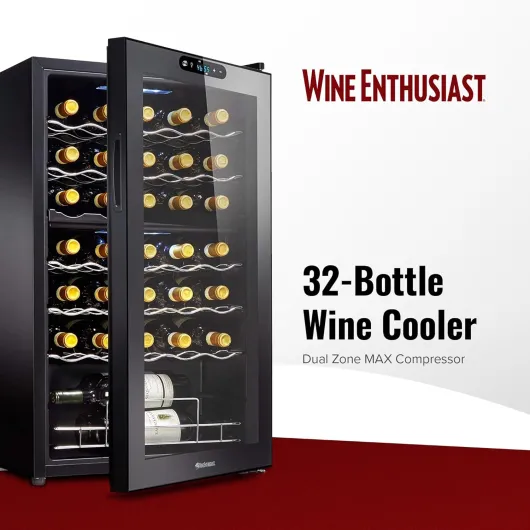
The Wine Enthusiast 32-Bottle Dual Zone MAX Compressor Wine Cooler targets people who want proper storage for both red and white wines without dedicating a whole room to a cellar. On paper, it’s a compact, freestanding unit (17"D x 19.5"W x 33.5"H) with a claimed 32-bottle capacity, separate temperature zones, and a compressor system designed to keep wines stable and extend their life. With more than 1,100 Amazon ratings and an average of 4.1/5, it clearly has a decent following, but it’s not without criticism.
What stands out immediately is the dual-zone layout and the promise of “MAX” compressor cooling that, according to the brand, should preserve wine up to twice as long as basic thermoelectric coolers. Several buyers describe moving up from small 12-bottle units that failed quickly, and they seem relieved to finally find something that runs more consistently. Others, however, mention noise issues and an annoying buzzing when the compressor kicks in, so the picture is mixed.
In my opinion, this model sits in that middle ground: not a luxury built-in cellar, but clearly above the entry-level toy fridges that struggle to hold temperature. The spec sheet shows proper compressor tech, dual digital controls, glass shelves, and a glass door, all in a relatively small footprint. At around 60 pounds, it’s light enough for most people to move but heavy enough to feel more like an appliance than a gadget.
The goal here is simple: check if this unit makes sense for someone who wants reliable storage for a moderate collection, maybe in a kitchen, bar, or even bedroom, without driving everyone crazy with noise or breakdowns. Looking at the specs and the wide range of user feedback, the cooler seems to deliver solid performance for many buyers, but there are a few red flags to keep in mind before committing.
Value for money: mid-range features with some trade-offs
The price is not displayed here, but given the specs and category rankings, this Wine Enthusiast 32-Bottle Dual Zone cooler clearly sits in the mid-range segment: more expensive than tiny 6–12 bottle thermoelectric units, cheaper than built-in or full-height cellars. The key question is whether the combination of dual zones, compressor cooling, and a 32-bottle capacity justifies that step up. Judging by the 4.1/5 rating across more than 1,100 reviews, many buyers feel they’re getting decent value.
Compared to small desktop coolers, the value argument is straightforward. You’re getting:
- Compressor technology that handles room temperature swings better than thermoelectric units.
- Dual-zone control so reds and whites aren’t forced into the same temperature compromise.
- Higher capacity that’s actually useful for someone who buys by the case or likes having a varied selection on hand.
The weak spots for value come from the negative experiences: the occasional unit with electrical buzzing, the perception of poor follow-up from customer service in at least one case, and the fact that capacity claims are, as usual, optimistic. Also, the manual defrost and basic feature set mean you’re not getting the bells and whistles of higher-end models (sliding wooden shelves, precise humidity management, or integrated installation). If those features matter to you, this fridge may feel limited.
In my opinion, this cooler offers good but not spectacular value. If your main goal is straightforward, reliable storage for a modest collection, with the bonus of separate zones for reds and whites, it lines up well with what most people need. The risk is that, like any mid-range appliance, a small percentage of units will have issues, and support experiences are not uniformly praised. If you’re okay with that trade-off and you’re upgrading from flimsy mini coolers, this model looks like a sensible investment. If you’re building a serious cellar or expect premium build and service, you might want to budget for something higher up the range.
Design and layout: compact footprint, dual zones, and glass racks
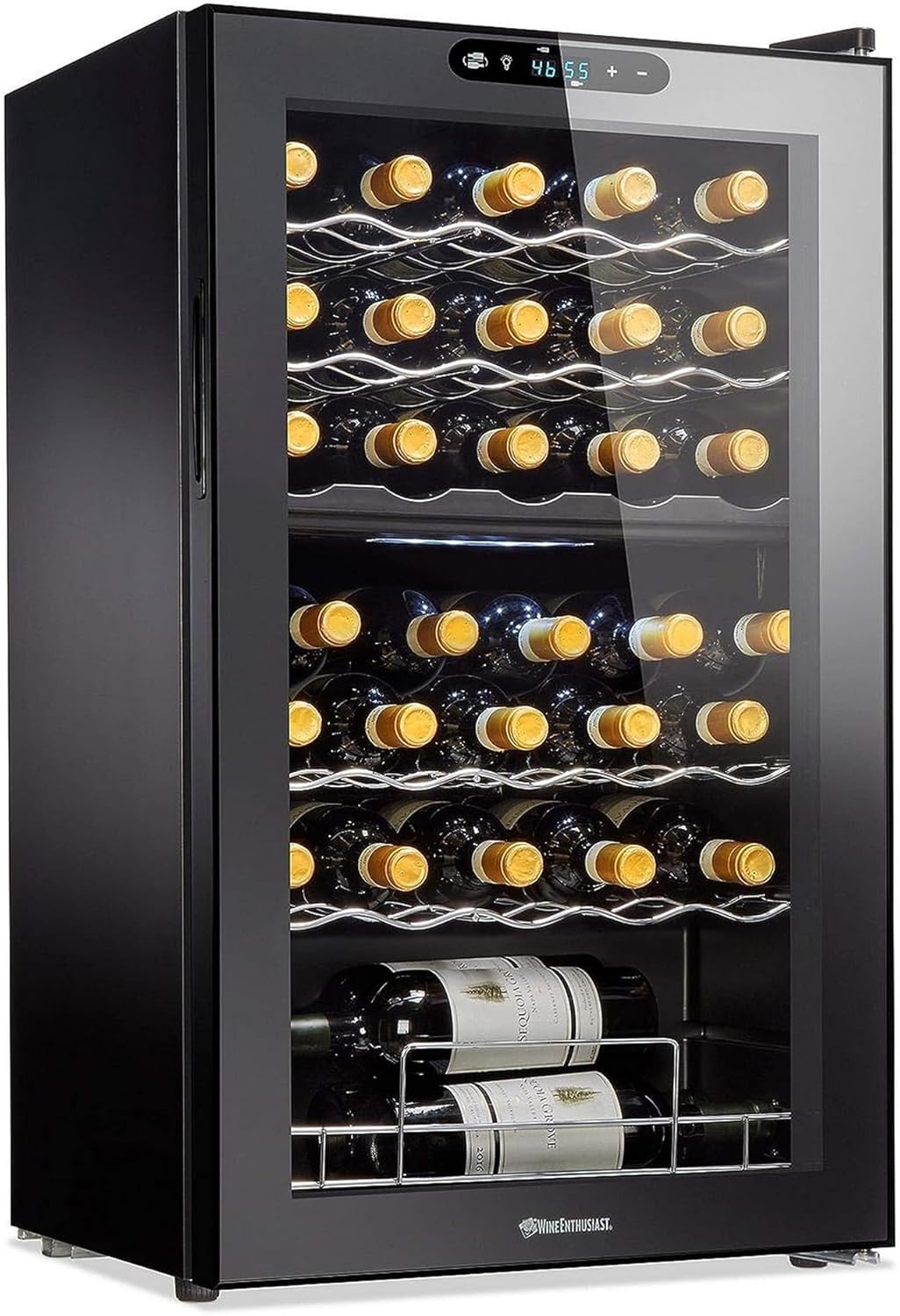
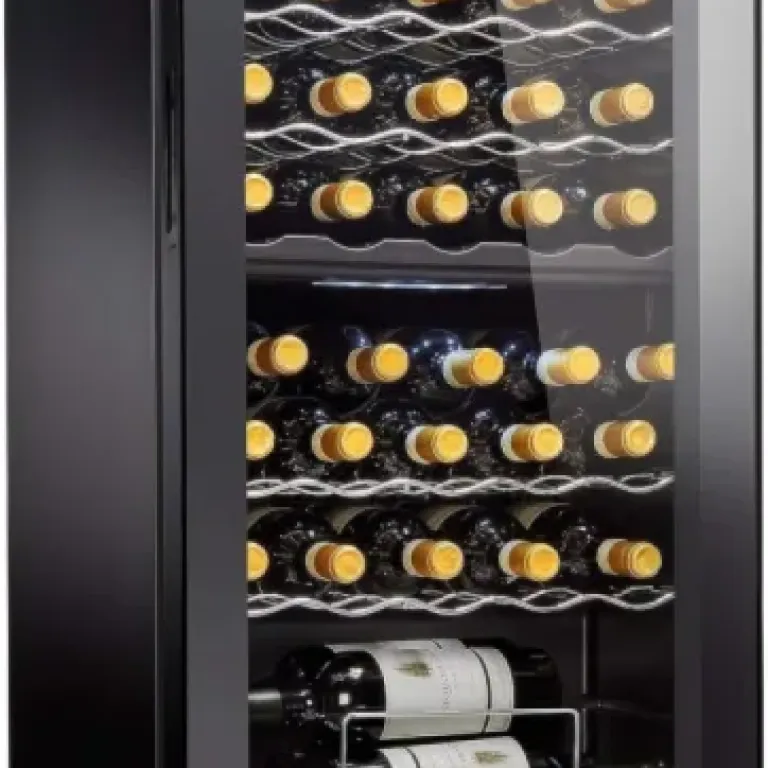
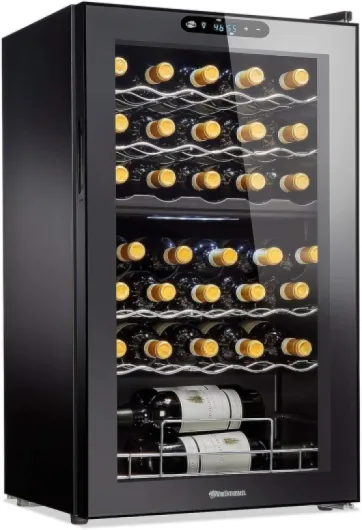
Design-wise, the Wine Enthusiast 32-bottle model goes for a simple, modern look: matte black body, glass door, and a clean digital control panel. Several reviewers comment that it “looks beautiful” or fits nicely into a wet bar area, which suggests the aesthetics are more than just basic appliance grey. The glass door and internal LED lighting are clearly there to turn the fridge into a display piece, not just a storage box you hide in a closet.
The dimensions (17"D x 19.5"W x 33.5"H) make it relatively easy to slide under a counter or next to other bar appliances, though again, it’s officially freestanding, so it needs airflow. One buyer mentions using it under-counter next to an ice maker, which gives a good idea of its scale: similar to a compact under-counter fridge, but not one of those tiny tabletop units. At about 60 pounds, it’s manageable to move with two people but not something you’d want to shift regularly.
The internal layout is organized around 5 glass shelves or racks. On paper, that should allow a decent mix of stacking and sliding bottles, but like most wine coolers, the advertised 32-bottle capacity assumes neat rows of standard bottles. If you drink a lot of Champagne or bulky reds, you can expect to lose some of that theoretical capacity. A few buyers note that when they “pack it tight,” the compressor kicks into higher gear briefly, which is normal for a system trying to pull down the temperature after loading.
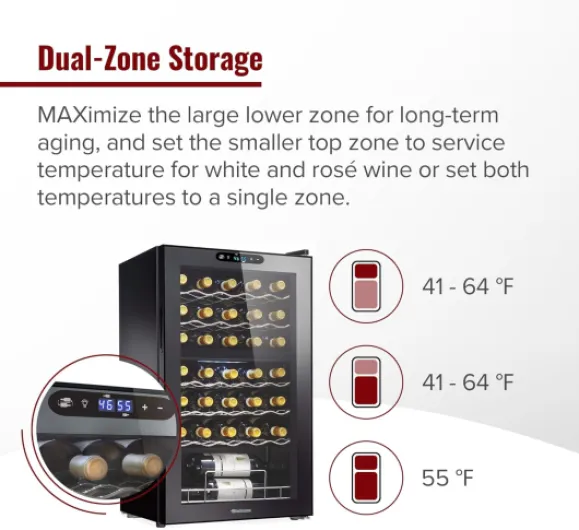
From a usability standpoint, the dual-zone design is the main selling point. You can dedicate one zone to reds at around 55–60°F and the other to whites and rosés at cooler temps, or set both zones the same if you’re using it as a general beverage fridge. The digital touchscreen and independent lights for each side get positive mentions from long-term owners, which suggests the interface is fairly intuitive. In my opinion, the design is practical and visually decent: not luxury-level, but absolutely suitable for a home bar, dining room, or even a living room corner if you like seeing your bottles on display.
Everyday usability: space, access, and living with it in your home
“Comfort” for a wine fridge basically comes down to how easy it is to live with: loading bottles, reading the display, controlling temperatures, and coexisting with the noise level in your actual living space. On this front, the Wine Enthusiast 32-bottle cooler seems to do a decent job for most owners. The compact footprint makes it relatively simple to slot into a kitchen, bar, or even a bedroom, and several buyers say it fits well into their bar setups or under-counter spaces, as long as they respect the freestanding ventilation needs.
Access to bottles is handled by 5 glass shelves/racks. While there aren’t a lot of detailed comments about shelf ergonomics, the general 32-bottle layout suggests you’ll be sliding bottles in and out horizontally in rows. As with most coolers of this size, the “32-bottle” claim is optimistic once you introduce non-standard bottles, so practical comfort will depend on your mix of wines. If you mostly store standard Bordeaux-style bottles, you’ll get closer to the official capacity; if you favor wide Champagne bottles, you’ll need to accept a lower count or shuffle things around more often.
On the control side, the digital touchscreen and LED display earn praise for being straightforward. Owners mention setting top and bottom zone temperatures easily and appreciating independent light controls. The child lock is a small but useful detail for families or shared spaces, reducing the risk of someone randomly changing settings. The LED lighting is also a comfort feature: it lets you see labels clearly without having to keep the door open for long, which is handy when you’re picking a bottle during a dinner or party.
Noise is part of comfort too. Many buyers describe the fridge as quiet or barely audible once leveled properly, which makes it realistic for open living areas. However, there are some complaints about buzzes or compressor sounds. In my opinion, if you’re planning to put this in a bedroom and you’re sensitive to noise, you should assume you’ll hear it at least a bit when the compressor cycles. For a kitchen, dining room, or bar area with normal background sounds, the majority of reviews suggest it will blend in fine once installed correctly and leveled on a stable surface.
Build quality and long-term reliability: better than mini units, but not flawless
Durability is where this Wine Enthusiast cooler tries to set itself apart from cheaper tabletop units. The move from tiny thermoelectric gadgets to a 60-pound compressor-based appliance usually means better longevity, and several buyers confirm that impression. One reviewer says they’ve had the fridge for years and specifically contrasts it with smaller plug-in coolers that “never lasted more than a year or two.” For them, this unit has held up well, still cooling properly and running quietly after a long period of use.
The materials listed are pretty standard: glass door, glass shelves, and a metal body with a matte black finish. Nothing in the spec screams premium, but nothing looks flimsy either. The manual defrost and basic Energy Star certification point to a no-frills, practical build rather than high-end engineering. On the upside, the relatively simple design can mean fewer parts to fail compared to more complex, feature-heavy models with fancy motors and auto-defrost systems.
That said, not all owners are happy. The most worrying report involves an “electrical buzzing” noise that the buyer felt made the fridge unusable. They describe limited and unsatisfying interaction with customer service, receiving only a video with no sound that supposedly described normal operation, and then no further response despite multiple follow-up emails. Even if this is an isolated case, it raises legitimate concerns about how issues are handled when something does go wrong. A few other comments mention noise developing after a short time, though without the same level of alarm.
In my opinion, the durability story is mixed but leaning positive. There are enough multi-year ownership reports to suggest the cooler isn’t a disposable gadget, especially compared to the smallest wine fridges on the market. At the same time, the occasional quality-control problem and inconsistent support mean you’re not buying a tank. If you’re okay with standard appliance risk—where most units are fine, but a minority may have defects and require persistence with support—this model should be acceptable. If you absolutely need bulletproof reliability and top-tier service, you might want to look at higher-end brands or models with stronger warranty feedback.
Cooling performance and noise: mostly solid, but some buzzing complaints
The key promise of this model is in the name: “MAX Compressor Cooling” and dual-zone temperature control. On paper, compressor-based systems are a big step up from thermoelectric coolers when it comes to holding steady temperatures, especially in warmer rooms. The brand even claims it can preserve wine up to twice as long, which is basically shorthand for saying it maintains more stable and appropriate storage conditions than basic units that drift a lot with ambient temperature.
Among the published reviews, performance in terms of cooling seems broadly positive. One buyer describes the top section reaching 58°F fairly quickly, with the bottom, set to 47°F, taking longer but eventually stabilizing. When they returned after work, they found what they call a very cooled fridge with both zones at the set temperatures. Another long-term owner says they’ve had the fridge for years and that, apart from a brief moment of higher compressor activity when they pack it full, it keeps temps well and quietly. Comments like these suggest that, in normal conditions (room temperature around 69–71°F), the unit does what it’s supposed to do.
The more divisive topic is noise. Some buyers insist their unit is “completely silent,” to the point where they have to put an ear to it to confirm it’s running. Others note a “slight noise when the compressor is running,” which is pretty standard for compressor coolers, and they don’t seem bothered. However, at least one reviewer reports an “electrical buzzing” that comes on randomly for a few seconds and finds it both irritating and concerning. That same person describes unsatisfying support from the brand, which clearly counts as a serious downside if you get a problematic unit.
In my opinion, the performance picture is this: for most owners, the cooler holds temperature well in both zones and runs at an acceptable noise level, especially if it’s leveled properly and the room isn’t too hot. The manual apparently emphasizes leveling and room temperature, and one satisfied owner says once they adjusted for an uneven floor, the earlier noise issues disappeared. Still, the existence of buzzing complaints and inconsistent support means there’s some risk. If you’re extremely sensitive to noise or plan to place this right next to a bed or in a silent office, it’s worth keeping that in mind.
What this 32-bottle dual-zone cooler actually offers
On paper, the Wine Enthusiast 32-Bottle Dual Zone MAX Cooler is a fairly straightforward proposition: a freestanding, freezerless wine fridge with a claimed 32-bottle capacity and two independently controlled temperature zones. The dimensions are 17 inches deep, 19.5 inches wide, and 33.5 inches high, so it’s roughly the size of a compact under-counter appliance or a small bar fridge. The exterior is matte black, with a glass front door and internal LED lighting to show off the bottles.
The spec sheet lists a 24-liter capacity, which doesn’t line up intuitively with the 32-bottle claim. As often happens with wine fridges, that 32-bottle figure is typically based on standard 750 ml Bordeaux-style bottles packed efficiently. In practice, wider bottles (Champagne, some Pinot Noirs, etc.) would reduce that number. There are 5 glass shelves or racks, and the configuration is meant to let you split reds and whites between the two zones. The door is right-hinged, and the unit is clearly labeled as freestanding, not built-in, so it needs ventilation space around it.
Control-wise, it uses a digital touchscreen and LED display, with separate controls for each zone. Several buyers highlight the ease of setting temperatures, and one long-term owner appreciates having independent light and temperature settings for each side. There’s also mention of a child safety lock, which may matter for households with kids or shared living spaces. Defrosting is manual, which is pretty standard in this price bracket but means you’ll need to keep an eye on frost or condensation over time.
In terms of positioning, this model ranks in the top 10 for freestanding wine cellars and has a 4.1/5 rating from over a thousand reviews. That suggests it’s not niche; it’s a mainstream option that many people gamble on when stepping up from tiny 6–12 bottle coolers. In my opinion, it’s designed as a practical, mid-range solution: enough capacity for a small but serious collection, dual-zone flexibility, and compressor technology, without the cost or complexity of a built-in or full-height cellar.
Pros
- Dual-zone compressor cooling for separate red and white wine temperatures
- Compact freestanding design with claimed 32-bottle capacity and LED display
- Many long-term owners report quiet operation and better reliability than small thermoelectric units
Cons
- Some reports of electrical buzzing or noticeable compressor noise
- Customer service feedback is mixed, with at least one unresolved issue mentioned
- Capacity and comfort drop if you use many non-standard, larger bottles
Conclusion
Analysis score
Looking at the specs and the large pool of public reviews, the Wine Enthusiast 32-Bottle Dual Zone MAX Compressor Wine Cooler comes across as a solid mid-range option for people who actually care about storing wine properly but don’t want a full cellar. The dual-zone layout, 32-bottle claimed capacity, and compressor cooling give it a clear advantage over the tiny thermoelectric units that struggle with temperature stability. Many buyers report quiet operation, stable temps, and multi-year reliability, which is exactly what you want from an appliance like this.
It’s not perfect, though. A few users mention electrical buzzing or noticeable compressor noise, and at least one person describes a frustrating interaction with customer service. Capacity is also optimistic if you store lots of large bottles, and the manual defrost plus basic glass-shelf interior remind you this is not a high-end cellar. In my opinion, this cooler is best suited for casual to moderately serious wine drinkers who want dependable dual-zone storage in a compact footprint—ideal for a home bar, kitchen, or living area.
If you’re extremely sensitive to noise, demand top-tier customer support, or are building a large, long-term collection with special bottle formats, you may want to look at more premium or specialized models. For most people upgrading from small, unreliable wine fridges, though, this Wine Enthusiast unit looks like a practical, good-value step up that should get the job done.