Summary
Analysis score
Average of the criteria rated below
Value for money: where the Tapo C410 sits in the market
Compact bullet design with practical touches
180-day battery claim and what buyers actually see
Weather resistance and long-term robustness
Image quality, detection, and smart features in real-world feedback
What the Tapo C410 (2-Pack) actually offers
Pros
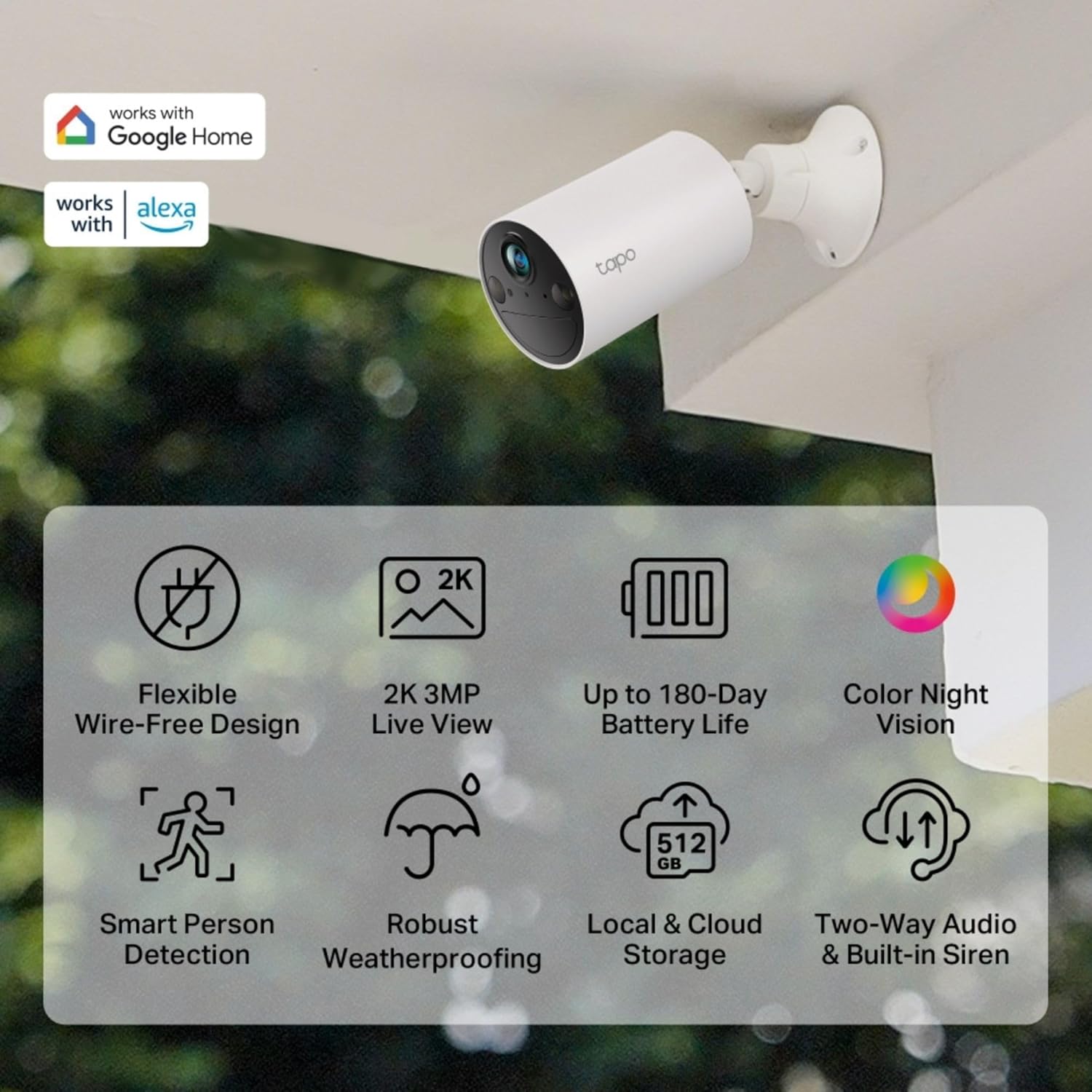
- 2K (3MP) resolution with clear image quality and colour night vision
- Wire-free, battery-powered design with IP65 rating for flexible indoor/outdoor placement
- Local microSD storage up to 512 GB plus optional cloud, so no mandatory subscription
Cons
- 15 fps frame rate and no motorised pan/tilt limit advanced use cases
- Plastic build and basic mounting hardware; some users may prefer sturdier accessories

Specifications
View full product page →| Brand | Tapo |
Wire-free security for people who don’t want a subscription
The Tapo C410 (2-Pack) targets a very specific crowd: people who want decent outdoor security, don’t want to pull cables, and really don’t feel like paying a monthly subscription just to review footage. On paper, it ticks most of the current buzzwords for home security: 2K (3MP) resolution, battery power, colour night vision, AI person detection, and integration with Alexa and Google Assistant. Add to that local microSD recording up to 512 GB via the hub and an advertised 180-day battery life, and the spec sheet looks solid for a mid-range kit.
In the Amazon comments, the general tone is positive. The product sits at about 4.3/5 from over 14,000 reviews, which is not flawless but clearly more good than bad. Buyers repeatedly mention that the cameras are easy to set up, the image quality is sharp, and the night vision is particularly convincing for a wireless model. Several people say they gave it as a gift or added extra units after trying one, which usually means the user experience is straightforward enough even for non-techy relatives.
The other big point that keeps coming back is how people handle charging. Since these are fully wire-free, you either take them down to charge or use a power bank/extension lead to top them up in place. Multiple reviewers explain that they use USB power banks to avoid removing the cameras from the wall, and they seem happy with that workaround. That lines up with the idea that the product is aimed at users who want flexible placement with minimal DIY.
It’s not perfect though. The frame rate is only 15 fps, there is no motorised pan/tilt, and the actual battery life clearly depends heavily on motion activity and Wi‑Fi quality. In my opinion, this kit makes sense for someone who wants a relatively simple, no-drill-friendly security setup with decent image quality and local storage, as long as you accept that it’s still a mid-range product with some compromises.
Value for money: where the Tapo C410 sits in the market
The exact price isn’t shown here, but judging by its position in the rankings—#108 in Electronics & Photo and #2 in Bullet Cameras on Amazon—and the feature set, the Tapo C410 (2-Pack) clearly plays in the competitive mid-range. You get two 2K cameras, battery power, a hub with up to 512 GB microSD support, IP65 weatherproofing, and smart integrations with Alexa and Google Assistant. For many households, that’s already enough to cover a front door and backyard or a driveway and garden without extra hardware.
What stands out in terms of value is the no mandatory subscription angle. A lot of battery-powered cameras practically require a cloud plan to be useful; here, you can run everything locally on a large microSD card and only add Tapo Care if you want the convenience of cloud backup and extra features. Several buyers say they use the cloud service and are satisfied, while others explicitly mention that they haven’t bought any additional storage options yet and are fine without them. That flexibility is a strong point for people who are tired of recurring fees.
On the downside, there are compromises that remind you this is not a premium system. The frame rate is 15 fps, there is no pan/tilt, and the construction is plastic with basic mounting accessories. A reviewer also hints that they would have liked rotation, which you do get on some similarly priced indoor-only cameras. So you’re paying for wire-free outdoor capability and decent image quality rather than fancy mechanics or high-end build.
In my opinion, the value for money looks good, bordering on very good, for typical home users: you get a lot of practical features (2K, colour night vision, AI detection, two-way audio, local storage) with a brand that already has other Tapo devices in many homes. People who want a fully wired 24/7 recording system with higher frame rates and professional-grade build will find better options elsewhere, but they’ll also pay more and give up the wire-free convenience. For someone upgrading from older 720p/1080p Wi‑Fi cams or adding security without rewiring, this kit makes financial sense.
Compact bullet design with practical touches
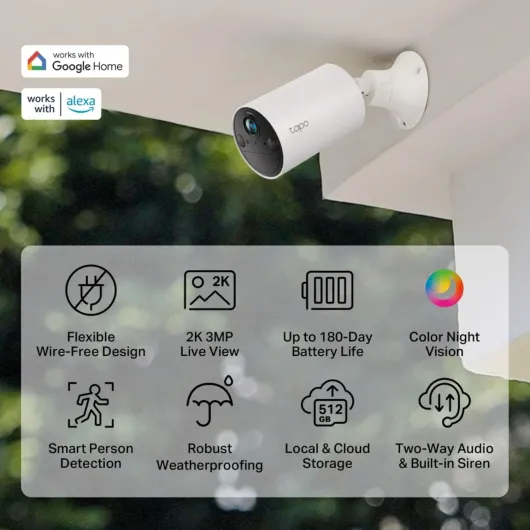
On paper, the Tapo C410 goes for a compact bullet design: about 6 x 8.9 cm per camera and a weight of around 460 g. The shape is classic bullet style, which makes it clear that it’s a camera. That can be a plus if you want a visible deterrent. The colour is listed as Pearl White, which keeps it discreet against most house walls, gutters, or soffits. Several reviewers mention that the cameras are quite small and easy to place, which matches the spec sheet dimensions.
The mount is wall-based, and users are expected to screw it into whatever surface they use. One reviewer points out that the supplied wall plugs broke easily and they had to use their own. That suggests the mount is light-duty and that people who want a very solid installation might prefer better rawlplugs or anchors. The camera does not rotate remotely; there’s no motorised pan/tilt. One buyer explicitly says they would have given another star if the camera could rotate when needed. So the design is more “point and forget” than “move around from the app”.
In terms of layout, the camera integrates LED spotlights on the front and an internal speaker/microphone for two-way audio. Reviews highlight that the lights are strong and the speakers are loud enough to be used for warnings or as an intercom. From a design perspective, that means the camera is not trying to be stealthy: when the spotlight and siren fire, people will notice. For many home users, that visible and audible presence is exactly the goal.
Overall, in my opinion, the design is practical and consistent with its purpose: a compact, visible outdoor camera that is easy to mount but not designed for constant repositioning or motorised scanning. If you want to cover multiple angles, the idea is to add more cameras rather than move one around. The main compromise is the lack of pan/tilt and the somewhat basic mounting accessories, which might push more demanding DIYers to use their own hardware.
180-day battery claim and what buyers actually see
The headline promise is clear: up to 180 days of battery life on a single charge, thanks to a large 12,800 mAh (listed as 12800 Amp Hours) rechargeable and removable battery and a low-power protocol. On paper, that’s very competitive in the battery camera market. But, as always, that “up to” figure assumes ideal conditions: few motion events, moderate temperatures, and a solid Wi‑Fi connection. The spec sheet doesn’t hide that it’s an estimate rather than a guarantee.
In the reviews, battery feedback is largely positive but more nuanced than the marketing line. Several buyers say the battery “lasts for months” and one mentions having the camera running for weeks with the battery still at 85%. Another points out that the actual duration strongly depends on how much traffic the camera sees, which is exactly what you’d expect. An always-busy street, a windy garden with moving branches, or a camera that’s constantly streaming to a smart display will drain faster than a calm backyard with only a few motion events per day.
A recurring theme is how people manage charging. Many reviewers say they use a USB power bank or an extension lead with a USB‑C adapter to recharge the camera without removing it from the wall. Others say that taking it down is easy enough when needed. The fact that multiple buyers mention this as a routine rather than a problem suggests the charging process is manageable, even if not as convenient as a permanently wired unit or a solar-powered model. One user explicitly states that they chose the C410 instead of a solar-panel camera to avoid having a panel spoiling the look of their setup.
In my opinion, the 180-day figure should be seen as a “best case”, not a baseline. For a typical home with moderate activity, a few months per charge seems realistic according to the published comments. If someone plans to monitor a high-traffic area with constant motion, they should expect shorter intervals and plan for regular top-ups. The removable battery is a plus, but the product would obviously be more convenient paired with smart placement and tuned motion zones to avoid unnecessary triggers that eat into battery life.

Weather resistance and long-term robustness
For outdoor use, the Tapo C410 carries an IP65 rating, meaning it is dust-tight and protected against low-pressure water jets from any direction. In plain terms, it should handle rain, splashes, and dusty environments without issue, as long as it’s installed correctly. The manufacturer explicitly advertises that it’s suitable for harsh outdoor conditions. The casing material is listed as plastic, which is standard in this category; it helps keep weight and cost down but won’t feel as tough as metal housing on higher-end cameras.
In the reviews, buyers focus more on connectivity and placement than on weather failures, which is usually a good sign. One user mentions their camera is placed at the bottom of the garden and still connects to Wi‑Fi properly, and they seem satisfied with its continuous operation in that spot. There is no flood of complaints about water ingress or cameras dying after the first storm, which would normally show up in a product with over 14,000 reviews if it were a common problem.
The one durability-related criticism that does come up explicitly is about mounting hardware quality. A reviewer notes that the included screw plugs broke easily, and they had to use their own. That doesn’t necessarily say much about the camera body itself, but it suggests some cost-cutting on accessories. For anyone installing the cameras in brick, concrete, or other tough surfaces, it would be sensible to have better wall plugs on hand rather than relying on the ones in the box.
In my opinion, the C410’s durability is consistent with a mid-range plastic-bodied outdoor camera: the IP65 rating and the lack of widespread complaints about weather damage inspire a basic level of confidence, but it’s not built like a professional metal CCTV dome. For typical home use—under an eave, on an external wall, or overlooking a garden—it should hold up fine as long as you don’t abuse it physically. People who live in very extreme climates (salt spray, heavy hail, vandalism-prone areas) might want to consider either extra protection or a more rugged, possibly wired alternative.
Image quality, detection, and smart features in real-world feedback
On the spec sheet, the Tapo C410 offers 2K (1296p) resolution with a 3MP CMOS sensor, 111° field of view, and H.264 video encoding. That’s a clear step up from 1080p, and reviewers back this up: several verified buyers describe the image as “super-clear” or “incredibly good” for a wireless camera. For most home security use cases (identifying faces at reasonable distance, reading number plates at close range, checking if a gate is open), 2K at 15 fps should be enough, even if it’s not cinema-smooth.
The camera uses a starlight sensor and dual LED spotlights to provide full-colour night vision. One reviewer calls the night vision “outstanding”, another mentions “great night vision and loud speakers”. Comments about the spotlight being powerful and the ability to tailor its intensity in the app suggest that the colour night mode is actually usable, not just a marketing bullet. The spec sheet also mentions 8 IR LEDs and a night vision range of about 9.1 metres, which fits typical front-yard and garden scenarios.
On the smart detection side, the C410 relies on AI person detection and motion alerts. Buyers say the detection sensitivity is very customisable, and one reviewer notes that it “doesn’t take long to find the range of sensitivity that works” for their needs. That’s important because battery life and notification fatigue are directly tied to how often the camera triggers. The product also supports light and sound alarms when motion is detected, with the option to craft custom audio messages; this can be useful to scare off intruders or simply talk to delivery people.
The main limitation on performance is the frame rate of 15 fps. For security footage, this is generally acceptable, but it is technically below what many 1080p cameras offer. For fast-moving scenes, license plates on speeding cars, or very detailed motion analysis, this could be a weak point. However, given the price range and the battery-powered nature, the compromise is understandable. In my opinion, the performance level is solid for a domestic, wire-free camera kit: strong image clarity, convincing night mode, and usable AI detection, with the trade-off of a lower frame rate and no advanced tracking features.
What the Tapo C410 (2-Pack) actually offers
The Tapo C410 (2-Pack) is a wire-free indoor/outdoor bullet-style camera kit that runs on a rechargeable battery and connects over Wi‑Fi. Each camera records in 2K (1296p) with a 3MP sensor and a 111° viewing angle. That’s wider than many traditional CCTV bullets but narrower than some fisheye-style devices, so it’s more about covering a doorway, driveway, or garden area than replacing a full 360° system. The frame rate is capped at 15 fps, which is enough for monitoring and identifying people, but not as fluid as a 25–30 fps camera.
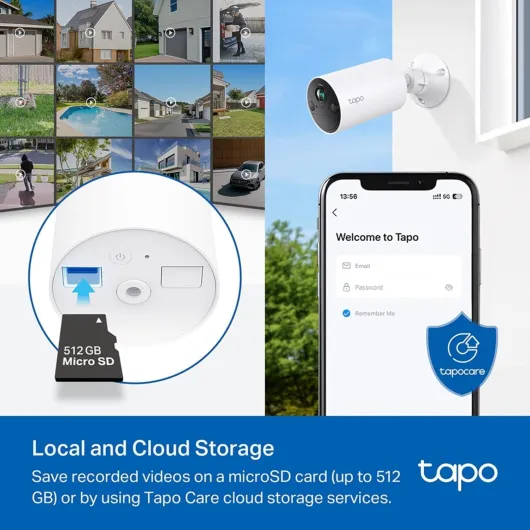
Storage is handled via a separate hub that takes a microSD card up to 512 GB or through Tapo’s cloud service (Tapo Care). Several reviews mention that they are happy with the cloud subscription, while others rely purely on the SD card option to avoid ongoing costs. That flexibility is one of the strong points: you can start with local storage only, then add cloud if you later want off-site backups or easier sharing.
On the smart side, the C410 supports Alexa and Google Assistant. Buyers say they can pull up the camera feed on compatible smart displays or ask their assistant to show the backyard, which is pretty standard now but still handy. The cameras also include two-way audio, a built-in siren, and dual LED spotlights that can be used for colour night vision and as an active deterrent. Some reviewers highlight using the audio as an intercom between house and garden or between separate buildings.
In my opinion, the overall feature package is coherent for the price range: 2K resolution, AI person detection, wire-free design, and flexible storage are the main pillars. It doesn’t try to be a high-end NVR system or a professional-grade CCTV solution. Instead, it aims at home and small office users who want to add a few cameras quickly without rewiring the house and who prefer the choice between local and cloud storage instead of being forced into a subscription.
Pros
- 2K (3MP) resolution with clear image quality and colour night vision
- Wire-free, battery-powered design with IP65 rating for flexible indoor/outdoor placement
- Local microSD storage up to 512 GB plus optional cloud, so no mandatory subscription
Cons
- 15 fps frame rate and no motorised pan/tilt limit advanced use cases
- Plastic build and basic mounting hardware; some users may prefer sturdier accessories
Conclusion
Analysis score
The Tapo C410 (2-Pack) comes across as a solid mid-range wire-free camera kit that gets the basics right: clear 2K image quality, convincing colour night vision, AI person detection, and genuinely flexible storage thanks to both microSD (up to 512 GB) and optional cloud. The 4.3/5 average from a very large number of reviews supports the idea that most buyers are satisfied, especially with ease of setup, picture quality, and the practicality of battery power. Add Alexa/Google integration, two-way audio, and an IP65 rating, and you have a fairly complete package for typical home security.
It’s not without trade-offs. The 15 fps frame rate, lack of pan/tilt, basic plastic build, and mediocre included wall plugs show where Tapo kept costs down. The 180-day battery claim is realistic only under light usage; in busier areas, you should expect shorter intervals and plan for charging, ideally with a power bank or convenient access. For someone who wants a fully wired, always-on professional CCTV system, this will feel limited.
In my opinion, this kit is a good fit for homeowners and renters who want to cover a few key areas—front door, garden, driveway—without drilling through walls for cables or signing up for mandatory subscriptions. It’s also suitable as a gift for less technical relatives, judging by how often buyers mention giving it to parents. People who are very picky about frame rate, want motorised tracking, or need a very rugged metal housing should look at higher-end, often wired alternatives.