Summary
Analysis score
Average of the criteria rated below
Value for money: strong specs with a risk factor
Design, folding and everyday practicality
Battery, range and charging: decent on paper, mixed in reviews
Riding comfort: tires, suspension and ergonomics
Build quality, reliability and after-sales support
Motor, speed and braking: how capable is it on the road?
What the HeyScooter W5 offers in theory
Pros
- 350W motor with 500W peak and reported top speed around 30 km/h, decent power for commuting and hills
- 8.5" pneumatic tires with some suspension and ergonomic grips, giving better comfort than rigid-wheel budget scooters
- Foldable design with lights and app control, 120 kg load capacity and relatively compact size for urban use
Cons
- Short 30-day limited warranty and weak brand recognition compared with major competitors
- Mixed user feedback including at least one serious case of flat tire + unreliable battery + poor after-sales support
- App functionality not reliable for all buyers, and spare parts (like inner tubes) not clearly supported

Specifications
View full product page →| Brand | HeyScooter |
An adult e-scooter that looks good on paper but divides buyers
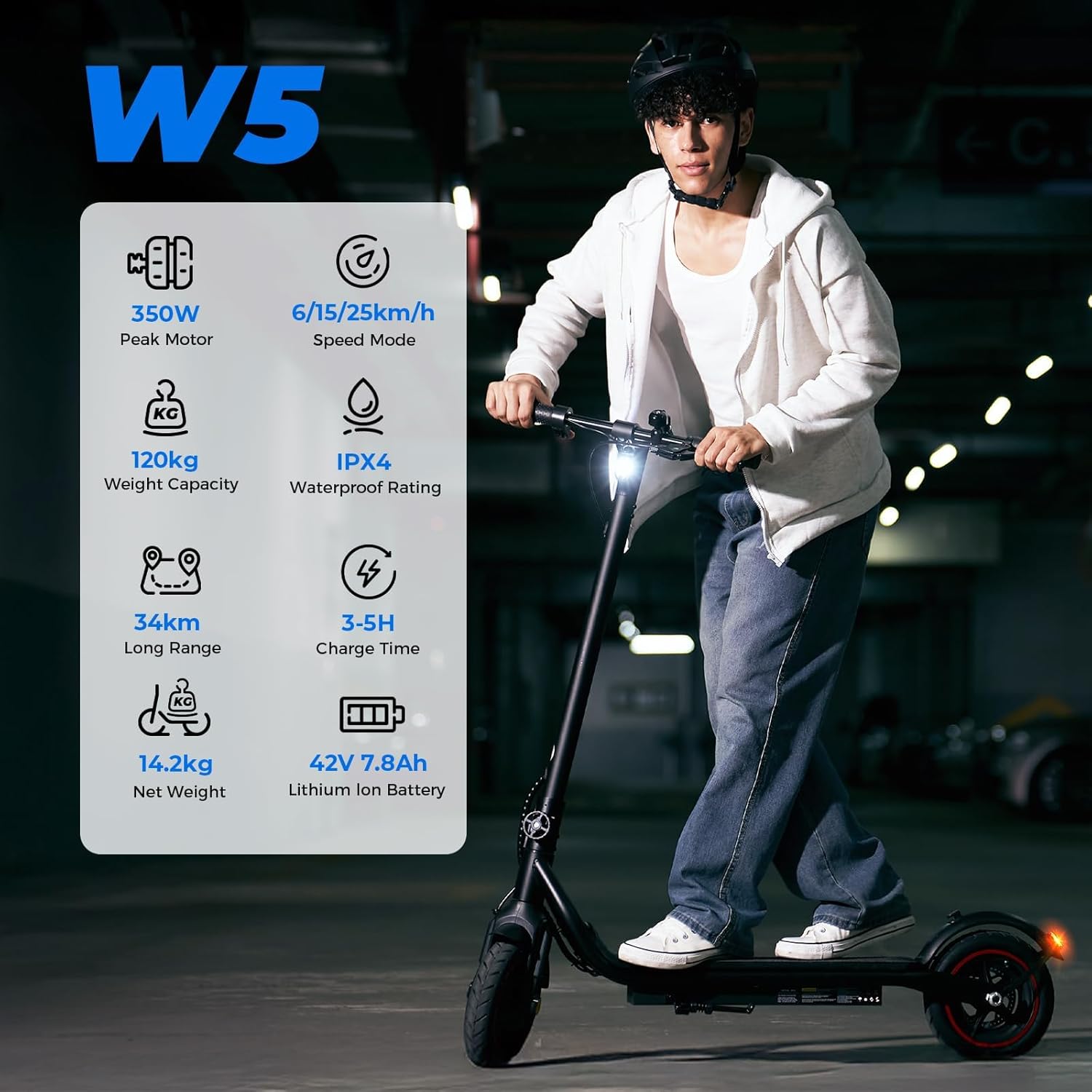
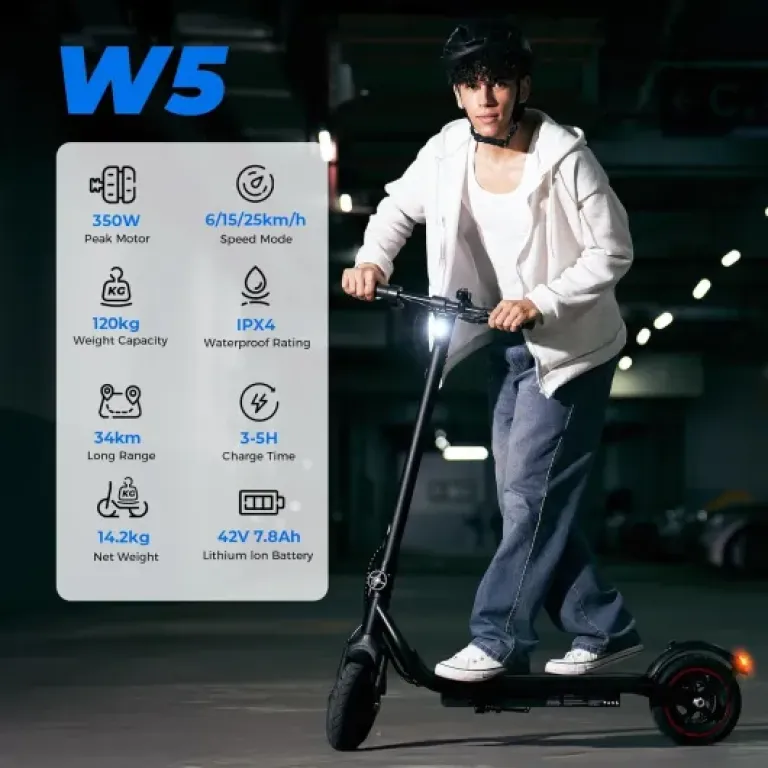
The HeyScooter W5 positions itself as a budget-friendly electric scooter for adults who want something simple for commuting or recreational riding. On paper, it offers a 350W motor (advertised peak 500W), a claimed range up to 24–34 km, 8.5" pneumatic tires, dual braking (disc + electronic), and a foldable design. It weighs 14.2 kg and supports riders up to 120 kg, which is fairly standard for this segment. The spec sheet is clearly aiming at the same crowd that looks at entry-level Xiaomi or Ninebot models, but with a slightly stronger motor and app control as selling points.
In the Amazon comments, the average rating sits around 3.6/5 over roughly 45 reviews, which instantly shows the product is not universally loved. Some buyers are very happy with the power, hill climbing and general comfort, while others complain about reliability, customer service and issues right from delivery. So you get a scooter that can apparently "do the job" for some people, but comes with a bit of a gamble factor.
In my opinion, this is the classic low- to mid-range e-scooter profile: attractive specs for the price, but several warning flags in the reviews. The interesting part is trying to understand whether the compromises are acceptable for your use. If you just want a simple machine for short urban trips and you’re ready to take a small risk on after-sales support, it might be worth considering. If you need solid reliability and strong warranty backing, the mixed feedback deserves attention.
The following sections look at what the HeyScooter W5 promises on paper and what buyers actually report in real use: design and build, comfort, performance, battery behavior, durability, and overall value. The idea is not to hype it up but to see clearly where it shines, where it’s just average, and where it looks weak compared with better-known competitors.
Value for money: strong specs with a risk factor
The exact price isn’t listed here, but from the context (position in the electric scooter rankings and the type of specs), the HeyScooter W5 clearly plays in the budget to lower mid-range segment. For that segment, the spec sheet is actually quite appealing: a 350W motor with 500W peak, up to 24–34 km advertised range, 8.5" pneumatic tires, dual braking, some form of suspension, app control, and a 120 kg load capacity. One buyer even notes that the price "isn’t bad at all for what you get", and another describes it as a capable scooter that "does the job" without costing too much. For riders focused on power and comfort per euro, that’s a strong argument.
However, value is not just raw specs; it’s also reliability, warranty, and the likelihood that you’ll need to replace the scooter prematurely. The mixed 3.6/5 average over about 45 reviews tells a clear story: many people are satisfied, but there are enough negative experiences to drag the average down. The most worrying parts are the short 30-day warranty and the detailed complaint about non-existent customer service when facing a flat tire and battery issues on a nearly new scooter. If you end up in that situation, the "good price" instantly becomes questionable because you might have to pay for repairs or even a replacement scooter much sooner than expected.
Compared with big names like Xiaomi or Ninebot, the W5 usually offers slightly more power or features for the same approximate budget, but with weaker brand trust and support. In my opinion, the value is decent but not outstanding: you’re trading long-term peace of mind for better specs today. If you ride occasionally, know how to deal with basic maintenance, and are willing to take a bit of risk on after-sales, the W5 can make sense as a cost-effective commuter. If this is your primary daily transport and you live in a place where support is crucial, spending more on a better-known model could save money and headaches in the long run.
So overall, the W5’s value for money hinges on your risk tolerance. The hardware you get for the assumed price point is attractive, but the variability in user experiences and the minimal warranty mean you should go in with your eyes open. For some buyers it will be a solid deal; for others, a bad unit and weak support can turn it into an expensive mistake.
Design, folding and everyday practicality
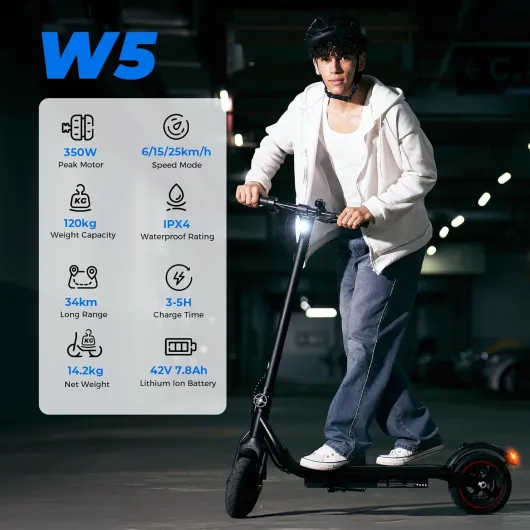
From a design point of view, the HeyScooter W5 sticks to the classic urban e-scooter formula: a black metal frame, straight handlebar with ergonomic grips, a deck long enough for adult feet, and a folding stem. The dimensions are 112.5 x 15.5 x 50 cm (L x W x H), so it’s relatively compact when folded and should fit in most car boots or under a desk. At 14.2 kg, it’s not featherweight, but still manageable for carrying up a few stairs or onto public transport if necessary. One positive review highlights that the folding mechanism is straightforward, which suggests the latch system is intuitive enough for regular use.
The scooter supports up to 120 kg, which is a decent capacity for an entry-level model and opens it to a wide range of adult riders. The combination of a robust metal frame and pneumatic tires gives it a more serious commuting profile than ultra-cheap plastic-heavy scooters. A buyer even mentions that the dual suspension is the standout feature, which implies that the overall structure and geometry are tuned more for comfort and stability than for super-light portability or sporty handling.
Lighting is mentioned in the comments as being bright enough for evening rides, which is an important safety point. Many cheaper scooters cut corners there, but at least one buyer feels safe using the lights in low light conditions. There is also app integration, which visually modernizes the product: you can lock the scooter, change modes, and monitor speed from your smartphone. However, another reviewer reports that the app does not work for them, which undermines this design advantage if you’re unlucky.
In my opinion, the W5’s design is solidly "standard commuter": nothing flashy, but the basics are there—folding, lights, app, decent payload. The downside is that at this weight and size, it’s more practical for people who store it in a hallway, office or car trunk, rather than those who need to carry it long distances. The short warranty and some complaints about support also mean that if the folding mechanism or other structural elements develop play or issues over time, you may be on your own. But purely on layout and features, the design ticks the expected boxes for urban use.
Battery, range and charging: decent on paper, mixed in reviews
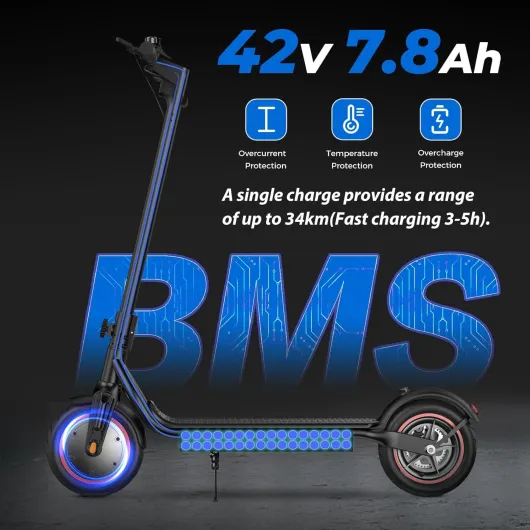
The battery setup on the HeyScooter W5 is built around a high-capacity 42V pack, with an advertised range of 24–34 km depending on conditions. That range is perfectly in line with many entry-level commuter scooters. For typical city use—say 5–10 km each way—you’d theoretically be able to do a full day of commuting and still have some reserve. The brand also claims a fast charging time of 3–5 hours, which is convenient if you need to recharge between rides at home or at the office. On paper, this combination of range and charging speed is well suited for short to medium daily trips.
However, range figures are always optimistic. They’re usually measured under ideal conditions: light rider, flat ground, eco mode, low average speed, no wind. In real life, heavier riders, frequent stops, hills and high-speed riding tend to cut those numbers significantly. Among the reviews, one commuter says that speed and range are "perfectly adequate for general commuting", which suggests that, for moderate use, the scooter can deliver something close to expectations. Another reviewer is very satisfied overall and doesn’t mention range as a problem, which is usually a good sign: people tend to complain when the scooter dies too quickly.
On the other hand, there is at least one very negative comment about unreliable battery life, combined with a flat tire and poor support. That buyer describes the battery as unreliable, although without precise details (sudden drops, loss of capacity, or random shut-offs). Even if it’s an isolated case, it shows that the quality control on the battery side may not be as consistent as on higher-end brands. The short 30-day warranty also doesn’t inspire total confidence when it comes to long-term battery durability, since batteries are often the first expensive component to fail on cheap e-scooters.
In my opinion, the W5’s battery and range are "good enough" in theory for urban use, but you shouldn’t expect miracles or long-term security. If you’re planning frequent 20+ km rides, you’ll likely be riding close to the limit and will see range degrade faster over time. For shorter trips and occasional use, it should be fine as long as you get a good unit. The fast charging is a real plus, though: 3–5 hours means you can realistically charge it during a workday or evening and be ready for the next outing. Just keep in mind that with the mixed feedback and short warranty, treating the battery gently (avoiding full discharges, not storing it fully empty) is probably a smart move.
Riding comfort: tires, suspension and ergonomics
Comfort is one of the areas where the HeyScooter W5 gets some of its best feedback. The scooter uses 8.5" pneumatic tires, which generally provide better shock absorption than solid rubber wheels. The description also mentions "tire dual suspension", and one buyer explicitly calls the dual suspension the standout feature, saying it saves their knees on bumpy paths. That kind of comment suggests that, for typical urban surfaces with cracks and small potholes, the scooter can smooth things out reasonably well for this price level.
The air-filled tires are said to offer better grip and cushioning, which on paper should help with both comfort and stability in corners or on slightly rough roads. One positive review even mentions that the scooter performs well on steep hills and in the rain. That’s one single buyer’s experience, but combined with the pneumatic tires, it fits the idea of a scooter that can handle less-than-perfect conditions without beating up the rider too much. The ergonomic grips are another small but useful point: they’re a standard feature, but they help limit hand fatigue on longer rides.
On the flip side, pneumatic tires come with maintenance: they can puncture or be delivered underinflated. A very negative review describes receiving the scooter with a flat tire and struggling to find any guidance or replacement inner tube, combined with no real help from the seller. This shows the other side of comfort: if you’re not comfortable with basic bike-style maintenance (inner tubes, tire changes), you may run into frustration if you get unlucky. That’s not unique to this scooter, but the lack of support mentioned by this buyer turns a simple flat into a serious problem.
Overall, in my opinion, the W5 looks relatively comfortable for an entry-level commuter: pneumatic tires, some form of suspension, ergonomic grips, and multiple speed modes so you can choose a gentler ride if needed. It’s not a premium suspension monster, but it should be more forgiving than rigid-wheel budget scooters. Just be aware that this comfort is tied to tires that may occasionally require DIY attention, and the customer service reports suggest you should not count too much on the brand to walk you through it.
Build quality, reliability and after-sales support
Durability and support are clearly the most sensitive topics for the HeyScooter W5. The frame itself is metal, the wheel material is rubber, and the maximum load of 120 kg suggests a reasonably sturdy structural design. Several happy buyers mention good overall quality, and one simply says "Excellent quality and service" without further detail. Another calls it a "sensible, well-engineered machine" that feels safe, which indicates that at least some units give a solid impression and hold up in early use. The problem is that not all comments line up with this positive picture.
One particularly frustrated buyer reports a scooter that arrived with a flat tire and an unreliable battery. They explain that the app doesn’t work, they don’t know how to change the flat tire, cannot find guidance or replacement inner tube, and feel that touching the scooter themselves could void the warranty. They also say they tried contacting the seller for weeks without any reply and were told they were out of date for a refund, leaving them with what they describe as "scrap metal". This is a single report, but it’s detailed and paints a worrying picture of after-sales service and practical repairability if something goes wrong early.
The 30-day limited warranty is another red flag from a durability standpoint. Many better-known brands offer at least 6–12 months on key components, and some have established networks for spare parts and repairs. Here, with a relatively unknown manufacturer and minimal warranty duration, buyers are essentially betting that their unit will be free of early defects. If you’re unlucky and receive a scooter with a bad battery, faulty app module or damaged tire, the path to a fix or refund seems uncertain according to this negative review.
In my opinion, the W5’s physical build (metal frame, pneumatic tires, dual brakes) is probably fine for normal use, and the positive reviews suggest that plenty of units work as expected and give a sense of sturdiness. But the combination of a short warranty, limited brand recognition, and at least one serious complaint about non-existent support brings the overall durability score down. If you’re comfortable maintaining tires and minor parts yourself and you accept the risk of weaker support, it may still be acceptable. If you want strong backing and easy access to spares, a more established brand is likely a safer bet even if the specs on paper look slightly less attractive.
Motor, speed and braking: how capable is it on the road?
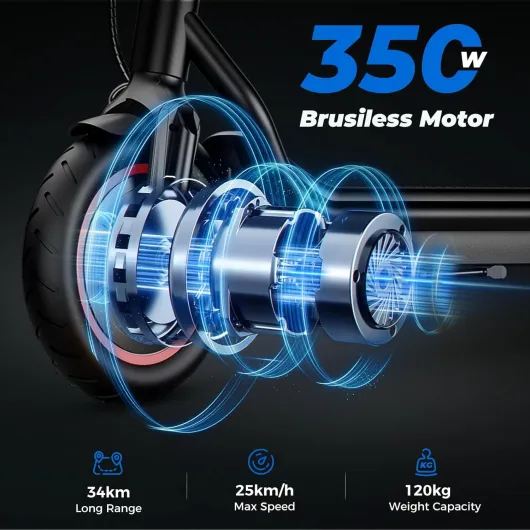
On the performance side, the HeyScooter W5 comes with a 350W motor and a claimed peak power of 500W. For a budget adult scooter, that’s a respectable configuration. One verified buyer explicitly mentions a top speed of around 19 mph (about 30 km/h), which is in line with what you’d expect from a 350–500W class motor. The same buyer also says it’s "great for going up steep hills", which is encouraging for anyone dealing with inclines on their commute. Another positive review calls it a "very capable scooter" and says that speed and range are perfectly adequate for general commuting.
There are 3 speed modes (sometimes described as 3–4 in marketing), and the app allows switching modes. That’s useful if you want to limit speed in busy areas or for newer riders. It’s also handy for managing range: staying in an eco mode usually helps stretch the battery. On the braking side, the W5 uses a combination of a rear disc brake and a hidden electronic brake. The brand highlights that this dual system improves stopping power and stability and even offers some energy recovery. One user comment supports the feeling of safety, noting that the scooter feels safe and the lights are bright enough for evening rides, which indirectly suggests the braking isn’t alarming for them.
There are no detailed complaints in the reviews about weak brakes or dangerous behavior at speed, which is a good sign. Most negative feedback focuses on battery, app, and after-sales support rather than riding dynamics. On paper, a 500W peak motor and dual braking system should be enough for typical city use: flat roads, moderate hills, commuting speeds of 20–25 km/h. Heavy riders near the 120 kg limit or those facing very steep hills should still keep their expectations realistic; this is not an off-road or high-performance machine.
In my opinion, performance is one of the strengths of this scooter for its segment. It seems to deliver enough power and speed for everyday use, with braking and lighting that at least one commuter finds reassuring. If your priority is raw speed beyond 30 km/h, this won’t satisfy you, but for legal and safety reasons most people will be fine at these levels. The main caveat is that performance is only valuable if the rest of the scooter (battery, electronics, mechanical parts) holds up over time, and the mixed reliability feedback does cast a shadow over what is otherwise a decent performance package on paper.
What the HeyScooter W5 offers in theory
The HeyScooter W5 is marketed as an adult electric scooter with a focus on commuting and recreational riding. The core specs are: a 350W motor with a claimed peak of 500W, a 42V battery, a maximum advertised range of 24–34 km, and a top speed that one buyer reports around 19 mph (about 30 km/h). It uses 8.5" pneumatic tires, a dual braking system (rear disc + electronic brake), and supports riders up to 120 kg. At 14.2 kg, it’s not ultra-light, but still within the typical range for foldable urban scooters.
The scooter folds, has integrated lights, and comes with app control. Through the app, the brand says you can check real-time speed, switch modes, lock/unlock the scooter and tweak some settings. There are 3 speed modes mentioned in the description (some marketing mentions 3–4 modes), which usually translates into an eco mode, a standard mode and a sport mode. The charging time is advertised at 3–5 hours, which is fairly quick for a scooter that claims up to 34 km of range. On paper, that combination makes it well suited for daily trips of 5–10 km each way without charging anxiety.
The product is listed for recreational riding, not heavy-duty delivery work or very long commutes. The manufacturer is Shenzhen Xincheng Times Technology Co.,Ltd, and the warranty is only 30 days with a limited type. That’s quite short compared with some competitors that offer 1 year on certain components. In my opinion, this already hints at where part of the compromise lies: attractive specs and price, but a minimal safety net if something goes wrong.
In the reviews, the overall tone is split. Some verified buyers say it’s a "very capable scooter" with good dual suspension feel, decent speed and range for commuting and a straightforward folding mechanism. Others complain about app issues, battery reliability and a lack of support from the seller. So the presentation is that of a feature-rich commuter scooter, but the user feedback suggests the real experience can vary a lot depending on the unit you receive and how much you rely on the app or after-sales service.
Pros
- 350W motor with 500W peak and reported top speed around 30 km/h, decent power for commuting and hills
- 8.5" pneumatic tires with some suspension and ergonomic grips, giving better comfort than rigid-wheel budget scooters
- Foldable design with lights and app control, 120 kg load capacity and relatively compact size for urban use
Cons
- Short 30-day limited warranty and weak brand recognition compared with major competitors
- Mixed user feedback including at least one serious case of flat tire + unreliable battery + poor after-sales support
- App functionality not reliable for all buyers, and spare parts (like inner tubes) not clearly supported
Conclusion
Analysis score
The HeyScooter W5 is a classic budget adult e-scooter: on paper, it offers quite a bit for the likely price. You get a 350W motor with 500W peak, a realistic commuting top speed around 30 km/h, pneumatic tires, some suspension, dual brakes, lights, app control, and a 120 kg load rating. Several buyers confirm that it feels capable, handles hills reasonably well, and offers enough comfort and range for everyday commuting. For riders who just want a straightforward scooter for short to medium trips, the package can be attractive.
The main downside is not the spec sheet but the risk profile. The 30-day limited warranty is short, and at least one detailed review describes serious trouble with a flat tire, unreliable battery, a non-functioning app, and no meaningful support from the seller. Combined with a 3.6/5 average rating, that suggests quality control and after-sales service are weaker than with big-name brands. In my opinion, this scooter suits people who prioritize low cost and decent power, are ready to handle basic maintenance themselves, and accept that support may be minimal.
If you rely on an e-scooter as your main daily transport and want strong warranty coverage and an established service network, a better-known model is safer, even if the raw specs are a bit lower. If you’re okay with some risk in exchange for more motor power and comfort features at a lower cost, the HeyScooter W5 can be a reasonable choice—but it’s not a no-brainer. Go for it if you’re budget-conscious and mildly handy; skip it if reliability and hassle-free support are your top priorities.