Summary
Analysis score
Average of the criteria rated below
Value for money: strong case against subscription-heavy rivals
Straightforward design focused on practicality
Battery life: 6400 mAh that seems to hold up
Build quality and resistance to the elements
Image quality, app behavior and smart features in real life
What the Tapo TD21 offers in concrete terms
Pros
- No mandatory subscription: full functionality with microSD local storage up to 512 GB
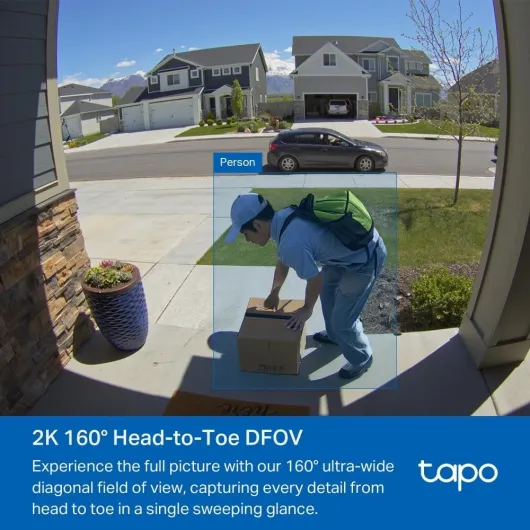
- 2K 3MP resolution with color night vision and 160° field of view for clear coverage
- Long battery life in real-world use according to reviews, with a 6400 mAh internal battery
- Wireless chime included and app can call your phone with low-latency alerts
- Good integration with the wider Tapo ecosystem (cameras, bulbs, robot vacuum) and Alexa/Google Assistant
Cons
- MicroSD card not included, adding a small extra cost for local recording
- Design is functional rather than premium, and only one color/finish option
- Internal (non-removable) battery means the unit must be taken down for charging

Specifications
View full product page →| Brand | Tapo |
A budget-friendly 2K doorbell that skips subscriptions
The Tapo TD21 Battery Video Doorbell positions itself as a low-cost way to secure a front door without getting trapped in monthly subscriptions. It’s a battery-powered, Wi‑Fi video doorbell with 2K (3MP) resolution, color night vision, free AI detection, and a chime included in the box. On paper, it targets the same use cases as bigger brands like Ring or Arlo, but with a very different approach to running costs: local microSD storage up to 512 GB and optional, not mandatory, cloud storage.
Among the Amazon reviews, the overall score sits around 4.4/5 from more than 2,800 ratings, which is solid for a connected security product. Buyers highlight the absence of compulsory subscription fees, the quality of the Tapo app, and the integration with other Tapo devices (cameras, bulbs, robot vacuum) as major selling points. Several owners explicitly say they switched from Blink, Arlo or other subscription-heavy systems and feel they’re saving money while gaining features.
On the technical side, the TD21 offers a 160° diagonal field of view, IP65 weather resistance, and a 6400 mAh internal battery advertised for up to 6 months of use. The spec sheet also mentions two-way audio, Alexa and Google Assistant compatibility, and real-time notifications with AI detection for people, vehicles, pets and packages. For a device that weighs only 250 g and runs on battery power, that’s a fairly complete set of features.
In my opinion, the TD21 is clearly built for people who want straightforward video security at the door without recurring costs. It’s not a luxury gadget and it doesn’t try to be. On paper and in the comments, it looks like a practical tool: decent image quality, long battery life according to buyers, and an app that covers the basics properly. The rest of the analysis is about seeing where it really stands out, and where the compromises are compared to more expensive competitors.
Value for money: strong case against subscription-heavy rivals
Where the Tapo TD21 really stands out is on ongoing cost and ecosystem value. Several buyers explicitly say they moved from systems like Arlo or other brands that required subscriptions for basic features. One review mentions paying about £16 per month previously, compared to £0 now by using a microSD card in the TD21. Another user says they’re saving £49.99 a year by avoiding a previous subscription, while also getting better picture quality and smarter motion detection.
The doorbell supports microSD cards up to 512 GB for local recording, and while one reviewer would have liked to see a card included in the box, the ability to run the system completely free after that one-time purchase is a serious argument in its favor. A buyer points out that if you do want cloud storage, the Tapo Care plan is around £26 per year, which is still relatively low compared to some competitors. But crucially, the essential functions — live view, event history, notifications, AI detection — are available without paying extra.
On top of that, the included wireless chime increases the perceived value. Many competing doorbells require you to buy the chime separately or rely only on phone notifications. Here, you get an instant audible alert at home plus an app call on your phone a second or two later, according to one review. Users also appreciate that the Tapo app can control other TP‑Link Tapo products like cameras, bulbs, and even a robot vacuum, which makes the whole ecosystem more attractive if you plan to expand.
In my opinion, the price-to-feature ratio looks very good. You get 2K video, IP65 weatherproofing, AI detection, local storage, voice assistant support, and a chime included, with a high user rating (4.4/5) and strong sales ranking in its category. It’s not perfect — no included microSD, and the design is more functional than premium — but for anyone tired of subscription traps and willing to stick with the Tapo ecosystem, the TD21 offers strong value compared with both entry-level and mid-range competitors.

Straightforward design focused on practicality
The TD21 uses a rectangular, box-style form factor with a white finish, consistent with the rest of the Tapo smart home range. At 15 cm tall and 5 cm wide, it’s relatively slim and should fit on most door frames or nearby walls without looking oversized. Reviews that mention the appearance generally describe it as tidy and more solid-looking in real life than in product photos, which some people found a bit cheap‑looking at first glance.
The front layout is classic: camera at the top, button at the bottom, with integrated microphone and speaker for two-way audio. There’s no mention of fancy design elements or interchangeable faceplates like some Ring models, which confirms the goal here: function over decoration. One buyer notes that it may not look as “slick” as a more expensive Arlo doorbell they had before, but still finds the build quality solid enough for daily use. That kind of comment fits the overall positioning: it’s not a design piece, it’s a tool.
Installation-wise, the TD21 supports a screw-in mounting system, and a reviewer points out that it also comes with an adhesive sticker for those who can’t or don’t want to drill into the wall. This flexibility can make a big difference for renters or anyone hesitant about permanent fixtures. Another user mentions that the whole installation and setup process took about 15 minutes, which suggests the mounting hardware and instructions are reasonably straightforward.
In my opinion, the design is decent but nothing more. It’s compact, practical, and neutral enough to blend into most entrances. There are no design frills, but you do get important usability touches: a clear button area, a form factor that leaves room for a large battery, and mounting options that don’t require heavy DIY skills. For a doorbell that aims at good value, this design approach makes sense, even if it won’t impress anyone looking for something ultra-premium or ultra-discreet.
Battery life: 6400 mAh that seems to hold up
The TD21 uses a built-in 6400 mAh lithium-ion battery, with an advertised autonomy of up to 180 days (about 6 months) on a single charge. For a battery-powered doorbell running 2K video and Wi‑Fi, that’s a fairly ambitious claim. In reality, autonomy always depends heavily on motion frequency, recording length, Wi‑Fi stability and temperature. High-traffic entrances or very cold climates will drain any battery faster.
What stands out in the published reviews is that several buyers are pleasantly surprised by the battery behavior. One user explicitly says they previously had a Blink doorbell where they had to change batteries every other week in a high-traffic area, while with the TD21 they’ve had it for a couple of months and only charged it once. Another reviewer who uses the TD21 for around six months mentions that battery life is “far better” than expected for a battery-powered model and that it’s still performing strongly after that time.
These comments suggest that, in typical use, the 6‑month figure is not just marketing fantasy, even if it should be taken as a “best case” scenario. The relatively low 15 fps frame rate and the fact that the doorbell only streams or records when motion is detected or the button is pressed likely help keep consumption under control. However, as with any battery device, someone with constant foot traffic or who sets very sensitive motion detection may see much shorter intervals between charges.
In my opinion, the TD21’s battery setup is a solid point in its favor. A non-removable internal battery means you’ll need to physically take the doorbell off its mount for charging, which is less convenient than removable battery packs, but it also keeps the hardware simpler and cheaper. Given the feedback about long intervals between charges, the trade-off seems reasonable. For users fed up with doorbells that die every few weeks, this model looks like a clear improvement, as long as expectations are aligned with real-world conditions and motion settings.
Build quality and resistance to the elements
For durability, the TD21 relies on a plastic rectangular housing with an IP65 waterproof rating. IP65 means it’s protected against dust and low-pressure water jets, which in practice should cover typical rain and splashes at a front door. The device is sold as suitable for outdoor security use, and nothing in the comments contradicts that: buyers using it on exterior doorways don’t report obvious water ingress issues.
In terms of build feel, one reviewer notes that they expected it to look a bit cheap based on the online images, but once installed, they found the build quality “solid” and not flimsy. They also mention that while it wouldn’t survive a hammer blow, it doesn’t feel like a fragile toy either. That’s roughly what you’d expect from a mid-range plastic smart doorbell: robust enough for daily use and weather, not a tank. The 250 g weight suggests there is enough material and internal structure to avoid feeling hollow.
The mounting system uses screws by default, with an adhesive option. For long-term durability, the screw mount is clearly the safer choice, especially in wet or windy environments; adhesive can degrade over time, particularly on rough or dirty surfaces. The inclusion of both options, though, gives flexibility to renters or those who can’t drill. None of the highlighted reviews mention cracks, broken mounts, or weather-related failures, which is a good sign, even if it doesn’t guarantee long-term reliability for everyone.
In my opinion, the TD21 lands in the “good enough” category for durability. It doesn’t claim ultra-rugged military standards, but the IP65 rating, the fairly compact body, and the positive comments on build solidity indicate it should handle standard UK weather and daily button presses without drama. As with any battery-powered, Wi‑Fi doorbell, the real long-term question is battery health after a few years of charge cycles, but that’s something no current review can fully answer yet. For now, there’s no red flag in terms of build or weather resistance.
Image quality, app behavior and smart features in real life
On the imaging side, the TD21 advertises 2K 3MP resolution (1440p) at 15 fps, with a 160° diagonal field of view. Several buyers explicitly say the video quality is “very good” or “amazing” for the price, both in daytime and at night. One user running the TD21 alongside two Tapo C320WS cameras describes the overall ecosystem as “first-class”, with sharp 2K images and clear night vision. The combination of a relatively high resolution and a wide field of view should be enough to recognise faces at the door and read some details like packages or clothing, as long as the Wi‑Fi connection holds up.
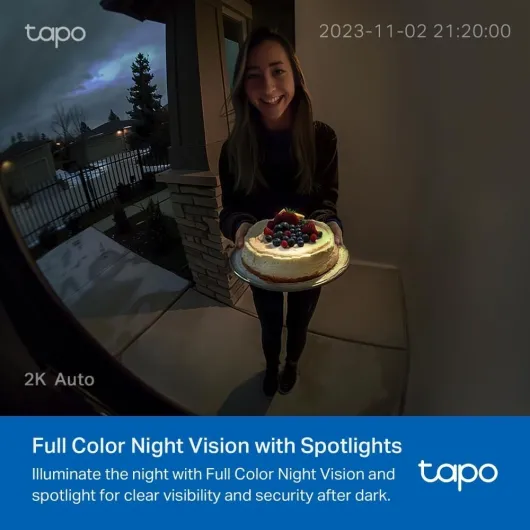
The doorbell also includes color night vision with a spotlight, plus standard infrared. Reviews mention that night vision is clear and usable, which is consistent with TP‑Link’s broader Tapo camera line. For a 15 fps device, motion should look smooth enough for a doorbell scenario, even if it won’t match a full 30 fps security camera. The 25‑foot night-vision range listed in the spec sheet is modest but reasonable for a front-door context, where you mostly care about people standing close to the door or walking by the entrance.
On the smart side, the TD21 offers AI-based detection for people, vehicles, pets and packages, plus real-time notifications. Multiple reviews praise the accuracy of motion detection and highlight that the app can distinguish between a person and general movement. One buyer notes that the doorbell doesn’t just send a silent notification: it actually “calls your phone”, which makes it much harder to miss someone at the door. Another points out that the chime rings almost instantly, and the phone alert comes 1–2 seconds later, with very little lag compared to their previous device.
In my opinion, performance is a strong point for this model, especially given its price range and the absence of mandatory subscription. The image quality comments are positive, the app seems responsive, and two‑way audio is described as working reliably, unlike what one user experienced with their older doorbell from another brand. There will always be occasional connectivity or notification hiccups with Wi‑Fi products, but the general tone of the reviews is that the TD21 gets the core job done: see who’s at the door, talk to them, and review events quickly from the Tapo app.
What the Tapo TD21 offers in concrete terms
The Tapo TD21 is a wireless, battery-powered video doorbell designed primarily for outdoor use. It records in up to 2K (1440p) with a 3MP sensor, at 15 frames per second, and has a 160° diagonal field of view to capture visitors from head to toe. The product dimensions are 15 x 5 x 3.8 cm, with a weight of 250 g, which keeps it compact enough for most door frames while still giving space for the camera, battery, and motion sensors.
From a connectivity standpoint, it uses Wi‑Fi and works with a smartphone via the Tapo app. It supports local storage on microSD up to 512 GB and optional Tapo Care cloud storage. This dual approach is one of its key strengths: several reviews insist that recording to an SD card, without any monthly fee, is exactly what convinced them to switch from subscription-based brands. For those who prefer the cloud, the Tapo Care plan mentioned by buyers is relatively low-cost compared to some competitors.
The doorbell is rated IP65 waterproof, meaning it should handle rain and dust reasonably well. The spec sheet and comments point to color night vision with a spotlight, plus infrared night vision up to about 25 feet. Voice control is handled through Amazon Alexa and Google Assistant, and some users mention displaying the live feed on an Echo Show or Fire TV. The package includes the video doorbell itself and a wireless chime, which is not always standard with other brands.
In my opinion, the overall feature set is coherent: 2K resolution, free AI detection (person, vehicle, pet, package), two‑way audio, and no mandatory subscription. Nothing here looks revolutionary on paper, but for the price segment it’s targeting, it’s a well-equipped product. The fact that it ranks near the top of Amazon’s “Video Doorbells” category suggests that, at least for now, the value proposition resonates with a lot of buyers who want a simple, self-contained system with decent image quality and flexible storage.
Pros
- No mandatory subscription: full functionality with microSD local storage up to 512 GB
- 2K 3MP resolution with color night vision and 160° field of view for clear coverage
- Long battery life in real-world use according to reviews, with a 6400 mAh internal battery
- Wireless chime included and app can call your phone with low-latency alerts
- Good integration with the wider Tapo ecosystem (cameras, bulbs, robot vacuum) and Alexa/Google Assistant
Cons
- MicroSD card not included, adding a small extra cost for local recording
- Design is functional rather than premium, and only one color/finish option
- Internal (non-removable) battery means the unit must be taken down for charging
Conclusion
Analysis score
The Tapo TD21 Battery Video Doorbell comes across as a practical, budget-conscious choice for securing a front door. On paper and in the reviews, its biggest strength is clear: no mandatory subscription while still offering 2K video, AI-based detection, and a usable event history via microSD. Buyers who switched from Blink, Arlo and other subscription-heavy brands seem particularly satisfied, highlighting both cost savings and better day/night image quality.
Technically, the TD21 delivers what most people actually need from a smart doorbell: 2K 3MP resolution at 15 fps, a wide 160° field of view, IP65 weather resistance, two-way audio that reviewers find reliable, and a battery that, according to several comments, lasts much longer than some rivals. The included chime, Alexa/Google Assistant support, and integration with other Tapo devices strengthen the overall package. It’s not a luxury device, and the design is more functional than stylish, but the build is described as solid and installation as quick and straightforward.
In my opinion, this doorbell is well-suited for users who want solid video security at the door, hate recurring fees, and are happy to manage recordings locally on an SD card. People looking for the slickest design, ultra-advanced smart-home automations, or the highest possible frame rate might prefer higher-end models. But for most households that just want to see, record, and talk to whoever is at the door — with minimal ongoing cost — the Tapo TD21 looks like a very sensible and cost-effective option.