Summary
Analysis score
Average of the criteria rated below
Price–feature balance and who it suits
Size, layout and installation practicality
LED lifespan vs. mixed reliability feedback
Image quality and home cinema performance
What the BenQ W2720i offers on paper
Everyday use: brightness, smart features and audio integration
Pros
- 4K UHD resolution with strong colour specs (90% DCI-P3, 98% Rec.709, Delta E < 3) for cinema-oriented image quality
- Long-life 30,000-hour LED light source and 3-year manufacturer warranty
- Good connectivity with 3× HDMI 2.1, eARC with Dolby Atmos pass-through, SPDIF and built-in Android TV
Cons
- Mixed reliability perception due to at least one reported early failure in a small review sample
- 2500 ANSI lumens may be limited for bright rooms or daytime viewing
- Built-in speaker is basic, so a separate audio system is almost mandatory for a proper cinema experience

Specifications
View full product page →| Brand | BenQ |
4K LED home cinema that aims at serious movie fans
The BenQ W2720i is clearly aimed at people who want a proper home cinema setup rather than a simple living-room gadget. On paper, it combines a 4K UHD LED light source, Android TV, and careful colour calibration with features usually seen on more expensive models. The brand highlights a 30,000‑hour LED lifespan, 2500 ANSI lumens, and support for HDR10, HDR10+ and HLG, which should cover pretty much all current video formats from streaming boxes, consoles and UHD Blu-ray players.
What stands out is the focus on colour accuracy. BenQ announces 90% DCI‑P3 and 98% Rec.709 coverage with Delta E < 3 thanks to its CinematicColor factory calibration. In plain language, it targets accurate and consistent colours rather than just pumping up saturation. For movie lovers who care about skin tones and natural-looking scenes, this is a strong promise, especially at this price bracket where many projectors cut corners on calibration.
The W2720i is also trying to simplify the living-room setup with its connectivity. It offers three HDMI 2.1 inputs with HDCP 2.3, plus SPDIF and eARC with Dolby Atmos pass-through for 7.1‑channel sound. That means it should slot easily into an AV receiver or soundbar setup, without juggling adapters or worrying about audio formats. Android TV and built-in apps add the streaming side, so you can run Netflix‑style services directly, as long as the app support is there for your region.
However, the picture is not all rosy. The average rating sits at 3.8/5 over a small base of 12 Amazon reviews, and the comments are mixed. Some buyers praise the image quality and low noise, while at least one verified buyer reports a complete failure after just a couple of months and is quite harsh on the brand’s reliability. In my opinion, this puts the W2720i in the category of promising but not risk‑free: very solid on paper, some happy owners, but also a few red flags that should make you look closely at warranty and retailer support before buying.
Price–feature balance and who it suits
The exact selling price isn’t listed here, but judging from the specifications and BenQ’s usual positioning, the W2720i sits in the mid to upper mid‑range of home cinema projectors. For that bracket, you’re paying for 4K resolution, an LED light source, colour calibration, and smart features. On paper, the feature set is quite complete: 4K UHD, 2500 lumens, 30,000‑hour LED, HDR10/HDR10+/HLG, AI Cinema Mode, 3× HDMI 2.1, eARC with Dolby Atmos, Android TV, and a 3‑year warranty. If you compare that to many lamp‑based 4K projectors with similar connectivity but shorter lamp life, the W2720i looks like a reasonable proposition.
The user feedback paints a more nuanced picture. The overall 3.8/5 rating with only 12 reviews means there is a mix of very happy owners and a few clearly frustrated ones. On the positive side, reviews mention excellent image quality, quiet operation, low heat and good price–performance ratio. That matches what you’d expect from the spec sheet: a projector that focuses on home cinema image quality without going into ultra‑high‑end pricing. On the negative side, there is at least one strong complaint about a unit failing after a short time, and another buyer annoyed at having received a returned item sold as new, which is more a retailer issue but still affects perceived value.
In my opinion, the W2720i offers good value if your priority is calibrated 4K image quality and long LED life, and you are ready to invest in a proper audio system around it. The strong colour spec (90% DCI‑P3, 98% Rec.709, Delta E < 3) is not something all competitors in this price band can claim. The downside is the risk element suggested by the negative reliability report and the fact that the review base is still small. If you are extremely sensitive to any reliability risk, there are safer bets in the form of more mature models with hundreds of reviews, sometimes at the cost of losing LED or some colour accuracy.
So, from a value perspective, the W2720i is best suited to home cinema enthusiasts who appreciate accurate colours, 4K sharpness and smart integration, and who are okay with doing a bit of homework on seller reputation and warranty handling. For casual users just wanting a cheap projector for occasional use in bright rooms, its feature set is probably overkill and you can spend less. For demanding cinephiles who want laser, ultra‑short throw, or reference‑grade contrast, this will feel more like a competent mid‑range option than a final destination.
Size, layout and installation practicality
From the dimensions and mounting information, the BenQ W2720i is clearly a stationary home cinema projector, not something you casually move from room to room every night. At 42 cm long, 30.5 cm wide and 14.3 cm high with a weight of 5.1 kg, it’s similar to many mid‑range home theater models. This size usually allows for a decent optical block and cooling system but requires either a dedicated shelf, a ceiling mount, or a stable TV bench. The official mounting type is listed as tabletop mount, but there’s nothing in the specs suggesting it couldn’t be ceiling-mounted with the right bracket.
The presence of auto screen alignment and digital keystone correction should make physical placement more flexible. You don’t necessarily have to line it up perfectly with the screen; the projector can adjust the image within limits. Vertical keystone correction is specified as 10 centimetres, which is an odd way to phrase it, but it suggests a relatively modest but usable correction range. In my opinion, it’s enough for typical living-room setups where the projector sits slightly below or above the screen center, but it’s not the kind of model you buy for extreme off-axis projection.
The colour is described simply as Standard, Black, which fits the typical home cinema aesthetic. A black chassis tends to disappear better in a dark room and reflect less stray light than a white one. According to a couple of buyers, setup is “leicht einzurichten” / “leicht einzurichten” (easy to set up), which hints that the menu system and alignment tools are reasonably straightforward, even for non‑experts. Remote control is the main control method, which is standard, and Android TV integration means you’re not forced to rely on external streamers if you don’t want to.
Overall, the design philosophy looks focused on classic home theater use: put it on a table or mount it, connect your HDMI sources and audio system, and leave it there. It’s not a compact lifestyle projector with a handle or battery, so if someone is looking for something ultra‑portable or stylishly decorative, this probably won’t impress. But for someone who values functionality, decent cooling space and multiple HDMI 2.1 ports over a tiny footprint, it makes sense. The few positive reviews calling it a “Guter Beamer” and praising the image while saying little about the body suggest the design is competent and unremarkable, which can be a good sign for a product meant to disappear in the room.
LED lifespan vs. mixed reliability feedback
From a technical standpoint, the W2720i has a lot going for it in terms of theoretical durability. The LED light source is rated for 30,000 hours, which, even if you take it with a pinch of salt, is far beyond the typical 3,000–5,000 hours of many lamp‑based projectors. That should mean fewer worries about brightness drop‑off and no expensive lamp replacements. For someone watching a couple of hours a day, you’re talking many years before approaching that figure. There is also a 3‑year manufacturer warranty, which is longer than some budget brands and suggests the manufacturer is somewhat confident in its hardware.
However, the published reviews show serious concerns from at least one buyer. One verified purchase reports that the projector failed after roughly two months and notes that it is already their third BenQ projector in six months, all apparently with problems. The comment is harsh (“de très très mauvaise qualité. A fuir.”) and expresses clear frustration about reliability. While this is a single, very negative experience, it weighs heavily because projectors are expensive and not easy to ship back and forth. When someone mentions multiple failures with the same brand in a short period, even without knowing all the details, it raises questions about quality control and consistency.
On the other hand, most of the other reviews do not mention hardware failures, focusing instead on image quality and usability. The average rating of 3.8/5 over 12 reviews suggests that not everyone is running into catastrophic problems, but the sample size is small. In my opinion, it’s fair to say: the design and LED specs point towards good long‑term potential, but there may be some variability in units leaving the factory. This is not unique to BenQ, but when you see a very negative reliability report among only a handful of reviews, it’s worth factoring in.
If you consider this model, the smart move is to lean on the 3‑year warranty and make sure you buy from a seller with straightforward return and replacement policies. Registering the product, keeping proof of purchase, and testing all inputs and features early on is also wise, so any defect shows up within the return window. In my opinion, the W2720i is not a clear disaster in terms of durability, but it is also not a product you buy blindly if you are extremely risk‑averse. The long LED life is a plus; the isolated but strong complaint tempers the picture.
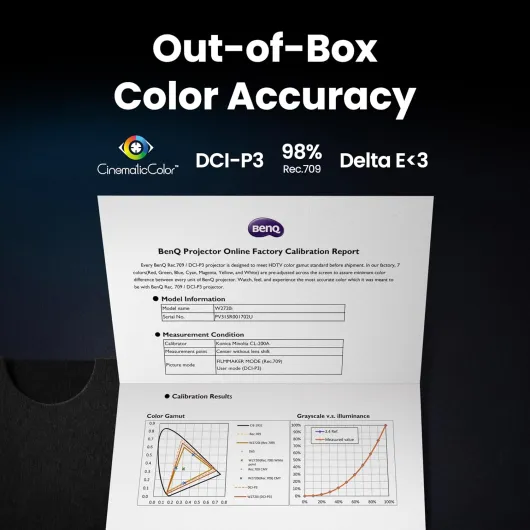
Image quality and home cinema performance
On paper, the performance focus of the W2720i is crystal clear: 4K sharpness, colour accuracy, and HDR handling. The projector offers native 3840 × 2160 resolution, which is proper 4K UHD. For large screens up to 200 inches, this should keep images detailed, especially with good 4K sources. Several positive reviews highlight the “Super Bild” and specifically mention that even 1080p content looks very good, which suggests that the internal upscaling does a solid job. For everyday use with Blu‑rays or streaming services that are often 1080p, that’s important.
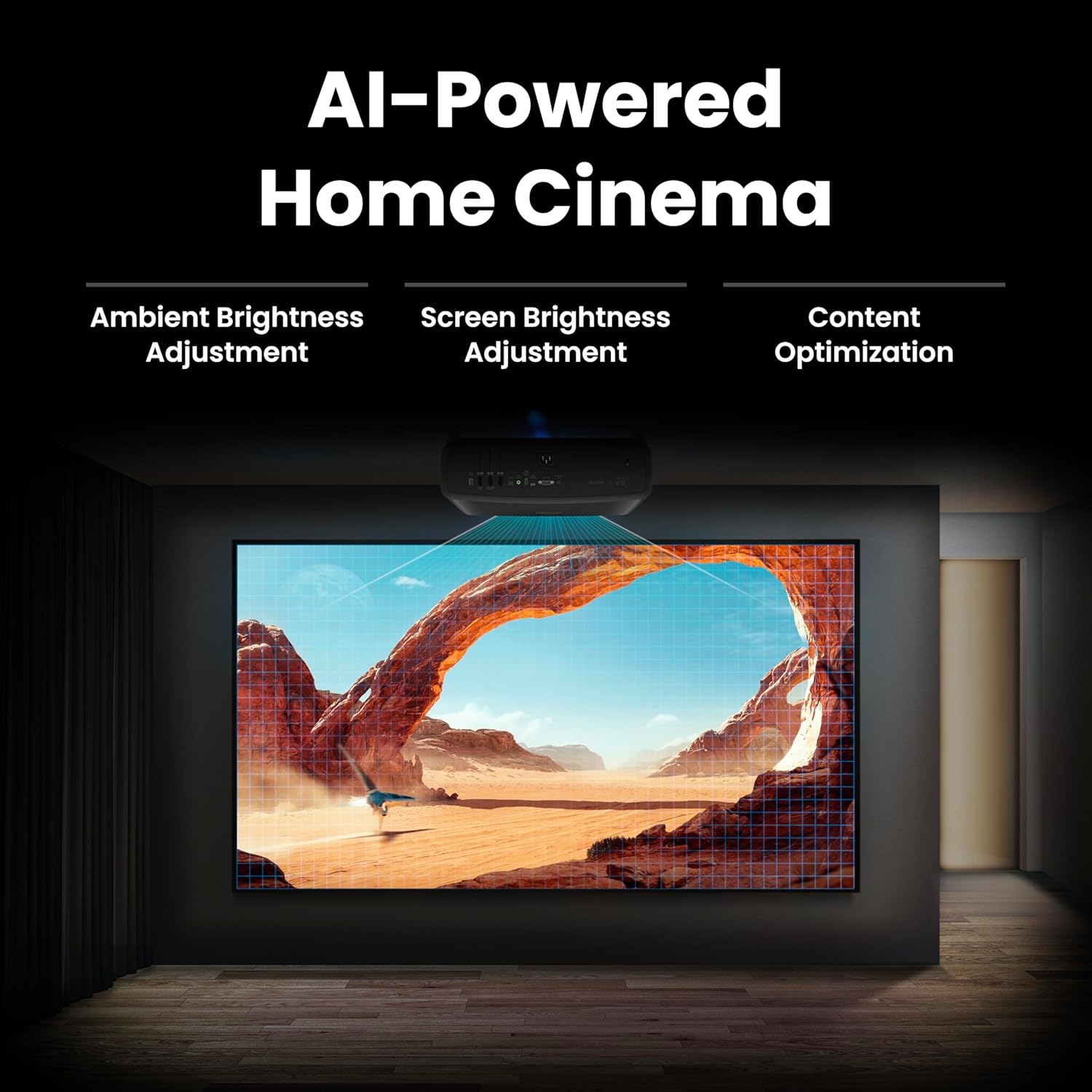
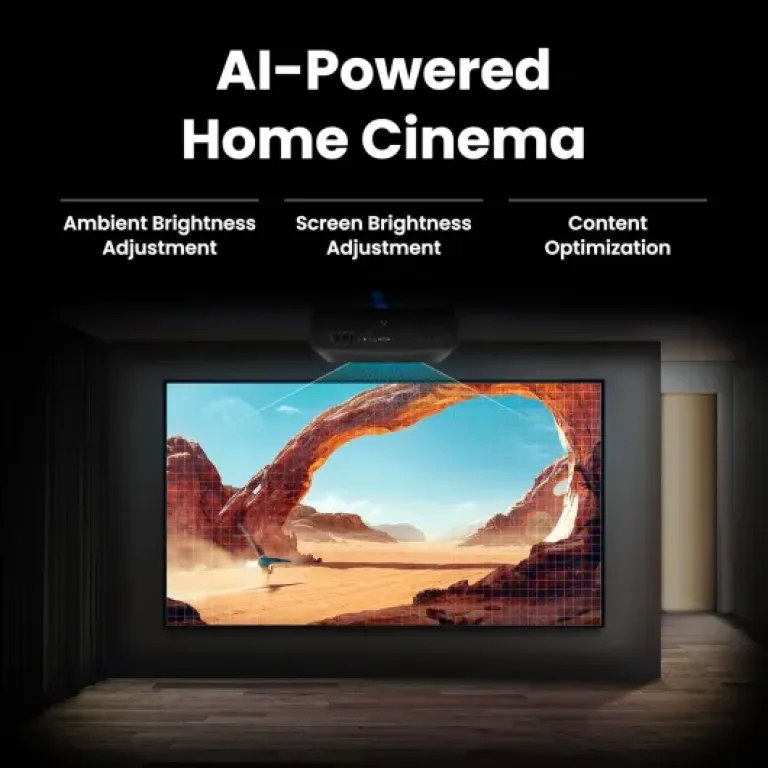
The big marketing argument is CinematicColor calibration: BenQ claims 90% DCI‑P3 and 98% Rec.709 coverage with Delta E < 3. Those numbers, if accurate, mean colours should be both wide and accurate enough for film content, with small visible deviations from reference. For a home theater projector in this category, that’s a serious selling point. The AI Cinema Mode adds another layer by adapting colours to ambient light and scene content. While it’s hard to know precisely how aggressive that is without lab measurements, the intention is to keep the image watchable and punchy in less‑than‑perfect dark rooms.
Brightness is advertised at 2500 ANSI lumens. In my opinion, this is a good but not extreme value: it should be fine in a dark room and usable in a slightly lit living room, but it’s not meant to overcome daylight on a white wall. For a dedicated home cinema, that’s acceptable, especially when combined with LED, which tends to maintain brightness better over time than traditional lamps. The 2,000,000:1 contrast ratio is a dynamic figure, but it at least indicates some form of dynamic contrast or light modulation, which can help HDR content look punchier with deeper blacks, as long as the implementation avoids pumping or visible brightness shifts.
From the small pool of reviews, the feedback around image performance is mostly positive. Comments like “Herrvoagende Bild Qualität und super Preis-Leistungs-Verhältnis” and “Super Bild, leicht einzurichten” show that people who received a working unit are generally happy with picture quality for the price. There are no detailed complaints about banding, rainbow effect or motion handling in the visible reviews, which doesn’t mean those issues are impossible, but at least they are not recurring complaints. In my opinion, if your priority is cinema-oriented 4K image quality with accurate colours and you plan to use it mainly in a dim room, the W2720i looks strong. If you need a projector that fights bright daylight or serves as a presentation beamer in lit offices, 2500 lumens and the home-cinema tuning might feel limited.
What the BenQ W2720i offers on paper
The W2720i is a 4K UHD (3840 × 2160) LED projector designed for home cinema. It uses an LED light source rated at 30,000 hours of average lifespan, which should, in theory, outlast many traditional lamp-based projectors and reduce maintenance costs. BenQ claims 2500 ANSI lumens of brightness, which is decent for dim or moderately controlled rooms, but not a light cannon for fully lit spaces. The contrast ratio is advertised at 2,000,000:1, a marketing figure typical of dynamic contrast, but it at least indicates a focus on perceived black levels and HDR handling.
On the video processing side, the device supports HDR10, HDR10+ and HLG, plus AI Cinema Mode. This AI feature is supposed to adapt colours based on both ambient light and scene content. In theory, that should help keep contrast and saturation under control whether you’re watching a dark movie at night or a brighter TV show during the day. The spec sheet also lists support for H.264 and H.265 encoding, which covers most modern streaming and downloaded content.
Connectivity is quite complete for a home cinema hub. You get three HDMI 2.1 ports (HDCP 2.3), which is enough for a streaming stick, a console and perhaps a Blu‑ray player without needing a switch. There’s also SPDIF and eARC for audio, USB 2.0 (Type‑A) and Mini USB 2.0 (Type‑B) for service or media, plus built‑in Android TV to run apps. The inclusion of eARC with Dolby Atmos pass‑through means it should work cleanly with modern soundbars or AV receivers that handle 7.1‑channel sound.
Physically, the projector weighs 5.1 kg and measures 42 × 30.5 × 14.3 cm, so it’s more of a semi‑permanent home cinema box than a portable toy. It supports image sizes up to 200 inches, with a minimum throw distance of 0.67 m and a maximum of 5.76 m, and has digital keystone correction and auto screen alignment to help setup. In my opinion, this is a fairly complete feature set for a 4K LED home cinema projector, with the main selling points being long LED life, strong colour promises, and solid connectivity rather than raw brightness or ultra‑short throw design.
Everyday use: brightness, smart features and audio integration
Effectiveness here means: does the W2720i get the home‑cinema job done in real living rooms? On paper, the combination of 2500 ANSI lumens, 4K resolution and AI Cinema Mode should allow it to handle typical movie nights and TV series in dim environments without much fuss. Several buyers confirm that the image is “Super Bild” and that the projector is “leicht einzurichten”, which suggests that, for non‑experts, it does what it’s supposed to do with minimal tweaking. One review also mentions that it is quiet and barely gets warm, which is a big plus if the projector sits close to the audience.
Smart features are handled by Android TV, which turns the projector into a standalone streaming device. That means you can install popular apps (subject to regional availability) and watch directly without an external box. For many users, that’s enough to turn it into a main TV replacement. However, as with all Android TV projectors, app support and updates can vary over time, so people who care about the best streaming experience often still plug in a dedicated streamer (Apple TV, Fire TV, etc.) using one of the three HDMI 2.1 ports.
Audio integration is clearly a strong point: eARC with Dolby Atmos pass-through and SPDIF allow the W2720i to forward high‑quality audio to an AV receiver or soundbar. The spec mentions support for 7.1‑channel sound, which means you can build a full surround system around it without audio bottlenecks. There is a built‑in speaker, but the sheet doesn’t boast about its power, and buyers hardly mention it, so in my opinion it’s best seen as a backup rather than your main sound solution. For a real cinema feel, pairing this with at least a decent soundbar is almost mandatory.
In daily use, the projector’s auto screen alignment and digital keystone correction should help if you can’t position it perfectly. That said, relying too much on digital keystone usually reduces effective resolution and can introduce artifacts, so it’s still better to align the projector physically as well as possible. Overall, the feedback from satisfied buyers plus the spec sheet point to a competent, easy‑to‑live‑with home cinema machine for people who mainly watch in the evening and have or plan a separate audio system. The main caveat is that its brightness and home‑cinema tuning make it less suited to bright, multi‑use rooms where lights are always on.
Pros
- 4K UHD resolution with strong colour specs (90% DCI-P3, 98% Rec.709, Delta E < 3) for cinema-oriented image quality
- Long-life 30,000-hour LED light source and 3-year manufacturer warranty
- Good connectivity with 3× HDMI 2.1, eARC with Dolby Atmos pass-through, SPDIF and built-in Android TV
Cons
- Mixed reliability perception due to at least one reported early failure in a small review sample
- 2500 ANSI lumens may be limited for bright rooms or daytime viewing
- Built-in speaker is basic, so a separate audio system is almost mandatory for a proper cinema experience
Conclusion
Analysis score
The BenQ W2720i positions itself as a serious 4K LED home cinema projector with a strong focus on colour accuracy and long-term use. On paper, it checks many boxes: 4K UHD resolution, 2500 ANSI lumens, a 30,000‑hour LED light source, support for HDR10/HDR10+/HLG, and factory calibration targeting 90% DCI‑P3 and 98% Rec.709 with Delta E < 3. Add Android TV, three HDMI 2.1 inputs, and eARC with Dolby Atmos pass-through, and you get a fairly complete hub for movies, series and games in a dim home cinema environment.
In practice, the small pool of reviews suggests that image quality, noise level and ease of setup are clear strengths. Owners who got a good unit are very positive about the picture and consider the price–performance ratio solid. The flip side is a worrying but isolated report of a unit failing after a short period, plus a complaint about receiving a returned item sold as new. That doesn’t condemn the product outright, but it does mean you should pay attention to the 3‑year warranty, retailer reputation, and early testing after purchase.
In my opinion, the W2720i is a good fit for home cinema fans who want accurate colours, 4K sharpness, and straightforward integration with a modern sound system, and who mainly watch in the evening or in controlled light. It’s less suited to bright multi‑purpose rooms or buyers who are extremely risk‑averse and prefer models with a long, spotless reliability track record. If you’re okay with that trade‑off, the W2720i offers a convincing combination of features and performance on paper, with the caveat that quality control and after‑sales support become part of the buying decision.