Summary
Analysis score
Average of the criteria rated below
Value for money: dual-zone features without premium pricing
Design and usability: built-in look, a few quirks
Materials and build: heavy, solid cabinet with basic wood racks
Packaging, installation and everyday practicality
Durability, reliability and daily handling
Cooling performance and noise: what buyers report
What this Ca'Lefort wine fridge offers on paper
Pros
- Dual-zone cooling (40–65°F) with fairly stable temperatures and quiet compressor, according to buyers
- Built-in or freestanding design with front venting and a 24" footprint that fits standard under-counter spaces
- Good capacity for the size (around 46 bottles) with removable wood shelves and tri-color LED interior lighting
Cons
- Shelves are not height-adjustable, don’t fully extend, and wood finish is basic compared with high-end units
- Controls are inside the door and there is no door lock, which reduces convenience and security in some settings

Specifications
View full product page →| Brand | Ca'Lefort |
A 46‑bottle dual‑zone wine fridge that’s getting a lot of attention
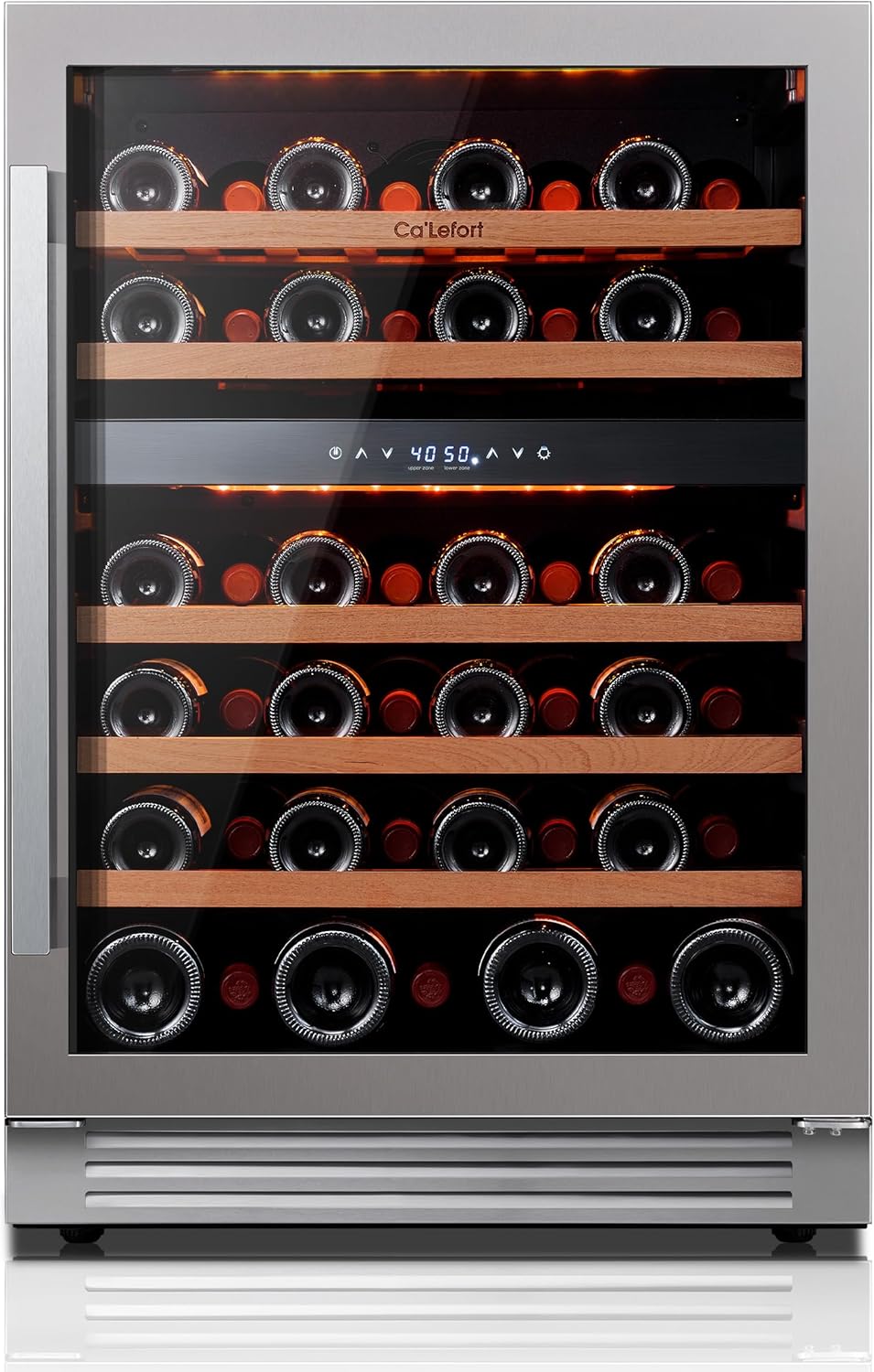
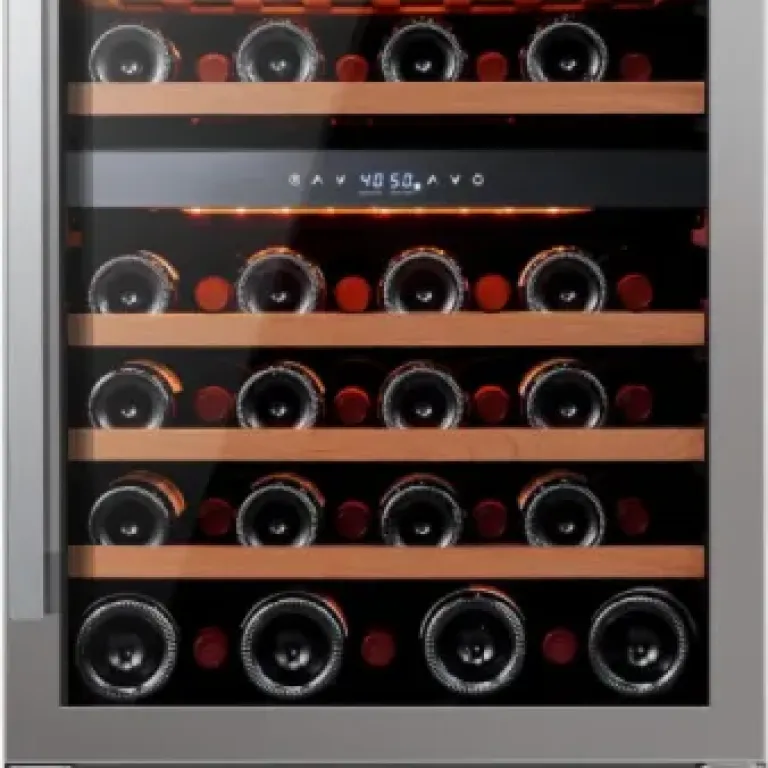
The Ca'Lefort 24-inch dual-zone wine fridge sits in a crowded segment: 46-bottle coolers that can be built into cabinetry or used freestanding. On paper, it checks most of the boxes wine drinkers look for: dual temperature zones from 40–65°F, space for around 46 standard bottles, a glass door with UV protection, and wood shelves in a stainless steel cabinet sized to slide under a counter (roughly 23.4"D x 23.8"W x 33.8"H). It’s also ETL certified and front-vented, which matters if you want a clean built-in look.
What stands out in the public reviews is a mix of aesthetics and practicality. Several buyers point to the quiet operation, decent temperature stability, and the overall look—brushed stainless, wood racks, and three selectable LED colors (amber/blue/white). Others emphasize that it feels like a solid, heavy unit (around 100 lbs empty) and that the packaging is very protective, even if that makes it a bit of a hassle to unpack.
There are also a few small criticisms that come up: shelves that don’t pull out fully, controls located inside the door, no door lock, and wood racks that some people find a bit basic in finish. None of these are deal breakers for most buyers, but they are worth knowing before you commit. With an average rating of about 4.5/5 over more than 300 reviews, the general mood is clearly positive, yet not blind to the compromises.
In my opinion, this cooler positions itself as a good value workhorse for people who actually store and drink wine regularly, rather than a high-end showpiece. If you want a dual-zone, under-counter-capable fridge that looks decent and doesn’t cost like a premium European brand, this one deserves a close look. If you’re extremely picky about shelf mechanics, locking doors, or ultra-luxury finishes, you may find a few points of frustration.
Value for money: dual-zone features without premium pricing
In terms of value, the Ca'Lefort 24" dual-zone fridge positions itself as a mid-range, feature-rich option rather than a luxury showpiece. It offers dual temperature zones, a 40–65°F range, real wood shelves, a stainless steel and glass build, front venting for built-in use, and a capacity around 46 bottles. On top of that, you get three-color LED lighting, automatic defrost, ETL certification, and power failure memory. That’s a fairly complete spec sheet for a 24" under-counter wine cooler.
Several buyers openly compare it to better-known brands and conclude that it provides “great product for the money” and “great value.” People who spent time researching alternatives mention that many competitors with similar capacity and dual-zone features are priced higher, especially once you add the built-in-friendly front vent and stainless door. The fact that this unit ranks highly in categories like “Freestanding Wine Cellars” and “Beverage Refrigerators” also suggests that plenty of people are choosing it over more established names.
The compromises that help keep the price in check are clear: no Wi‑Fi or app control, no lock, shelves that are not on full-extension rails and not height-adjustable, and wood racks that some consider a bit basic in finish. For many home users, these are acceptable tradeoffs, especially if the core performance (temperature stability and noise) is solid, which is what the reviews indicate. If you’re building a high-end custom wine room or want a unit that screams luxury in every detail, you might lean toward more expensive brands with smoother shelf mechanics and a more polished interior.
In my opinion, for someone wanting a dual-zone, under-counter-capable fridge to store a mixed collection of reds, whites, and some sparkling wines, this Ca'Lefort delivers strong value. You’re paying for functional features and capacity rather than brand prestige or smart connectivity. As long as you’re aware of the limitations—no lock, internal controls, slightly basic shelves—the balance between price, features, and reported performance looks good. That’s why a 4/5 value score feels justified: not perfect, but clearly competitive and attractive for many buyers.
Design and usability: built-in look, a few quirks
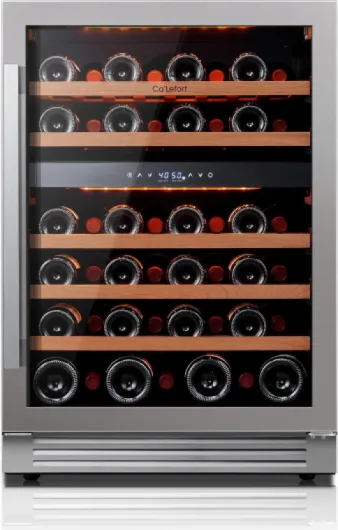
From a design perspective, the Ca'Lefort cooler aims for a clean, built-in aesthetic. The brushed stainless steel door frame and matte finish body are fairly neutral, so it should blend with most modern kitchens and bar areas. Several buyers explicitly say it “looks beautiful” and “looks great” between living and dining spaces, which suggests the industrial-style stainless and glass combo works well in real homes, not just in product photos. The front venting grille is low-profile, and the unit’s height (below 34") is intentionally kept manageable to fit under standard counters.
The glass door is double-glazed with UV protection and is described as having good sealing. That matters both for temperature stability and for protecting wine from light exposure, especially if the unit sits in a bright room. One reviewer wished for an extra UV film layer, which hints that while there is some UV protection, it may not be at the level of heavily tinted or triple-glazed premium doors. Still, for indoor placement away from direct harsh sun, the current setup should be adequate for most users.
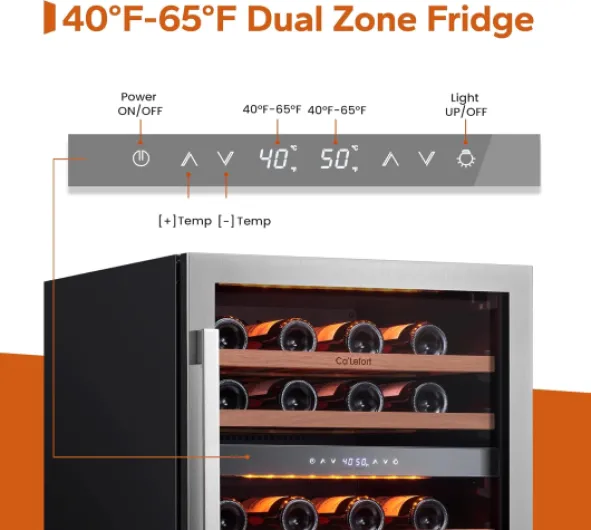
Usability-wise, a couple of design choices draw mixed reactions. The controls are located inside the cabinet, so you have to open the door to adjust temperature or lighting. Some see this as a minor annoyance, especially if you tweak settings often or want to turn the light on/off for display without letting warm air in. The shelves ride on simple runners and do not pull out completely, which makes it a bit harder to read bottle labels at the back. One buyer mentions this specifically as a quibble, not a deal breaker. The shelves also are not adjustable in height, which simplifies the internal structure but limits customization for very odd bottle sizes.
The lighting is a design highlight. Multiple reviews mention the LEDs adding a “beautiful nuance” and appreciate the ability to choose between three colors. That’s largely cosmetic, but for a unit that may sit in a living area or open kitchen, visual impact matters. In my view, the design overall is practical and fairly restrained: no flashy branding, a standard right-hand hinge, and a look that aims to blend in rather than dominate. The tradeoffs—internal controls, partial shelf extension, no lock—are typical at this price level and won’t bother everyone, but they’re worth keeping in mind if you’re picky about day-to-day ergonomics.
Materials and build: heavy, solid cabinet with basic wood racks
On the materials side, the Ca'Lefort fridge is built around a stainless steel and glass structure with wood shelves. The door frame and exterior are listed as brushed stainless steel, which should resist fingerprints better than polished finishes and offer decent corrosion resistance in a kitchen environment. Several buyers describe the construction as “sturdy” and note that the unit is quite heavy—around 100 lbs empty. That weight suggests a substantial cabinet, proper insulation, and a full compressor system rather than a lightweight thermoelectric design.
The door uses double-layer tempered glass with UV protection. Tempered glass is standard for safety, and the double glazing should help with both insulation and noise. A good seal is repeatedly mentioned in the marketing description, and one reviewer points out that the door feels solid, though they would have liked an additional UV film. For most indoor installations, this kind of door should be more than adequate, but if someone plans to place it in a sun-drenched area, a darker tint might be preferable. There’s no mention of soft-close hinges or reversible doors, so this is a relatively straightforward hardware setup.
Inside, the shelves are made of sapele wood, a hardwood often used as a more economical alternative to mahogany. Reviews describe them as attractive and lightweight. One person calls them “nice quality,” while another says they feel a bit “unfinished/cheaper” in comparison to higher-end units. That contrast is typical in this price band: you get real wood, but you shouldn’t expect luxury joinery or thick, lacquered planks. The shelves are removable, which helps with cleaning or making extra space for large bottles, but they don’t appear to sit on ball-bearing slides, which limits how far they can extend.
Overall, the material choices make sense: stainless steel for durability and a neutral look, tempered glass for safety and insulation, and wood racks to avoid clanking bottles against metal. In my opinion, the build sounds solid where it counts—the cabinet, door, and compressor—while the shelves are a clear area where cost has been controlled. For the price bracket this cooler sits in, that’s a reasonable tradeoff, but buyers expecting ultra-premium shelf hardware and finishes may find them a bit basic.
Packaging, installation and everyday practicality
Packaging is one area where this fridge consistently gets praise. Several buyers emphasize that it arrives very well protected, with one person saying the packaging was so robust that it was actually hard to get the unit out. Another notes that theirs showed up via a somewhat rough delivery service but still had no damage, which suggests the foam, cardboard, and internal bracing are doing their job. For a 100 lb glass-front appliance, overkill packaging is preferable to the alternative.
Because of that weight, installation is not a one-person job for most people. One reviewer mentions that “unless you’re a very large man” you’ll need two people to move it any distance. That’s worth planning for if you’re sliding it into a tight built-in space or carrying it up stairs. The manufacturer’s instructions tell you to let the fridge rest for 24–36 hours before turning it on, so the refrigerant and compressor oil can settle. A buyer who spent time researching coolers underscores the importance of this step, which is standard guidance for compressor-based units but often ignored.
Once installed, day-to-day practicality is mostly positive with a few minor compromises. Shelves are easy to pull out as long as you support them with both hands when they’re loaded, since they’re carrying a lot of weight. Owners comment that the fridge runs quietly and doesn’t noticeably impact their electricity bill, which is important if it sits in a main living or dining area. The tri-color LED lighting is a small but appreciated touch, letting you choose a color that fits your room or mood.
On the downside, there is no door lock, which a few users mention they would have liked, especially for units installed in more public areas or homes with curious kids and guests. The internal control panel also means you have to open the door to adjust settings or turn the light on and off, which is slightly less convenient than having external controls. In my opinion, though, these are predictable tradeoffs at this price level. The big picture is that the fridge arrives in good shape, installs like a typical under-counter appliance, and seems straightforward to live with, as long as you’re okay with the lack of a lock and the need for two people during setup.
Durability, reliability and daily handling
Durability is always tricky to judge early, especially for a product whose current reviews mostly cover the first months of ownership. That said, there are some signs that the Ca'Lefort unit is built with longevity in mind. First, the weight and cabinet construction repeatedly come up: one buyer calls it “sturdy” and notes it’s about 100 lbs empty, which usually indicates thick panels, proper insulation, and a full-size compressor. Another mentions that it feels like a “big boy cooler” in how it behaves, hinting at a more substantial build than compact, ultra-light models.
Packaging quality is also highlighted by multiple buyers. People mention that it arrives very well protected, to the point where it’s actually a bit of work to unpack. That may sound trivial, but careful packaging reduces the chances of shipping damage that can shorten the life of compressors or lead to misaligned doors. The seller recommends letting the unit sit for 24–36 hours before powering it on so the compressor oil can settle, and at least one reviewer repeats this advice, which shows that the brand is following standard best practices for compressor appliances.
On the moving parts side, the shelves and door are where wear and tear will show up first. Shelves are wooden and slide on simple runners; users mention that they pull out easily but need to be kept balanced with two hands when fully loaded, since they don’t extend all the way. That’s more a usability point than a durability red flag, but it does mean you should be gentle when pulling them out with many bottles onboard. There are no widespread reports of shelves breaking or rails bending. The door hinges are standard, with no soft-close mechanism mentioned, so careful handling will help avoid sagging over time.
The brand offers 12 months of product support, which is fairly basic but at least gives you a safety net for early failures. There’s no long-term data yet about five- or ten-year lifespan, but buyer comments so far don’t show a pattern of early breakdowns or leaks. In my opinion, the durability outlook is cautiously positive: heavy cabinet, decent hardware, and a conventional compressor design that should be serviceable if needed. It doesn’t scream ultra-premium longevity, but nothing in the feedback suggests it’s fragile either, as long as the shelves and door are handled sensibly.
Cooling performance and noise: what buyers report
Performance-wise, the Ca'Lefort fridge uses a compressor-based system with automatic defrost and forced air circulation. The advertised temperature range is 40–65°F, adjustable in 1°F increments via a digital panel. This range covers typical serving and storage temperatures for most wine styles, from chilled whites and sparkling at the low end to cellar-temperature reds in the mid-50s. One detailed review mentions a small gradient of about 2–3°F between top and bottom at a set point of 53°F, which is entirely normal in multi-shelf wine coolers and actually useful if you want slightly different micro-zones within one compartment.
Several buyers say that the temperatures “seem to be accurate” and that the unit “works perfectly.” One person specifically notes that it cooled down quickly even when loaded with about 20 room-temperature bottles. There are no recurring complaints about major temperature swings or zones not holding their settings, which is a good sign. The power failure memory feature should also help maintain consistency after outages, reducing the risk of your wines sitting at the wrong temperature for hours if you’re not home.
Noise is a common concern with built-in appliances, and here the feedback is quite positive. Multiple reviews use words like “quiet” and “surprisingly quiet,” including from someone who replaced a thermoelectric cooler, which is typically very low-noise. Owners who have the fridge in dining or open-plan living areas report that it does not disturb conversation and that they haven’t seen a noticeable impact on their electric bill. That suggests the compressor cycles are reasonably efficient and not excessively loud.
In my opinion, the performance picture is solid: stable temperatures suitable for proper wine storage, dual zones that appear to behave as expected, and noise levels that fit well in social spaces. It’s not a lab-grade cellar with precise humidity control or multi-layer climate management, but for a 46-bottle home unit, the performance described by buyers is more than adequate. The main limitations are typical of the category: slight temperature stratification between shelves and a bit of compromise when mixing very large and standard bottles in the same zone.
What this Ca'Lefort wine fridge offers on paper
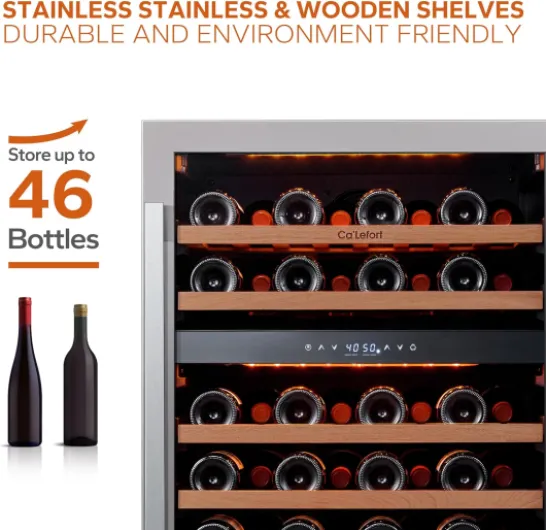
The Ca'Lefort CLF-WD24-A is a 24-inch, 5.65 cu.ft wine refrigerator designed for both built-in and freestanding use. The official dimensions (about 23.43 x 23.82 x 33.86 inches) are standard for a 24" under-counter slot, and the front venting means it can sit flush in cabinetry without suffocating the compressor. It’s a freezerless configuration focused purely on wine storage, with a single right-hinged stainless steel door and a double-layer tempered glass panel that includes UV protection. The stated capacity is 46 standard 750 ml bottles, split across five wooden shelves plus the bottom area.
The key functional feature is the dual-zone temperature control, covering 40–65°F with 1°F increments via a digital panel. That range is wide enough to run one zone cooler for whites and sparkling wines and the other a bit warmer for reds. Buyers mention using the bottom zone as the cooler one, which fits the usual behavior of similar compressors and airflow layouts. Ca'Lefort also highlights a power failure memory feature that restores your previous settings after an outage, which is a small but useful detail if your area gets occasional power blips.
Inside, the shelves are made of sapele wood, are removable, but not height-adjustable according to one detailed review. That means the internal layout is optimized around standard Bordeaux/Burgundy bottles, while larger champagne bottles need to go on the top rack or the bottom "floor" space. One buyer notes they can fit more champagne bottles than the spec suggests (they manage around five at the bottom), which implies the 46-bottle claim is conservative if you’re flexible with how you stack. The interior lighting can switch between three LED colors—amber, blue, and white—mainly for ambiance and visibility.
The manufacturer lists automatic defrost, ETL certification, and a 12-month product support window. There’s no mention of a door lock, Wi‑Fi, or app control. In my opinion, this places the product in a mid-range, practical category: strong basics, no smart features, and a focus on capacity, dual zones, and a built-in-friendly design rather than tech gimmicks. If you want a straightforward wine fridge with enough flexibility for a mixed collection, the spec sheet lines up well with that use case.
Pros
- Dual-zone cooling (40–65°F) with fairly stable temperatures and quiet compressor, according to buyers
- Built-in or freestanding design with front venting and a 24" footprint that fits standard under-counter spaces
- Good capacity for the size (around 46 bottles) with removable wood shelves and tri-color LED interior lighting
Cons
- Shelves are not height-adjustable, don’t fully extend, and wood finish is basic compared with high-end units
- Controls are inside the door and there is no door lock, which reduces convenience and security in some settings
Conclusion
Analysis score
The Ca'Lefort 24" dual-zone wine fridge comes across as a solid, practical choice for people who care more about storing wine properly than showing off a prestige brand. It offers a good mix of features: dual zones from 40–65°F, space for around 46 bottles, front venting for built-in or freestanding use, and a stainless/wood/glass look that fits easily into modern kitchens and living spaces. Public reviews consistently highlight quiet operation, decent temperature stability, and strong packaging, which are exactly the basics you want from a wine fridge in this size.
It’s not flawless. The shelves don’t pull out fully and aren’t adjustable in height, the controls sit inside the door, and there’s no lock. The wood racks, while functional and visually fine, won’t impress someone used to high-end, fully finished cabinetry. But those compromises are understandable given the price positioning, and most buyers calling them out still rate the fridge highly overall. The heavy cabinet and compressor-based design suggest a machine built for everyday use rather than minimalism, and the 12-month support window provides at least a basic safety net.
In my view, this fridge is a good match for: homeowners finishing a bar or kitchen who want a dual-zone, under-counter unit; wine drinkers who keep a mixed collection of reds, whites, and a few sparkling bottles; and anyone who wants quiet operation in a shared living space without paying a premium-brand markup. People who should probably look elsewhere are those who need a locking door, ultra-luxury finishes, app control, or fully customizable shelving for unusual bottle sizes. Overall, as an all-rounder for home wine storage, it earns a solid 4/5 from an analysis of its specs and customer feedback.