Summary
Analysis score
Average of the criteria rated below
Value for money: where the M2 Plus sits in the market
Design and navigation: compact LiDAR robot with obstacle avoidance
Battery life and self-emptying base: real convenience or just numbers?
Build, reliability and long-term use according to buyers
Cleaning performance: strong suction with some carpet limits
What the Lefant M2 Plus actually offers
Pros
- Self-emptying base advertised for up to 75 days reduces maintenance significantly
- Strong 6000Pa suction and LiDAR navigation give effective, structured cleaning on hard floors
- Good feature set for the segment: dual-band Wi‑Fi, app with no-go zones, voice control, carpet detection and auto-resume
Cons
- Carpet pickup, especially for fluff and deeper dirt, is only moderate according to some buyers
- Mopping is light-duty and won’t replace manual scrubbing for tougher stains

Specifications
View full product page →| Brand | Lefant |
A self-emptying robot vacuum that aims to take over your floors
The Lefant M2 Plus positions itself as a fairly complete robot vacuum and mop for people who want to stop worrying about daily floor cleaning. On paper, it combines several features that usually sit in the mid-to-upper range: a self-emptying base announced for up to 75 days of hands-free use, 6000Pa suction, LiDAR navigation, obstacle avoidance and both 2.4 GHz and 5 GHz Wi‑Fi. The average rating sits at around 4.3/5 from more than 5,000 published reviews, which suggests that most buyers are satisfied, even if it’s clearly not flawless.
The spec sheet targets mixed homes with hard floors and carpets, with a 3200 mAh battery and an advertised runtime of up to 140 minutes to cover about 140 m². It vacuums and mops in one go thanks to a 300 ml water tank and app-controlled water flow. Voice control through Alexa and Google Assistant is supported, plus a companion app that lets you draw no-go zones, schedule cleanings, and tweak suction per room. On paper, it tries to check most boxes people look for in a modern robot vacuum.
In the reviews, several verified buyers highlight that it “cleans floors brilliantly”, “leaves floors amazingly clean”, and that installation is straightforward. Others mention that it still picks up extra dirt even after a manual hoovering, which indicates the suction and coverage are not just marketing. There are also some nuances: one buyer notes that it works better on tile than on carpet, and that fluffy debris on carpet may be picked up only when it happens to line up with the suction opening.
In my opinion, this puts the M2 Plus in a realistic zone: strong on features and generally effective, but not magic. It looks like a solid tool to reduce daily cleaning effort, especially in homes with hard floors and pets, as long as expectations on carpets and obstacle handling stay reasonable. The rest of the analysis digs into where it shines and where it’s just decent for the price.
Value for money: where the M2 Plus sits in the market
With a Best Sellers Rank of 11 in Robotic Vacuums and an average rating of 4.3/5 from 5,000+ reviews, the Lefant M2 Plus clearly has found an audience. The exact price isn’t listed here, but given its feature set—self-emptying base, 6000Pa suction, LiDAR navigation, dual-band Wi‑Fi, app and voice control—it competes with mid-range models from bigger brands that often cost noticeably more. Several buyers call it “well worth the money”, “good value for money” or a “steal with the discount code”, which gives a rough idea that people feel they are getting a lot of features for what they paid.
Where the M2 Plus really scores on value is the combo of self-emptying and LiDAR. Many robots at entry-level prices either skip LiDAR (using random navigation) or skip the self-emptying dock. Here, both are present, along with mopping and carpet detection. For someone who wants near full automation—schedule it and mostly forget it for weeks—this combination is very attractive. The trade-off is that it’s still not a miracle worker on carpets, and the mopping is more for maintenance than deep cleaning. If you expect it to fully replace a strong manual vacuum on thick rugs, you may be disappointed.
In my opinion, the real sweet spot is for mixed hard-floor homes, maybe with pets, where the main pain point is daily dust and hair. For that use, the M2 Plus’s spec sheet looks strong, and buyer comments about effective cleaning and reduced workload back that up. People with mobility issues or chronic pain also seem to appreciate the reduction in manual housework; one review from a person with multiple types of arthritis highlights how it helped shift cleaning duties off their partner, which is a very concrete benefit.
There are of course more advanced robots on the market with auto-wash mop systems, better carpet agitation, or smarter object recognition, but they usually cost quite a bit more. On the flip side, cheaper robots often lack mapping, self-emptying or decent suction. In my opinion, the M2 Plus sits in a balanced middle ground: not top-tier, but feature-rich for its likely price bracket, with enough positive feedback to justify considering it if you want a capable, mostly hands-off cleaner without jumping to premium price levels.

Design and navigation: compact LiDAR robot with obstacle avoidance
On design, the Lefant M2 Plus sticks to the classic round robot vacuum shape in a black finish, with the LiDAR turret on top. At around 32 x 32 x 9.5 cm, it’s relatively slim for a LiDAR robot, which should help it get under some sofas and low furniture where tower-style models sometimes struggle. The black color is neutral and will blend in most interiors; nothing flashy here, which in my opinion is a good thing for an appliance that lives on the floor.
The more interesting part of the design is the navigation hardware. The LiDAR sensor on top is responsible for building maps and planning efficient routes, while 190° wide-angle sensors and full-body scanning handle obstacle detection. The brand claims collisions are reduced by 95%, which is obviously a marketing number, but the combination of LiDAR and proximity sensors usually gives smoother movement than basic bump-and-go robots. Several reviews mention that it “smoothly navigates around furniture, toys, and tight spaces”, with fewer random bumps than simpler models, though there are occasional reports of it getting stuck in difficult spots and sending a notification asking for help.
The base station is larger than a simple charging dock because it contains the self-emptying system and dust bag. That means you need to dedicate a bit of wall space with some clearance around it so the robot can dock easily. Reviews highlight that the robot generally finds the charger easily, which suggests the docking system and base design are well thought out. However, as with most self-emptying robots, you have to accept a slightly bulkier object in your hallway or living room compared to a small, flat dock.
In my opinion, the design is functional rather than stylish, which is exactly what this category needs. The combination of a relatively low profile, LiDAR turret, and wide-angle sensors should give decent access under furniture and around table legs, while the self-emptying base trades compactness for convenience. If you want something ultra-discreet, a non-self-emptying model would be smaller, but you’d lose the 75-day hands-free promise.
Battery life and self-emptying base: real convenience or just numbers?
The Lefant M2 Plus is equipped with a 3200 mAh battery, with an advertised runtime of up to 140 minutes on a single charge and coverage of about 140 m². On paper, that’s enough for many average-sized UK homes, at least for a single level. Runtime depends heavily on suction level and how much carpet you have: running constantly at 6000Pa on thick carpet will drain it faster than using a standard mode on mainly hard floors. The robot also supports auto-resume, meaning it returns to the dock when the battery is low, recharges, then goes back to finish the job instead of restarting from scratch.
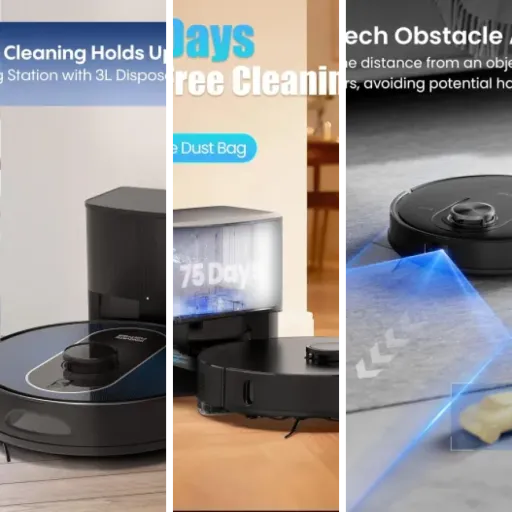
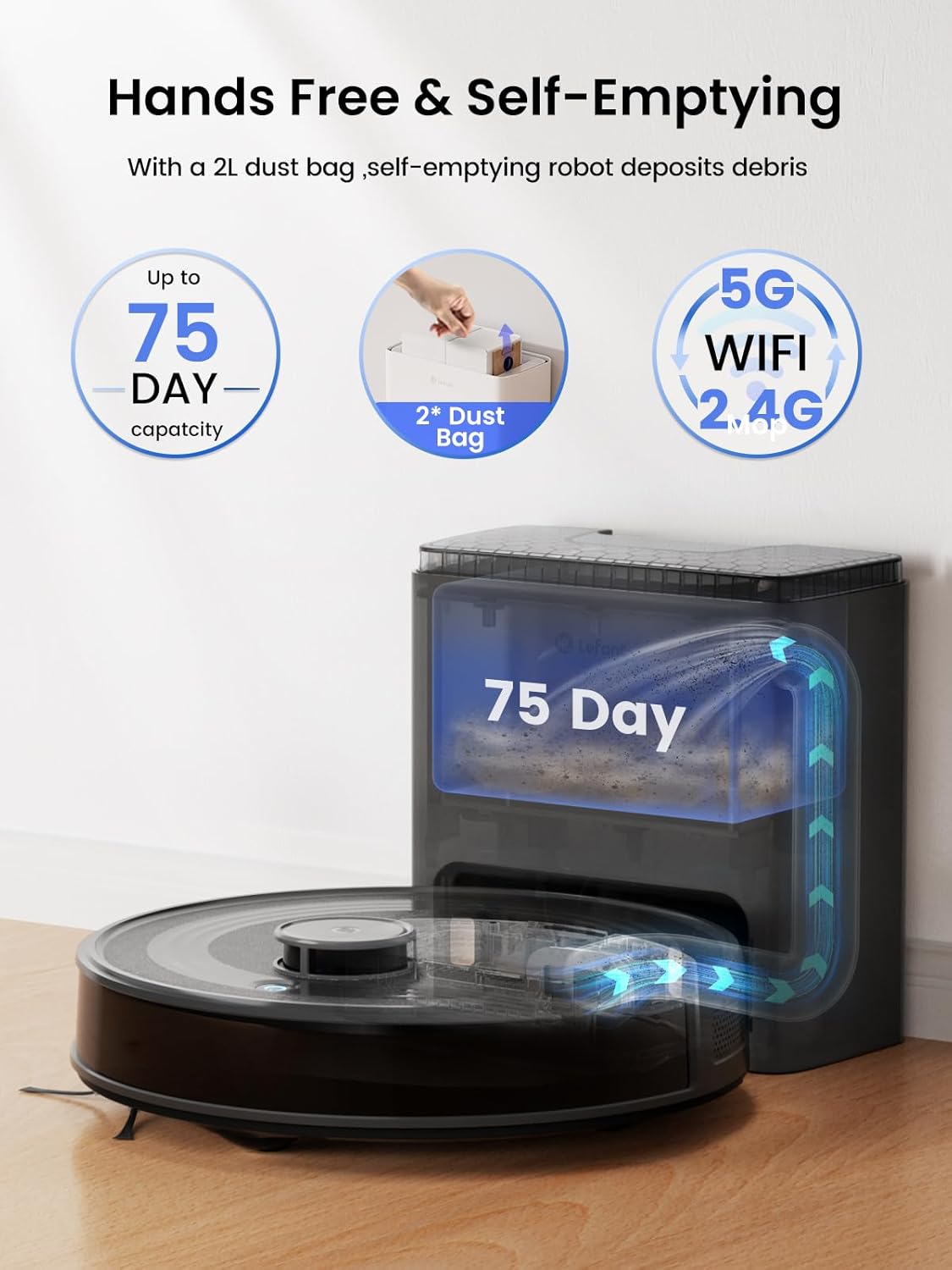
The more visible piece of convenience is the self-emptying base. The manufacturer claims up to 75 days of hands-free use thanks to a large dust bag in the base station. In reality, this number will depend on how often you run it and how dirty your home is. A home with multiple pets and daily cleaning will fill the bag faster than a small flat cleaned twice a week. Still, reviewers tend to appreciate self-emptying systems because they remove the chore of emptying a tiny bin after every cycle. One buyer specifically mentions that their partner “just pops it on and it does the whole downstairs” and returns to the base when low, which matches the advertised autonomous behavior.
Charging behavior seems predictable: several comments say it finds its charging bay easily. That suggests that the combination of LiDAR and IR guidance on the base works reliably. When it does get stuck in tricky spots, the robot sends a message asking for help, which is standard behavior but still useful so you don’t wonder where it disappeared. There are no detailed reports about full charge time, but for this battery size, several hours to full is typical.
In my opinion, the battery and base system are aligned with what you’d expect from a mid-range LiDAR robot. The headline “75 days hands-free” is optimistic marketing, but the real benefit is less frequent bin emptying and fewer interruptions mid-clean. If you have a large house with many carpets and want the robot to run on max power every time, you may see shorter runtimes and more frequent recharges. For small to medium homes with mixed floors, the combo of 140-minute claimed runtime and auto-resume should be enough for full coverage without much babysitting.
Build, reliability and long-term use according to buyers
On durability, there isn’t a detailed breakdown of components, but a few hints can be drawn from the form factor and feedback. The robot weighs a bit over 6 kg with the base included, which suggests a reasonably solid build and a proper self-emptying mechanism rather than a flimsy shell. The LiDAR turret and sensors are exposed on the top and sides like most robots, so they’ll rely on the obstacle avoidance system to avoid frequent hard impacts. The brand also claims a 95% reduction in collisions thanks to the 190° wide-angle sensors and full-body scanning, which, if roughly true in practice, should help protect furniture and the robot itself over time.
Among the published reviews, comments about reliability are mostly indirect: people praise consistency more than they describe failures. Several users mention that it “finds the charger easily” and that scheduled cleanings run as expected, which points to stable navigation software and charging contacts that don’t misalign too often. One buyer notes that it sometimes gets stuck in difficult places and sends a message asking for help; this is more about environment complexity than durability, but it does show that the robot is at least aware of its own limits and doesn’t just burn power spinning wheels.
The dust box is described as “easy to clean”, which matters for long-term maintenance. Easy access usually means less risk of people forcing parts and breaking clips. Consumables like the dust bag in the base, brushes and filters will need periodic replacement; this is standard for the category, but it’s worth factoring the ongoing cost and availability of spare parts. Lefant is a brand that already has other models on the market, so it’s reasonable to expect at least basic consumables to be findable, though that always depends on region.
In my opinion, nothing in the spec sheet screams ultra-premium robustness, but nothing looks worrying either. A 4.3/5 average from over 5,000 ratings suggests there isn’t a widespread reliability issue causing mass complaints. As with any robot vacuum, long-term durability will heavily depend on regular cleaning of sensors, brushes and the self-emptying channel. People with a lot of cables, high thresholds or very cluttered spaces may see more incidents and cosmetic wear simply because the robot has more chances to bump or get wedged. For a typical flat or house with some basic robot-proofing, the M2 Plus should hold up reasonably well.
Cleaning performance: strong suction with some carpet limits
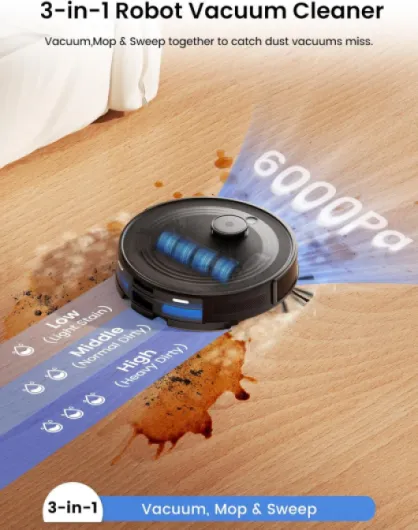
On cleaning performance, the 6000Pa suction is one of the strong points on paper. That figure is high compared with many entry-level robots that sit around 2000–3000Pa. Several buyers report that it “leaves floors amazingly clean” and that it still picked up extra dirt even after a manual hoovering. One review from a household with two large dogs mentions that keeping on top of pet hair is usually difficult, but that this robot picked up more than expected and did so quite thoroughly. That aligns with what you’d expect from 6000Pa plus a reasonably sized intake.
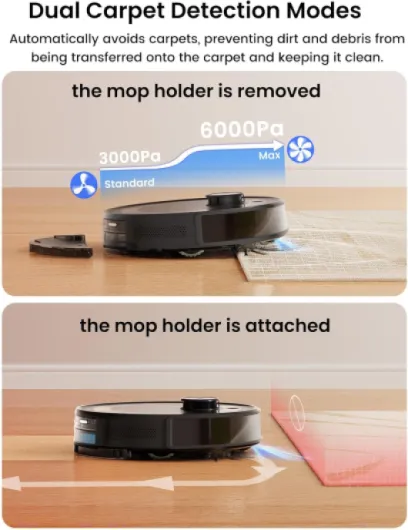
The robot supports carpet detection and carpet boost. When the mop holder is attached, it avoids carpets to keep them dry; when mopping is disabled, it automatically raises suction on carpets. This is a sensible approach: mopping on carpet is usually a disaster, and automatic boost helps pull more dust from fibers. However, one buyer notes that fluffy debris on carpets is only picked up when it lines up well with the suction opening, and that the robot works clearly better on tiled floors than on carpets. That’s not surprising: many robot vacuums struggle with deeper carpets or scattered, light debris, especially if they rely on a narrow intake instead of a full-width roller brush.
The mopping function uses a 300 ml water tank with three adjustable flow levels via the app. Reviews describe the mopping as a useful maintenance step rather than a deep scrubber. That’s typical for this category: it’s mainly for dust, light stains and footprints, not dried-on spills. Being able to set different water levels per room is handy if you have, for example, tile in the kitchen and laminate in the living room where you might want less moisture.
Noise is mentioned by one buyer who says it “could be quieter on quiet mode”, while admitting they are being “incredibly picky”. So it’s probably in the usual robot vacuum range: audible, but not absurdly loud. In my opinion, performance on hard floors and for daily pet hair pickup is the main strength here. On thicker carpets, it will likely do a decent job but not replace a powerful upright vacuum, especially for ingrained dirt.
What the Lefant M2 Plus actually offers
The Lefant M2 Plus is a robotic vacuum and mop with a self-emptying base. The robot itself is a round unit about 32 cm in diameter and 9.5 cm high, weighing roughly 6.37 kg according to the listing (robot plus base combined weight is likely included there). The headline numbers are 6000Pa maximum suction, a 3200 mAh battery for up to 140 minutes of operation, and a 300 ml water tank for mopping. It’s designed for hard floors, tiles and carpets, with automatic carpet detection: it avoids carpets when the mop is mounted, and when mopping is disabled it boosts suction to maximum when it detects carpet.
The second big block of features is navigation and control. It uses dToF LiDAR (called PreciSense LiDAR) for mapping, with a claimed 15 m scanning range, and PSD / 190° wide-angle obstacle sensors to reduce collisions. The manufacturer claims up to 95% fewer bumps into objects, and the presence of LiDAR means it should handle dark rooms better than camera-based models. It supports multi-floor mapping, room recognition, and lets you define no-go zones and specific cleaning areas in the app. Dual-band Wi‑Fi (2.4 GHz and 5 GHz) is a plus, as many older robots only work on 2.4 GHz.
Control-wise, the M2 Plus ties into the Lefant app, where you can schedule cleaning, choose rooms, tweak suction and water levels and trigger spot cleaning. Voice control via Alexa and Google Assistant is supported, so you can send it to a room by voice. The self-emptying base is advertised as giving up to 75 days of hands-free operation, thanks to a large dust bag that automatically collects debris from the robot’s internal bin after each run.
From the published reviews, the general picture is that setup is mostly straightforward, the app is usable, and core cleaning behavior matches what the spec sheet promises. Several buyers say it “does a great job hoovering and mopping” and that it can handle a full downstairs area without manual intervention, returning to the base on its own when the battery is low. In my opinion, the overall package is quite complete for a mid-range robot: self-emptying, LiDAR, app control, voice commands and combined mop are usually the main features people look for.
Pros
- Self-emptying base advertised for up to 75 days reduces maintenance significantly
- Strong 6000Pa suction and LiDAR navigation give effective, structured cleaning on hard floors
- Good feature set for the segment: dual-band Wi‑Fi, app with no-go zones, voice control, carpet detection and auto-resume
Cons
- Carpet pickup, especially for fluff and deeper dirt, is only moderate according to some buyers
- Mopping is light-duty and won’t replace manual scrubbing for tougher stains
Conclusion
Analysis score
The Lefant M2 Plus looks like a solid mid-range robot vacuum and mop that focuses on real-world convenience: self-emptying, LiDAR mapping, decent suction, and app/voice control. The spec sheet is stacked for this segment, and the 4.3/5 average rating from thousands of buyers suggests it delivers on core promises. On hard floors and for daily pet hair and dust, it seems to get the job done well, with several reviewers genuinely impressed by how much extra dirt it pulls up and how easy it is to integrate into a routine.
It’s not perfect. Carpet performance, while helped by carpet boost, still isn’t at the level of a powerful upright or premium robot with more advanced brush systems. Mopping is clearly for maintenance, not heavy stains. Noise is present, even if most users find it acceptable. And like all robots, it can get stuck in tricky layouts. But in my opinion, these are normal trade-offs at this price and feature level rather than red flags.
If you live in a flat or house with mostly hard floors, maybe a few rugs, and you want to reduce daily cleaning effort without spending on high-end flagships, the M2 Plus offers strong value. It’s especially relevant for pet owners and anyone who physically struggles with frequent vacuuming. People with very thick carpets, highly cluttered spaces, or those expecting near-human mopping should either adjust expectations or look higher up the range. Overall, as a practical, feature-rich robot to handle routine cleaning with minimal fuss, it earns a solid place on the shortlist.