Summary
Analysis score
Average of the criteria rated below
Is the Blue Max 3250i worth the money?
Discrete look and bedroom-friendly design
Unboxing experience and setup practicality
Filters, running costs and long‑term use potential
Noise, smart features and day‑to‑day behaviour
What the Blue Max 3250i actually offers
Air cleaning and odour removal: does it get the job done?
Pros
- Very quiet on low and night modes, with Quiet Mark certification
- Effective at reducing everyday odours and dust according to many buyers
- Useful smart features: WiFi, app control, auto mode and clear air quality indicator
Cons
- Official replacement filters are relatively expensive and sometimes hard to find
- High fan speeds can be quite loud, and one LED remains lit in night mode

Specifications
View full product page →| Brand | BLUEAIR |
A compact smart purifier that’s getting a lot of attention
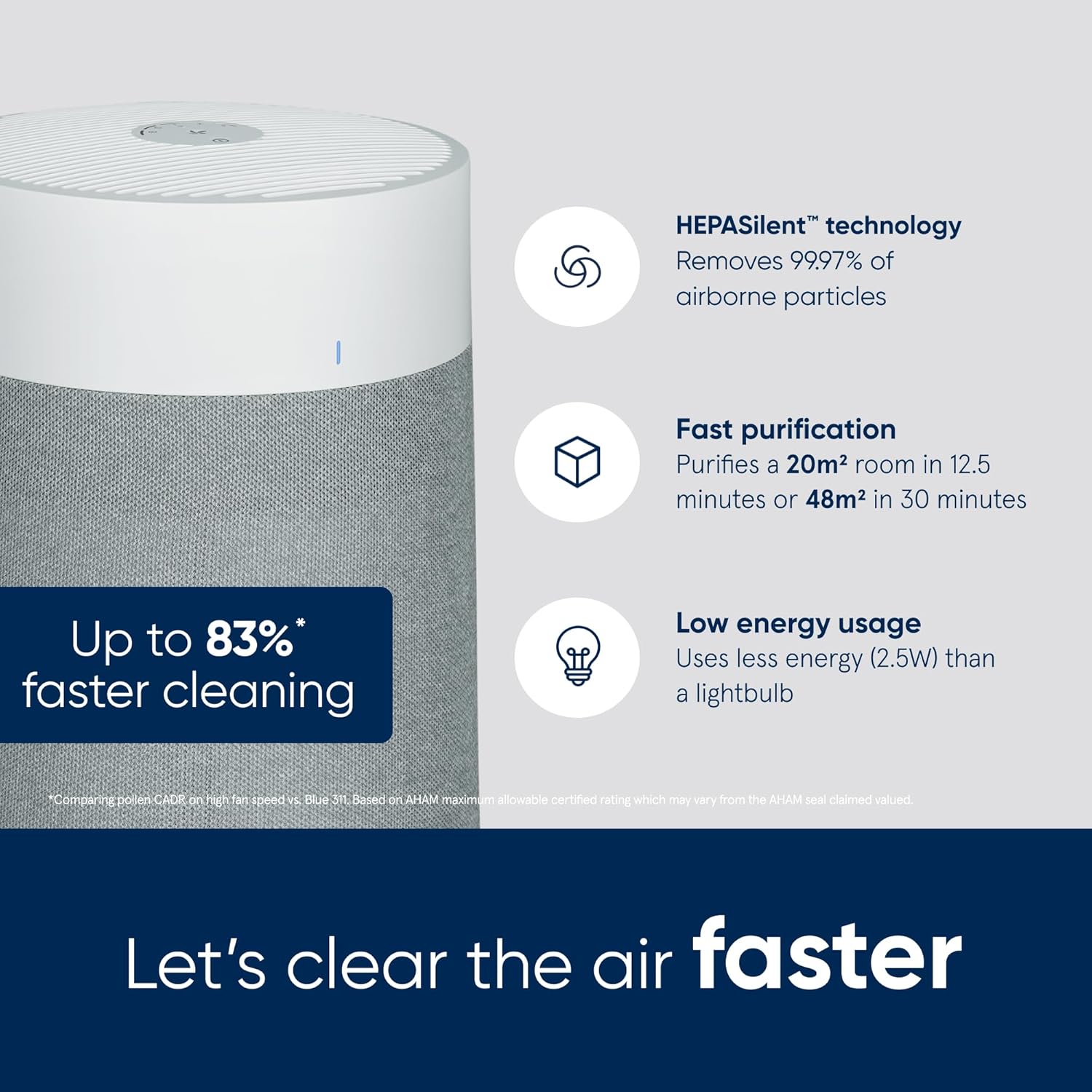
The Blueair Blue Max 3250i sits in that crowded segment of compact air purifiers for bedrooms and living spaces up to roughly 40–50 m². On paper, it leans heavily on Blueair’s HEPASilent technology, which combines mechanical filtration and electrostatic charging to reach a claimed 99.97% capture rate down to 0.1 microns. With 1,600+ Amazon ratings averaging 4.3/5 and a top-20 spot in the UK air purifier category, it’s clearly not a niche product.
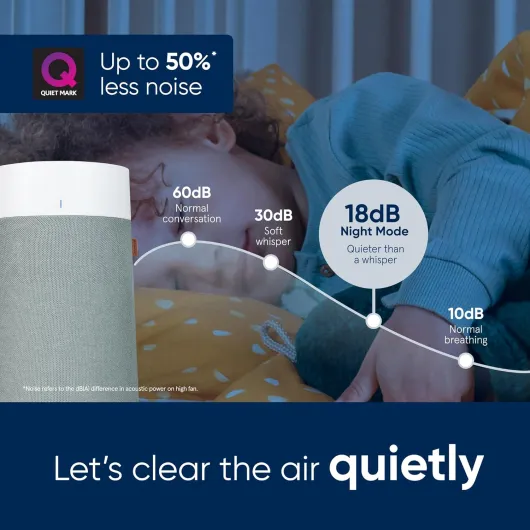
What stands out straight away is the balance between power and discretion. The brand advertises purification of 48 m² in 30 minutes on high, while also claiming just 18 dB at the lowest fan speed, which is quieter than many fridges. Several buyers highlight exactly that: strong odour removal and noticeably fresher air, but with fan noise that largely fades into the background in bedroom use when the unit stays on low or night mode.
Another big hook is connectivity. Unlike basic purifiers with a single button and maybe a timer, this one brings WiFi, an app, air quality tracking and an automatic mode that adjusts fan speed. A good number of published reviews mention that the auto mode reacts quickly to cooking fumes, candles or wax burners, with the colour ring shifting from blue to green or red, then dropping back once the air is cleared.
So this is not the cheapest plastic box with a fan and a filter. It’s a relatively light 3.39 kg connected purifier from a brand that markets itself as heavily awarded in the UK between 2019 and 2023. In my opinion, it targets users who care about quiet operation, hassle-free control and odour reduction more than raw industrial-level CADR figures. It’s not perfect, but the overall satisfaction level in the comments suggests it generally gets the job done for typical flat or small house rooms.
Is the Blue Max 3250i worth the money?
The exact retail price isn’t quoted here, but positioning clues are clear: the Blue Max 3250i sits in the mid-range segment, not at the rock-bottom budget level and not at the ultra-premium tier either. With a 4.3/5 average from around 1,684 ratings and a Best Sellers Rank of 14 in Air Purifiers in the UK, buyers seem largely satisfied with what they’re getting for the price. The value proposition mixes quiet operation, smart features, recognised branding and certified HEPA filtration.
Looking at what it offers, you get:
- Coverage up to 48 m² in 30 minutes on high.
- HEPASilent combination filter with both particle and carbon layers.
- Very low advertised noise (18 dB on low) and Quiet Mark certification.
- WiFi, app control, auto mode and air quality indicator.
On the downside, filter costs and availability eat into long-term value. At least one buyer calls the official filters expensive and notes that they might opt for third-party alternatives. Another mentions difficulty finding replacement filters in stock. Over several years, these factors can outweigh a modest upfront price difference compared to a competitor with cheaper or more widely available consumables.
In my opinion, if your priorities are quietness, simple smart features and decent odour removal in a small to medium room, this purifier offers good value. You’re paying partly for the Blueair name and the Quiet Mark label, but you’re also getting a product that, according to many owners, “just works” in auto mode and doesn’t annoy them with constant noise. For buyers on a tight budget who don’t care about WiFi or app control, a simpler purifier with cheaper filters might be more economical. For those who want a plug‑and‑play smart purifier that doesn’t dominate the room or the soundscape, the overall value looks solid, with the main caveat being ongoing filter expenses.
Discrete look and bedroom-friendly design
Visually, the Blue Max 3250i goes for a minimalist, boxy design in a colourway called “Stockholm Fog”, which is essentially a neutral, light-toned look. At roughly 27 cm wide and deep and 48 cm high, it’s closer to a compact tower than a squat cube, so it can sit beside a wall, near a doorway or in a corner without dominating the room. Several buyers mention putting it near a doorway or in a bedroom without it feeling intrusive, which suggests the industrial design is fairly discreet.
The control interface mixes physical buttons with a light ring that communicates air quality: blue for excellent, green for good and red when pollution is higher. Reviewers appreciate this simple visual feedback, especially in auto mode, where you can see the purifier react to cooking fumes, candles or other pollutants. One person explains that with flowers or wax burners, the colour changes and the fan ramps up, then settles back to blue once the air is cleaner, which makes the system feel transparent rather than mysterious.
Design-wise, night use has clearly been considered but not everyone is fully satisfied. The device has a night mode that reduces fan speed and turns off the main front LED that shows air quality, which is a plus for people sensitive to light. However, one detailed review points out that another indicator LED (showing the operating mode) stays on, even in night mode. It is dimmable, but the buyer would have preferred it to switch off completely by default, with the option to turn it on only when adjusting settings. This kind of detail matters for light-sensitive sleepers.
In my opinion, the design leans more towards practicality than style statement. The footprint is small, the colour neutral, and the interface seems straightforward. It’s not trying to be a decor piece like some designer purifiers, but it doesn’t scream “industrial appliance” either. For someone who wants an unobtrusive device in a bedroom or living room, the proportions and visual language look well thought out. The only real caveat from a design standpoint is the LED behaviour in night mode, which might annoy users who want a fully dark room.
Unboxing experience and setup practicality
While packaging isn’t the most crucial aspect of an air purifier, it does say something about how thoughtfully the product is presented and how easy it is to get started. One of the more detailed Amazon reviews mentions that the Blue Max 3250i is easy to unpack and that the packaging does not use excessive plastic. For buyers who care about waste, this is a small but welcome point: less plastic, fewer unnecessary inserts, and still enough protection to keep the device safe during delivery.
In terms of setup, several comments highlight that installation is straightforward, both for manual use and via the app. People describe taking it out, plugging it in, and quickly connecting it to WiFi without complications. The app installation is called “so straightforward” by one user, which suggests the QR codes, instructions or pairing process are clear enough even for those who are not especially tech-savvy. This matters because many smart-home products stumble at this first hurdle.
Another practical aspect tied to packaging and initial setup is the filter configuration. Users note that changing the filter is simple, which implies that getting the initial filter into place (if it’s not pre-installed) is also intuitive. There are no repeated complaints about confusing manuals, missing pieces or badly protected parts, which tends to happen quickly if packaging is poorly designed. Here, the silence on those issues is almost as telling as direct praise.
In my opinion, the packaging and setup experience of the Blue Max 3250i looks clean and user-friendly, without unnecessary bells and whistles. There’s no fancy premium unboxing ritual described, but for an air purifier that’s arguably a good thing: people just want to get it running. The main takeaways are: not too much plastic, clear instructions, and quick app pairing. For someone buying this as their first smart purifier, that’s reassuring and reduces the friction between purchase and actual use.
Filters, running costs and long‑term use potential
Durability for an air purifier is mostly about build quality and the cost/availability of filters. The Blue Max 3250i weighs only 3.39 kg, which suggests a largely plastic construction. That’s standard in this category and doesn’t automatically mean it’s fragile, but there’s nothing in the specs that screams heavy-duty industrial build either. Among the reviews, people don’t commonly complain about cracks or structural failures, which is a good sign, though absence of complaints is not proof of long-term robustness.
Filter access and replacement are often pain points on purifiers, and here the feedback is generally positive. At least one detailed review explicitly mentions that unpacking and setup are easy, and that changing the filter is equally simple. There are also references to different filter options being available, including some third-party alternatives that may be cheaper. Official filters are described as expensive by one buyer, who notes that less costly non-Blueair filters exist and are probably adequate for their needs. This points to a realistic running-cost picture: the machine itself may be reasonable value, but genuine filters will add up over several years.
One practical concern raised is filter availability. A reviewer says they have noticed replacement filters being sold out in many places, although the filters are supposed to last 6–9 months. If supply remains patchy, that could be annoying, because an air purifier is only as good as the filter inside it. On the other hand, the fact that third-party filters exist and are already mentioned in comments indicates that users have options if official stock is tight, though quality may vary.
In my opinion, the Blue Max 3250i looks like a typical modern home appliance: light, reasonably solid, but not indestructible. The brand’s reputation and the large number of positive reviews suggest it isn’t plagued by widespread failure issues. The real long-term question is filter cost and availability. If you stick to original filters and change them every 6–9 months as suggested, total ownership cost will climb steadily. For someone who values clean air and quiet operation, that might be a fair trade-off, but buyers who are very budget-sensitive should factor this into their decision rather than focusing only on the initial purchase price.
Noise, smart features and day‑to‑day behaviour
Performance here is not just about filtration, but also noise levels, responsiveness and smart control. Blueair claims the Blue Max 3250i runs as low as 18 dB on its lowest fan speed, which is quieter than a whisper. It is also Quiet Mark certified, a label given to products that meet specific low-noise criteria. Among the Amazon reviews, a lot of people call the device “very quiet” or say they barely notice it in night mode or when the air quality is good and the fan stays low.
When the fan ramps up, opinions are a bit more nuanced. One buyer explains that noise is “noticeable but not intrusive” when the unit goes to higher speeds as the air quality indicator turns red, for example with wax burners. Another says night mode and low-speed operation are very quiet, but finds the higher settings “quite loud”, which is normal for a compact purifier moving a lot of air. In my opinion, this is standard behaviour: any purifier that can clean 48 m² in 30 minutes will need airflow and will generate audible noise when pushed.
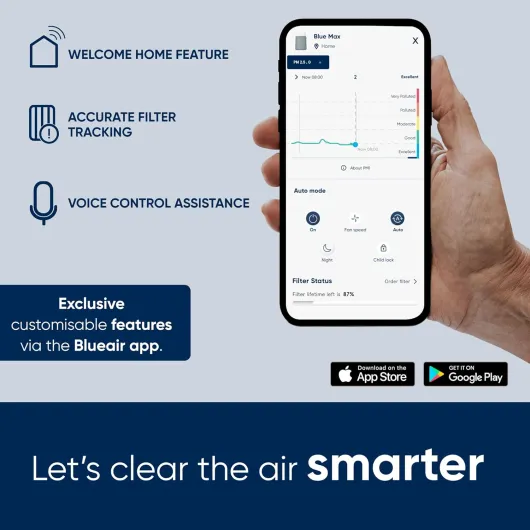
On the smart side, the WiFi and app integration get mostly positive comments. Users say setup is straightforward, scheduling is handy (for example, running high in the afternoon to stir up and filter dust, then dropping to night mode), and the automatic mode adjusts fan speed based on the sensor readings. One detailed review notes that the air quality history graphs in the app are a bit awkward to navigate, but still finds the app generally useful. The presence of an auto mode that reacts to flowers, cooking, dust or wax burners is regularly praised, as it lets people “set and forget” the purifier.
Overall, the performance picture is that of a quiet machine at low speeds, with predictable noise at high speeds and a competent smart system layered on top. In my view, anyone expecting silent operation even at maximum airflow is unrealistic, but for bedroom use at night and background use in a living room, the combination of Quiet Mark certification and user feedback suggests it stays within a comfortable range. The only area where some might feel underwhelmed is the air movement at low speeds, which one buyer suspects may be insufficient to cover the full advertised area unless the sensor is triggered to ramp up.
What the Blue Max 3250i actually offers
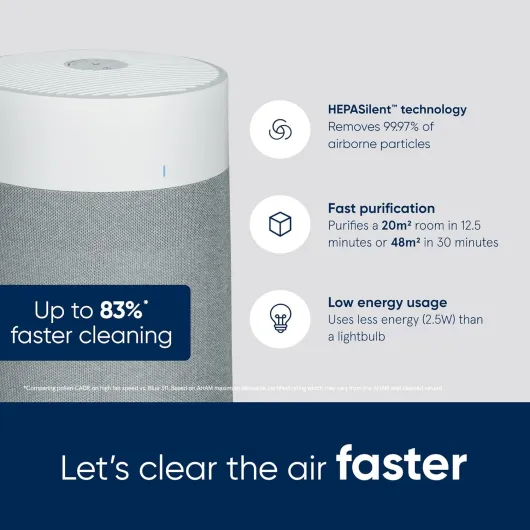
On the spec sheet, the Blueair Blue Max 3250i is a corded electric air purifier designed for rooms up to 48 m². The brand states it can clean that area in 30 minutes on the highest setting, or 20 m² in about 12.5 minutes. The filtration system is a HEPASilent combination filter, which mixes particle filtration for dust, pollen, pet dander and micro-particles with an activated carbon layer meant to reduce VOCs and household odours from cooking, smoking and pets.
The unit weighs 3.39 kg and measures 26.9 x 26.9 x 48.1 cm, so it’s relatively compact and easy to move around a flat. It’s positioned as a small-room purifier, but the coverage figures suggest it can reasonably handle an average UK bedroom or living room if you’re not expecting hospital-grade air changes per hour. Power consumption is not detailed in the snippet, yet buyers repeatedly mention that running costs feel low, especially at the lower fan speeds.
Functionally, key features include:
- Automatic mode with particle sensor and air quality colour indicator (blue/green/red).
- WiFi connectivity with app control, including scheduling and mode changes.
- Night mode with reduced fan speed and dimmed lights.
- Certified HEPA specification and Quiet Mark certification for low noise.
In the Amazon comments, people often highlight the way it reacts to pollutants. One buyer describes placing it in a living room in auto mode; the ring stayed blue most of the time, then turned green and ramped up when flowers were brought in, and went to red when a wax burner was on, before returning to blue after a while. In my opinion, this behaviour, combined with a clear light indicator, makes the product accessible to non-techy users who just want to know if their air is “OK” at a glance.
Overall, the presentation is that of a smart, quiet, mid-range purifier rather than a basic budget fan-with-filter. There’s no battery or portability beyond the 3.39 kg weight, but for a static home unit that’s standard. The main selling points are the HEPASilent branding, odour and particle removal claims, smart features and low noise, which line up with what most urban users in small homes are actually asking for.
Air cleaning and odour removal: does it get the job done?
On paper, the Blue Max 3250i aims high on filtration performance. Blueair advertises removal of at least 99.97% of airborne particles down to 0.1 microns, which covers fine dust, pollen, pet dander, mould spores, bacteria and some viruses. The integrated activated carbon layer is there to trap VOCs and household odours from cooking, smoke and pets. For coverage, the brand claims it can purify up to 48 m² in 30 minutes on the highest fan speed, which is decent for a small-footprint unit.
In the Amazon comments, many buyers back up the odour reduction claims. Several verified purchases mention that cooking smells are cleared quickly when the unit is on auto or higher speeds. One user notes that it reacts strongly to wax burners, turning the air quality ring red and increasing fan speed, then returning to blue after about half an hour. Another says it deals well with frying odours and noticeable amounts of dust, although they feel it may not fully cover an entire room at low speeds unless the sensor detects enough pollutants to ramp up.
People with allergies and sensitivity to dust often describe the air as feeling cleaner or “fresher”. One colourful review says the air feels like it’s “made of vanilla ice cream”, meaning it smells and feels much cleaner, and that they are satisfied with the performance. Others mention a clear difference in how quickly cooking or pet odours disappear compared with not having a purifier. These are subjective impressions, but the pattern is consistent: buyers generally feel that odours and visible dust are reduced noticeably.
In my opinion, the effectiveness is solid for typical domestic use, especially when the unit is allowed to run continuously in auto mode. The HEPASilent marketing should be taken as branding rather than laboratory proof, but the combination of a certified HEPA filter, carbon and responsive sensor is a sensible setup. It’s not a magic solution for heavy smoke or industrial pollution, and a few users hint that the lowest speeds might not move enough air to cover the full advertised area if the sensor doesn’t detect much. Still, for everyday pollen, dust, pet hair and kitchen smells in small to medium rooms, the overall feedback is that it does the job well.
Pros
- Very quiet on low and night modes, with Quiet Mark certification
- Effective at reducing everyday odours and dust according to many buyers
- Useful smart features: WiFi, app control, auto mode and clear air quality indicator
Cons
- Official replacement filters are relatively expensive and sometimes hard to find
- High fan speeds can be quite loud, and one LED remains lit in night mode
Conclusion
Analysis score
The Blueair Blue Max 3250i comes across as a quiet, smart and generally well‑received purifier for small to medium rooms. It combines a certified HEPA‑grade filter with activated carbon and a responsive sensor system, wrapped in a compact 3.39 kg body. Buyers frequently praise the low noise in night or low modes, the way it reacts to cooking fumes, flowers or wax burners, and the straightforward app setup. For bedrooms and living rooms where noise and ease of use matter as much as raw airflow, it fits the brief.
It’s not flawless. Official filters are described as pricey, and at least one user has struggled with filter availability, which dents long‑term value. Noise at high speed is noticeable, as expected for a purifier moving enough air to cover up to 48 m² quickly, and one light indicator staying on in night mode may bother very light‑sensitive sleepers. Also, if you want heavy‑duty air cleaning for large open‑plan spaces or serious smoke problems, you may need something bigger and more powerful.
In my opinion, this model suits people who want a set‑and‑forget smart purifier: allergy sufferers in flats, pet owners, or anyone annoyed by cooking smells who also cares about low fan noise and a clean design. Those who are extremely budget‑focused, hate the idea of expensive filters, or don’t care about WiFi or app control might be better off with a simpler, cheaper unit. Overall, the balance of features, user satisfaction and practical performance justifies a strong but not perfect rating.