Summary
Analysis score
Average of the criteria rated below
Value for money compared to other portable ACs
Design, footprint and everyday practicality
Comfort, night use and the Sleep/Silent modes
Build quality, safety and long-term prospects
Noise, inverter behaviour and real-world operating profile
What the Bosch Cool 5100 offers on paper
Cooling and dehumidifying: strong potential, but divided opinions
Pros
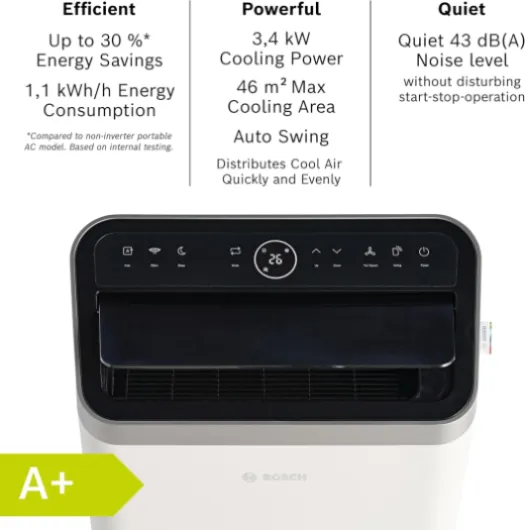
- Powerful 3.4 kW cooling capacity, suitable on paper for rooms up to 46 m²
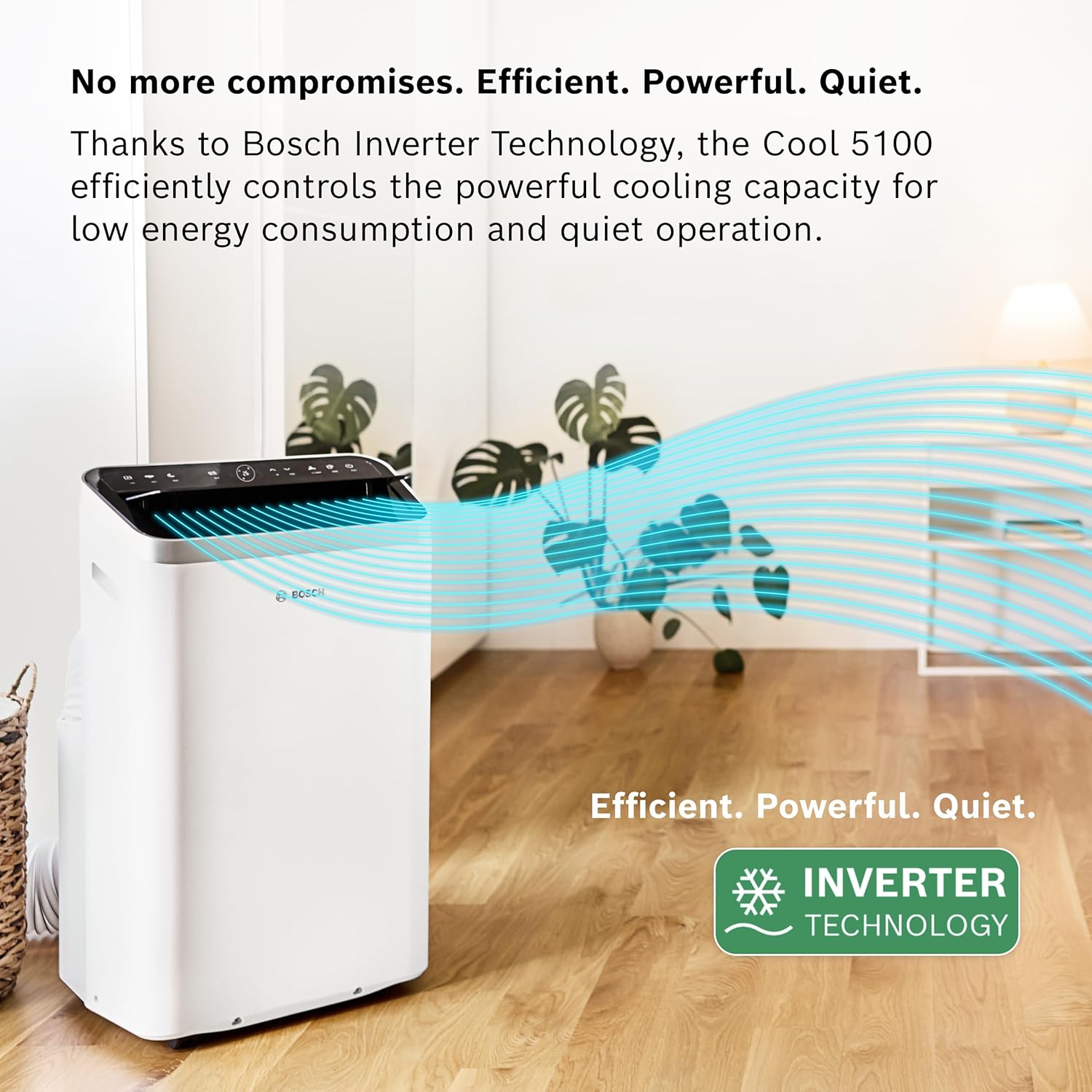
- Inverter technology for quieter operation and better energy efficiency (A+)
- Generally low noise with Silent and Sleep modes, several buyers use it comfortably in bedrooms
Cons
- Cooling effectiveness and comfort depend strongly on room sealing and installation quality
- Condensate tank and drainage design can be problematic for some setups, especially at night
- Premium pricing compared to basic portable ACs, without solving all limits of single-hose systems

Specifications
View full product page →| Brand | Bosch Thermotechnik |
Portable AC for real heatwaves, not just a desk fan
The Bosch Cool 5100 positions itself as a higher-end portable air conditioner: 3.4 kW of cooling power, inverter technology, and a promised noise level starting at 43 dB(A). On paper, this puts it well above entry-level mobile units that often struggle beyond 20–25 m². Bosch claims coverage up to 46 m² (around 115 m³), with three operating modes (cooling, dehumidifying, fan) and several presets (Auto, Silent, Sleep) to simplify daily use.
In the Amazon comments, the tone is mixed but leans positive: an average of 3.8/5 from a small base of 10 reviews. Some buyers describe very efficient cooling and quiet operation, even in heat around 30 °C. Others are much harsher, especially on cooling performance versus expectations and on condensate management, which a critical review calls “useless” for night use because of a fast-filling reservoir and awkward drainage.
In my opinion, this puts the Bosch Cool 5100 in a particular category: not a cheap, noisy cube, but a more technical product that benefits from inverter technology and a known brand, yet still carries some compromises typical of portable ACs. The spec sheet looks solid: 1300 W power consumption for 3.4 kW cooling, A+ efficiency, touch controls and remote, integrated window kit, and wheels for mobility. But the user feedback shows that expectations around cooling and condensate management must be realistic.
If you are looking at the Cool 5100, the real question is whether its quiet operation and inverter efficiency compensate for the classic limits of single-hose portable units: installation through a window, hot air recirculation, and condensate to evacuate. The following sections dig into what the numbers and published reviews suggest about its design, performance, practicality and value, without pretending to replace a lab measurement or a professional installation study.
Value for money compared to other portable ACs
The price of the Bosch Cool 5100 is not listed here, but reviewers refer to it as a premium-priced unit compared to entry-level portable air conditioners. One satisfied buyer explicitly says it is “certainly worth the premium price for the advanced tech and quality.” That statement gives a clue: this is not aimed at the cheapest segment, but rather at users ready to pay more for lower noise, better efficiency and a known brand. With an A+ efficiency label, inverter technology, 3.4 kW of cooling and quiet modes, the spec sheet supports that positioning.
From a value perspective, the main advantages are clear: quiet operation, high cooling capacity, and multi-function use (cooling, dehumidifying, fan). In climates with hot, humid summers, being able to both cool and dehumidify a medium to large room can justify a higher price, especially for those who cannot install a split system. Several buyers emphasise the comfort gains compared to older, noisier portable ACs, which suggests that people upgrading from an older unit may find the investment more acceptable than someone buying their first AC.
However, the uneven feedback on cooling effectiveness and condensate management weakens the value proposition for some profiles. If you expect to cool a small, poorly sealed room to very low temperatures (around 18–20 °C) and do not have an easy way to manage drainage, one critical review suggests you could end up frustrated and feel you have overpaid for a device that behaves, in your eyes, like an expensive fan after a few hours. On the other hand, buyers with better installation conditions and realistic expectations report being very satisfied, which shows that the perceived value is highly context-dependent.
In my opinion, the Bosch Cool 5100 offers good but not universal value. For someone who wants a quiet, efficient, branded portable AC for a properly sized and reasonably well-insulated room, and who can set up a sensible exhaust and drainage configuration, the extra cost over a generic unit can make sense. For someone only looking for the lowest price per kW of cooling or planning to use it in difficult conditions (very leaky room, no drainage options, expectation of fridge-like cold), there are probably cheaper or more suitable alternatives, even if they are noisier or less refined.
Design, footprint and everyday practicality
Visually, the Bosch Cool 5100 sticks to a simple white cabinet design, 80 cm high, 40 cm wide and 46 cm deep. It is not ultra-compact, but with 3.4 kW of cooling and an integrated inverter compressor, this size is expected. In a living room or bedroom, it will be visible but not monstrous. There is no mention of fancy colours or decorative panels; it is clearly a functional appliance intended to blend into the background rather than become a design object.
Several design elements aim to make it easier to live with. The unit has integrated handles and wheels, which is important given the 31.5 kg weight. You are not going to carry it up and down stairs every day, but moving it from a bedroom to a living room on the same floor should be feasible for most people. One reviewer mentions using it to cool an upstairs sleeping area and a large sitting room, suggesting the physical handling is manageable once the exhaust hose and window kit are set up appropriately in each area.
The touch control panel on top and the supplied remote provide two ways to control the device. Reviews describe the interface as well designed and easy to understand. For a summer appliance that might be used by several household members, this matters more than it seems: confusing icons and nested menus are often a pain on cheaper units. Here, buyers seem satisfied with the readability and simplicity of the controls, which supports Bosch’s positioning as a slightly more premium option.
Installation-wise, the window kit and integrated exhaust hose are pretty standard but still central to the design. A positive review highlights quick installation, while another mentions some temperature losses because their window is not properly sealed, underlining a classic limitation of mobile ACs: the best unit in the world cannot compensate for a poorly sealed opening. In my opinion, the design of the Cool 5100 is practical and serious but not revolutionary: it ticks the boxes (wheels, handles, remote, integrated kit) without going into ultra-compact or ultra-slim territory. For someone who values ease of movement and a clean look more than aesthetics, it should be adequate.
Comfort, night use and the Sleep/Silent modes
Comfort with a portable AC is not just about raw cooling; it is also about noise, airflow, light, and operating logic at night. On this front, the Bosch Cool 5100 gets rather positive feedback for noise and general comfort, but one review strongly criticises the behaviour of Sleep mode and the way condensate is handled, which directly impacts night-time use.
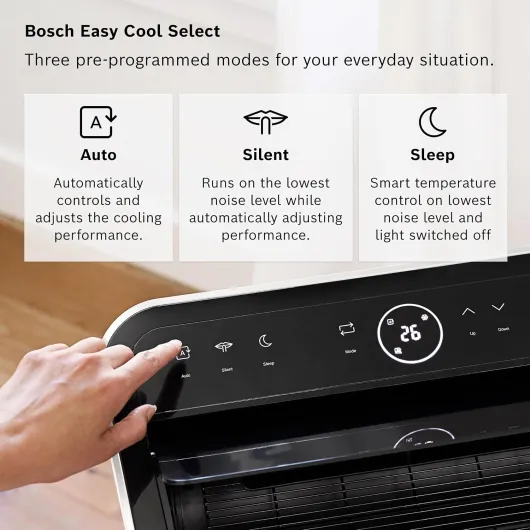
Several buyers say the Silent and Sleep modes are genuinely quiet. One calls the night setting “near silent”, another says the device is “very quiet in the silent mode and keeps the large bedroom cool”. For people sensitive to noise, this is one of the big reasons to consider an inverter-based portable instead of a cheaper on/off model that bangs its compressor on and off. The unit also offers three fan speeds, which should help adjust airflow to personal tolerance: higher speed for faster cool-down before bed, then a quieter, lower speed for the night.
Where things become more controversial is the Sleep mode temperature profile. A critical reviewer points out that, according to the manual, Sleep mode increases the set temperature by 2 °C over the first two hours, maintains this higher level for six hours, and then returns to the original temperature. They see this as the opposite of what they want for sleep, arguing that many people like a cooler room to fall asleep and stay asleep. In my opinion, this behaviour is standard for many AC brands (it is designed to avoid overcooling and to match the natural drop in body temperature overnight), but it clearly does not suit everyone. If you like a constant or very cool room at night, you may prefer to stay in standard mode with a fixed setpoint.
The other big comfort factor at night is the condensate tank. One buyer complains that the small reservoir fills after only a few hours in their conditions, triggering loud beeps and shutting off cooling, turning the device into a simple fan until it is drained. They also criticise the low drain plug and cumbersome emptying procedure, which they find unsuitable for daily use in a bedroom. Other reviews, however, mention that all condensation is expelled via the exhaust hose and that they have not experienced reservoir issues. This suggests that comfort will depend strongly on how the unit is installed and whether a continuous drain option is used or not. Overall, the Cool 5100 seems potentially very comfortable in noise and airflow, but only if the operating modes and drainage are configured in a way that fits your sleep habits and room layout.
Build quality, safety and long-term prospects
Bosch is generally perceived as a solid brand for home appliances, and some buyers of the Cool 5100 explicitly mention that the unit feels solidly built. One reviewer praises the construction and design of the control panel, describing it as well thought out and easy to use. The 31.5 kg weight and the fairly large cabinet also suggest a serious internal structure rather than ultra-thin cost-cut shells. The included 2‑year warranty from Bosch Thermotechnik is standard for this type of product in many markets and indicates the manufacturer is reasonably confident in its hardware.
From a safety and reliability perspective, the spec sheet notes automatic shut-off and overheating protection. These are important protections for a device that can run for many hours in summer, sometimes unattended. The product is manufactured in China, like the majority of portable ACs, but designed and branded by Bosch. Without long-term statistics, it is difficult to predict failure rates, yet the absence of mass complaints in the few available reviews suggests there is no obvious systematic defect, at least in the short period covered by these comments.
One older review concerning the previous Bosch Cool 5000 model mentions an electric shock when touching the plug prongs after unplugging, allegedly due to capacitors in the inverter stage still holding a charge. This is a serious anecdote, though it is isolated and not specifically about the 5100. It does, however, underline that inverter appliances contain energy storage components and that handling plugs immediately after disconnection should be done carefully. From a design standpoint, this is more a question of discharge circuitry and plug design than of mechanical durability, but it can influence user trust in the brand’s safety engineering.
As for long-term mechanical durability, there is not yet enough feedback to form a robust picture. No one reports compressor failures, cracked housings, or wheel issues in the current comments. Some buyers have only used the unit for one season or less, which is too short to judge longevity. In my opinion, the combination of Bosch branding, perceived solidity and standard protections suggests a decent durability outlook, but it is not a guarantee. Proper usage (no constant tipping, correct drainage, no blocking of vents) will be key. If long-term reliability is your top priority, registering the product and keeping proof of purchase for warranty use is clearly advisable.
Noise, inverter behaviour and real-world operating profile
The Bosch Cool 5100 highlights noise control and inverter efficiency as key selling points. The official spec lists a starting noise level of 43 dB(A), which is lower than many portable units that easily climb above 50–60 dB(A) in normal use. Several buyers back this up: one calls the night setting “near silent” and praises the lack of compressor clunk, while another notes that the device is “very quiet in the silent mode” and suitable for bedroom use even above 30 °C outside.
The inverter system is central here. Instead of turning the compressor on and off at full speed, it modulates the speed using a power electronics stage. One detailed review explains this principle in their own words and appreciates the smoother operation and lower energy consumption compared to an older non‑inverter unit. In theory, this should also increase comfort: fewer abrupt temperature swings, less vibration, and more stable noise levels once the setpoint is reached. The published comments generally align with this: those who are satisfied often mention that once the room is cooled, the device becomes very unobtrusive.
However, inverter technology also adds complexity. A negative review of the previous Bosch 5000 model reports an electric shock after unplugging the unit and touching the prongs, attributing it to capacitors still holding a charge. This is an isolated report and concerns the earlier version, not specifically the 5100, but it is a reminder that inverter-based appliances store energy briefly after shutdown. From an analytical standpoint, this is more a safety and design concern than a performance issue, yet it can affect user confidence. In any case, care is advisable when handling the plug immediately after disconnection.
On the energy side, Bosch announces up to 30% energy savings thanks to the inverter, with around 1.0 kWh/h consumption. One reviewer who replaced a 9-year-old portable AC feels that running costs have clearly dropped, although this is not a measured value but their impression based on usage. With 1300 W input for 3.4 kW cooling, the theoretical efficiency is respectable for a portable monobloc. In my opinion, the performance profile is coherent: quiet and relatively efficient for its class, especially in maintenance mode. But the advantages fully show only when the room is correctly dimensioned and installation is done properly; otherwise, the compressor may run more intensely, increasing noise and consumption like any other unit.
What the Bosch Cool 5100 offers on paper
The Bosch Cool 5100 is a portable, monobloc air conditioner aimed at residential use. It combines three functions: cooling, dehumidifying, and simple air circulation (fan mode). The manufacturer announces a cooling capacity of 3.4 kW, which is substantial for this product category and theoretically suitable for rooms up to 46 m² (115 m³), assuming standard ceiling height and reasonable insulation. Power consumption is given as 1300 W, with an A+ efficiency label and an advertised 1.0 kWh/h consumption in operation.
The unit runs on inverter technology, which several buyers highlight as a strong point. Instead of cycling the compressor on/off at full power, it modulates the speed, which should limit peaks in consumption and reduce noise when maintaining temperature. According to comments, this translates into smoother, quieter behaviour compared to older portable ACs. One buyer who replaced a 9‑year‑old unit notes significant gains in both noise and running costs, at least subjectively according to their bill and experience.
Controls are handled by a touch panel and a remote control, with several pre-set modes: Auto, Silent, and Sleep. The idea is to avoid constantly tweaking the temperature and fan speed. Bosch also supplies a window installation kit and an integrated exhaust hose, which is standard on this type of product but still good to see explicitly included. The device is corded (220 V) and does not require any outdoor unit, which makes it compatible with rentals or situations where fixed split systems are not allowed.
On the practical side, the Cool 5100 weighs around 31.5 kg and measures 46 × 40 × 80 cm. That is bulky but typical for a powerful mobile AC. Bosch mentions integrated handles and smooth-running wheels for easier transport between rooms. Official noise starts at 43 dB(A), which is relatively low for a portable unit; some reviews back this up, especially in Silent and Sleep modes, while one critical buyer concedes that the product is indeed quiet even though they find the cooling disappointing. Overall, the spec sheet sketches a fairly complete and modern portable AC, with a focus on energy efficiency and noise control rather than flashy connected features.
Cooling and dehumidifying: strong potential, but divided opinions
On paper, the 3.4 kW cooling capacity for up to 46 m² is one of the main arguments of the Bosch Cool 5100. One satisfied buyer reports that in an 18 m² bedroom, the unit was able to bring the temperature down to 18 °C at night while it was 30 °C outside, which is a strong result for real-world use in a heatwave. Another review explains that the device helped keep the entire upstairs of a four-bedroom house reasonably cool (with the help of additional fans to circulate air between rooms), and that a large sitting room stayed comfortable once the initial temperature was brought down.
However, not all feedback is aligned. A very critical comment calls the cooling “really, really lacklustre” and claims the unit struggled to drop a small room from 22 °C to 20 °C, with outside temperatures below 20 °C. This same user also criticises the manual’s recommendation to set the target temperature between 24 °C and 27 °C, which they interpret as a misunderstanding of what people expect from air conditioning. In my opinion, this discrepancy probably reflects different room configurations: insulation, sun exposure, air leakage around the window kit, and expectations. Portable single-hose units always fight against some degree of warm air ingress; if the room is poorly sealed or the window kit is improvised, the effective cooling can drop sharply.
Regarding dehumidification, one satisfied reviewer mentions that the unit collected about 3 litres of water in 12 hours, which indicates active moisture removal in a bedroom. Another buyer, on the contrary, complains that the internal reservoir fills up in just a few hours, triggering loud beeps and shutting off the cooling during the night. They also describe the drain plug as too close to the ground, making it hard to empty without spilling, and criticise the design of the drain hose connection. This suggests that condensate management is a potential weak point for some setups, especially if continuous drainage to a lower-level drain is not possible.
In summary, the raw performance potential looks solid for a portable AC: high cooling power, effective dehumidification, inverter modulation to hold temperature without brutal cycling. But the real effectiveness depends heavily on installation quality and room conditions. If you expect to cool a well-sealed bedroom or living room and can manage condensate properly, the positive reviews suggest good results. If the room is leaky, the window kit is poorly adapted, or you cannot set up a practical drainage solution, frustration is likely, and the cooling may feel underwhelming compared to the numbers on the box.
Pros
- Powerful 3.4 kW cooling capacity, suitable on paper for rooms up to 46 m²
- Inverter technology for quieter operation and better energy efficiency (A+)
- Generally low noise with Silent and Sleep modes, several buyers use it comfortably in bedrooms
Cons
- Cooling effectiveness and comfort depend strongly on room sealing and installation quality
- Condensate tank and drainage design can be problematic for some setups, especially at night
- Premium pricing compared to basic portable ACs, without solving all limits of single-hose systems
Conclusion
Analysis score
The Bosch Cool 5100 positions itself as a quiet, efficient portable AC with serious cooling power and inverter technology. The spec sheet lines up well: 3.4 kW cooling for up to 46 m², A+ efficiency, 1300 W consumption, three operating modes, and several presets (Auto, Silent, Sleep). Comments from buyers often confirm the strengths: many highlight the low noise, especially at night, the solid build and the ability to keep a large bedroom or a floor area comfortable in 30 °C heat, provided the room is not a sieve and air circulation is helped with fans if needed.
Where opinions diverge is on cooling expectations and condensate handling. One buyer finds the cooling weak even in a small room and strongly criticises Sleep mode logic and the condensate tank that, in their case, fills quickly and is awkward to empty. Others report that all condensation is expelled via the exhaust and that they have no such issue. This shows the product is sensitive to installation quality (window sealing, hose routing, drainage setup) and to what each person expects from “cooling”: a comfortable 24–25 °C or a near-fridge temperature.
In my opinion, the Cool 5100 suits users who value quiet operation, brand reputation and energy efficiency more than absolute low price. It makes sense for medium to large, reasonably insulated rooms where you can properly install the window kit and, ideally, arrange continuous drainage. If you live in a very leaky space, want to push the room to 18–19 °C regardless of conditions, or cannot manage condensate easily, you might find the product underwhelming and the price hard to justify. It is a capable portable AC with clear strengths, but not a magic solution that erases the inherent limits of single-hose mobile systems.