Summary
Analysis score
Average of the criteria rated below
Value for money: strong price argument, clear compromises
Design and handling: simple manual tool, not a luxury build
Build quality and durability: mostly metal, but quality control doubts
Real-world performance: manual focus workflow and learning curve
What this Lightdow 85mm f1.8 actually offers
Image quality and focusing: strong blur, mixed sharpness feedback
Pros
- Very low price for an 85mm f/1.8 lens compatible with Canon EF/EF-S
- Bright aperture and 85mm focal length suited to portraits and background blur
- Mostly metal construction and simple manual design with large focus ring
Cons
- Fully manual with no autofocus or electronic contacts; requires manual camera setup
- Quality control appears inconsistent, with some reports of severe optical or mechanical issues
- Not ideal for fast action or professional work due to manual focus and potential sample variation

Specifications
View full product page →| Brand | lightdow |
A dirt-cheap 85mm f1.8 for Canon EF… with strings attached
The Lightdow 85mm f1.8 EF portrait lens targets Canon DSLR users who want that classic 85mm look and strong background blur without paying Canon prices. On paper, it offers an 85mm focal length, a bright f1.8 aperture, and compatibility with a long list of Canon EF and EF‑S mount cameras, from older Rebels to 5D, 6D, 7D and even 1D series bodies. It sits around the very low end of the price range for an 85mm prime, which immediately explains its popularity and also the mixed expectations around it.
There are a few key points that define this lens. First, it is fully manual: no autofocus, no electronic contacts, no EXIF data for aperture, and you must run your camera in full manual mode or at least enable options like “release shutter without lens.” Several buyers insist on this in the Amazon comments, especially those who initially thought it was faulty before changing the camera settings. Second, Lightdow promotes an optical formula with 6 elements in 6 groups, a 6‑blade rounded aperture, hybrid aspherical elements and multi‑coating to control aberrations and flare.
With over 1,700 reviews and a 4.0/5 average, the general feeling among buyers is that you get usable image quality and strong background blur if you accept the manual workflow and some quality‑control lottery. Some comments praise the sharpness and value, others describe severe focusing or build issues, including one user who reports the lens only being usable around 4–5 ft at anything wider than f/22 and complaining about a light leak due to a gap around the mount. That kind of story shows what can go wrong at this price level.
In my opinion, this lens is clearly aimed at two profiles: budget‑conscious portrait shooters who want to experiment with manual focus, and learners who see manual glass as a training tool. For someone expecting Canon‑level autofocus and consistency, it looks like a bad match. For someone ready to fight a bit with settings and focus to save a lot of money, it might make sense, as long as you accept the risk of getting a dud and possibly dealing with after‑sales support.
Value for money: strong price argument, clear compromises
The strongest argument for the Lightdow 85mm f1.8 is clearly value for money. It sits at the very low end of the price range for an 85mm f/1.8 lens compatible with Canon EF and EF‑S mounts. Canon’s own 85mm primes and even many third‑party autofocus options are significantly more expensive. That price gap explains why this lens ranks high in the SLR camera lenses category and has accumulated over 1,700 reviews with an average of 4.0/5. For many buyers, the combination of a bright aperture, portrait‑friendly focal length and full‑frame coverage at such a low cost is enough to justify the purchase.
From what users say, those who understand the manual‑only nature and are willing to accept some imperfections generally feel they got a good deal. Comments like “good for what it is” and “great lens” from verified purchases show that, in their eyes, the delivered image quality and usability match or exceed expectations given the cost. One user even mentions that being forced to shoot manually has improved their skills, which adds educational value: you’re basically paying for a training tool that also delivers usable portraits.
On the other side, the harsher reviews highlight the hidden cost of this low price: quality control lottery, possible optical duds, and mechanical quirks. If you receive a unit that only works at f/22 or has a mount gap causing light leaks, the bargain suddenly looks like wasted money and hassle with returns. Also, there is no resale value comparable to Canon or Sigma lenses; if you decide manual focusing is not for you, you might struggle to recover much of the investment.
In my opinion, the value proposition is decent but not universal. For a beginner or enthusiast who is curious about manual focus, wants an 85mm portrait look on a tight budget, and is ready to deal with some trial and error, the lens can be a solid low‑risk experiment. For someone who needs reliability, consistent optical performance, and autofocus for paid work or critical shooting, it makes more sense to save up for a more reputable option. The low purchase price is attractive, but the real value depends heavily on your tolerance for manual handling and potential sample issues.
Design and handling: simple manual tool, not a luxury build
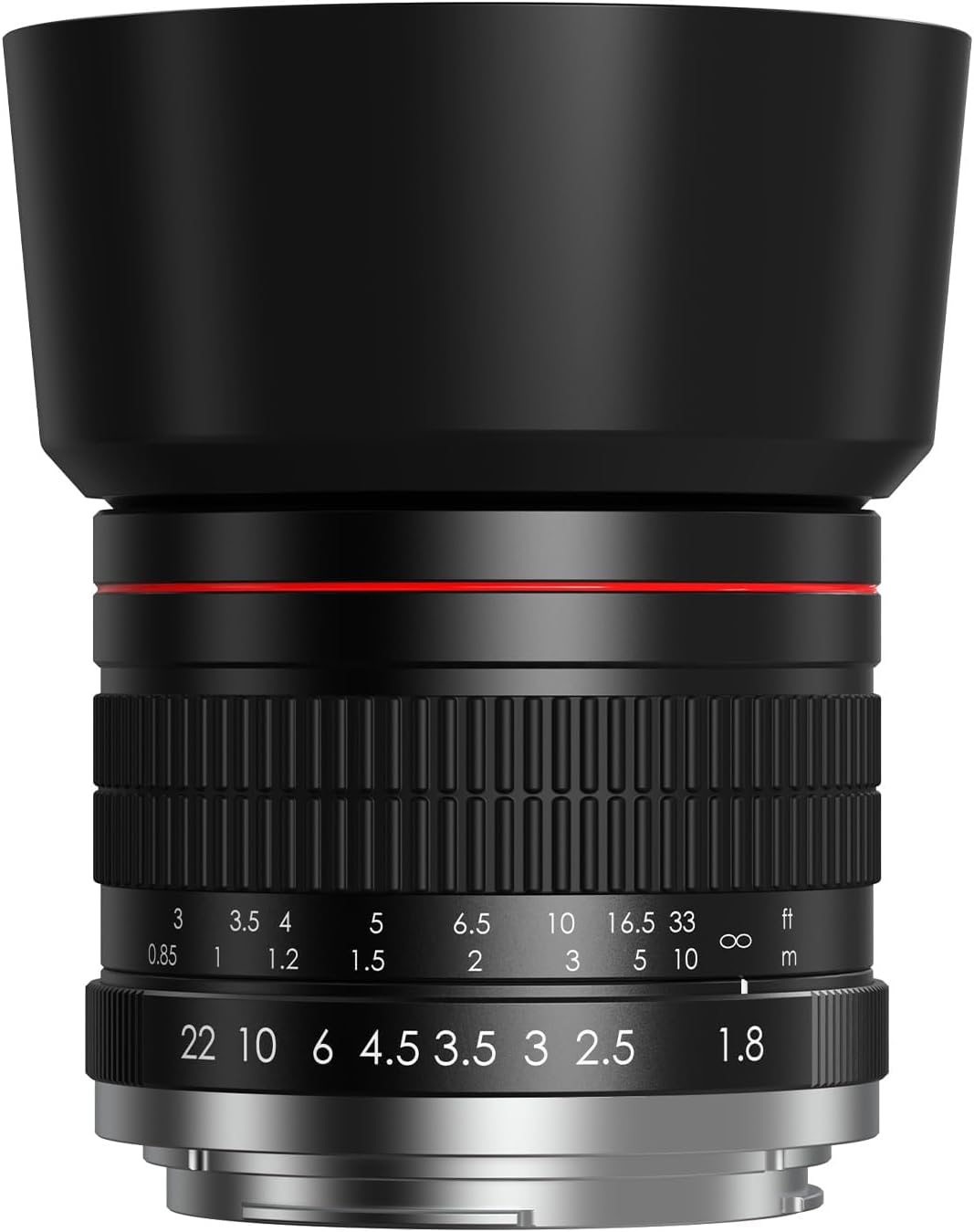
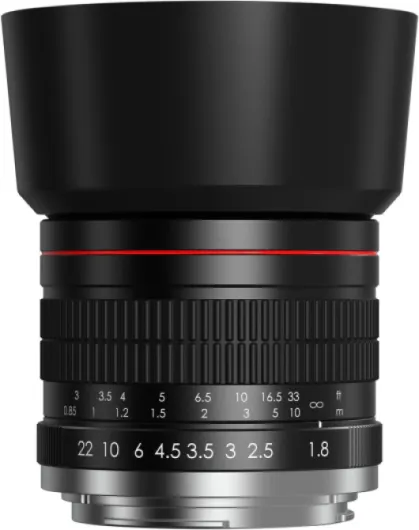
Physically, the Lightdow 85mm f1.8 is fairly compact for an 85mm prime. The listed dimensions are 4.33 x 2.76 x 2.76 inches with a weight of about 1.06 lb (around 480 g). So it’s not a tiny pancake, but it should balance reasonably on most Canon DSLRs, from smaller Rebels to larger 5D or 1D bodies. The design is classic: a metal barrel (according to several comments describing it as “mostly metal” and “substantial”), a large focus ring, and an aperture ring near the mount. There is no focus window, no switches, and no decorative extras. It looks more like a generic manual lens than a branded Canon EF prime.
The manufacturer mentions a “smooth large focus ring design” and an internal focusing mechanism (IF) for fast and quiet operation. Since there is no autofocus motor, “fast and quiet” here only concerns the mechanical movement when you turn the ring yourself. A few buyers say that once broken in, the focusing action is smooth and easy to control, which is important because with manual focus, the ring feel is your main interface. One positive review notes that after an initial stiffness problem, the ring became smooth and the lens was straightforward to use for those who know how to handle manual focusing.
However, design execution seems inconsistent. One user reports that the lens arrived with the focus mechanism stuck and that they had to apply force to free it, hearing something snap inside. They still ended up using the lens and even mention the manufacturer offered a discount as compensation, but it shows that quality control on the mechanics can be rough. Another negative review talks about a diameter smaller than the EF mount and a gap leading to light leak, which is a serious design flaw if accurate for that copy. These are not things you usually see on first‑tier brands.
In my opinion, the design concept is fine for a budget manual lens: simple, metal‑heavy, big focus ring, old‑school aperture ring, no electronics. The issue is consistency. If you get a copy with smooth rings and a snug mount, the design should be perfectly usable. If you fall on one of the problematic units, the same simple design becomes a headache. That’s the trade‑off with a very low‑cost manual lens from a smaller brand: less refinement and more sample variation compared with Canon or Samyang.
Build quality and durability: mostly metal, but quality control doubts
Durability is one of the more debated aspects of this lens. On the positive side, multiple buyers mention that the lens is “mostly metal” and feels substantial in the hand. The weight of about 1.06 lb supports the idea that it’s not an all‑plastic toy. A metal barrel and mount usually suggest better long‑term resistance to knocks and frequent mounting/unmounting compared with very light plastic kit lenses. For a budget product, that’s a strong point, at least in theory.
However, several comments raise quality control and mechanical issues that directly affect perceived durability. One buyer reports that their focus ring arrived stuck and required significant force to move it the first time, with an internal snap sound. After that, the ring became smooth and the lens remained usable, but this is not the kind of experience that inspires confidence in the assembly process. Another very critical reviewer describes a mis‑sized mount area that allegedly leaves a gap and causes light leaks between the lens and body. If a mount is not perfectly matched to the EF standard, that’s a serious design or manufacturing problem, and it can have long‑term implications if it wears the camera mount or keeps flexing.
On the brand side, Lightdow emphasizes “professional after‑sales support” with maintenance and replacement under warranty. At least one user confirms that the manufacturer responded and offered a discount following a build problem. That suggests that while the initial quality might be inconsistent, the company is at least somewhat reactive when customers complain. Still, warranty support doesn’t fully compensate for the time lost or the risk of being stuck with a flawed unit outside the return period.
In my opinion, the durability picture is mixed. The materials and general construction concept (metal barrel, simple manual mechanics) should allow the lens to survive regular use if the sample is built correctly. But the reports of stiff focusing, internal snapping and possible mounting tolerances show that sample variation is a real concern. If someone buys this lens, they should be prepared to test it thoroughly as soon as it arrives (focus smoothness, mount fit, light leak checks) and use return or warranty options quickly if anything feels off. For a low price, that might be an acceptable risk for some, but it’s far from the consistency you’d expect from first‑tier brands.
Real-world performance: manual focus workflow and learning curve
Performance here is less about pure lab sharpness and more about how the lens behaves in actual shooting conditions, based on what buyers describe. The first big point is that the lens is entirely manual focus with manual aperture control. That means no autofocus, no focus confirmation via contacts, and the camera will often complain there is “no lens” attached unless you switch it to full manual mode and enable things like “release shutter without lens.” Several reviewers insist on this configuration step, and one beginner using a Canon EOS R100 explains that after some research and enabling those settings, the lens worked fine and they were happy with the results.
This manual setup has clear consequences. For fast action, events, or moving subjects, the lack of autofocus is a real limitation. You need to pre‑focus, use focus peaking (if your camera or adapter supports it), or rely on magnified live view. For static portraits, posed shots, or product photos, it’s more manageable. One reviewer points out that it’s “easy to use if you know how to use a manual focus lens,” which sums up the situation well. Veteran photographers used to manual glass will probably adapt quickly; beginners may struggle at first but some see it as a useful learning exercise.
In terms of speed, the bright f/1.8 aperture should allow relatively low ISO and faster shutter speeds in dim environments, at least on paper. However, several users implicitly show that the effective speed of shooting is limited more by the manual workflow than by light gathering. You spend more time focusing, checking zoomed‑in previews, and adjusting aperture on the ring. For some, that’s part of the fun and a way to slow down and think about composition. For others expecting a quick point‑and‑shoot experience, it becomes frustrating and leads to missed shots.
My take is that performance is very context‑dependent. For a controlled portrait session where the subject can stay relatively still and you can take your time, the lens likely performs well enough, especially if you stop down slightly to f/2.8 or f/4 to get a bit more depth of field and forgiveness. For street, kids, pets or events, the lack of autofocus and electronic integration is a big handicap. The lens does not pretend to be anything else, though. It’s a cheap manual tool; performance is acceptable when you play to its strengths and disappointing if you try to use it like a modern AF prime.
What this Lightdow 85mm f1.8 actually offers
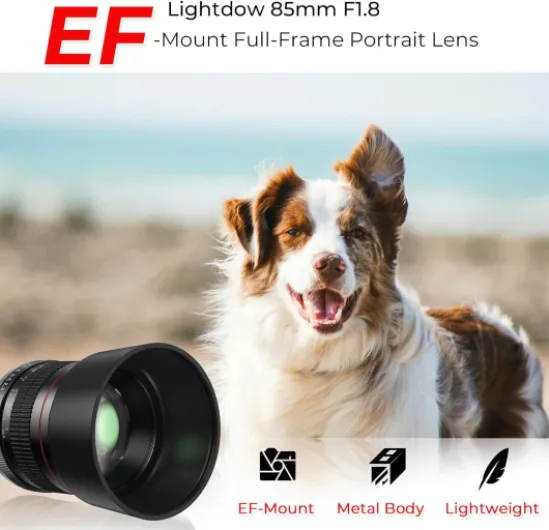
On the spec sheet, the Lightdow 85mm f1.8 is a standard short‑telephoto prime designed for Canon EF and EF‑S mounts. The focal length is fixed at 85mm, a classic portrait distance that gives flattering compression for faces and lets you keep some working distance from your subject. The maximum aperture of f/1.8 is the other main selling point: in theory it allows low‑light shooting and strong subject isolation with pronounced background blur. Inside, the lens uses 6 elements in 6 groups, with a 6‑blade rounded diaphragm, hybrid aspherical elements and multi‑coating to limit chromatic aberration and flare.
Compatibility is a big argument here. The brand explicitly lists a huge range of Canon bodies: entry‑level Rebels like T7, T6, T5, T3i, mid‑range 70D/80D/90D, and full‑frame models like the 5D Mark IV, 6D Mark II and even 1D X series. Some reviews also mention using it on newer mirrorless bodies like the EOS R100 via adapter, as long as the camera can be forced into full manual mode and “shoot without lens” is enabled. So the lens is clearly meant as a cheap way to get an 85mm look across almost any Canon system that accepts EF glass, directly or with adapter.
There is no autofocus and no electronics. The mount has no contacts, so the camera cannot control aperture or read focus distance, and EXIF will not show the lens data. All exposure parameters (shutter, ISO, aperture) must be set manually on camera, while focus and aperture are set on the lens rings. Several buyers say this surprised them at first, but once they learned how to configure their camera, they were satisfied with the creative control. Others, especially beginners who expected a plug‑and‑play lens, were more frustrated.
In my view, the product positioning is clear: this is a low‑cost, manual‑only alternative to Canon’s own 85mm primes. You lose electronic convenience and, judging from some comments, some sample‑to‑sample consistency, but you gain a very low entry price to try portrait photography with a bright 85mm. If someone understands up front that it behaves more like an old manual film lens than a modern AF prime, expectations will be more realistic.
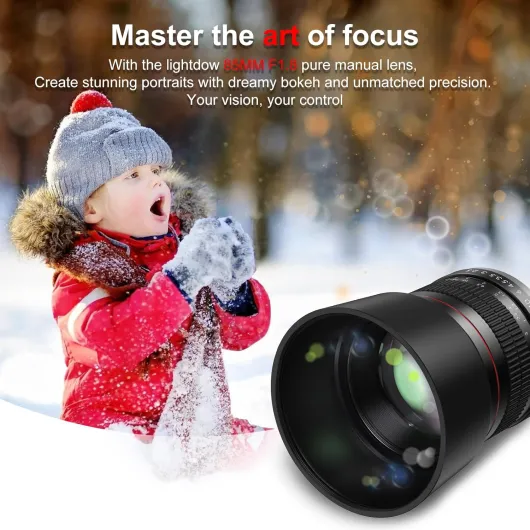
Image quality and focusing: strong blur, mixed sharpness feedback
On paper, the effectiveness of this lens comes from three things: the 85mm focal length, the bright f/1.8 aperture, and the 6‑blade rounded diaphragm. This combo is made for portraits with a shallow depth of field and pronounced background blur. The brand also highlights hybrid aspherical elements and multi‑coating (H‑ASP and UMC) to reduce aberrations and flare, promising clear images and “dreamy background blur.” In theory, that should give you reasonably sharp subjects with pleasing bokeh, especially at portrait distances.
Among the Amazon comments, several buyers are happy with image quality for the price. Phrases like “image quality is fantastic”, “pictures are clear” and “works well, clear” come back a few times. One Rebel T7 owner just sums it up as a great lens that fits perfectly and delivers clear results. Another reviewer, using a Nikon version, says that being forced to shoot manually has even improved their photos, which indirectly suggests that the optical output is good enough that the limiting factor becomes user skill rather than the glass itself.
But there is also at least one very harsh review that describes the lens as almost unusable beyond about 5 ft at any aperture wider than f/22, even when focusing at infinity on stars. That buyer calls the lens “jokingly bad”, complains about extreme blur at normal settings, and mentions a light leak issue. They suspect they might have a dud and are waiting for a replacement, but it shows that some units may be far out of alignment optically. When someone is forced to stop down to f/22 just to get stars in focus, that defeats the whole point of an f/1.8 portrait prime.
In my opinion, if you get a good copy, this lens should be effective for portraits, headshots and subject isolation, especially on APS‑C where 85mm behaves like ~136mm equivalent. You’ll likely have some softness and aberrations wide open at f/1.8, as is common on cheap fast primes, but for social media or moderate prints, that can be perfectly acceptable. The concern is variability: user feedback suggests some copies perform decently for the money, while others suffer from serious optical or mechanical flaws. So effectiveness is not just about the design; it heavily depends on whether your specific unit is properly assembled.
Pros
- Very low price for an 85mm f/1.8 lens compatible with Canon EF/EF-S
- Bright aperture and 85mm focal length suited to portraits and background blur
- Mostly metal construction and simple manual design with large focus ring
Cons
- Fully manual with no autofocus or electronic contacts; requires manual camera setup
- Quality control appears inconsistent, with some reports of severe optical or mechanical issues
- Not ideal for fast action or professional work due to manual focus and potential sample variation
Conclusion
Analysis score
The Lightdow 85mm f1.8 EF is a very cheap way to get into the 85mm portrait look on Canon DSLRs and EF‑compatible bodies. On paper, it ticks key boxes: 85mm focal length, bright f/1.8 aperture, full‑frame coverage, and a mostly metal build. The average 4.0/5 score across a large number of reviews suggests that many buyers feel they got their money’s worth, especially those who knew they were buying a fully manual lens and wanted to practice manual focusing while enjoying strong background blur.
At the same time, the feedback also shows clear compromises: no autofocus, no electronics, a mandatory manual‑exposure workflow, and real doubts about consistency. Some users praise the sharpness and clarity for the price, while at least one describes a copy that was almost unusable except at f/22 and complains about a light leak at the mount. That kind of variability is the main risk here. The brand’s after‑sales support seems responsive, but you still need to be ready to test your copy quickly and possibly go through replacements or returns.
In my opinion, this lens makes sense for budget‑minded photographers and learners who want to experiment with portraits, understand depth of field, and train manual focus skills without investing heavily. It is less suitable for people who expect Canon‑like reliability, fast autofocus, and consistent quality across copies. If you’re okay with some potential headaches in exchange for a very low entry price into fast 85mm territory, it can be a useful tool. If you need something you can trust for important work, this is probably not the right place to cut costs.