Summary
Analysis score
Average of the criteria rated below
Value for money: where this kettle stands
Design: minimalist, matte, and counter-friendly
Materials and build: stainless steel first, plastic kept away from water
Durability and reliability over time
Heating performance and pouring control
What this Mecity gooseneck kettle offers on paper
Pros
- 304 stainless steel interior with no plastic contact with water, reducing risk of off-tastes
- Gooseneck spout for controlled, precise pouring suited to pour-over coffee and tea
- Compact 0.8 L capacity and 1000 W power give quick boils for one or two servings
Cons
- Small 0.8 L capacity is limiting for families or cooking tasks
- No detailed information on advanced temperature control or presets compared with high-end barista kettles

Specifications
View full product page →| Brand | Mecity |
A small gooseneck kettle aimed at coffee and tea fans
The Mecity Electric Gooseneck Kettle targets people who want more control than a basic jug kettle, especially for pour-over coffee and more precise tea brewing. On paper, it’s a compact 0.8 L / 27 fl oz stainless steel kettle with a 1000 W heater, gooseneck spout, and auto shut-off. It sits around the mid-range price bracket for electric kettles, but the feature set clearly leans toward coffee hobbyists rather than families boiling water for pasta.
Its average rating sits at about 4.5/5 over more than 1,100 reviews, which suggests that most buyers are satisfied with how it performs on daily tasks like making coffee, tea, or instant drinks. Several comments highlight quick heating, quiet operation, and good control while pouring. That already gives a decent idea of what this product is good at, even without any fancy app or smart features.
The brand insists on the stainless steel construction and the fact that water doesn’t touch plastic, which speaks directly to buyers who are wary of plastic taste or potential leaching at high temperatures. Reviews echo this point, with multiple users mentioning that they specifically chose this kettle to avoid silicone or plastic taste and seem reassured by the design once they start using it.
It’s not a high-capacity unit, and it doesn’t try to compete with 1.7 L family kettles. Instead, it looks like a focused tool for one or two people making pour-over coffee or tea with a bit of ritual. In my opinion, the promise here is simple: a small, stainless steel, gooseneck kettle that heats fast, looks good on the counter, and keeps plastic away from hot water.
Value for money: where this kettle stands
The Mecity Electric Gooseneck Kettle sits in a price range where you can find both basic plastic kettles and some entry-level specialty coffee kettles. One verified buyer explicitly states that, for under $40, the kettle feels like a high-end product. That’s a strong statement from someone who actually paid for it, and it gives a hint about perceived value. Considering the stainless steel interior, gooseneck spout, auto shut-off, and likely some form of temperature control, the feature set looks competitive for that price bracket.
In terms of trade-offs, the main limitation is clearly the 0.8 L capacity. If you need to boil water for several people or for cooking, you’d probably want a 1.5–1.7 L kettle. Here, you’re paying for controlled pouring and materials rather than sheer volume. For someone who mainly makes pour-over coffee or tea for one or two people, that’s not a drawback; it’s actually efficient, because you’re not wasting time and power heating excess water. But for a family kitchen, it might feel too small and require multiple boils.
The overall user rating of 4.5/5 from more than 1,100 reviews also weighs in the value discussion. When that many people rate a product highly, it usually means it delivers what it promises for most buyers. The comments highlight build quality, looks, quiet operation, and the absence of plastic taste. These are exactly the kind of things that justify paying a bit more than for a basic supermarket kettle. On the flip side, it doesn’t offer advanced smart features or ultra-precise barista-level control like some premium brands, so hardcore coffee geeks might see it as an entry point rather than an endgame tool.
In my opinion, the value is good to very good for its target user: someone who wants a compact stainless steel gooseneck kettle, cares about avoiding plastic contact with water, and doesn’t need a massive capacity. If you’re only going to boil large quantities of water with no interest in pour-over control, you can get a bigger, simpler kettle for similar money. But if controlled pouring and materials matter to you, the Mecity model looks like a sensible compromise between price, performance, and build.
Design: minimalist, matte, and counter-friendly
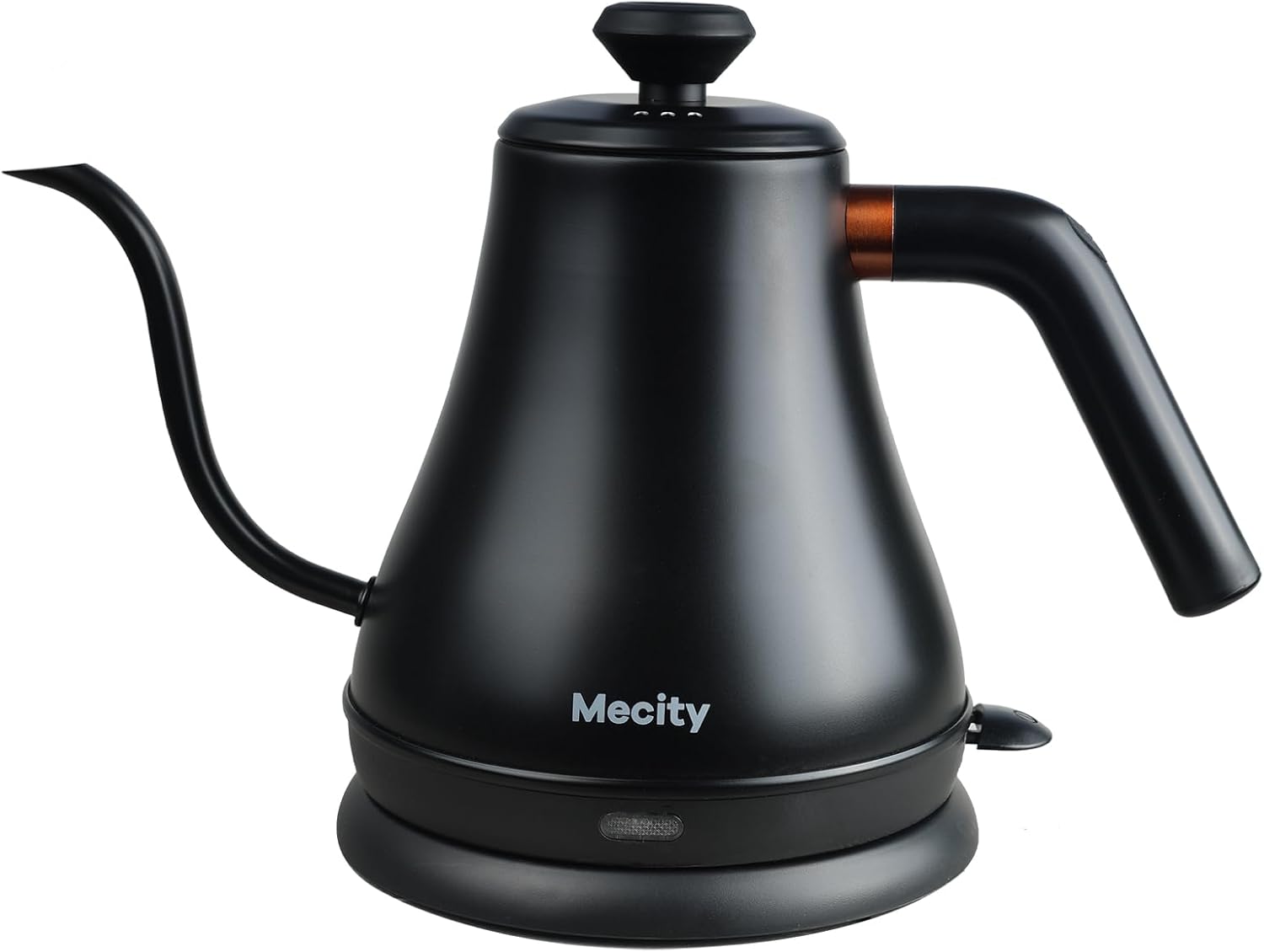
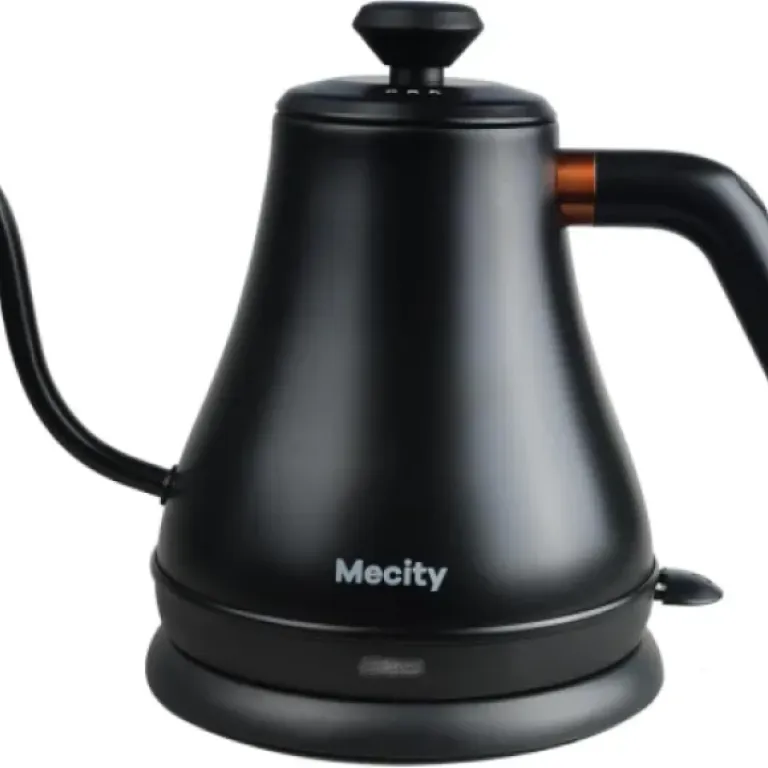
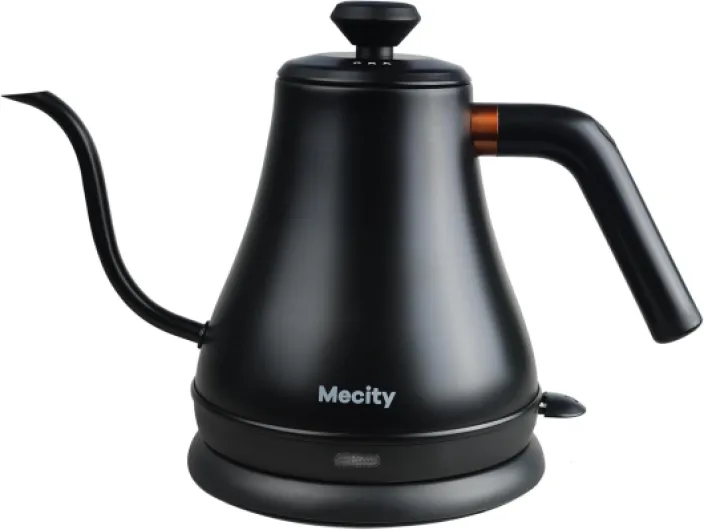
The Mecity gooseneck kettle goes with a matte black finish and a fairly minimalist silhouette. The brand even calls out the fact that it was designed in California, and several buyers comment on how it looks on their counter. Words like "stylish," "trendy," and "fits perfectly with my kitchen" come up in the reviews, which suggests the visual side is a real selling point. The matte finish is also mentioned as being resistant to smudges, which is practical for a black appliance that gets handled daily.
The gooseneck spout gives it that classic specialty-coffee profile: long, thin, and curved for better control. One review notes that pouring is smooth and accurate, which is the whole point of this type of design. The kettle body itself is relatively compact, and with 0.8 L of capacity, it doesn’t need to be bulky. As a result, it should sit comfortably even on a small countertop or desk. At roughly 2.9 lb, it’s light enough on paper that most people should move it around without much effort, yet some buyers still describe it as feeling "sturdy" and "well built," so it doesn’t sound flimsy.
There is an indicator light and what buyers describe as a signal when the water is ready. The spec sheet lists this as a special feature, but doesn’t go into detail about whether it’s only a light or also includes an audio cue. Either way, users say it’s clear enough to know when heating is done. The base seems to follow the usual circular design of most cordless electric kettles, and the whole thing is described by buyers as "very functional," which implies that the everyday ergonomics don’t get in the way.
In my opinion, the design is a strong point for this product: the combination of matte black, neat curves, and a gooseneck spout gives it a modern coffee-bar look without going into gimmicky territory. It’s not overloaded with buttons or screens, which will appeal to people who just want a clean, simple tool. The only minor aesthetic complaint spotted in the reviews is from someone who bought the milk white color and noticed slight color variation between body and lid; that doesn’t directly concern the matte black version, but it shows that finish consistency isn’t absolutely perfect across the range.
Materials and build: stainless steel first, plastic kept away from water
Mecity emphasizes that this kettle is "mostly made of 304 stainless steel" and that no plastic contacts the water. For many buyers, this is the main reason to choose it over cheaper plastic kettles. 304 stainless steel is a common food-grade alloy, used in cookware and kitchen appliances because it’s corrosion-resistant and durable. The spec sheet explicitly lists "corrosion-resistant and durable" under material features, which matches what you’d expect from 304 steel in a kettle that regularly faces boiling temperatures.
The product description also mentions a mechanical temperature sensor made of stainless steel instead of an electronic sensor that might be more fragile. The claim is that this mechanical sensor is more reliable and durable, extending the life of the kettle. Without lab data it’s impossible to verify the long-term difference, but the idea is clear: fewer electronic parts inside the hot water path and more passive, mechanical components. Several buyers report using the kettle daily over months with no issues, which gives some indirect support to the durability claims so far, even if that’s still relatively short in kettle terms.
Reviews repeatedly stress that there is no plastic or silicone taste in the water. One buyer specifically says they chose this model because they were tired of silicone taste and were happy to find that the water from this kettle doesn’t carry that flavor. That lines up with the "no plastic contact" claim: if the internal surfaces are indeed all metal, that should limit the risk of off-tastes, provided the stainless steel is properly finished and rinsed before regular use.
In my opinion, for the price bracket, the material choices look solid. A full-stainless interior with minimal plastic exposure is a plus, and the mechanical sensor is an interesting angle for longevity. There’s no mention of fancy coatings or non-stick interiors, which is actually a good thing in this case: fewer coatings usually mean fewer things that can peel or degrade. If there’s a weak point, it’s that we don’t have detailed information on the handle material or any external plastic parts beyond the general claim that water doesn’t touch them. But from what buyers are saying, there are no widespread complaints about smells, flaking, or cheap-feeling materials.

Durability and reliability over time
Durability is always tricky to judge early, but there are a few concrete elements here. First, Mecity highlights the use of a stainless steel mechanical temperature sensor instead of a more fragile electronic probe. The claim is that this design is more reliable and expands the kettle’s service life. Mechanically driven cut-offs have been used in kettles for years, and they tend to be robust if properly engineered, so the logic behind this claim makes sense on paper.
The kettle’s body and interior are mainly 304 stainless steel, which is known for good corrosion resistance. Electric kettles often fail due to scale buildup and corrosion at joints or seams, so using a common, proven alloy is reassuring. The product care instructions specify hand washing, which is normal for this type of appliance. As with any stainless steel kettle, regular descaling will likely be important for long-term reliability, especially in hard water areas, but this isn’t unique to Mecity.
In the reviews, there are some signs of decent early durability. One buyer mentions having the kettle for about five months with daily use and says it has been working perfectly. Others describe it as "sturdy" and "well-built." There are no major patterns of early failure, leaks, or broken handles in the comments provided. That doesn’t guarantee flawless longevity, but if there were widespread issues in the first few months, they tend to show up quickly in ratings and angry reviews, which doesn’t seem to be the case here given the 4.5/5 average across more than a thousand ratings.
In my opinion, the durability picture is cautiously positive: stainless steel construction, a mechanical sensor, and the absence of plastic in the hot water path all point in the right direction. It’s not a heavy-duty commercial kettle, and the 0.8 L capacity clearly places it in the home niche, but for a daily-use home appliance, nothing stands out as a red flag. Long-term durability beyond a couple of years remains an open question as with any relatively young product, yet the early user feedback and material choices suggest at least a solid baseline.
Heating performance and pouring control
On the performance side, the Mecity gooseneck kettle combines a 1000 W heating element with a relatively small 0.8 L capacity. That combination should, on paper, give fairly quick boil times for the amount of water typically used in pour-over brewing. Several buyers explicitly say it "heats quickly" or "heats up very quick," and one person who uses it daily over several months still highlights this as a strong point. There are also comments about the kettle being "impressively quiet" with just a soft hum during heating, which is appealing if you’re making coffee early in the morning or in a shared space.
Multiple reviews also mention precise temperature control and a hold-temp feature. The base spec list doesn’t spell out the exact implementation (no clear mention of digital display or exact degree settings here), but users talk like there is at least some form of temperature selection and the ability to maintain temperature. That would make it more flexible for different brewing styles: cooler water for green tea, hotter for black tea or coffee. The fact that buyers are satisfied with this function suggests that, even if it’s not as advanced as high-end barista kettles, it’s good enough for home use.
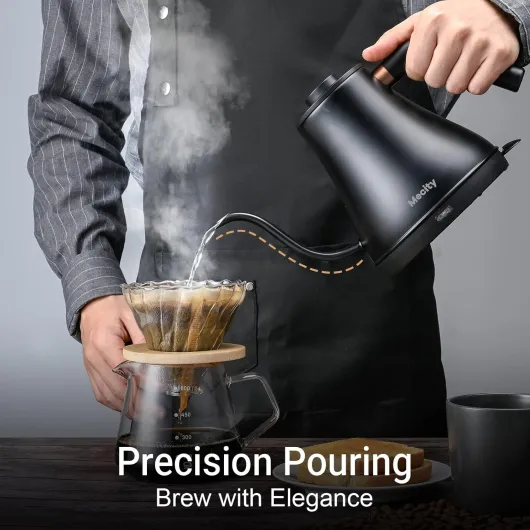
The gooseneck spout is another big part of performance. Owners say it allows smooth, accurate pouring, which is key for pour-over: you want to control both flow rate and direction without dumping too much water at once. This is where a gooseneck design beats a standard wide spout. With only 0.8 L capacity, the kettle will naturally be lighter when half full, which should further help with control, especially for people who are still learning pour-over techniques.
From a safety and reliability angle, the auto shut-off and boil-dry protection are important performance features too. They reduce the risk of overheating if you forget the kettle, and they protect the hardware from damage. There are no widespread complaints in the reviews about the kettle failing to shut off or boiling endlessly, which is a good sign. In my opinion, performance-wise, this model is clearly tuned for individual coffee and tea prep rather than bulk boiling. If you regularly need to boil a full liter or more at once, it will feel limited; but for its intended use, the feedback around speed, noise, and pouring precision is clearly positive.
What this Mecity gooseneck kettle offers on paper
The Mecity Electric Gooseneck Kettle is a 0.8 L (27 fl oz) electric kettle rated at 1000 W. That capacity is on the small side compared with standard electric kettles (often 1.5–1.7 L), but it lines up well with pour-over brewing, where you usually need 300–600 ml per session. At 1000 W, it should be able to bring that amount of water to a boil fairly quickly without drawing as much power as some 1500–1800 W models. The dimensions, roughly 7.7"L x 9.4"W x 12.8"H and a weight of about 2.9 lb, suggest a compact footprint that won’t dominate a countertop.
The spec sheet highlights 304 stainless steel as the main material, with the brand explicitly saying there is no plastic contacting the water. That’s an important selling point for buyers who are sensitive to off-tastes or skeptical about plastic parts in hot environments. It also comes with core safety features: automatic shut-off and boil-dry protection, which are now standard but still crucial. If the kettle runs out of water or reaches boiling, it should cut off power by itself.
In terms of usage, the product is positioned simply as a boiling tool, with “Recommended Uses: Boiling.” There is mention in at least one review of a hold-temp or keep-warm feature, though the base spec given here doesn’t go into detail on temperature presets or a digital display. That suggests Mecity might have variants or firmware differences, or the feature is basic rather than a full temperature-control system with exact degrees displayed.
Included in the box is the kettle itself and a heating base. There’s no mention of extra accessories like cleaning brushes or measuring tools. Care instructions say hand wash, which is standard for electric kettles since you can’t immerse the base or heating element. Overall, the presentation is straightforward: a small-capacity gooseneck kettle focused on stainless steel, safety, and controlled pouring, rather than on smart connectivity or large volume.
Pros
- 304 stainless steel interior with no plastic contact with water, reducing risk of off-tastes
- Gooseneck spout for controlled, precise pouring suited to pour-over coffee and tea
- Compact 0.8 L capacity and 1000 W power give quick boils for one or two servings
Cons
- Small 0.8 L capacity is limiting for families or cooking tasks
- No detailed information on advanced temperature control or presets compared with high-end barista kettles
Conclusion
Analysis score
The Mecity Electric Gooseneck Kettle positions itself as a compact, stainless steel option for people who care about pour-over control and water purity more than raw capacity. With 0.8 L volume and a 1000 W heater, it’s clearly aimed at coffee and tea drinkers preparing drinks for one or two people at a time. The gooseneck spout, stainless steel interior with no plastic contact, and mechanical temperature sensor are the main selling points, and the user feedback largely confirms that these aspects work as intended. Buyers talk about quick, quiet heating, precise pouring, and no plastic or silicone taste, which lines up well with the spec sheet.
It’s not a do-it-all kitchen kettle for a big household, and it doesn’t chase high-end barista features like ultra-granular temperature presets or advanced displays. Instead, it offers a focused feature set at a relatively accessible price, with a design that many find attractive on the countertop. In my opinion, it suits people who want to step up from a basic plastic jug kettle into the world of pour-over and specialty tea without spending high-end money. Those who need large capacity or are indifferent to pouring precision might be better off with a larger, simpler model, but for compact, daily coffee and tea use, the Mecity kettle looks like a solid and sensible pick.