Summary
Analysis score
Average of the criteria rated below
Value for money: strong for casual riders, with clear trade-offs
Design and practicality: compact, simple, with a few quirks
Battery and range: 12 miles on paper, less in real life but still usable
Build quality and reliability: sturdy feel but watch the weather
Speed, acceleration and hills: decent for flat city rides
What the iScooter i8 offers on paper
Pros
- Solid value around the budget price point with 18 mph top speed and 350W motor
- Lightweight (26.4 lb) and quick-folding design suitable for carrying and trunk storage
- Dual braking system (disc + EABS) and built-in lights for safer commuting
Cons
- Range and power drop as the battery level decreases, especially for heavier riders or hills
- No latch to keep the scooter locked in the folded position, making it awkward to carry
- Not suited for rain or wet conditions, with at least one user reporting issues after getting it wet

Specifications
View full product page →| Brand | iScooter |
A budget commuter scooter that’s getting a lot of attention
The iScooter i8 is one of those low-priced electric scooters that pops up a lot in rankings, and the numbers explain why: it sits around the #27 spot in Electric Scooters on Amazon, with a 4.4/5 average from more than 1,100 reviews. On paper, it targets adults and teens with an 18 mph top speed, 12-mile advertised range, and a 350W motor, all in a 26.4 lb frame. So clearly it’s aimed at short daily commutes, campus runs, and neighborhood rides rather than long-distance travel.
The brand pushes a few key arguments: foldable in 3 seconds, double braking system (disc + EABS), cruise control, and lighting for night rides. It also claims a 220 lb weight limit, which matters for heavier riders wondering if a budget scooter will still pull them up moderate slopes. Several reviews from verified buyers highlight that it feels sturdy for the price and that the speed and range are decent for everyday use, especially when the battery is near full.
There are, however, some clear limits emerging from the comments. One recurring point is that the scooter loses power as the battery gauge drops, both in speed and hill-climbing ability. Another user points out that there’s no lock mechanism to keep it closed when folded, which makes carrying it awkward. There’s also at least one clear warning: this is not a rain-friendly scooter, with a buyer describing issues after it got wet on a porch.
In my opinion, the i8 looks like a pragmatic, low-cost option for light use rather than a robust daily workhorse for long, hilly commutes. It seems to hit a solid balance between price, performance and weight, but there are compromises on range, weather resistance, and a few practical details. The rest of the analysis digs into design, performance, battery, durability, and value to see who this scooter really suits.
Value for money: strong for casual riders, with clear trade-offs
The iScooter i8 positions itself clearly as a budget electric scooter. Several reviewers explicitly mention that, for roughly the $200 range, it offers a lot: usable speed, decent range for short trips, cruise control, dual braking, lights, and a relatively light chassis. One buyer sums it up as “not too bad for a $200 scooter,” which captures the general mood: it’s not premium, but you get a functional commuter or neighborhood scooter without spending a fortune.
On the plus side for value, you have:
- 18 mph top speed and a 350W motor, enough for basic commuting.
- 12-mile advertised range, which real users say can be close to 10–12 miles depending on conditions.
- Lightweight 26.4 lb frame and quick folding for transport and storage.
- Dual braking system and lighting, which many cheap scooters cut corners on.
- A 4.4/5 average rating from over 1,100 reviews, indicating that most buyers feel they got their money’s worth.
On the downside, the scooter shows typical budget compromises. There’s no lock for the folded position, making it less practical to carry. Performance drops noticeably as the battery empties, especially for heavier riders or steep hills. There’s no proper weather sealing, with at least one case of issues after rain exposure. The rigid frame with no suspension also means comfort relies heavily on the 8.5-inch tires, which is fine for smooth roads but not ideal for rough surfaces.
In my opinion, the value is strong for the right profile: teens, students, and adults with short, mostly flat commutes who can store the scooter indoors and don’t ride in the rain. For heavier riders, hilly cities, or people who need 15–20 miles of real-world range, spending more on a higher-capacity model would make sense. But if the goal is to keep costs low and still have a practical, fun way to move around a neighborhood or campus, the i8 offers a convincing package for the price bracket it targets.
Design and practicality: compact, simple, with a few quirks
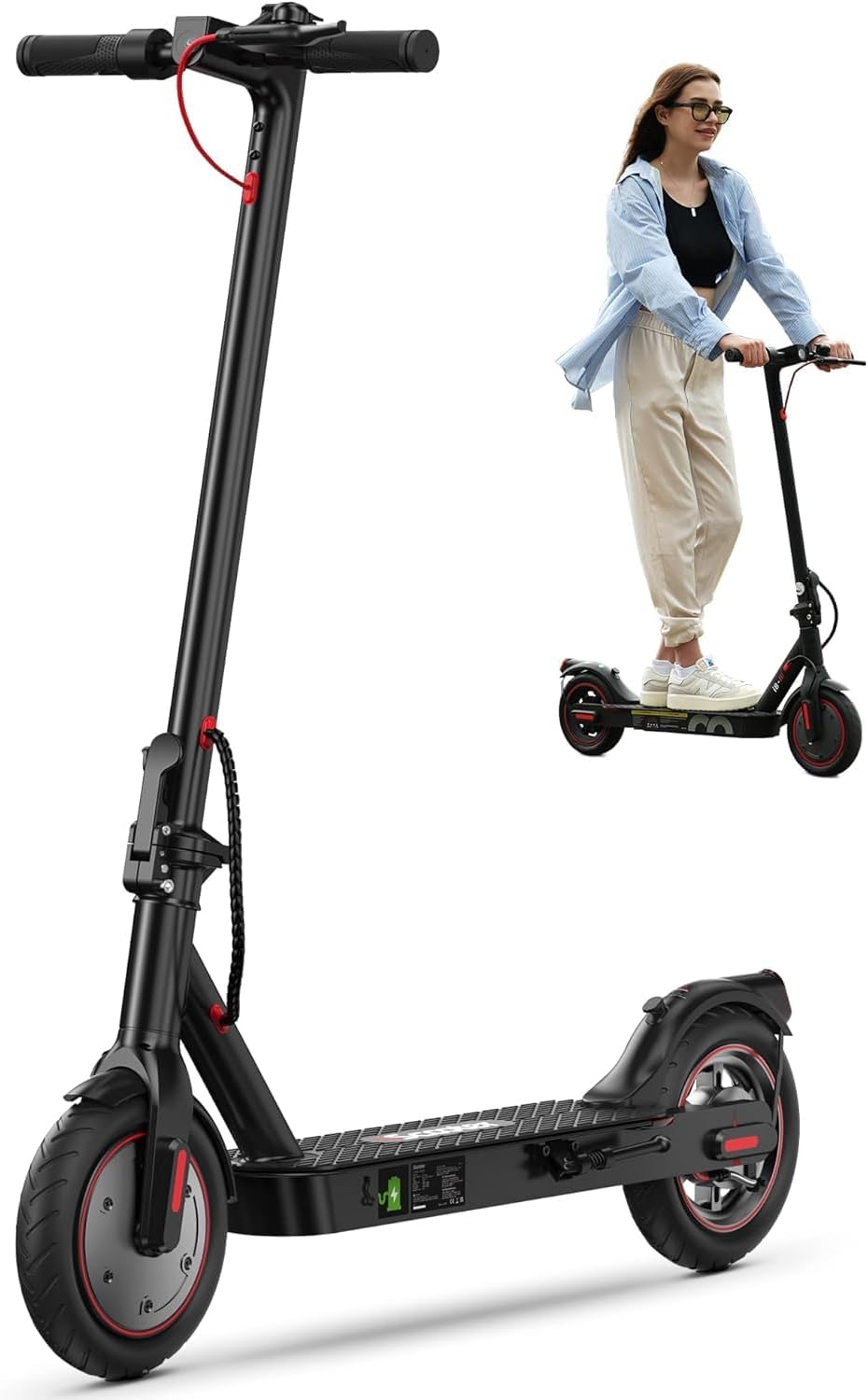
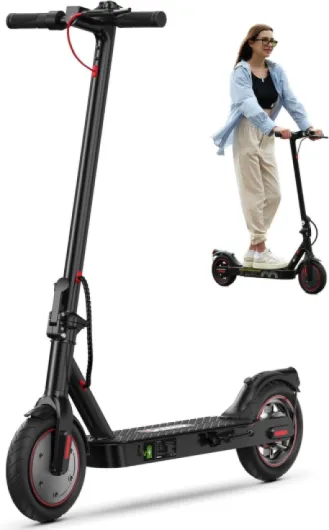
Visually and functionally, the iScooter i8 sticks to a classic black commuter scooter design: straight fixed handlebar, slim stem, and a narrow 6-inch wide deck. The compact dimensions (21 x 6 x 43 inches) and 26.4 lb weight clearly aim at people who need to store it in tight spaces, carry it into apartments, or fit it in a car trunk. Several reviews mention that it’s easy to fold and transport for school or neighborhood use, which is consistent with the manufacturer’s claim of a 3-second folding mechanism.
The cockpit appears simple: a display with mode selection, speed, and battery bars, plus a power button that also manages settings. The scooter comes set to “assist mode” by default, and there’s a somewhat hidden feature: you can switch to zero-start (push-button start) by pressing the power button four times quickly. That’s the kind of detail that can confuse new owners if they don’t read the manual, but once you know it, it gives a bit more control over how the scooter takes off.
One practical downside that stands out in the comments: the scooter does not lock in the folded position. A buyer points out that when folded, there’s no latch to keep the stem attached to the deck or rear fender, making it awkward to carry. For someone using this daily with stairs or trains, that’s not a small detail. It doesn’t make the scooter unusable, but it’s the kind of basic ergonomic feature that many competitors now include, even at low prices.
Lighting and controls seem functional rather than fancy. You get headlight and taillight for night visibility, which is a minimum for any commuter scooter. The deck is described as non-slip, which is standard but still important for safety. In my opinion, the design is coherent: compact, straightforward, and clearly built around cost control. The main trade-offs are the lack of folded locking, the fixed handlebar height (no adjustability for very short or very tall riders), and an overall utilitarian feel. For a budget scooter, that’s acceptable, but not impressive.
Battery and range: 12 miles on paper, less in real life but still usable
The iScooter i8 comes with a 187.2 Wh battery, which is on the smaller side compared to mid-range scooters but typical for budget models. The brand claims up to 12 miles of range, and a charging time of 5–6 hours. On paper, that’s enough for short city commutes, quick errands, or several shorter rides across a few days if you only do a couple of miles at a time. It’s clearly not a long-distance machine, but it doesn’t pretend to be one either.
Among the reviews, one commuter gives a more concrete idea of what to expect: they report about 10–12 miles per charge with a combination of a long, steep hill and a heavier rider. That’s actually quite close to the advertised figure, which usually assumes a lighter rider on flat ground. This suggests that lighter users on mostly flat terrain could reasonably get around the claimed 12 miles, while heavier riders or hillier routes will see less. Another parent notes that their child gets about an hour and a half of riding per charge, and sometimes a charge lasts several days when used for shorter neighborhood sessions.
The main operational detail is how performance drops as the battery depletes. The commuter review mentions that once the battery indicator goes from 4 bars to 3, then down to 1–2, both speed and hill-climbing ability decrease noticeably. That’s quite common in this price range, but it means you should not expect the same punch at 30% battery as you get at 100%. For people planning a commute near the maximum range, this is a practical concern: you may still reach your destination, but more slowly, especially if there are hills.
Charging time of around 5–6 hours is moderate: plug it in after work or in the evening, and it should be ready the next morning. There’s no mention of removable batteries, so all charging happens on the scooter. In my opinion, the battery setup is adequate for short-distance users: daily commutes of 3–5 miles each way or occasional rides are fine, but if you want to do 10+ miles every single day with hills, you’re pushing the limits of this pack. For that use case, a scooter with a larger battery would make more sense.
Build quality and reliability: sturdy feel but watch the weather
From a construction standpoint, the iScooter i8 uses an aluminum frame and rubber pneumatic tires, with a rigid (non-suspended) design. Several buyers describe it as sturdy for the price, and one user who bought two units mentions both are working well and feel safe and solid in daily use. For a scooter in this cost bracket, that’s reassuring, because cheap frames and wobbly stems are a common complaint elsewhere.
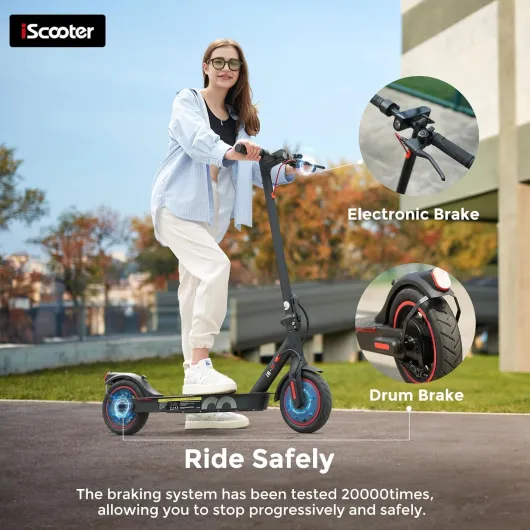
The double braking system (disc brake plus EABS regenerative braking) is another positive point for durability and safety. Mechanical disc brakes are relatively simple to maintain, and the EABS system helps prevent wheel lock-up and recovers a bit of energy. Reviews do not highlight systematic issues with brakes, which tends to suggest that, at least in the short term, the system holds up for typical commuting and neighborhood riding.
The most important durability warning comes from a user who left the scooter on a porch during a sudden rain shower. They report that afterwards the scooter would power on but not drive; after being left overnight and tried again later, it started working, but the experience clearly shows the model is not suited for wet conditions. There is no advertised high water-resistance rating, and this real-world anecdote confirms that exposure to rain can cause temporary or potentially more serious issues. For anyone in a rainy climate, this is a major point: this scooter is best treated as a fair-weather vehicle and kept under cover when not in use.
In terms of long-term durability, the product has only been available since April 2024, so there’s not a huge volume of long-horizon feedback yet. However, the 4.4/5 rating across more than 1,100 reviews suggests that there isn’t a widespread pattern of early failure or catastrophic defects. The brand also offers a limited warranty of 6 or 12 months depending on the part, which is standard at this price. In my opinion, the i8 seems reasonably solid for light to moderate urban use, provided you avoid rain and treat it as a budget commuter rather than a heavy-duty daily workhorse.
Speed, acceleration and hills: decent for flat city rides
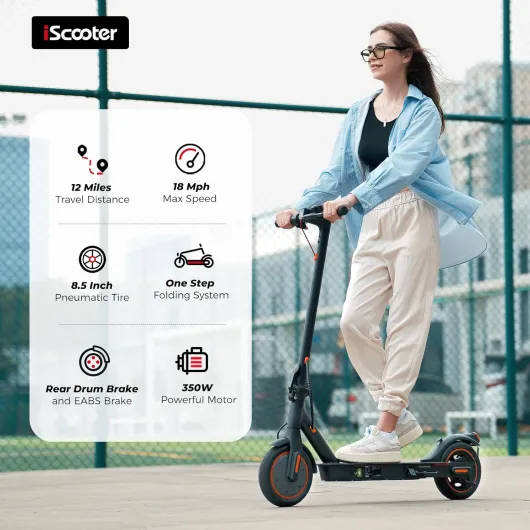
On the performance front, the iScooter i8 sits where you’d expect a 350W budget motor to be. The brand advertises up to 18 mph in the fastest mode, with two lower modes at about 6 and 12 mph. Several positive reviews mention that there is “plenty of speed” for casual riding and that it’s fun for both adults and older kids. For flat urban routes, that speed range is usually enough to keep up with bike traffic without feeling sluggish.
One commuter who uses it a couple of days a week notes that power and climbing ability are closely tied to battery level. At full charge (4 bars), the scooter pulls reasonably well, even up a long, steep hill, but once the battery drops to 3 bars or less, the scooter slows down and struggles more with inclines. That’s very typical for this motor size and battery capacity, especially with heavier riders, but it’s worth keeping in mind if your route has hills. Lighter riders and teens will likely notice less of a drop compared to adults closer to the 220 lb limit.
In straight-line riding, buyers describe the scooter as smooth enough for roads, driveways and even grass in a yard, thanks in part to the 8.5-inch pneumatic tires. There’s no suspension, so this is not a performance model for rough terrain, but for basic city surfaces it seems to handle daily use without major complaints in the reviews. The cruise control feature is also highlighted as a plus, providing a more relaxed ride on longer straight sections, which is unusual but welcome at this price level.
Overall, in my opinion, performance is decent but nothing more. The i8 isn’t built for speed addicts or heavy hill climbing. It fits better as a moderate-speed commuter or a neighborhood scooter for teens and adults who mostly ride on flat ground. If you weigh close to the 220 lb limit or live in a very hilly area, you should expect reduced speed on climbs and when the battery drops below full. For light to moderate riders on mostly flat routes, the performance should be adequate for the price segment.
What the iScooter i8 offers on paper
The iScooter i8 is positioned as a compact commuter scooter for adults and teens (suggested 14+). It uses a 350W motor with three speed modes (around 6 / 12 / 18 mph), which should allow both cautious beginner riding and faster urban cruising. The advertised top speed of 18 mph is fairly standard in the budget segment and is enough for city bike lanes and neighborhood streets, without drifting into high-performance territory.
The battery is listed at 187.2 Wh, with an advertised maximum distance of 12 miles and a charging time of about 5–6 hours. That clearly places it in the short-range category: it’s more for 3–5 mile commutes each way or casual rides than for long urban cross-town trips. One commuter comments that they get roughly 10–12 miles on a charge with hills and a heavier rider, which actually lines up decently with the spec sheet, as real-world range is usually below the advertised figure.
The scooter weighs 26.4 lb (about 12 kg) and folds with a one-step mechanism. That weight is light enough to carry up a few flights of stairs or throw in a trunk, but it’s not ultra-light either. The frame is aluminum, with 8.5-inch pneumatic rubber wheels, a fixed handlebar at 43 inches, and a non-slip deck. iScooter announces a 220 lb (100 kg) weight limit, which is important for adults near that threshold; one review from a heavier user does confirm that the scooter still manages hills, but slows once the battery drops.
On the safety and comfort side, you get front headlight, rear warning taillight, and a double braking system: mechanical disc brake plus EABS regenerative anti-lock braking. There’s no suspension (rigid fork and frame), so comfort depends heavily on the 8.5-inch pneumatic tires. In my opinion, the overall presentation is that of a straightforward, no-frills commuter: enough power for flat-city use, limited range, practical folding, and a focus on keeping the price down while still offering the basics like lights and dual brakes.
Pros
- Solid value around the budget price point with 18 mph top speed and 350W motor
- Lightweight (26.4 lb) and quick-folding design suitable for carrying and trunk storage
- Dual braking system (disc + EABS) and built-in lights for safer commuting
Cons
- Range and power drop as the battery level decreases, especially for heavier riders or hills
- No latch to keep the scooter locked in the folded position, making it awkward to carry
- Not suited for rain or wet conditions, with at least one user reporting issues after getting it wet
Conclusion
Analysis score
The iScooter i8 comes across as a no-nonsense budget scooter that does what it says, as long as you use it within its limits. On paper and in the reviews, it delivers a usable 18 mph top speed, a real-world range that can approach 10–12 miles in favorable conditions, and a light 26.4 lb frame that folds quickly for storage. The dual braking system, headlight and taillight, and cruise control are solid features for this price level, and the 4.4/5 rating from over a thousand buyers suggests that most users are satisfied with what they get.
It’s not perfect. Performance drops as the battery drains, especially for heavier riders and on hills. There’s no latch to keep it locked when folded, which is annoying if you carry it often. Comfort is basic with no suspension, and the model clearly doesn’t like rain, so it needs to be treated as a fair-weather scooter. In my opinion, it’s well-suited for teens, students, and adults who want an affordable way to cover short, mostly flat trips, ride around the neighborhood, or commute a few miles each way and can store it indoors.
If you’re heavier, live in a very hilly or rainy area, or need long daily range, this is probably not the right tool; looking at more powerful, better-sealed scooters with larger batteries would be wiser. But for light to moderate use with realistic expectations, the i8 offers good value and a practical entry point into electric scooters without a big financial risk.