Summary
Analysis score
Average of the criteria rated below
Price-to-performance: where the XT60 makes the most sense
Straightforward tower design meant to blend in
What to expect when you receive it
Build, reliability and what long-term owners suggest
Sound performance and home theater behavior from reviews and specs
What the Polk Monitor XT60 offers on paper
Pros
- Strong price-to-performance for home theater when paired with a sub and center
- Hi-Res Audio certified and compatible with Dolby Atmos, DTS:X and Auro 3D setups
- Lightweight, easy-to-place tower with rubber feet for carpet and hardwood
- Part of a timbre-matched Monitor XT ecosystem for easy 5.1 or 7.1 expansion
Cons
- Basic vinyl-wrapped MDF cabinet with plain aesthetics
- Sold as a single speaker, so costs add up when buying pairs and full surround
- Needs a subwoofer for truly deep bass and maximum movie impact

Specifications
View full product page →| Brand | Polk Audio |
A budget tower that’s all about home theater value
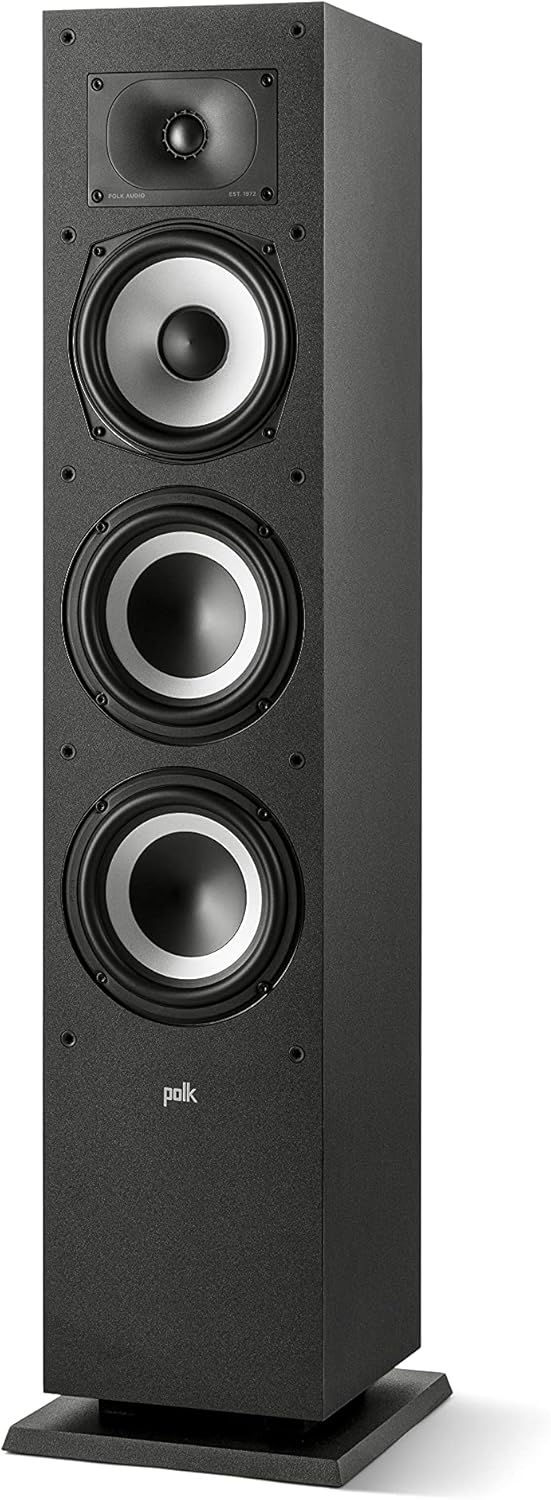
The Polk Monitor XT60 sits in a very specific spot: a budget-friendly floorstanding speaker that tries to plug straight into modern home theater setups. On paper, it combines a 1" Terylene tweeter, a 6.5" woofer and two 6.5" passive radiators in a relatively compact tower that weighs about 20 lb. It’s advertised as Hi-Res Audio certified and compatible with Dolby Atmos, DTS:X and Auro 3D, so the promise is clear: give people an affordable way into surround systems without chasing audiophile gear.
In the published reviews, the wider XT family (XT60, XT70, XT subs and centers) gets a lot of praise for price-to-performance. The XT60 itself sits around 4.6/5 from several thousand ratings, which is strong for a mass-market speaker. Buyers who run full Polk XT setups with Denon or similar AVRs often describe the result as punching above its price, especially in home theater use with blockbuster movies and streaming content.
On the flip side, the spec sheet shows some expected compromises. This is a vinyl-wrapped MDF box, not a high-end wooden enclosure, and there’s no built-in amplification or wireless streaming. It’s an 8-ohm passive speaker designed to be driven by a receiver or amp, with a claimed power handling up to 200 W. So you’re not getting luxury materials or audiophile bragging rights; the focus is on getting decent sound pressure and clarity into a living room without spending a fortune.
Overall, the XT60 comes across as a practical workhorse: simple wired connectivity, home-theater-friendly tuning, and a design that should mix easily with other Monitor XT models. In my opinion, the interest here is less about chasing ultimate detail and more about putting together a full 5.1 or 7.1 system that feels coherent, loud enough, and reasonably clear for movies and casual music listening.
Price-to-performance: where the XT60 makes the most sense
The XT60 is clearly positioned as a value-focused tower. While the exact price isn’t shown here, it sits in the entry-level to lower midrange segment, competing with other affordable floorstanders from brands like Yamaha, Sony and Pioneer. The combination of a 4.6/5 average rating and thousands of reviews for related XT products hints that Polk has hit a sweet spot for many buyers: enough performance to feel like a real upgrade from soundbars or tiny satellites, without jumping into expensive hi-fi territory.
The real value appears when you look at the whole Monitor XT ecosystem. You can pair XT60 towers with the MXT20 bookshelves, MXT30 center, MXT90 height modules and MXT12 sub to build a complete 5.1 or 7.1.2 system on a budget. One reviewer who built a full XT-based home theater, powered by a Denon AVR, says the total spend was around $1,200–$1,300 and describes performance similar to systems three to four times that price. That kind of anecdote shows why these speakers are popular among people setting up dedicated rooms without wanting to overspend.
Of course, there are compromises. You’re not getting premium cabinet finishes, exotic drivers, or the last word in refinement. Compared with more expensive towers, the XT60 will likely have less low-end authority on its own and a more modest sense of detail at very high volumes or in critical listening. Also, the fact that each listing is for a single speaker means the perceived price may feel less attractive once you realize you need two for stereo and more for surround.
In my opinion, the XT60’s value is strong if your goal is home theater first, music second, on a limited budget. If you already plan to add a subwoofer and a matching center, the XT60 can serve as capable front channels without draining your wallet. If you mostly listen to two-channel music and care deeply about timbre, imaging and cabinet finish, it may be worth stretching to a more music-oriented tower. But for someone coming from a TV’s built-in speakers or a basic soundbar, the jump in impact and clarity with an XT60-based system should feel significant for the money.
Straightforward tower design meant to blend in
The XT60 goes for a no-nonsense tower look: black vinyl veneer, rectangular cabinet, and a standard cloth grille. There’s nothing flashy or boutique here, which fits the budget positioning. Buyers often describe Polk Monitor XT gear as looking modern and professional enough for living rooms and dedicated theater rooms, without drawing too much attention. On paper, the footprint (roughly 17.9"D x 16"W x 16.4"H is clearly mis-listed; the height is closer to 1043 mm / ~41") suggests a slim-ish tower that won’t dominate a medium-size room.
The cabinet uses MDF with a vinyl wrap, typical for this price range. You’re not getting real wood or fancy finishes, but comments about the XT series regularly mention that build feels decent and not toy-like, even if the speakers are lighter than some competitors. The included rubber feet are designed for both carpet and hardwood floors. That may sound minor, but it’s handy if you’re rearranging your room or moving from an apartment with carpet to a house with wood floors; you don’t need extra spikes or pads just to get started.
In terms of visual integration, the XT60 is clearly designed to disappear next to a TV. The black color helps it blend with most electronics and media furniture. With the grille on, it looks like a simple black column; with the grille off, you see the woofer and passive radiators stacked under the tweeter. There’s no glossy piano finish or colored accents, which some people might find a bit plain, but that also means it won’t clash with your décor.
In my opinion, the design choice is pragmatic: Polk keeps costs down with basic materials and focuses on a clean, neutral look. If you want a piece of furniture that doubles as a visual centerpiece, this probably won’t impress you. But if you just need functional towers that don’t look cheap and align visually with a center channel and sub from the same family, the XT60 design makes sense. The trade-off is obvious: understated looks and vinyl wrap instead of premium aesthetics, in exchange for keeping the price accessible for building a full surround system.
What to expect when you receive it
The product listing indicates that the XT60 is sold as a single tower (“Unit Count: 1.0”), not as a pair. That’s important for expectations: if you’re building a stereo or front left/right setup, you’ll need to order two units. The included components are minimal: essentially the speaker itself and documentation. No cables are provided, which matches what several audio buyers mention across Polk products—they typically use their own speaker wire and banana plugs anyway.
The tower ships with rubber feet for floor placement, suitable for both carpet and hardwood according to the description. These feet are part of the setup experience because they influence stability and also protect floors. Owners of other Monitor XT speakers often say installation is straightforward: attach feet if required, connect speaker wire to binding posts, and you’re done. There’s no remote, no external power brick, and no calibration microphone; all that lives with your AVR or amp, not the speaker.
There aren’t many detailed comments specifically about XT60 packaging, but Polk generally packs speakers in foam with protective bags and cardboard bracing. Given the 20 lb weight, the box should be manageable for one person, though taller towers are still a bit awkward to maneuver in stairwells. As usual, it’s wise to keep the original packaging if you might move or resell the speakers later, since towers are easier to damage when transported loose.
In my opinion, the packaging and included accessories reflect the no-frills approach of the XT60. You’re paying for the drivers and cabinet, not a pile of extras. For most users, that’s fine; speaker wire and tools are usually already on hand when someone is assembling a home theater. The only real trap is forgetting that this is a single speaker listing and expecting a pair—so double-check your cart if you’re planning a stereo or 5.1 front stage.
Build, reliability and what long-term owners suggest
The XT60 uses standard materials for its price bracket: MDF cabinet, vinyl veneer finish, and conventional dynamic drivers. There’s no claim of weather resistance or water protection; the spec sheet even states that it’s not water resistant and not waterproof. So this is clearly meant for indoor living rooms, dens or dedicated theater rooms, not for patios or humid environments. At about 20 lb per tower, it’s lighter than some higher-end floorstanders, but that doesn’t automatically mean it’s fragile; it just reflects thinner walls and less internal bracing than premium models.
In the Amazon comments, people who own multiple Polk components often mention consistent build and durability across the brand. The XT series gets described as feeling of good quality without being overly heavy. No pattern of failures or major defects stands out in the overview of ratings; with a 4.6/5 average across thousands of reviews for the XT line and related models, serious quality issues would likely show up more clearly if they were common. The simple design—passive cabinet, no built-in amp, no electronics beyond the crossover—also tends to be less failure-prone than powered speakers or complex smart devices.
That said, vinyl-wrapped MDF has some obvious limits. It’s more vulnerable to dings, corner damage and peeling if you drag the speaker around or knock it with furniture. The light weight means it’s easier to tip over if someone bumps into it, especially in homes with kids or pets. Using the included rubber feet and placing the towers away from high-traffic paths is just common sense. There’s a limited warranty, which is standard for Polk, but details will depend on the region and seller, so it’s worth checking coverage for drivers and cabinets before purchase.
In my opinion, the XT60 should hold up fine under normal indoor use: stable placement, no moisture, and reasonable handling during moves. It’s not built like a tank, and it doesn’t pretend to be, but the basic construction and the lack of complicated electronics are in its favor for longevity. If you want something that can survive rough handling or constant relocation, you might want a more rugged enclosure. For a typical living room or theater that doesn’t see abuse, the durability looks adequate and aligned with the price.
Sound performance and home theater behavior from reviews and specs
On paper, the XT60 is built for room-filling, cinema-focused sound rather than ultra-precise audiophile listening. The combination of a 1" Terylene tweeter, a 6.5" woofer and two 6.5" passive radiators suggests a tuning that pushes decent bass and a wide soundstage. Polk highlights Hi-Res Audio certification and compatibility with Dolby Atmos, DTS:X and Auro 3D, which mainly signals that the speaker can handle extended high-frequency content and dynamic home theater tracks when driven by a capable AVR.
Among the published reviews of full XT setups, owners often describe the sound as crisp, dynamic and immersive for movies, with strong dialogue clarity when paired with the XT30 center. One user who built a dedicated theater with XT70 towers, dual XT30 centers, OWM3 surrounds and an XT12 sub, powered by a Denon AVR, says the system performs like something three to four times the price. Explosions, orchestral music and subtle dialogue are all described as clear and engaging, which indirectly reflects well on the XT front towers as the main left/right channels.
At the same time, this is still a budget tower. You should expect good output and clarity for the price, not miracles. The spec sheet doesn’t list ultra-deep bass extension figures, and owners nearly always run these with a subwoofer for serious home theater. That fits the design: the passive radiators help the XT60 reach lower than a simple bookshelf, but it isn’t meant to replace a dedicated sub if you want real impact in action scenes or EDM. For music, comments around the XT family generally mention a wide soundstage, tight enough bass and clean highs, especially when properly driven and calibrated with tools like Audyssey or Dirac on Denon/Onkyo receivers.
In my opinion, the XT60’s performance profile is clear: high-efficiency, versatile front channels that can get loud enough in small to medium rooms, with decent bass support and highs that suit modern movie mixes and streaming services. If you’re chasing micro-detail and absolute neutrality for critical two-channel listening, there are more specialized options. But for someone building a practical 5.1 or 7.1 system on a budget, the XT60 looks like a solid anchor that won’t be the weak link, especially once you add a sub and matching center.
What the Polk Monitor XT60 offers on paper
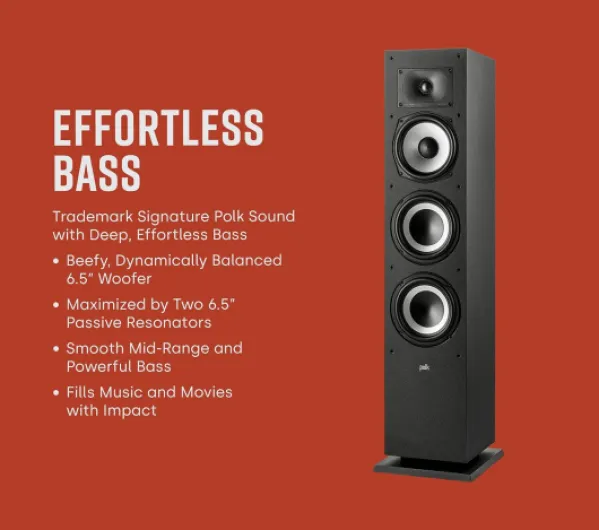
The core of the XT60 is a three-driver front array: a 1" high-resolution Terylene tweeter, one 6.5" dynamically balanced polypropylene woofer, and two 6.5" passive radiators. This layout suggests Polk is trying to squeeze more bass out of a relatively slim tower by using passive radiators instead of a larger cabinet or rear port. The brand claims smooth midrange and strong low end, and several home theater owners in the comments say the XT series delivers convincing bass for movies when paired with a subwoofer.
The speaker is rated at 8 ohms with a maximum power handling of 200 W and is designed as a passive, wired tower in a stereo or multichannel setup. It’s specified as Hi-Res Audio certified and compatible with Dolby Atmos, DTS:X and Auro 3D, which mainly means the frequency response and dispersion are suitable for use in modern AV receiver configurations. It does not have built-in amplification, Bluetooth streaming or smart features despite one line in the data mentioning Bluetooth; real-world setups described by buyers always involve an external amp or AVR.
Physically, the XT60 is a floorstanding tower in midnight black, with a height of around 1043 mm and a weight of about 20 lb. That’s relatively light for a tower, which matches comments saying the speakers feel solid but not overly heavy. Polk includes rubber feet meant to work on both carpet and hardwood, making placement easier for typical living rooms. Connectivity is standard speaker terminals, and reviews mention that the posts accept bare wire or banana plugs, which is what you’d expect at this price point.
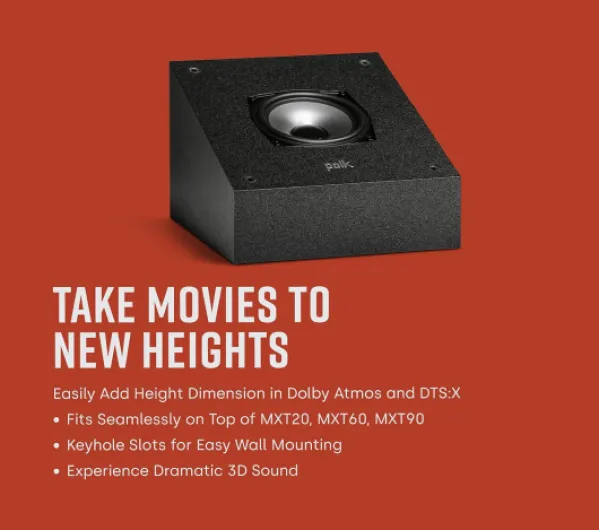
The XT60 sits inside the wider Monitor XT ecosystem: you can add the MXT20 bookshelf speakers, MXT30 center, MXT90 Atmos height modules and the MXT12 subwoofer. Several reviewers have built full systems around that family and describe a consistent timbre and coherent soundstage. In my opinion, that ecosystem angle is one of the main selling points: the XT60 isn’t trying to be a one-off stereo masterpiece but a main front-channel workhorse that integrates cleanly into a larger surround setup.
Pros
- Strong price-to-performance for home theater when paired with a sub and center
- Hi-Res Audio certified and compatible with Dolby Atmos, DTS:X and Auro 3D setups
- Lightweight, easy-to-place tower with rubber feet for carpet and hardwood
- Part of a timbre-matched Monitor XT ecosystem for easy 5.1 or 7.1 expansion
Cons
- Basic vinyl-wrapped MDF cabinet with plain aesthetics
- Sold as a single speaker, so costs add up when buying pairs and full surround
- Needs a subwoofer for truly deep bass and maximum movie impact
Conclusion
Analysis score
The Polk Monitor XT60 comes across as a practical, budget-friendly tower aimed squarely at people building or upgrading a home theater. On paper, the 1" tweeter, 6.5" woofer and dual passive radiators, combined with Hi-Res and Dolby Atmos/DTS:X compatibility, make sense for modern movie and streaming content. The cabinet and finish are basic, but published reviews of XT setups consistently describe clear dialogue, strong dynamics and satisfying bass when paired with a sub and matching center.
It’s not chasing audiophile prestige. You get vinyl-wrapped MDF, a relatively light cabinet and minimal accessories. For critical stereo listening and premium aesthetics, there are better—though more expensive—options. But as a main left/right speaker in a reasonably priced 5.1 or 7.1 system, the XT60 looks like a solid workhorse with good reliability and an easy-to-place footprint. The ability to mix and match within the Monitor XT line is a real plus for building a coherent system over time.
In my opinion, the XT60 is a good fit if you have a decent AVR, a small to medium room, and a priority on movies, TV and casual music over obsessive hi-fi listening. It’s less compelling if you want luxury finishes, deep standalone bass without a sub, or if your focus is two-channel music above all. As a value play for home theater, though, it hits its target well enough to justify the strong user reception.