Summary
Analysis score
Average of the criteria rated below
Value for money: cheaper than replacing your speakers
Compact box with straightforward layout
Aluminum housing and gold-plated RCA connectors
Reliability and long-term expectations
Stereo PCM performance and real-world use cases
What this PROZOR DAC actually does (and doesn’t do)
Pros
- Handles both Toslink/optical and coaxial digital inputs with simultaneous RCA and 3.5 mm analog outputs
- Supports up to 192 kHz / 24-bit stereo PCM/LPCM with an aluminum alloy housing and gold-plated RCA connectors
- Affordable way to keep existing analog speakers and amps usable with modern TVs and players
Cons
- Limited to 2-channel PCM/LPCM, no Dolby/DTS or 5.1 decoding
- 3.5 mm output reported as noisier than RCA and no integrated volume control
- Requires a separate 5 V 1 A power adapter and careful TV audio settings configuration

Specifications
View full product page →| Brand | PROZOR |
A small DAC to keep your old speakers alive
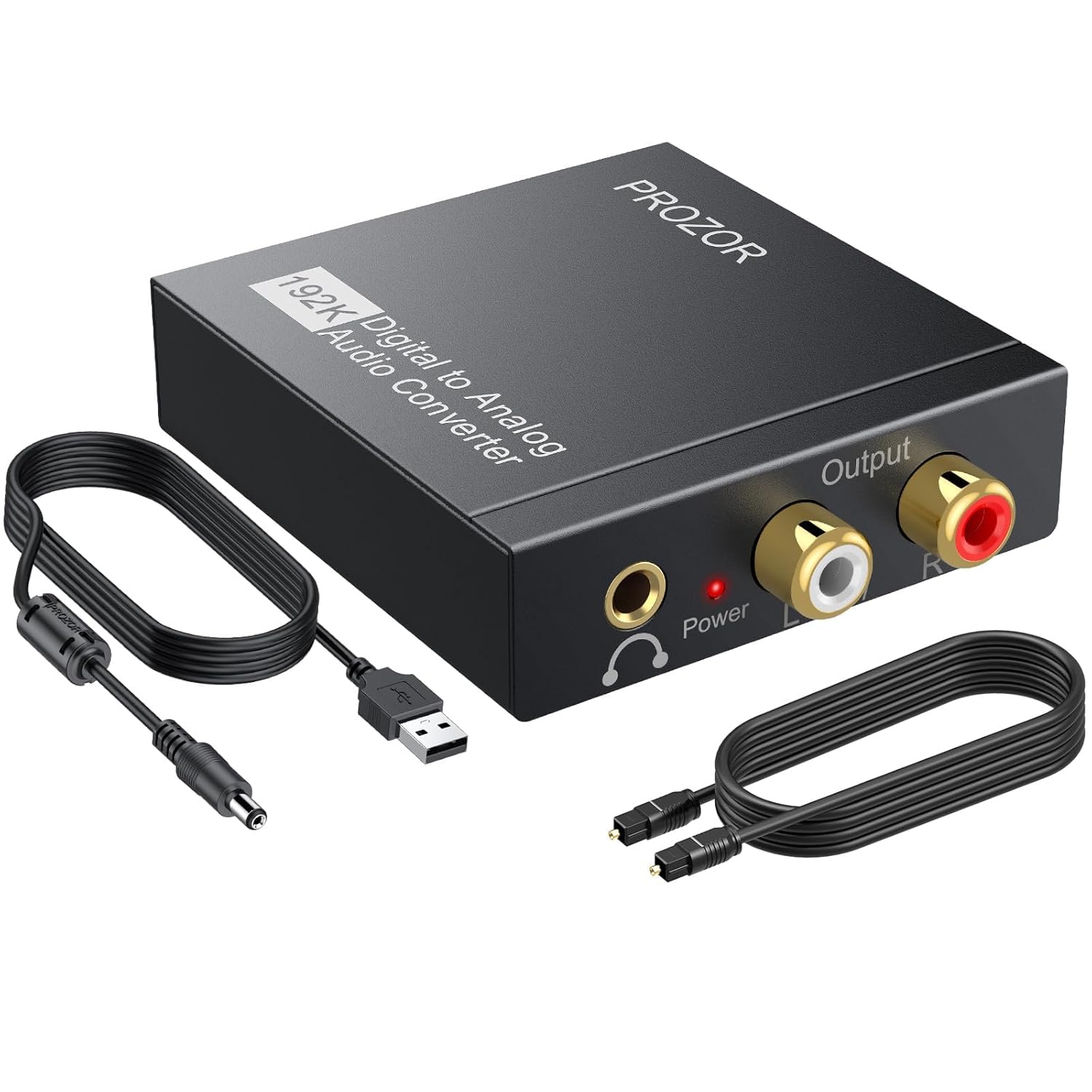
The PROZOR 192KHz Digital to Analog Audio Converter targets a very concrete problem: modern TVs and consoles mainly output audio via optical or coaxial digital ports, while many existing speakers, mini-amps and sound systems only accept analog RCA or 3.5 mm jack. This small box is meant to sit between the two worlds and keep older gear in service instead of forcing a full replacement. With an advertised support of up to 192 kHz / 24-bit PCM and both RCA and 3.5 mm outputs, it tries to cover the most common living room setups.
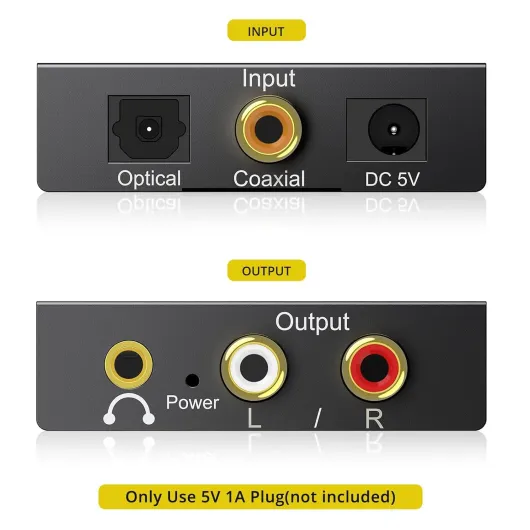
On paper, the device is basic: one Toslink optical input, one coaxial input, and simultaneous analog output on left/right RCA and a 3.5 mm jack. It is powered by 5 V / 1 A via USB (adapter not included) and packaged in an aluminum alloy housing. No Bluetooth, no HDMI, no fancy surround decoding here; this is strictly about converting uncompressed 2-channel PCM or LPCM into analog stereo. For users who only want to get sound from their TV or console into existing speakers, that simplicity can actually be a plus.
The Amazon rating sits around 4.4/5, which suggests that most buyers feel it does the job. Comments highlight affordable pricing, compact format and straightforward setup. A few people mention noise on the 3.5 mm output or configuration issues when the TV is not set to PCM, but that is typical for this type of entry-level DAC. The brand also insists on using a proper 5 V 1 A wall adapter instead of a TV USB port to avoid power-related problems.
In my opinion, this product is clearly aimed at users who want a cheap, simple fix rather than audiophiles chasing top-tier sound quality. If the priority is to get reliable stereo audio out of an optical or coaxial source, the spec sheet and reviews suggest it is a sensible option. If you are looking for surround decoding, a built-in volume knob or fully silent 3.5 mm output, it might be wiser to look at more advanced or pricier alternatives.
Value for money: cheaper than replacing your speakers
Several reviewers explicitly highlight the value for money of this PROZOR DAC. One buyer points out that newer TVs lack a 3.5 mm analog output, and instead of buying a whole new speaker system, they chose this small converter as a cheaper bridge. They describe it as working perfectly, easy to use, with great connectivity and a compact size. That is exactly the niche this product targets: avoiding the cost and hassle of replacing otherwise functional speakers or amps just because the TV only has optical out.
Another verified purchaser mentions that the converter is affordable, easy to install and worked as expected. For them, it solved a reconnection issue after the optical connector in their soundbar broke. By using the PROZOR DAC powered from the TV’s USB port, they were able to keep using their existing audio gear. This kind of scenario shows the financial logic: rather than buying a new soundbar or home cinema system, a small DAC extends the life of existing hardware for a fraction of the price.
On the hi‑fi side, the buyer who used it to feed a mini amp from a CD player via coaxial reports a noticeable sound improvement and says they have “no complaints at all” considering the price and conversion reliability. That comment also mentions ignoring a negative expert opinion about sound quality because the user’s expectations were aligned with the low cost and basic feature set. This underlines a key point: for the price bracket, expecting reference-grade audio would be unrealistic, but for everyday listening and TV use, most buyers seem satisfied.
In my opinion, this DAC offers good value if you need exactly what it does: convert optical/coaxial PCM stereo to RCA and 3.5 mm. It lacks extras like 5.1 decoding, a volume knob, Bluetooth or an included power adapter, and the 3.5 mm output is not perfectly clean according to at least one user. But considering the aluminum housing, gold-plated RCA connectors, 192 kHz / 24-bit support and overall positive feedback, it sits in a sweet spot for budget-conscious users. If someone needs more advanced features, PROZOR itself suggests upgraded models, which will naturally cost more. For basic digital-to-analog duties, the price-to-function ratio here is hard to argue with.
Compact box with straightforward layout
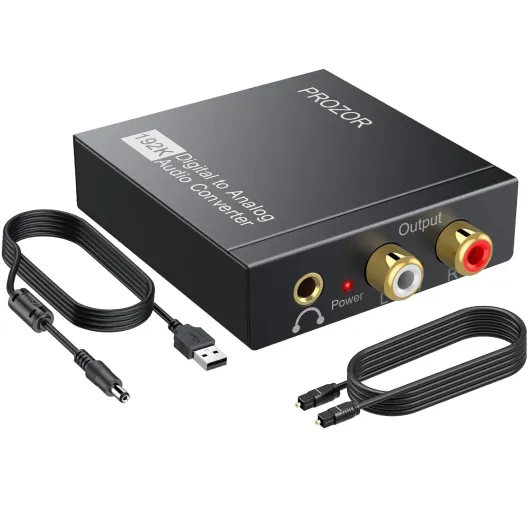
On design, the PROZOR 192KHz DAC is clearly focused on being small and unobtrusive. The listed dimensions are about 1.13 x 0.34 x 0.85 inches and a weight of around 3.2 ounces, which is tiny for a converter that handles both optical and coaxial inputs. Several buyers highlight the “small design” and the fact that it tucks easily behind a TV or next to a mini-amp without cluttering the area. For users trying to keep their media setup clean, that compact footprint is a strong point.
The connectors are logically organized: digital inputs on one side (Toslink and coaxial), analog outputs on the other (RCA left/right plus 3.5 mm). Power is supplied via a 5.5 mm USB power cable that plugs into a 5 V 1 A adapter. There is a power indicator light mentioned in the description, used to quickly check if the unit is receiving power. Nothing fancy here, but it is the kind of basic feedback that helps diagnose simple issues like a loose USB cable or a dead adapter.
One review mentions using the device to feed an external subwoofer amp from an LG OLED TV, with the DAC hidden in the setup. Another buyer talks about connecting a CD player via digital coaxial to a mini amp. Both examples show that the layout is flexible enough to adapt to different use cases, as long as everything remains stereo PCM. The lack of physical controls (no volume knob, no input selector) might bother some users, but that simplicity also means fewer things to break or misconfigure.
In my opinion, the design is typical of low-cost DAC boxes: black rectangular housing, clear labeling on ports, and a minimalist interface. For this category, that is exactly what you want. There is no display, no remote and no menu system to manage. As long as users understand that all adjustments (volume, format) must be done on the TV or source device, the hardware layout should not cause frustration. For the price range, the design looks coherent and functional rather than fancy.
Aluminum housing and gold-plated RCA connectors
Materials are one of the small advantages this PROZOR DAC has over the most basic plastic converters. The housing is made from aluminum alloy, which the brand presents as better for electromagnetic shielding and heat dissipation than standard ABS plastic. In theory, a metal enclosure can indeed help reduce interference when the box is surrounded by multiple electronic devices, especially around TVs, consoles, Wi‑Fi routers and power supplies. For a DAC that will often live in a cable jungle, this is a sensible choice.
The RCA outputs are described as gold-plated connectors. In this price segment, gold plating is mostly about corrosion resistance and ensuring a more consistent contact over time rather than any dramatic sound difference. It also lets users pair their own RCA cables, which some reviewers appreciate when connecting to mini-amps or powered speakers. One buyer explicitly mentions using it to feed a mini Fosi Audio subwoofer amp, which shows that the RCA side is standard enough to integrate into typical budget hi-fi setups.
The power input relies on a standard 5.5 mm USB power cable, with a strong warning from the manufacturer: use only a 5 V 1 A plug and avoid other chargers. This insistence suggests that the internal power circuitry might be sensitive to higher currents or voltage spikes, which is common on cheaper electronics. A few comments mention plugging the USB power into the TV itself, even though PROZOR advises a separate certified adapter. From a materials and reliability standpoint, a dedicated 5 V 1 A wall adapter is likely safer and more stable.
In my view, the materials are decent for the category. The aluminum shell and gold-plated RCA connectors are a small but real step above the many no-name plastic DACs with flimsy ports. That said, there are no premium touches beyond that: no reinforced optical port, no rubber feet mentioned, and no heavy chassis. It looks like a practical, low-cost build intended to be installed once and forgotten, rather than a showpiece component in an exposed hi‑fi rack.
Reliability and long-term expectations
Durability for a device like this mainly comes down to three aspects: the housing, the connectors, and the power requirements. The aluminum alloy enclosure should handle everyday knocks and cable tension better than thin plastic shells seen on many ultra-cheap DACs. Metal also tends to age better cosmetically under heat from nearby components, which is relevant if the unit lives behind a TV or in a closed cabinet. There are no moving parts inside, so mechanical wear is mostly about ports and solder joints.
The gold-plated RCA connectors are another small plus for longevity, especially in humid environments or where cables are plugged and unplugged regularly. Buyers who use the PROZOR as a semi-permanent link to an amp or subwoofer are unlikely to stress the connectors much after the initial setup. Reviews do not highlight widespread failures of ports or loose sockets, which is a good sign, although the sample of comments is not huge. One user did mention using it as a workaround after the optical connector on a soundbar broke, which suggests they trust this little box more than the original device’s port.
The power side is where caution is needed. The description warns clearly: use only a 5 V 1 A adapter and avoid other plugs. This suggests the internal voltage regulation may not tolerate higher voltages or noisy supplies well. Some buyers still choose to power it from the TV’s USB port and report that it works, but PROZOR discourages this, likely to reduce the risk of noise or instability. If someone uses a random fast charger or an unregulated adapter, they may shorten the DAC’s lifespan or cause glitches.
In my opinion, for a low-cost converter launched back in 2015 and still sold, the overall reliability looks acceptable. The 4.4/5 average score and absence of repeated complaints about sudden death or overheating are reassuring. It is still an inexpensive electronic box, so expecting decades of flawless service would be optimistic. But with a proper 5 V 1 A adapter, reasonable cable management and minimal plugging/unplugging, it should last long enough for typical TV or small hi‑fi setups. Users looking for industrial-grade robustness or extended warranties will probably need to move up a price bracket.
Stereo PCM performance and real-world use cases
On performance, everything revolves around stereo PCM up to 192 kHz / 24-bit. One buyer used the DAC to convert a CD player’s digital coaxial output to RCA for a mini amp and reports a clear improvement compared to running the amp without any DAC. According to that comment, the sound became more enjoyable for listening to a CD collection, which indicates that, for basic hi‑fi, this box can hold its own. That same reviewer had seen an expert calling the product “junk” but disagreed after trying it in their setup, which shows how expectations and use cases heavily influence perceived performance.
Another verified buyer uses the PROZOR to add a subwoofer to an LG OLED TV: optical out from the TV into the DAC, RCA out to a small subwoofer amplifier. They report that the system works as intended, with only a tiny amount of noise on the RCA output and a more noticeable noise floor on the 3.5 mm jack. They still consider the result acceptable, especially given the low cost. This matches a general pattern on these cheap DACs: the RCA path tends to be cleaner than the headphone jack, which is often an afterthought.
For console and TV use, several reviewers say that once the TV audio output is set to PCM/LPCM, the converter delivers stable sound without dropouts. The manufacturer also stresses that the TV remote volume button may not adjust optical output directly; users often need to go into the TV audio menu (for example, on Sony: Sound Settings → Advanced Settings → Digital Audio Output Volume). This can be a frustration point if someone expects plug-and-play volume control, but that limitation is usually on the TV side rather than the DAC itself.
In my opinion, performance is decent for the role: converting digital stereo to analog with minimal fuss. The advertised upgraded amplifier chipset and dual-channel op-amp are a nice claim, but without measurements or chip references, it is hard to quantify. What matters more is that most buyers describe the sound as “good” or “works perfect” for TV, CD and basic subwoofer setups. For critical listening or studio work, this unit is probably too basic, but for home cinema and casual music, the reported performance is in line with its budget positioning.
What this PROZOR DAC actually does (and doesn’t do)
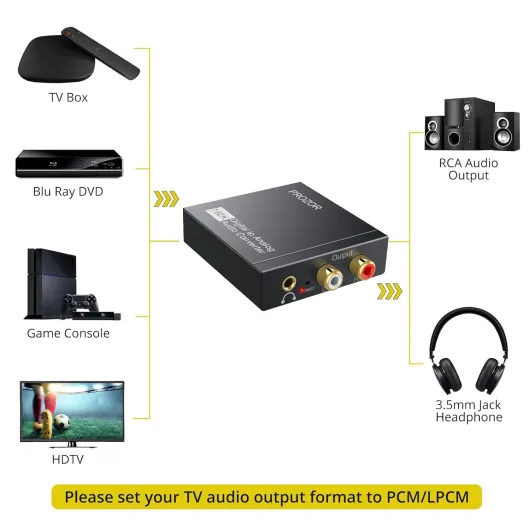
The PROZOR 192KHz DAC is a small digital-to-analog converter designed to handle Toslink/optical SPDIF and coaxial digital inputs and output them as analog stereo. The input side offers one optical port and one coaxial port. On the output side, you get two RCA connectors (left/right) and a 3.5 mm jack that work simultaneously. That layout makes sense if you want to feed, for example, a mini amplifier via RCA while also sending signal to headphones or another device through the 3.5 mm jack.
The manufacturer clearly states that it supports uncompressed 2-channel LPCM or PCM only. That means no Dolby Digital, DTS or 5.1 decoding. If a TV or console is set to output bitstream surround formats, users report that you simply get no sound. Several comments insist that the audio output format must be changed to PCM/LPCM in the TV settings, and in some cases, SPDIF output mode must be forced for brands like Panasonic. PROZOR itself repeats this point in the description, which shows they know this is a frequent source of confusion.
On the technical side, the DAC claims support for sampling rates of 32, 44.1, 48, 96 and 192 kHz at 24-bit on left and right channels. The brand also mentions an “upgraded” audio amplifier chipset and dual-channel operational amplifier to improve clarity and reduce distortion compared to their previous versions. However, there is no detailed information about the exact chips used or measured distortion figures, so expectations should stay moderate: this is a budget converter, not a high-end audiophile DAC.
In practice, reviewers mainly use it for three things: recovering sound from TVs that only have optical out, feeding older amps or powered speakers that only take RCA, and connecting devices like CD players with digital coaxial output to small analog amplifiers. Several verified buyers say that for these basic roles, it gets the job done reliably. In my view, the product description is honest: it is a simple stereo PCM DAC, not an all-purpose home theater decoder. If someone needs 5.1 or volume control on the box, PROZOR itself points them to other models in their lineup.
Pros
- Handles both Toslink/optical and coaxial digital inputs with simultaneous RCA and 3.5 mm analog outputs
- Supports up to 192 kHz / 24-bit stereo PCM/LPCM with an aluminum alloy housing and gold-plated RCA connectors
- Affordable way to keep existing analog speakers and amps usable with modern TVs and players
Cons
- Limited to 2-channel PCM/LPCM, no Dolby/DTS or 5.1 decoding
- 3.5 mm output reported as noisier than RCA and no integrated volume control
- Requires a separate 5 V 1 A power adapter and careful TV audio settings configuration
Conclusion
Analysis score
The PROZOR 192KHz Digital to Analog Audio Converter is a straightforward, low-cost way to connect modern digital-only sources to older analog gear. It handles optical and coaxial inputs and outputs stereo PCM over RCA and 3.5 mm, with support for sampling rates up to 192 kHz / 24-bit. The aluminum housing and gold-plated RCA connectors put it a notch above the flimsiest plastic boxes, and the average user rating around 4.4/5 backs up the idea that it generally does what it claims. Reviews from people using it with TVs, CD players and small amps are mostly positive, with comments about easy installation and sound that is “good” for everyday use.
It is not perfect. The DAC is limited to uncompressed 2-channel PCM/LPCM, so there is no Dolby or DTS decoding. Users must be comfortable diving into TV audio settings to force PCM output and sometimes to adjust digital output volume, since the TV remote volume buttons do not always affect optical output. At least one buyer reports noticeable noise on the 3.5 mm jack and a small amount on RCA, which is typical for this price range. There is no included 5 V 1 A power adapter, and the manufacturer insists on using the right type, which adds a small extra cost if you do not already have one.
In my opinion, this DAC is a good fit for people who want an inexpensive, compact bridge between a TV or digital player and existing analog speakers, mini-amps or a subwoofer amp. It suits living rooms, small hi‑fi corners and simple home cinema setups where stereo is enough. Those who need 5.1 decoding, ultra-clean headphone output, integrated volume control or premium components should skip it and look at more advanced DACs or AV receivers. For its core job—basic digital-to-analog conversion for stereo PCM—it offers solid value and a pragmatic solution to a very common connectivity problem.