Summary
Analysis score
Average of the criteria rated below
Value for money: strong feature set, realistic expectations needed
Compact body and 360° stand: built for casual placement
Build, cooling and support: how reliable does it look?
Image quality, brightness and noise: what to expect
What the Wielio AE211B promises on paper
Smart features, autofocus and keystone: does it actually simplify life?
Pros
- Native 1080p resolution with 4K decoding and HDR10 for sharp, clean images in dim rooms
- Android 14 smart system with built-in apps, WiFi 6 and Bluetooth 5.2 for true all-in-one streaming
- Auto keystone, electric focus, 50–100% zoom and 360° stand make setup quick and flexible
Cons
- Real brightness is around 300 ANSI lumens, limiting comfortable use in bright environments
- Built-in speaker is only average, external speakers recommended for better sound
- Unknown brand, so long-term reliability and service quality remain less proven despite the 2-year promise

Specifications
View full product page →| Brand | Wielio |
A budget smart projector that’s punching above its category?
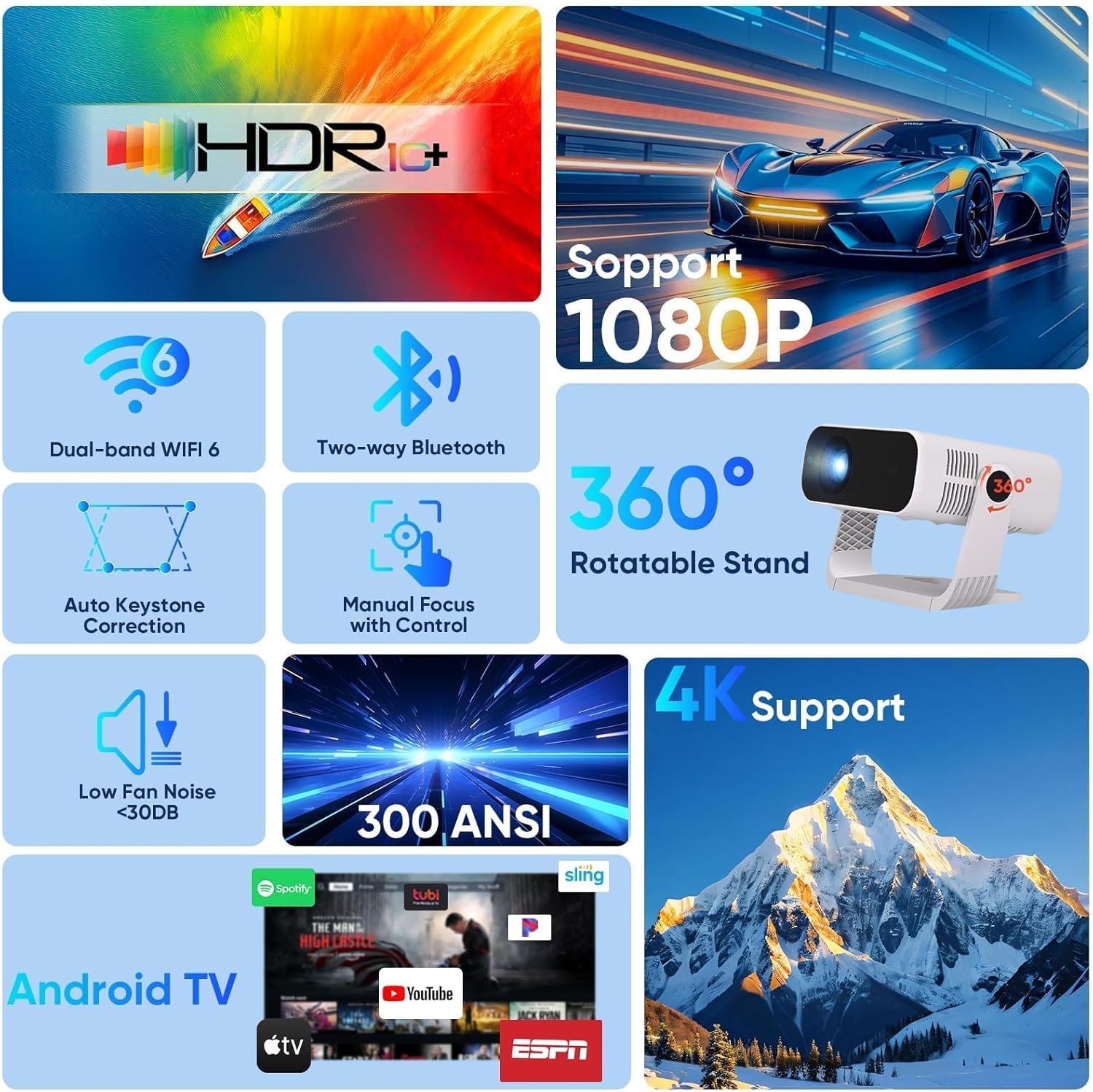
The Wielio AE211B is one of those projectors that makes you raise an eyebrow just reading the spec sheet. Native 1080p, 4K support, Android 14 smart system, WiFi 6, Bluetooth 5.2, auto keystone, electric focus, 360° stand, low fan noise under 30 dB, and a claimed 20,000 lumens… all from an unknown brand sitting at the top of the Amazon projector rankings. On paper, it looks packed, especially for a compact, portable model aimed at home cinema, gaming, and casual business use.
What stands out in the public reviews is the very high average rating: 5.0/5 from over 130 ratings. That’s rare, especially in a category where people usually complain quickly about brightness, fan noise, or software bugs. Buyers repeatedly mention easy setup, smooth apps, and picture quality that feels sharp enough for films and console gaming. Several comments also highlight that it works fine on a plain wall without a dedicated screen, which says something about perceived sharpness and contrast at normal home viewing distances.
At the same time, the spec sheet has a few numbers that clearly look marketing-heavy. The 20,000-lumen claim is not aligned with the 300 ANSI lumens listed further down, and that 300 ANSI figure is much more realistic for this class. So you get the usual cheap-projector exaggeration: a big lumen number to catch attention, with the real usable brightness being closer to what you’d expect from an entry-level home projector designed mainly for dim rooms and evening sessions.
In my opinion, the interest of this model is less about raw power and more about the combo: compact form factor, full smart OS with Android 14, built-in apps, wireless connectivity, and a stand that lets you point it at a wall or ceiling without extra accessories. If you want a plug-and-play living-room or bedroom projector that behaves more like a small TV with apps than a bare projector, it looks like a serious candidate, as long as you keep realistic expectations about brightness and sound.
Value for money: strong feature set, realistic expectations needed
The exact price isn’t mentioned, but given the positioning and the Amazon ranking, this projector clearly sits in the budget to lower mid-range category. For that segment, the feature list is dense: native 1080p, Android 14 with built-in apps, WiFi 6, Bluetooth 5.2, electric focus, auto keystone, zoom, 360° stand, low-noise cooling, and a 2-year service promise. Many competitors at similar prices either skip the smart OS entirely or rely on older Android versions and weaker connectivity. From that angle, the value looks solid.
Reviews back this up: people repeatedly call it “great value for money”, “great projector”, and “solid choice” for home use. One detailed comment about a comparable Wielio smart projector explicitly notes that while the brightness is moderate and works best in darker environments, the overall package (picture quality, smart features, portability) makes it a strong option for casual home theater. That’s exactly how this AE211B should be seen: not a replacement for a high-end living-room TV or a premium cinema projector, but a practical way to get a big image without spending a fortune.
The main caveat on value is the usual marketing inflation. The 20,000-lumen claim is clearly there to impress, but the 300 ANSI lumens figure is the real one. If you buy it expecting true daylight performance like a 3,000–4,000 ANSI lumen office projector, you’ll be disappointed. If you see it as an evening and dim-room machine that just happens to have smart features built in, the package makes much more sense. Also, the built-in speakers are described as “fine” rather than great, so budgeting for a small Bluetooth speaker or soundbar is wise if you care about sound.
In my opinion, the AE211B offers good value for people who want an all-in-one smart projector and are willing to accept some compromises: brightness tuned for darker rooms, average integrated audio, and an unknown brand. You’re paying for convenience and features rather than raw performance. If you prefer maximum brightness and don’t care about Android apps, a non-smart projector paired with an external streaming stick could be a better route. But for simple, cable-light setups and flexible room usage, this model earns its place in the cart.
Compact body and 360° stand: built for casual placement
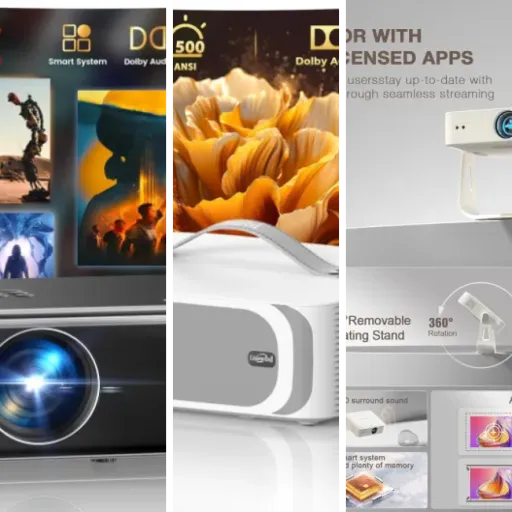
The Wielio AE211B is described as a portable projector with a tabletop mount and a 360° rotatable stand. That stand is one of its key selling points: instead of having to stack books or buy a separate tripod, you’re supposed to be able to rotate the projector freely and lock it at any angle. The product page even mentions projection on walls, ceilings, and tents. For real-world use, that kind of flexibility usually matters more than it seems, especially in small apartments or dorm rooms where furniture placement is not ideal for traditional projectors.
The color scheme is black and white, with a compact form factor that several reviews call “lightweight” and “easy to move around”. The exact weight is not listed, but the recurring comments about portability suggest it’s closer to a mini home projector than a bulky living-room unit. With only a power cord, HDMI cable, and remote in the box, the setup looks straightforward: plug, connect Wi-Fi, log into apps, and you’re set. No mention of a carry bag, so if you want to move it a lot between homes or travel frequently, a small protective case would probably be a sensible extra purchase.
The control approach is classic: a remote plus app control. That means you’re not stuck if the remote goes missing, as long as you pair it with a phone. For a budget projector, having both is a good point. The dustproof design is also highlighted, which, in theory, should reduce the risk of dust spots on the image over time, a common annoyance on cheap LCD projectors. There is no detailed IP rating, so it’s more about everyday dust resistance than any kind of outdoor weather protection.
In my opinion, the design philosophy here is clear: make it as easy as possible to drop it in a room, point it at a surface, and start watching. The rotatable stand, auto keystone, zoom, and electric focus all go in that direction. You don’t get premium materials or a super-polished design, but you get a practical object that fits bedroom ceilings, living-room walls, and occasional outdoor sessions without much planning. For this price segment, that’s exactly what most buyers seem to be looking for.
Build, cooling and support: how reliable does it look?
The AE211B uses an LCD light engine and is presented as having a dustproof design and an “ultra-quiet cooling system”. While there are no hard figures on lamp life in the description, similar LED-based LCD projectors often claim tens of thousands of hours. The key here is dust and heat management: dust entering the optical path can cause visible spots, and poor cooling can shorten LED and component life. The brand’s emphasis on upgraded heat dissipation and noise reduction suggests they’ve at least tried to address these common weak points.
Among the public reviews, there are no recurring complaints about early breakdowns, overheating, or image degradation so far. Most comments focus on ease of use and picture quality rather than reliability problems. That said, the product still seems relatively new, so long-term durability is still a question mark. This is where the 2-year professional service promise becomes important: the brand talks about free product replacement, professional maintenance, and one-on-one technical guidance with a guaranteed 24-hour response time. For a no-name or lesser-known brand, that kind of stated backup is a reassuring element, even if you obviously can’t verify the quality of that service without dealing with it directly.
The portable form factor has two sides. On one hand, a light, compact projector is less likely to suffer from heavy impacts because people tend to move it gently and use it indoors. On the other hand, more frequent moves between rooms or to friends’ houses means more chances for bumps and cable pulls. There’s no mention of reinforced casing or drop resistance, so it’s reasonable to treat it as standard consumer electronics: fine on a table or shelf, but you should avoid rough handling and consider a padded bag if you travel with it regularly.
In my opinion, the durability outlook is cautiously positive for a budget smart projector. There’s nothing on the spec sheet that screams premium build, but there’s also no obvious red flag in the reviews. The quiet cooling and dustproof claims, combined with a 2-year service commitment, point to a product that should be acceptable for regular home use over several years, as long as it’s used in normal indoor conditions and not treated like a rugged outdoor device.
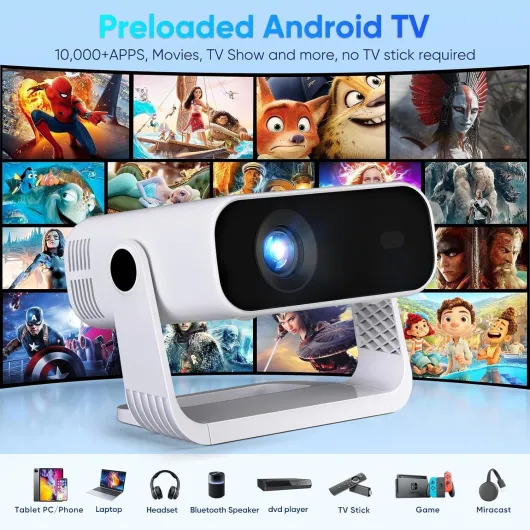
Image quality, brightness and noise: what to expect
On the performance side, there are two very different brightness numbers: a bold claim of 20,000 lumens and a much more realistic 300 ANSI lumens in the spec list. The ANSI figure is the one to take seriously. 300 ANSI lumens put this projector solidly in the entry-level home cinema range, suitable for dim or dark rooms. Among the reviews, users often describe it as bright enough in the evening or with curtains drawn, but one long comment about a similar Wielio smart projector mentions that moderate brightness may struggle in very bright settings. That’s exactly what 300 ANSI suggests: fine for movie nights and bedrooms, clearly not built for fully lit offices or sunny outdoor use.
The native 1080p resolution and HDR10 support are a stronger point. Multiple buyers highlight sharp picture quality, “clear images”, and “colours pop” for films and streaming. For a 200-inch maximum size, keeping the image crisp will depend heavily on distance and ambient light, but for typical 80–120 inch setups in a dim room, 1080p is usually enough to look clean from a sofa distance. 4K support here means it can accept a 4K signal and downscale it; you’re not getting a 4K panel, but at this price that’s expected.
Noise is advertised as <30 dB thanks to an “ultra-quiet cooling system”. Several comments across similar models mention fan noise being low or not distracting during movies. That lines up with the spec: under 30 dB is roughly laptop-fan territory, which in a normal living room tends to fade behind the soundtrack, especially if you use external speakers. Of course, there’s no guarantee that every unit performs identically, but there are no complaints standing out about loud fans among the published reviews, which is reassuring.
On motion and gaming, the brand doesn’t give input lag numbers, so it’s impossible to say how suitable it is for competitive gaming. Buyers do mention using it for PS5 and Switch and seem satisfied for casual sessions. In my opinion, it’s safer to see this as a projector aimed primarily at movies, series, and casual console gaming. If you’re chasing ultra-low latency for fast online shooters, a dedicated gaming monitor remains a better choice. For Netflix, YouTube, single-player games and split-screen Mario Kart with friends, this model looks like it will get the job done, as long as you accept its brightness limits.
What the Wielio AE211B promises on paper
This projector is positioned as a compact all-in-one entertainment device rather than a barebones office beamer. It uses an LCD panel with a native 1920 x 1080 resolution and can decode 4K content. That means your PS5, Switch, or streaming apps will be displayed in real 1080p, not upscaled 720p, which is still common at low prices. The maximum claimed image size is 200 inches, with a throw distance from 1.3 m up to 10 m, so in theory it can cover anything from a small bedroom wall to a backyard projection if you have enough space and low ambient light.
The smart side relies on Android 14 with a built-in app store. The brand claims access to major streaming platforms like YouTube and Prime Video directly on the projector, without needing a Fire Stick or similar device. Reviews back this up: several buyers say the apps run smoothly and highlight being able to get going in a few minutes. For control, the projector supports an included remote and app control, plus WiFi 6 for network connection and Bluetooth 5.2 for wireless speakers or headphones.
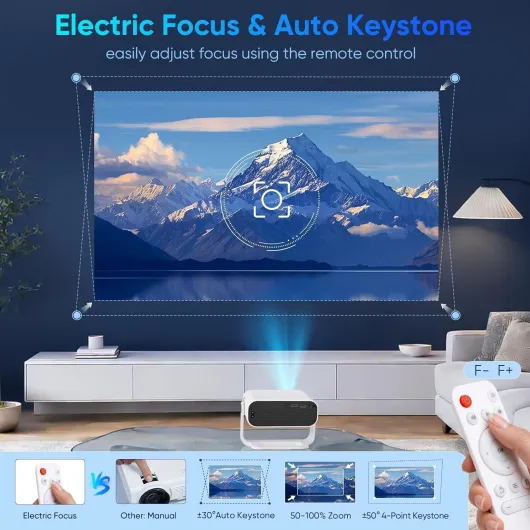
Connectivity is fairly standard but complete for this segment: HDMI, USB, Wi-Fi, and Bluetooth. That covers consoles, laptops, streaming sticks, USB media, and external audio. The manufacturer also pushes some convenience features: auto 4-point keystone correction, 50–100% zoom, and electric focus. If these work as described, you should be able to square the image, resize it, and get it sharp without moving the projector around each time, which is handy when you’re projecting in different rooms or on different walls.
On the usage side, the brand explicitly targets home cinema, gaming, education, and business. One verified review mentions using it for quick work presentations as well as films and games, which fits this multi-purpose positioning. In my opinion, the spec sheet clearly leans more toward home entertainment than professional office gear, but for occasional slideshows or classroom content in dimmed rooms, it should be serviceable. The 2-year service promise with free replacement and one-on-one technical guidance is also a plus for a lesser-known brand, at least on paper.
Smart features, autofocus and keystone: does it actually simplify life?
The big selling point here is how self-sufficient the projector is. With Android 14 and a built-in app store, it behaves much more like a smart TV than a dumb projector. Reviews mention that apps like YouTube and Prime Video are already available, and one buyer explicitly notes that setup took only minutes and that apps run smoothly. That’s important: if the interface were laggy or buggy, people usually complain loudly, and that’s not what shows up here. So on the “plug in, log in, and watch” front, it seems to deliver.
The auto 4-point keystone correction and 50% zoom are another big part of the convenience story. In theory, auto keystone means you can put the projector slightly off-axis, and it will correct the trapezoid image into a proper rectangle by itself. The zoom lets you adjust image size without moving the unit. Several reviewers talk about image adjustment being simple and praise the auto keystone for quickly squaring the picture. For casual setups on shelves, coffee tables, or bedside tables, that’s a real advantage over models that require lots of manual tweaking.
Wireless connectivity also plays into effectiveness. With WiFi 6 you get a more stable and faster connection than older Wi-Fi standards, which helps reduce buffering when streaming HD content. Buyers mention that phone mirroring works “without any fuss” and that streaming is lag-free in normal conditions. Bluetooth 5.2 lets you pair external speakers or soundbars, which is almost essential if you want a more cinematic feel, even though the built-in speaker is described as “fine” by one reviewer for basic use.
In my opinion, this projector is effective for what most people actually do: watch streaming content, mirror a phone for quick videos, plug in a console, and move the projector between rooms. It is not a professional installation product and doesn’t try to be one. The combination of smart OS, electric focus, auto keystone, zoom, and wireless options means you spend more time watching and less time fiddling with settings. The main caveat is that all these features are still tied to entry-level hardware; if you push it in very bright rooms or expect high-end TV-like HDR, you’ll hit its limits, but for everyday home use it looks well thought out.
Pros
- Native 1080p resolution with 4K decoding and HDR10 for sharp, clean images in dim rooms
- Android 14 smart system with built-in apps, WiFi 6 and Bluetooth 5.2 for true all-in-one streaming
- Auto keystone, electric focus, 50–100% zoom and 360° stand make setup quick and flexible
Cons
- Real brightness is around 300 ANSI lumens, limiting comfortable use in bright environments
- Built-in speaker is only average, external speakers recommended for better sound
- Unknown brand, so long-term reliability and service quality remain less proven despite the 2-year promise
Conclusion
Analysis score
The Wielio AE211B is a compact smart projector that leans heavily on convenience. Native 1080p, a modern Android 14 system with built-in apps, WiFi 6, Bluetooth 5.2, auto keystone, electric focus, and a 360° stand add up to a product that’s clearly designed for everyday home use rather than professional installations. The public reviews are very positive: people praise its ease of setup, decent picture quality in dim rooms, and the fact that you can just point it at a wall, launch YouTube or Prime Video, and start watching without extra hardware.
It’s not perfect. The honest brightness figure is 300 ANSI lumens, despite the inflated 20,000-lumen claim, so it’s clearly meant for darker environments. The built-in speaker is described as acceptable but not cinematic, so external audio is recommended if you want a more immersive feel. As an unknown brand, long-term durability remains a bit of a question, even if the 2-year service commitment with free replacement and quick support is a reassuring sign.
In my opinion, this projector fits best for people who want a simple, portable home cinema setup for bedrooms, living rooms with dimmed lights, and occasional movie nights or casual gaming sessions. It’s less suited to bright offices, serious competitive gaming, or users who need top-tier HDR and color accuracy. If your priority is a plug-and-play big screen with integrated streaming and flexible placement at a reasonable price, the AE211B looks like a sensible choice. If you care more about raw brightness or premium sound, you might want to look at more specialized – and usually more expensive – alternatives.