Summary
Analysis score
Average of the criteria rated below
Value for Money: Strong Cooling Without Paying for a Big Name
Bulky but Practical: Design and Handling
Build Quality, Reliability and a Serious Incident to Note
Noise, Modes and Day-to-Day Performance
What the Tanoxo 14,000 BTU Is Actually Offering
Cooling Effectiveness in Real Homes
Pros
- High practical cooling capacity (10,000 BTU SACC) suitable for up to ~65 m² / 700 sq. ft.
- 4-in-1 operation with cooling, fan, dehumidification, and quiet sleep mode plus Smart Mode
- Generally positive buyer feedback on cooling speed, noise levels, and customer service responsiveness
Cons
- Unknown brand with limited long-term track record and only a limited warranty
- Bulky and heavy unit that takes up floor space and is not ideal to carry between floors
- Isolated report of plug/outlet melting, calling for extra care with electrical installation and usage

Specifications
View full product page →| Brand | Tanoxo |
A Budget-Friendly Heavyweight for Hot Summers
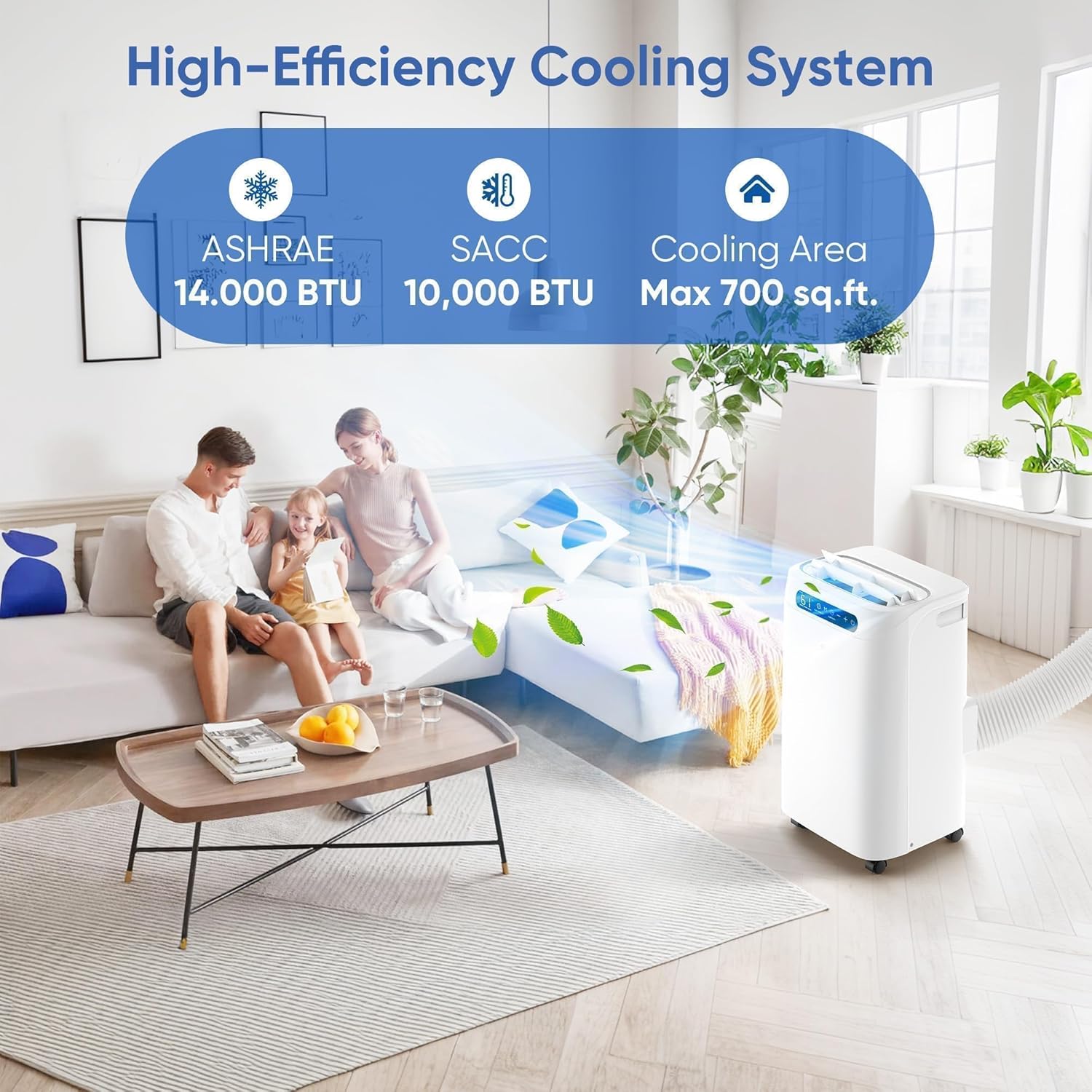
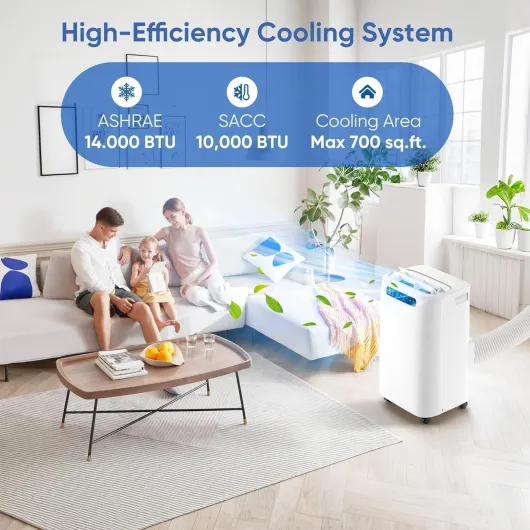
The Tanoxo 14,000 BTU portable air conditioner positions itself as a high-capacity unit aimed at people who need to cool fairly large spaces without installing a fixed system. On paper, it covers up to 65 m² (about 700 sq. ft.) and combines several functions in one box: cooling, fan, dehumidification, and a quieter sleep mode. It runs at 1250 W on 115 V, uses R-32 refrigerant, and is rated at 10,000 BTU SACC, which is the more realistic capacity standard for portable ACs. For an unknown brand, it shows a surprisingly complete spec sheet.
Public reviews are quite positive overall: an average of 4.4/5 from close to a hundred ratings suggests that most buyers feel they got what they paid for, and often a bit more. Several verified purchasers say it cools faster and over a larger area than they expected, and a few even use it to support or partially replace central air when heat waves hit. That’s a strong sign that the raw cooling output is not just marketing numbers.
The manufacturer highlights hassle-free installation with a full window kit, self-evaporation to avoid constant draining under normal humidity, and a remote with LED display. The unit is fairly heavy at about 29.4 kg (64.9 lb) but sits on 360° casters and has an integrated handle, so it’s meant to be rolled from room to room. Noise is announced at 48 dB in sleep mode, which, on paper, is relatively low for this kind of product.
In my opinion, the big question around this model is not whether it cools – that seems well covered by both the numbers and the comments – but whether an unknown brand with a limited warranty can deliver consistent reliability and safety. The vast majority of reviews are reassuring, but there is at least one serious incident reported. So this is a product that looks strong on performance and value, but that deserves a careful look at installation quality, electrical setup, and after-sales support.
Value for Money: Strong Cooling Without Paying for a Big Name
From a value perspective, the Tanoxo 14,000 BTU sits in an interesting spot. The brand is unknown to most people, which usually means a lower price than better-known competitors with similar specs. The listing doesn’t show a fixed price here, but judging by the tone of the reviews, buyers seem to feel they got a good deal: phrases like “well worth the money”, “better than expected”, and “definitely recommend” appear repeatedly. When people buy a no-name AC last minute before a heat wave and end up satisfied all summer, that’s a strong hint the price/performance ratio is attractive.
On paper you get a lot: 14,000 BTU (ASHRAE) / 10,000 BTU (SACC), coverage up to 700 sq. ft., 4 operating modes, auto-swing, Smart and Sleep modes, self-evaporation, complete window kit, remote control, and casters. Comparable units from big brands with similar capacities often cost significantly more, especially if they include Wi‑Fi or dual-hose designs. Here, you clearly pay for function over branding. If you don’t care about app control or a famous logo on the front, the feature set is more than enough for typical apartment or house use.
The energy efficiency is decent (SEER 11, 5-star BEE rating in the listing), so operating costs should be in line with other units in this power class. One user specifically mentions no major surprise on the electricity bill, despite heavy use in a hot summer. That doesn’t turn it into a low-consumption miracle, but it indicates that you’re not buying a power hog disguised as a bargain. And since it can realistically cool more space than a basic 8,000 BTU model, you might avoid buying multiple smaller units.
In my opinion, the main trade-off is brand reputation vs savings. You get strong cooling and practical features for the money, but you don’t have the same long-established support network as with the biggest names. The isolated plug-melting case is a reminder that you’re not in premium territory, even if customer service reacted well. For someone who needs a powerful portable AC quickly, wants to spend less than on a flagship model, and is ready to be a bit vigilant about installation and power supply, the value for money here looks quite solid.
Bulky but Practical: Design and Handling
Physically, the Tanoxo TAC-10CPD-B1 is a fairly large and heavy unit. The dimensions are about 35.6 x 41.9 x 68.6 cm (D x W x H), and the weight is 64.9 lb (around 29.4 kg). So this is not the kind of device you casually pick up and move upstairs; it’s designed to be rolled. To make that easier, it sits on 360° casters and includes a recessed ergonomic handle. Several buyers say they moved it between rooms without much trouble, which suggests the wheels do their job on typical indoor floors.
The design is classic portable-AC style: a white plastic body, front air outlet, and top control panel with a touch-sensitive LED display. The screen shows the current temperature and settings, which is practical when you are near the unit. The remote control is described as LED-backlit, with a claimed range of about 23 feet, allowing you to adjust temperature, fan speed, and modes from across the room. According to reviews, users appreciate being able to manage it from the couch or bed, and one person mentions it cooled multiple connected rooms from a central position.
Airflow management is another design point. The unit offers auto-swing with wide-angle airflow, so the louver can move to distribute cold air more evenly. You can also adjust the angle manually if you want to direct air toward a specific area. Buyers often mention that it cools multiple rooms or an entire small apartment, which lines up with this design choice: spread the cold air rather than just blasting one spot. For many people using it in living room + kitchen combos, this seems to work reasonably well.
From an aesthetic standpoint, there’s nothing fancy or particularly stylish. It’s a neutral white box that will visually blend into most interiors but won’t win any design awards. In my opinion, that’s not a problem at this price segment and power level; what matters more is that the form factor and controls are practical. On that front, the combination of clear display, remote, swing function, and wheels looks solid. The main downside is simply the bulk: if you have very limited floor space or narrow passages, this kind of unit always feels a bit intrusive.
Build Quality, Reliability and a Serious Incident to Note
Durability is always a tricky topic for a relatively new, lesser-known brand. The Tanoxo TAC-10CPD-B1 launched around 2023, so there isn’t a decade of hindsight available. However, some signs are positive. Several buyers mention using it for an entire summer or for months in hot climates and say it still works “great” and “like a charm”. One reviewer even highlights that it feels less fragile than their previous portable AC. The filters are reported as easy to clean, and the self-evaporating system means less frequent manual draining, which reduces the risk of neglect-related issues like overflow or mold.
The unit weighs nearly 30 kg and uses a rotary scroll compressor, which on paper suggests a fairly robust mechanical core. The use of R-32 refrigerant is modern and widely adopted, and nothing in the comments points to common failures like early compressor death or major leaks. Most reviews simply don’t talk about breakdowns, which is usually a good sign for a product with close to a hundred ratings. The brand provides a limited warranty (details not given in the listing), and at least some customers interacted with support and got real answers quickly.
However, there is one serious incident reported: a buyer in a hot state describes that after a few days of use, the unit’s plug and the outlet port melted and the AC stopped working. The company reacted quickly and sent a replacement, and the user shipped the faulty unit back. This is just one case among many positive comments, but it’s not a trivial issue. It raises questions about either the specific household outlet, a defective plug, or a one-off manufacturing problem. Whatever the cause, anyone buying this model should make sure their electrical installation is sound (dedicated circuit if possible, no overloaded power strips) and check the plug and outlet for abnormal heat in the first days of use.
In my opinion, the overall reliability picture is cautiously positive: many people run the unit for months in harsh conditions with no complaints, and service responsiveness is praised when problems arise. But that isolated melting-plug story is enough to justify a bit of vigilance. For a heavy-draw appliance like a 1250 W AC, that’s true anyway, regardless of brand. So I would say the durability looks decent for the price, with the usual caveats of an emerging brand: it’s not a tank from a premium manufacturer, and long-term track record is still being built.
Noise, Modes and Day-to-Day Performance
Performance here is not just about raw cooling; it’s also about noise, modes, and energy behavior. The spec sheet lists a noise level of 48 dB, which is relatively low for a portable AC. That figure likely refers to the low or sleep mode rather than full blast, but it still sets expectations. Among the Amazon reviews, several buyers explicitly say the unit is “not super loud”, “very minimal noise”, or “just sounds like a small fan blowing”. One person even says they barely notice it. Others use it in bedrooms or small apartments without complaining about sleep disturbance, which backs up the announced noise level.
The Sleep Mode is designed to run at low speed and around 48 dB, maintaining a comfortable temperature at night without the constant roar some portable ACs produce. For people sensitive to noise, that’s a real plus. There is also a straightforward 3-speed fan control, so you can choose High if you want faster cooling and don’t care about noise, or drop to Mid/Low once the room is at the right temperature. The auto-swing function helps distribute air without needing to crank the fan to max all the time.
On the energy side, the unit is rated at 1250 W with a SEER of 11 and is labeled as “highly efficient” with a 5-star BEE rating in the listing. In real-life terms, one reviewer says they were unsure about efficiency but notes that the electricity bill did not spike enough for their mother to complain, which is a good sign for moderate usage. Another uses it for months to help an underpowered central unit, and there is no mention of a shocking bill. It’s still a 1250 W appliance running for hours, so it will never be “cheap” to run, but it appears to sit in the normal range for this power class.
Overall usability seems decent: the Smart Mode automates switching between Cool and Fan, the remote has enough range to be used across a room, and the self-evaporating system reduces maintenance under 85% humidity. In very humid regions or when using dehumidification mode, manual drainage is still necessary, which is clearly stated. In my opinion, the performance profile is that of a strong, straightforward machine: good cooling, acceptable noise, and reasonable energy behavior, without the finesse or ultra-quiet operation of premium dual-hose or inverter models.
What the Tanoxo 14,000 BTU Is Actually Offering
This Tanoxo unit is a portable monobloc air conditioner with a claimed 14,000 BTU (ASHRAE) and 10,000 BTU (SACC). In practical terms, that puts it in the upper mid-range of portable ACs for home use, clearly above the usual 8,000–10,000 BTU units that struggle in large rooms. The brand says it can handle up to 65 m² / 700 sq. ft., which matches the SACC rating and the feedback from people using it in open-plan apartments or large living areas.
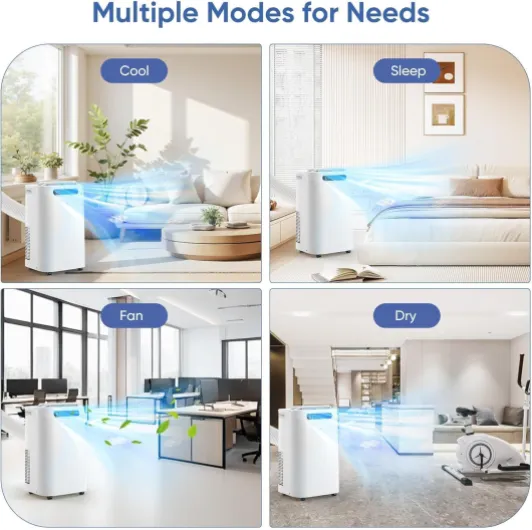
Function-wise, it’s a 4-in-1 device: cooling mode for hot days, a dehumidification mode for humid conditions, a fan-only mode when you just want air movement without cooling, and a sleep mode that drops the fan speed and noise. The temperature can be set from 61°F to 88°F in 1°F increments, which allows reasonably fine tuning. There is also a Smart Mode that uses an internal temperature sensor to switch automatically between Cool and Fan to keep a stable climate while saving power.
The unit comes with a complete installation kit: exhaust hose, window bracket, sealing strip, adapters, remote control, user guide and quick guide. The window kit is designed mainly for sliding windows, with minimum opening height 12" and maximum 36", and a maximum width of 16.5" for the panel. No extra tools are supposed to be needed, which several reviews indirectly confirm by calling the install easy or quick. For drainage, it uses a self-evaporating system that should avoid manual emptying under 85% humidity, but a drain hose is included for continuous draining in dehumidify mode or very humid climates.
On the technical side, it uses R-32 refrigerant, a rotary scroll compressor, SEER 11, and a rated noise level of 48 dB in its quieter mode. It is not an inverter model, so the compressor is either on or off, not modulated. In my opinion, the picture that emerges is a classic non-premium portable AC with relatively high cooling capacity, modern refrigerant, and a focus on practicality more than fancy smart-home features. No Wi‑Fi or app control here – the control method is strictly via the onboard touch panel and the remote.

Cooling Effectiveness in Real Homes
The strong point of this model is clearly its cooling effectiveness. On paper, 14,000 BTU (ASHRAE) / 10,000 BTU (SACC) for up to 65 m² / 700 sq. ft. is already a serious spec. What gives it credibility is that many verified buyers describe it as cooling larger spaces than they expected. One person reports using it in an 1100–1200 sq. ft. apartment and says it kept the whole place comfortable through a tough summer, even if it could not always hold exactly 70°F during extreme heat. Another mentions it cooling a kitchen, living room, and hallway effectively.
Several comments emphasize that it cools rooms quickly and maintains a consistent temperature once it has caught up. People using it in hot states like Texas and Florida say it helps central air that can’t keep up, or keeps large areas bearable in strong heat. That’s a good sign the compressor and airflow are sized correctly for real-world conditions, not just lab numbers. Some users also note that the self-evaporating system leaves very little water to drain, which suggests the unit is effectively removing and reusing moisture during normal cooling.
The multiple fan speeds (High / Mid / Low) and 61–88°F temperature range allow some fine-tuning. Combined with auto-swing and wide-angle airflow, this should help avoid hot spots. The Smart Mode, which switches between Cool and Fan according to room temperature, also makes sense in terms of effectiveness: the AC doesn’t waste energy overcooling when the target is reached, and the fan keeps the air moving. Buyers rarely mention fiddling constantly with settings, which indirectly suggests that once configured, the unit holds a stable climate without much babysitting.
It’s not perfect, of course. A portable AC with a single hose always loses some efficiency because it pulls some indoor air out through the exhaust. In very large or poorly insulated spaces, no 10,000 SACC unit will perform miracles. A few users hint that during extreme heat waves, it can’t maintain very low set temperatures across an entire large dwelling, but they still describe the environment as pleasant. In my opinion, for a monobloc portable AC in this price and power range, the effectiveness looks strong: it seems fully capable as the main cooling source for a large room or as reinforcement for central air in multi-room setups.
Pros
- High practical cooling capacity (10,000 BTU SACC) suitable for up to ~65 m² / 700 sq. ft.
- 4-in-1 operation with cooling, fan, dehumidification, and quiet sleep mode plus Smart Mode
- Generally positive buyer feedback on cooling speed, noise levels, and customer service responsiveness
Cons
- Unknown brand with limited long-term track record and only a limited warranty
- Bulky and heavy unit that takes up floor space and is not ideal to carry between floors
- Isolated report of plug/outlet melting, calling for extra care with electrical installation and usage
Conclusion
Analysis score
The Tanoxo 14,000 BTU portable air conditioner comes across as a strong performer from a relatively unknown brand. On paper it offers high cooling capacity (10,000 BTU SACC), a realistic coverage claim up to 65 m² / 700 sq. ft., and a practical 4-in-1 feature set with cooling, fan, dehumidification and sleep mode. In the published reviews, many buyers say it cools larger spaces than they expected, sometimes even supporting or partially replacing central air in hot climates. Noise is often described as moderate to low, especially in sleep mode, which makes it usable in living areas and bedrooms.
The downsides are mainly around brand maturity and one serious but isolated incident of a melted plug/outlet, which justifies being careful with the electrical setup. It’s also a big, heavy box that takes floor space and won’t match the refinement or ultra-quiet operation of premium dual-hose or inverter models. There is no Wi‑Fi or app control, and the long-term track record is still limited. That said, customer support is repeatedly praised as responsive and helpful, and most comments after months of use are simply that it works and keeps homes comfortable.
In my opinion, this unit suits people who need a lot of cooling power in one portable device, have a medium to large room or small apartment, and prefer spending less rather than paying extra for a famous logo. It’s also a good fit as a booster for underpowered central air during heat waves. Those who are extremely sensitive to noise, want smart-home integration, or prioritize a big-brand warranty network might be better off looking at higher-end models. For everyone else, this looks like a capable, fairly priced workhorse with solid real-world feedback and a few reasonable caveats.