Summary
Analysis score
Average of the criteria rated below
Value for money versus app-based competitors
Design and practicality of the screen-based setup
Battery life and power constraints
Build, weather resistance and long-term reliability
Video, audio and day/night performance
What this TKMARS doorbell actually offers
Pros
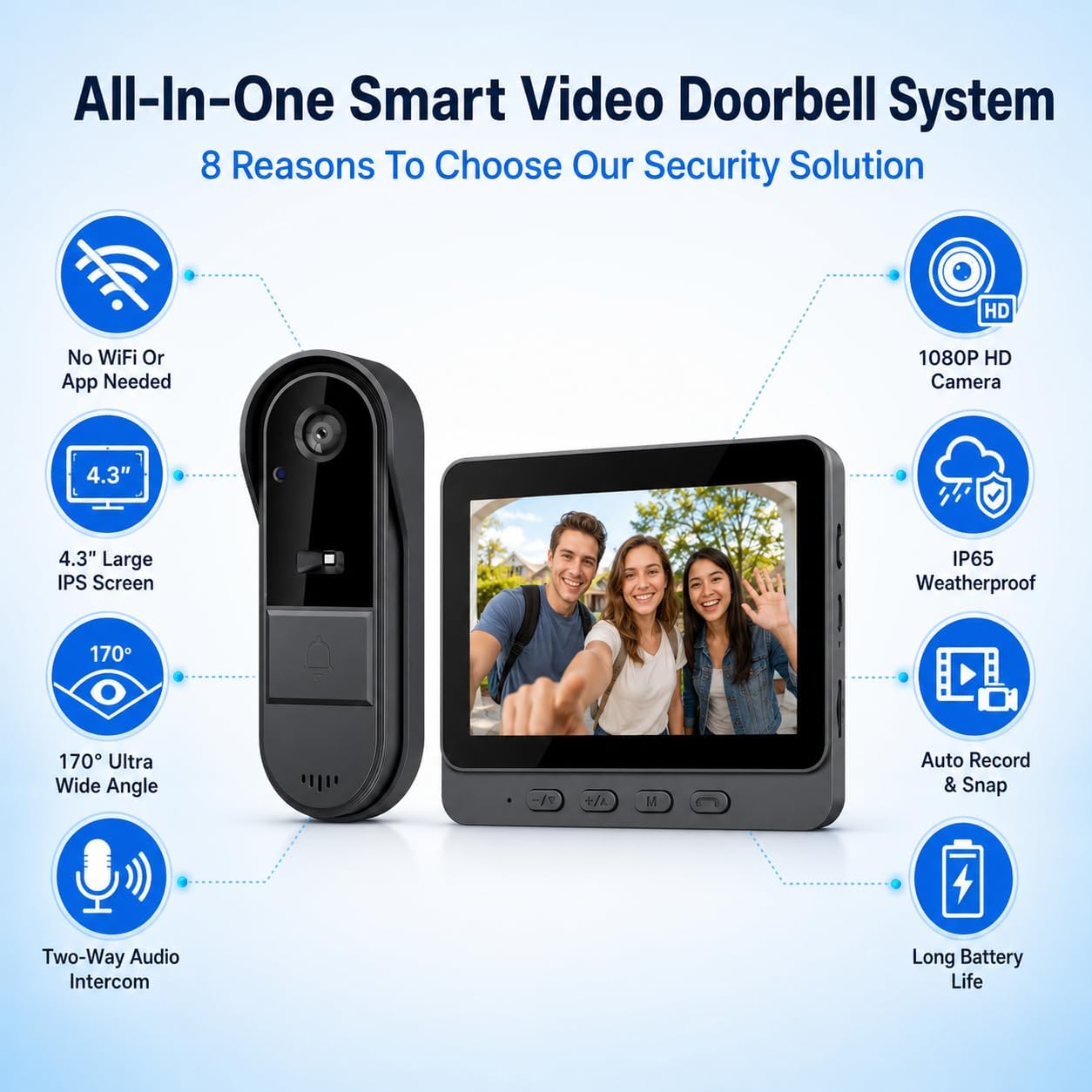
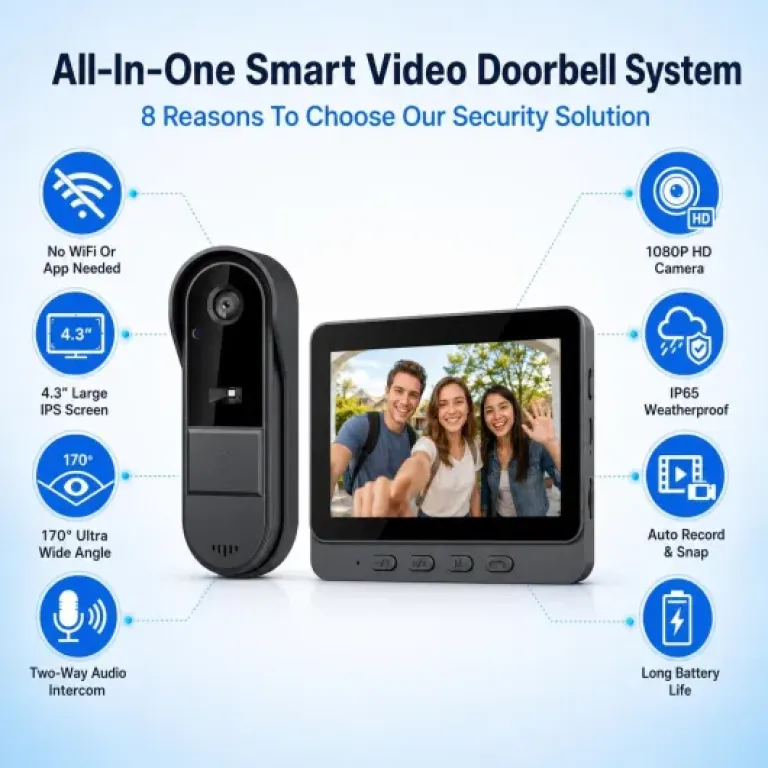
- No Wi‑Fi or app required: included 4.3" IPS screen handles all viewing and communication
- 1080p resolution with 170° wide angle and infrared night vision suitable for basic door monitoring
- Local microSD recording up to 32 GB with two-way audio and IP65 water resistance for outdoor use
Cons
- No remote access or smartphone notifications since it does not connect to Wi‑Fi
- Recording mainly triggered by button presses, not designed for continuous surveillance
- Modest battery capacity and reliance on MJPEG codec limit autonomy and storage efficiency compared with some competitors

Specifications
View full product page →| Brand | TKMARS |
A no‑Wi‑Fi video doorbell for people who just want it simple
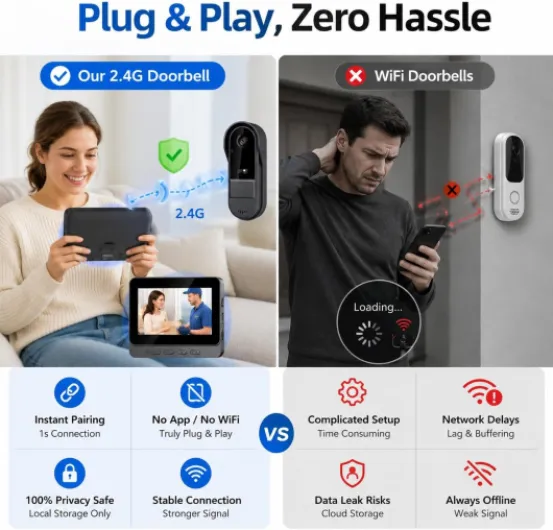
The TKMARS wireless video doorbell goes against the current trend of ultra-connected devices. Instead of forcing you through an app, cloud accounts and subscriptions, it comes with its own 4.3" indoor IPS screen and runs on a 2.4G wireless Bluetooth link between the outdoor unit and the display. No Wi‑Fi, no router setup, no QR codes. On paper, it targets people who want to see and talk to whoever rings the bell, without adding one more gadget to their phone.
The spec sheet is fairly clear: 1080p camera, 170° wide angle, night vision with infrared, IP65 water resistance, and local recording on microSD (up to 32 GB). Power comes from a 1000 mAh battery in the doorbell and a 400 mAh battery in the indoor display, with USB charging for both. Buyers can expect a basic but fairly complete package: doorbell host and display, both already paired via 2.4G wireless according to the description.
In the published reviews, the tone is mostly positive but not ecstatic. The global Amazon rating sits around 3.9/5 with more than 700 opinions, which suggests a product that generally does the job but is not flawless. Some buyers praise how it “works great” and highlight night vision and overall simplicity. Others are more neutral or return the product, without always giving much detail beyond durability or operation concerns.
In my opinion, this doorbell is clearly aimed at users who do not care about remote access from the office or push notifications on their smartphone. If the priority is to have a self-contained indoor screen that shows who is at the door and allows two-way audio without any app, the concept makes sense. If you’re expecting advanced motion detection, continuous recording or smart-home integration, the spec sheet already shows that this is not the right profile.
Value for money versus app-based competitors
With an Amazon rating of 3.9/5 from more than 700 reviews and a mid-pack ranking (around 188 in video doorbells), this TKMARS model clearly has a market but is not a star of the category. The price is not displayed here, but this kind of no-Wi‑Fi, local-screen doorbell typically positions itself below big smart brands that charge more for app integration and cloud features. The comments that say “absolutely brilliant works like it should” and “would buy it again” suggest that, for some buyers, the cost/benefit balance is good: they got a functioning video doorbell with night vision and two-way audio without spending a fortune or dealing with subscriptions.
The main value argument is simple: you pay once, you get a doorbell with 1080p camera, 170° field of view, IR night vision, local recording to microSD and an included 4.3" IPS indoor screen. No extra chime, no mandatory cloud plan, no need to own a smartphone. For households where not everyone is comfortable with apps, that’s a real advantage. On the other hand, you give up remote access, smart notifications on your phone, easy sharing with family members, and integration with other smart devices.
There are also some subtle trade-offs that impact value. Using MJPEG instead of a more modern codec means you use more storage for the same video length, although the event-only recording partly compensates for that. The 32 GB microSD limit is modest but acceptable for a doorbell that only records button presses. The lack of continuous recording and advanced motion detection may be seen as a downside by people who expected a full-fledged security camera rather than a video intercom. The few neutral or negative comments, including a return, show that not everyone finds the product aligned with their expectations, whether due to reliability or misunderstood features.
In my opinion, the value is decent if you specifically want an offline, screen-based solution. If you compare it directly with entry-level Wi‑Fi video doorbells that offer app access, cloud storage and smarter motion alerts in the same price zone, it can feel underwhelming on features. But for someone who doesn’t want their doorbell connected to the internet and prefers a simple, no-account setup, the proposition makes sense. The key is to be clear: this is a video intercom with local recording, not a smart cloud camera. If that aligns with your needs, it’s a reasonable buy; if not, better look elsewhere.
Design and practicality of the screen-based setup
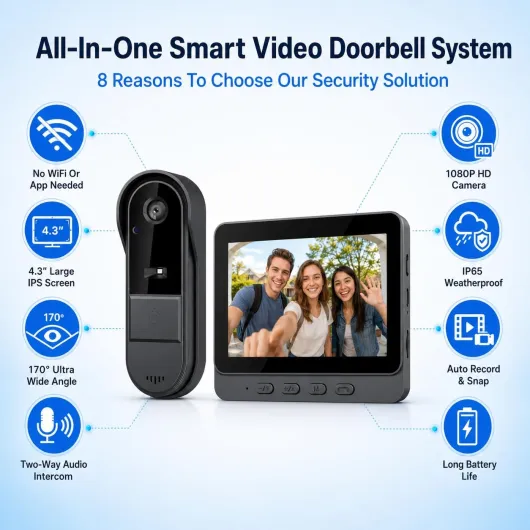
From the spec sheet, the TKMARS doorbell follows a classic rectangular design for the camera unit paired with a separate indoor monitor. The doorbell is described as a “turret” form factor, mountable using a standard doorbell mount. The indoor 4.3" IPS display is the main interface: instead of opening an app, you look directly at the screen to see who is outside. For households with older people or those who don’t want to rely on smartphones, this layout has a clear logic: walk up to the screen, press a button if needed, talk to your visitor, done.
The 4.3" IPS panel is not huge, but it should be large enough to recognize faces at the door, especially combined with 1080p resolution and a 170° wide angle. IPS usually means decent viewing angles and sufficient brightness for indoor use. The physical separation between camera and screen also means you can position the monitor in a convenient location inside the house, as long as the wireless link holds. Buyers who mention the product generally focus on how it “works like it should” rather than on the aesthetics, which suggests the design is functional and unobtrusive rather than stylish.
In terms of controls, the philosophy is push-button simplicity: someone presses the doorbell, the indoor screen activates with video and audio, and you can talk back. There is no mention of complex menus, touch interfaces or configurable zones. For some people, that’s a plus: less to configure, less to break. For others, the minimal interface will feel limited, especially if they are used to app-based systems that let you review clips, zoom in, or tweak motion sensitivity from a phone.
In my opinion, the design is clearly oriented toward ease of use over sophistication. The trade-off is that you lose flexibility: if you want to see your door from multiple rooms, you’d need to relocate the screen or buy additional hardware, whereas app-based systems let you use any phone or tablet. For a small apartment or a single main entrance, this monitor-based approach is practical. For a large house where you’d like to answer the door from upstairs or from the garden, the design will feel more restrictive.
Battery life and power constraints
The power setup of this TKMARS doorbell is quite specific. The outdoor unit uses a 1000 mAh built-in battery, while the indoor display has a 400 mAh battery and is meant to be connected to a power source via USB for extended operation. The brand claims a pure standby time of 4–6 months for the doorbell after a full charge. That kind of figure usually assumes relatively few doorbell presses and limited video usage, since every activation consumes more energy than simple standby.
On paper, 1000 mAh is not huge compared with some battery-powered cameras that go above 5000 mAh, but this device has a more limited duty cycle: no constant motion-triggered recording, no Wi‑Fi connection constantly pinging a server. Under those conditions, a lower capacity battery can still last several months between charges. The catch is that real-world autonomy always depends on how busy your door is. A house with daily parcel deliveries and frequent visitors will drain the battery faster than a quiet entrance that gets a few rings per week.
The indoor display is a bit different: its 400 mAh battery is more like a backup to keep it alive during short power cuts or when moved briefly. The manufacturer itself says it “needs to be connected to a power source” and that any ordinary USB charger can power it and extend the working time. In other words, you should plan a permanent USB power point near where you want to place the screen. Treating it as a purely battery-powered monitor would likely lead to frustration.
In my opinion, the power design is acceptable but not generous. The doorbell should be fine for people who accept occasional USB recharging—think once every few months in moderate use—but it is not the kind of set-and-forget wired solution that you never touch again. There are no detailed complaints in the sample reviews about battery life, but also no strong praise. If low-maintenance power is your top priority, a wired doorbell or a unit with a much larger battery might be more reassuring. Here, the balance is tilted toward ease of installation (no wiring) rather than extreme autonomy.
Build, weather resistance and long-term reliability
The TKMARS doorbell is advertised with an IP65 water resistance level, which means it should be protected against dust and low-pressure water jets from any direction. For a doorbell, that typically translates to decent resilience to rain and splashes, as long as it’s mounted correctly and not directly under a heavy water flow. The material is listed as metal, which is reassuring compared with flimsy all-plastic housings, at least on paper. The unit is also quite light at around 0.45 kg for the whole kit, suggesting a mix of metal and plastic rather than a full metal block.
Among the published opinions, the majority of positive comments focus on function rather than build, but there is at least one buyer who mentions that they dropped the screen and the screen broke, then states they would buy it again. That anecdote doesn’t say much about inherent quality; most small electronic displays will crack when dropped badly. Another review mentions the item being collected for return, which hints at at least one case where the product didn’t meet expectations or had a fault, though the exact cause isn’t explained. With a 3.9/5 average across more than 700 reviews, it’s fair to assume there are both satisfied users and a noticeable number of issues.
Since the device is battery powered and uses a 2.4G wireless link, long-term durability also depends on how well the internal battery and radio hold up over time. There is no mention of replaceable batteries or user-serviceable parts. In many products of this type, the battery performance slowly declines over a couple of years, leading to shorter intervals between charges. Without detailed long-term feedback here, that remains a reasonable risk to factor in rather than a proven flaw.
In my opinion, the durability picture is middling but not alarming: IP65 and a metal designation are good signs for outdoor use, but the absence of detailed reinforcement claims (impact resistance, UV stabilization) means it’s safer to treat it as a normal consumer device, not industrial hardware. If you mount it in a somewhat sheltered spot and avoid rough handling of the indoor screen, it should be fine for typical household use. If you need something to survive vandalism, extreme temperatures or years of direct sun and heavy rain, this model feels more basic than professional.
Video, audio and day/night performance
On the performance side, the TKMARS unit promises 1080p video with a wide 170° viewing angle and infrared night vision. On paper, that combination should be more than enough to clearly see who is at the door, even in low light. A couple of buyers explicitly mention that it “works great” and one highlights “lovely night vision”, which suggests that, for typical porch distances, the night mode is doing its job. The advertised 80 m night vision range is probably theoretical; most doorbell scenarios are within a few metres anyway, where IR LEDs are usually effective.
The camera uses MJPEG encoding and records in MP4 format to a microSD card (up to 32 GB). MJPEG is not the most efficient codec compared with H.264 or H.265, so the same card will hold fewer minutes of footage than on some competitors. However, since the camera only records when the button is pressed (as one verified review clearly states), storage pressure is less critical than on continuous recording systems. The absence of Wi‑Fi and cloud means all performance is local: no streaming delays through the internet, but also no remote access when you’re away from home.
Audio performance is described as two-way talk with a “powerful speaker and high-sensitivity microphone”. Comments from satisfied buyers indicate that it “works like it should”, which usually means visitors can hear you and you can hear them without too much trouble. There are no detailed reviews complaining about audio quality in the data provided, but with this kind of product it’s reasonable to expect some dependence on how far the doorbell is from the visitor and environmental noise (traffic, wind, etc.). On paper, nothing stands out as high-end, but it covers the basics.
In my opinion, the performance package is solid but basic. If you want AI motion detection, person-only alerts, or cloud-based clip analysis, this device is not aimed at you. However, if the goal is straightforward: “when someone rings, I see them clearly, including at night, and can talk to them,” the spec sheet and the more positive reviews indicate that it gets that core job done. The main technical limitation is the event-only recording and MJPEG codec, which mean it’s more of a video intercom with snapshot-style clips than a full surveillance camera.
What this TKMARS doorbell actually offers
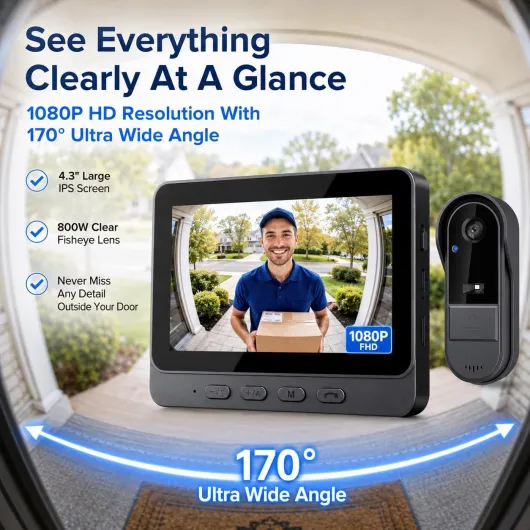
On paper, the TKMARS wireless video doorbell is a compact kit that combines an outdoor camera/doorbell unit with an indoor 4.3" IPS screen. The camera records in 1080p using MJPEG encoding and saves video in MP4 format to a microSD card up to 32 GB. The viewing angle is advertised at 170°, which is wide for this category and should cover a large portion of your entrance area. The brand also puts forward night vision with infrared LEDs and a claimed range of up to 80 metres, which in real life would usually translate to a decent but more modest usable distance at the door.
The communication between the doorbell and the indoor screen uses 2.4G Bluetooth-type wireless, not Wi‑Fi. That means the system is closed: the screen talks directly to the doorbell, with no internet in between. According to users, the camera is triggered by someone pressing the button and then records during the call; it is not a continuous recorder and does not seem to act as a full-time surveillance camera. This is an important point that one buyer explicitly mentions, and it lines up with the basic control method (push button alert, motion alert mentioned but clearly not central in the marketing).
Function-wise, you get two-way audio, so you can speak to your visitor from inside via the indoor screen’s microphone and speaker. The manufacturer claims the camera can effectively recognize faces thanks to HD resolution and the wide angle. The doorbell is powered by a 1000 mAh battery, while the indoor display has a 400 mAh battery but is meant to be kept plugged into a USB power source for extended runtime. Both units are fairly lightweight: the total package weighs around 0.45 kg and measures roughly 19.5 x 15.3 x 5.1 cm in its boxed form.
Overall, the feature set is simple but coherent: local recording, no apps, basic motion alert stated in the spec line, two-way talk, and weather-resistant construction (IP65). In my opinion, this is a product meant for people who are more concerned about having a straightforward peephole replacement than about building a full smart security ecosystem. The absence of Wi‑Fi and cloud is a strong point for some, and a hard limitation for others. The Amazon ranking (around 188 in video doorbells) shows it is not a top bestseller, but it has found a decent audience among users who value this offline approach.
Pros
- No Wi‑Fi or app required: included 4.3" IPS screen handles all viewing and communication
- 1080p resolution with 170° wide angle and infrared night vision suitable for basic door monitoring
- Local microSD recording up to 32 GB with two-way audio and IP65 water resistance for outdoor use
Cons
- No remote access or smartphone notifications since it does not connect to Wi‑Fi
- Recording mainly triggered by button presses, not designed for continuous surveillance
- Modest battery capacity and reliance on MJPEG codec limit autonomy and storage efficiency compared with some competitors
Conclusion
Analysis score
The TKMARS wireless video doorbell is a straightforward, offline solution aimed at people who want to see and talk to visitors without dealing with Wi‑Fi, apps or cloud accounts. It delivers 1080p video, a wide 170° viewing angle, infrared night vision and two-way audio through an included 4.3" IPS indoor screen. Reviews that highlight how it “works great” and praise the night vision back up the idea that, for basic intercom use, it does its job. The IP65 rating and metal material label suggest it should handle normal outdoor conditions, and the 1000 mAh battery is advertised to last several months in standby between charges.
On the flip side, this is not a smart doorbell in the modern sense. There is no Wi‑Fi, no app, no remote access from your phone. Recording appears to be triggered mainly by button presses, with no continuous surveillance mode, and storage is limited to a 32 GB microSD card using MJPEG encoding. Some buyers have returned the product or mention breakage when dropped, which, combined with the 3.9/5 average rating, paints a picture of a functional but not flawless device. It’s more of a digital peephole with intercom than a full security system.
In my opinion, this doorbell suits people who want simplicity and privacy: seniors, technophobes, or anyone who doesn’t want their front door camera on the internet. If you’re happy to check a single indoor screen and occasionally recharge the battery, it can be a sensible choice. If you expect remote notifications, smart-home integration, continuous recording or powerful motion detection, you’ll likely be frustrated and should look at Wi‑Fi-based alternatives, even if they cost more or involve subscriptions.