Summary
Analysis score
Average of the criteria rated below
Value for money: where it makes sense and where it doesn’t
Compact, flip-screen design focused on vlogging convenience
Battery life and everyday practicality
Build quality, weak spots and long-term concerns
Image and video performance: decent in good light, mixed elsewhere
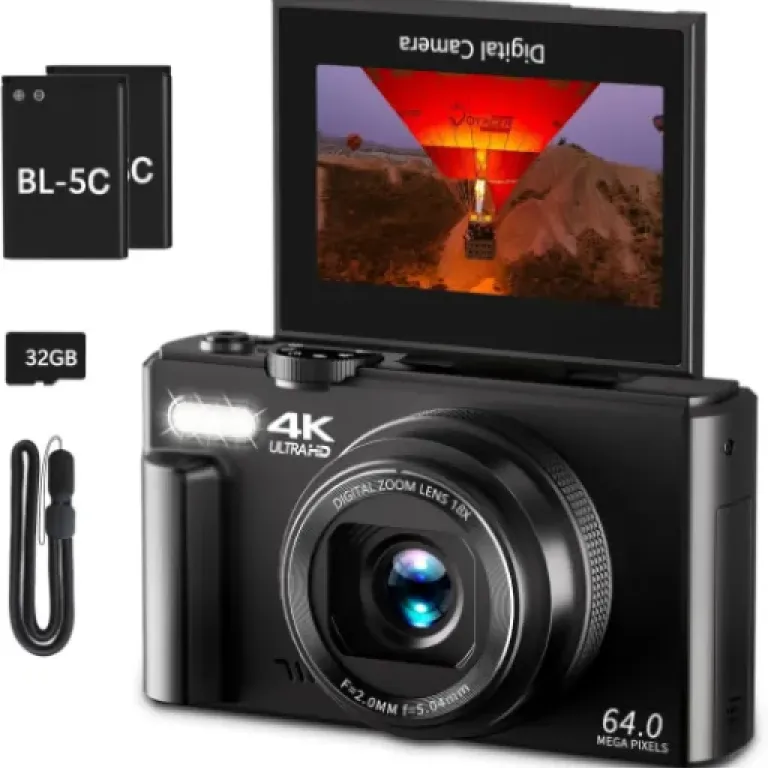
What this VJIANGER 4K camera actually offers
Pros
- Flip-up 3-inch screen and tripod mount make it practical for vlogging and overhead shots
- Comes as a full starter kit with 32 GB card, two batteries, bag and lanyard
- Wi‑Fi transfer and USB webcam mode add flexibility for beginners and content creators
Cons
- Image quality drops quickly in low light and can be similar to or worse than a decent smartphone
- No optical zoom and exposed non‑retractable lens raise practical and durability concerns
- Autofocus and startup speed are limited, making it less suited to spontaneous or fast-moving subjects

Specifications
View full product page →| Brand | VJIANGER |
A budget 4K camera aiming at beginners and vloggers
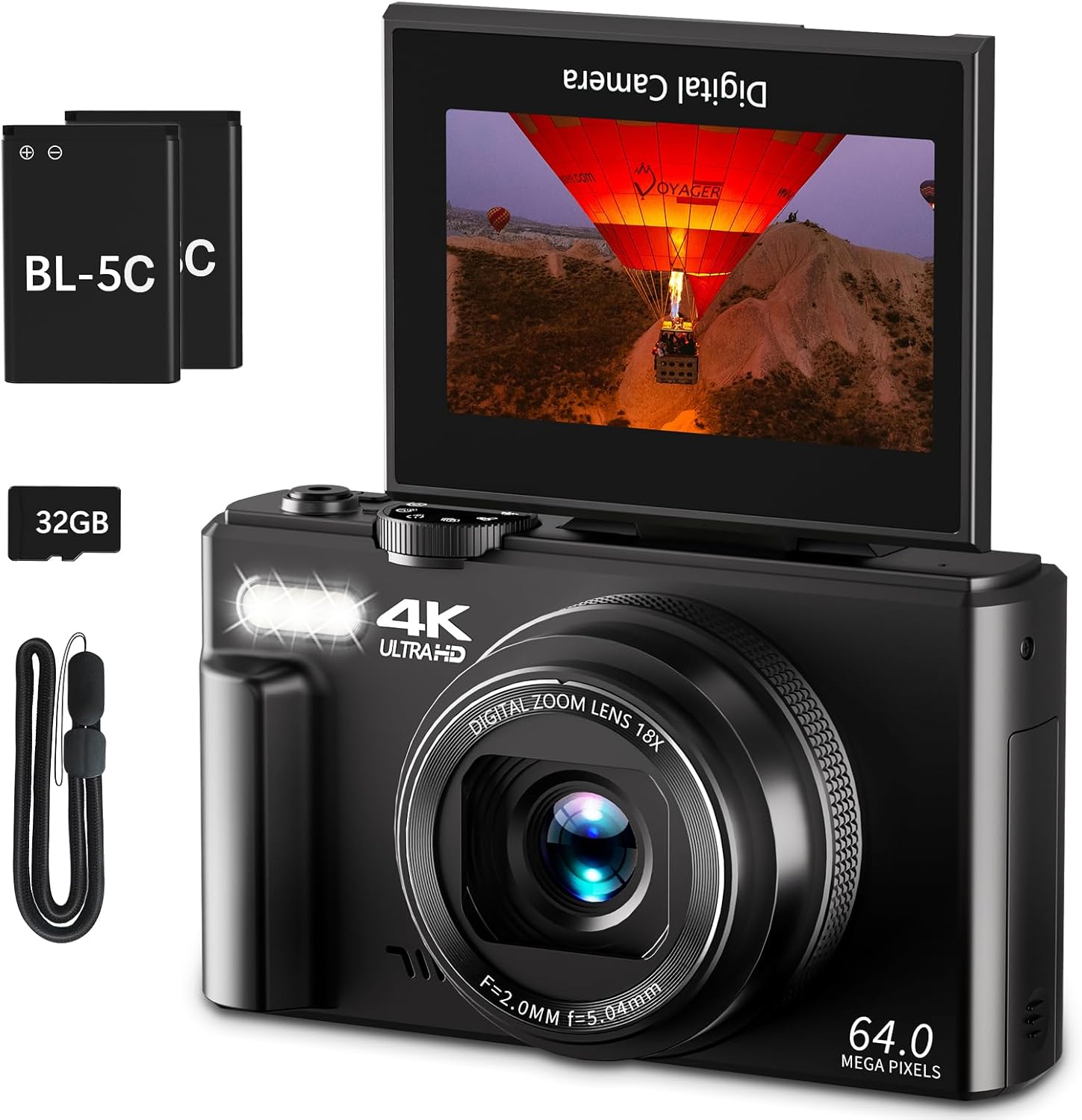
The VJIANGER W08 positions itself as a low-cost way to get into 4K video, basic photography and YouTube-style vlogging. On paper, it offers a lot for the money: 4K UHD video, a 64 MP sensor, 3-inch 180° flip screen, Wi‑Fi, webcam mode, and an 18x digital zoom. It also ranks very high in its category (#6 in Digital Point & Shoot Cameras on Amazon) and sits at an average of 4.1/5 from around 1,850 reviews, which suggests that many buyers are broadly satisfied, even if not everyone is convinced.
The brand clearly targets beginners, kids, and casual content creators who don’t want to pay for a DSLR or mirrorless setup. Skill level is explicitly labeled as “Novice”, the body is compact at about 0.4 kg, and the box includes a 32 GB microSD card, two batteries, a bag, and a lanyard, so it’s meant to be usable quickly without extra purchases. Several positive comments describe it as easy to handle for children or first‑time camera owners, and praise the value for the price.
However, the spec sheet also reveals several compromises. The lens is fixed-focus with no optical zoom (only 1x optical, 18x digital), maximum aperture is limited (listed as F8.0, which is quite narrow), shutter speed range is short (up to 1 second), and stabilization is digital only. Some buyers highlight that image quality drops quickly in anything but good light, and that audio through the built‑in speaker is weak. Others compare it to a smartphone and find their phone still better in less than ideal conditions.
In my opinion, this camera is best seen as an affordable tool for simple videos, learning basic photography concepts, or giving a kid their first "real" camera. It is not trying to compete with higher‑end mirrorless bodies or recent iPhones. If expectations are aligned with that — basic 4K clips, simple vlogs, easy file transfers — it looks like it can get the job done. If you’re chasing cinematic quality, strong low-light performance, or fast photography of moving subjects, the limitations show up quickly in the feedback.
Value for money: where it makes sense and where it doesn’t
With a 4.1/5 average rating from about 1,850 Amazon reviews and a #6 position in Digital Point & Shoot Cameras, the VJIANGER W08 clearly finds its audience. Multiple five‑star reviewers call it great "for the price", emphasize that it’s "kid friendly", and that the included accessories (card, bag, batteries) make it feel like a good deal. For someone who wants a dedicated device for simple 4K video, doesn’t want to rely on a phone, and appreciates the flip screen plus webcam mode, the feature bundle is hard to argue with.
The strengths in terms of value are pretty clear:
- All‑in‑one starter kit: camera, 32 GB U3 microSD, two batteries, bag, lanyard, USB‑C cable.
- Beginner‑oriented usability: simple menus, flip screen, built‑in flash, Wi‑Fi transfer, webcam functionality.
- Price vs. capabilities: 4K recording, 64 MP stills, Wi‑Fi, time‑lapse and basic manual controls at a budget level.
On the flip side, at this price range the main competitor is not another compact camera, it’s the smartphone you may already own. One 1‑star review states bluntly that in anything but perfect lighting, the image is worse than an older Motorola G7 Play, and that the daughter ended up using the phone instead. Another more moderate review says directly "it’s not iPhone quality" and describes the image as clear but not very vibrant, while calling the sound from the built‑in speaker too low. For someone with a recent mid‑ to high‑end phone, this camera doesn’t necessarily represent an upgrade in pure image quality.
In my opinion, the value is good if you fit one of these profiles: you want a dedicated camera for a kid; you need a basic overhead or desk camera that isn’t your phone; or you’re starting out with vlogging and just want a cheap 4K tool with a flip screen, tripod mount, and easy file transfer. If you are more demanding about image quality, low‑light performance, audio, or durability, spending more on a better compact or an entry‑level mirrorless body will make more sense in the long run. This VJIANGER sits comfortably in the "good enough and affordable" slot, as long as you don’t expect miracles.
Compact, flip-screen design focused on vlogging convenience
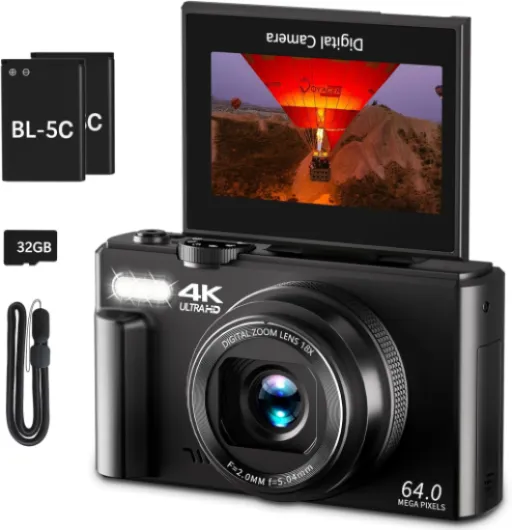
The W08 is clearly designed as a compact point‑and‑shoot. It weighs about 0.4 kg (roughly 9.8 ounces mentioned in the description), which keeps it light enough for kids and for one‑handed use while vlogging. The form factor is listed as "compact" and there is a 1/4" standard tripod thread on the bottom, which several reviewers appreciate for mounting above a table or desk. One user specifically mentions using it for recording crafting sessions from above, something that can be awkward with a phone.
The main ergonomic feature is the 3-inch LCD that tilts and flips 180°. For YouTube, TikTok, or Instagram content, being able to see yourself while framing is a big plus. Reviews from parents of younger users mention that their kids like the flip screen and find it intuitive. The interface seems to follow typical point‑and‑shoot logic: a dedicated zoom rocker (W/T), shared photo/video buttons, and basic mode options. Comments from buyers often mention that it is "easy to use" and "user friendly" even for a 10‑year‑old, which is consistent with the novice positioning.
Controls for the flash, zoom, power, and recording are described as clearly separated, with one reviewer calling out the dedicated zoom in/out buttons and the ability to keep the flash on while recording. That indicates a layout that favors quick access over deep customization. There is no optical viewfinder, only the LCD, which is standard at this price but means outdoor visibility will depend entirely on the screen brightness and coating. The spec sheet calls it a "flexible LCD" and "adaptive touch screen", though touch capability is not heavily highlighted in the comments.
On the downside, one critical review points out that the lens does not retract and the camera does not include a lens cover. For a device marketed to kids and travelers, that’s a real concern: a permanently exposed front element is easier to scratch or smudge, especially if it’s being tossed into bags. In my opinion, the overall design makes sense for vlogging and casual shooting, but serious users would probably want at least a simple third‑party lens cap or case to protect that fixed lens. Visually and ergonomically, it sounds functional and straightforward rather than premium.
Battery life and everyday practicality
The W08 comes with two lithium‑ion batteries, and the listing states an average life of about 2 hours. For a compact 4K camera at this price, that’s fairly typical. You’re not getting all‑day endurance, but with two batteries, casual users can usually cover a short outing, a vlogging session, or a kid’s play session before needing to recharge. The batteries are very light (listed at 0.01 kg each), which also hints at limited capacity, so constant 4K recording will drain them faster than occasional clips and photos.
The camera charges and connects via USB Type‑C, which is a plus in 2026 terms. That means you can likely use the same cable as your phone or laptop charger instead of hunting for a proprietary connector. Some cameras in this price range still use older USB standards, so Type‑C is a practical detail. There is no explicit mention of USB‑powered operation during recording, so it’s safer to assume you rely mainly on the internal batteries and treat USB as a charging and data link, not a power source for long live streams.
One critical review does mention that the camera takes a while to start up when you power it on. That has a direct impact on perceived battery life: if you keep it on to avoid missing spontaneous shots, you’ll burn through the batteries faster. If you turn it off to save power, you risk missing quick moments due to the startup delay. That’s a classic trade‑off on budget hardware where processors and firmware aren’t optimized for instant wake.
From a practicality standpoint, the inclusion of two batteries in the box is one of the solid points of the package. Many entry‑level cameras ship with a single battery, forcing an immediate extra purchase. Here, a novice user or parent buying it for a child can alternate between batteries without planning too much. In my opinion, you should still plan for regular charging and bring both batteries for a full day trip, especially if you’re shooting in 4K or using Wi‑Fi and the flip screen a lot. For a budget vlogging camera, the battery story is "acceptable but not generous" — workable if you manage it, not something you can ignore.

Build quality, weak spots and long-term concerns
The product description highlights a compact body and includes a camera bag and lanyard, but doesn’t claim any ruggedization or weather sealing. Water resistance level is explicitly "Not Water Resistant", so this is clearly not intended for heavy outdoor abuse or rainy conditions. The materials are not detailed, but at this price point, it’s reasonable to assume a mostly plastic construction. That isn’t necessarily a problem for weight and kids, but it does mean you need to be mindful of drops and impacts.
The most concerning durability point in the feedback is the exposed lens. One 1‑star reviewer points out that the optical assembly does not retract when powered off and that the camera does not ship with a lens cover. They warn that this makes it easy to scratch the lens, especially if used by a child or thrown into a backpack, and they see that as a potential way to ruin the camera over time. For a device that targets beginners and even 10‑year‑olds, that criticism is fair: a simple clip‑on lens cap or at least a mention of recommended protection would have made sense.
Another complaint from the same buyer is that their unit arrived without the promised 32 GB microSD card. That’s more of a quality‑control or packing issue than a physical durability problem, but it does raise questions about consistency between units. They also mention the slow startup and mediocre performance in anything but perfect light, which led their daughter to abandon the camera mid‑trip and go back to an older smartphone. That’s a single case among many positive comments, but it shows that expectations and reality can clash hard if someone is hoping for a clear jump over a decent phone.
On the positive side, there are many 4‑ and 5‑star reviews that don’t report any immediate hardware failure. Parents say their kids use it without trouble, and other buyers plan to "have fun" with it for crafting videos and social media content, hoping it lasts. No widespread reports of broken hinges, dead pixels, or failing buttons appear in the highlighted comments. In my opinion, durability is average for a cheap compact: treat it carefully, consider adding a protective case and some form of lens protection, and don’t expect it to survive rough conditions or heavy professional daily use.
Image and video performance: decent in good light, mixed elsewhere
Performance is where expectations need to be realistic. The W08 advertises 4K UHD video and 64 MP stills, which look strong on a product page, but the underlying hardware is a small 1/2.5" CMOS sensor with a simple fixed lens and digital stabilization. Among the reviews, opinions on image quality are split. Some verified buyers say the image is "crystal clear", colors are "vibrant", and that the footage "looks completely professional" for their needs. Others describe the output as similar to, or slightly below, a mid‑range smartphone, especially once lighting is less than ideal.
One detailed negative comment explains that in perfect lighting conditions the camera performs roughly like a good phone, but as soon as the light drops, photos become dull with mediocre brightness and contrast. That matches what you might expect from a small sensor and narrow maximum aperture (the spec sheet lists F8.0, which is far from bright). Another buyer mentions needing a ring light indoors, even in daytime, to get the look they want. So on paper, and in the feedback, this is a "good light" camera: outdoors in daylight or in a well‑lit room, it should be fine for casual use; in low light, noise and flat colors are likely.
Autofocus uses contrast detection with continuous‑servo AF (AF‑C) and claims 150 AF points. One reviewer notes that autofocus can hunt and cause blur when subjects are moving, which is common with basic contrast‑detect systems. They solved part of this by choosing fixed focus for video to avoid constant refocusing. For static vlogging setups (talking to camera, crafting tutorials, product demos on a table), that’s workable. For kids running around or fast action, it’s less ideal. Burst shooting is listed at 30 FPS, but with a small sensor and heavy processing, this is probably more of a gimmick than a serious sports mode.
Video format is MP4, which is easy to handle for editing and sharing. The camera offers 1080p and 4K, and several comments mention that transferring files by removing the microSD card and plugging it into a computer is straightforward. One buyer contrasts this with their struggles moving large video files off an iPhone, and says this camera simplifies that workflow. In my opinion, the performance story is simple: for beginners shooting in decent light who mainly care about having an independent camera with a flip screen and direct file access, it’s good enough. For anyone who already has a recent high‑end smartphone or expects strong low‑light and fast AF, it will feel limited.

What this VJIANGER 4K camera actually offers
On paper, the VJIANGER W08 is a compact 4K camera built around a 1/2.5-inch CMOS sensor with an advertised 64 MP resolution. It records MP4 video up to 4K UHD 2160p, and stills up to 64 MP JPEG. The lens is a simple fixed prime with contrast-detect autofocus, a real angle of view of 84.3°, and effectively no optical zoom (1x), relying instead on 18x digital zoom. For a beginner camera, that means framing flexibility comes mostly from stepping closer or further away, with digital zoom reserved for occasional use due to the expected loss in detail.
The screen is a 3-inch tilting LCD that flips 180°, clearly aimed at vloggers who need to see themselves while recording. There is built‑in Wi‑Fi for transferring photos and videos to a smartphone or tablet and for remote control via an app. The camera can also act as a webcam over USB by selecting “Camera mode” when connected to a PC. For content creators who stream or record tutorials, this dual use (camera + webcam) is one of the more practical aspects of the spec sheet.
The bundle is one of its selling points. Buyers receive:
- the camera body
- two lithium‑ion batteries (about 2 hours average life each according to the listing)
- a 32 GB microSD card (U3 rated, around 60 minutes recording capacity in the specs)
- a camera bag and lanyard
- a USB Type‑C cable and user manual
In terms of usage, the camera offers automatic and manual exposure modes, evaluative metering, continuous‑servo AF (AF‑C), time-lapse, self-timer, built‑in flash with fill mode, and digital image stabilization. ISO ranges from 80 to 25,600 according to the spec sheet, but given the sensor size and lens, expectations for clean high‑ISO output should stay modest. From the Amazon comments, the main real‑world roles seem to be: starter camera for kids/teens, basic YouTube or crafting videos, and a simple travel camera for people who don’t want to rely only on their phone.
Pros
- Flip-up 3-inch screen and tripod mount make it practical for vlogging and overhead shots
- Comes as a full starter kit with 32 GB card, two batteries, bag and lanyard
- Wi‑Fi transfer and USB webcam mode add flexibility for beginners and content creators
Cons
- Image quality drops quickly in low light and can be similar to or worse than a decent smartphone
- No optical zoom and exposed non‑retractable lens raise practical and durability concerns
- Autofocus and startup speed are limited, making it less suited to spontaneous or fast-moving subjects
Conclusion
Analysis score
The VJIANGER W08 4K camera is a budget‑oriented tool that packs a lot of features into a small, beginner‑friendly package: 4K video, 64 MP stills, 3" flip screen, Wi‑Fi, webcam mode, and a full starter kit with two batteries and a 32 GB card. The Amazon rating around 4.1/5 with a large number of reviews suggests that many buyers feel they got their money’s worth, especially parents buying it for kids and novices using it for simple vlogs or desk‑based videos.
Its limits are just as clear. There is no optical zoom, only 18x digital zoom, the sensor and lens combination struggle in low light, autofocus can hunt with movement, and there’s no weather sealing. One detailed negative review also highlights the exposed, non‑retractable lens and missing SD card in their box, which are valid concerns about protection and quality control. Compared to a good modern smartphone, the image is not a guaranteed upgrade, particularly in difficult lighting.
In my opinion, this camera makes sense if you want a cheap, dedicated device for a child, a basic YouTube or crafting setup, or you just prefer not to film everything on your phone. It offers solid convenience features for that role. If you already own a strong phone camera or you care a lot about low‑light performance, fast AF, and robust build quality, it’s worth saving for something higher‑end. Used with realistic expectations, the W08 is a practical entry point into 4K and vlogging rather than a rival to serious cameras or flagship phones.