Summary
Analysis score
Average of the criteria rated below
Is the EufyCam S330 worth the money compared to rivals?
Discreet, compact cameras with integrated solar panels
Solar charging, battery life, and when you may need a cable
Weather resistance, build, and support concerns
4K image quality, AI detection, and app behavior in real life
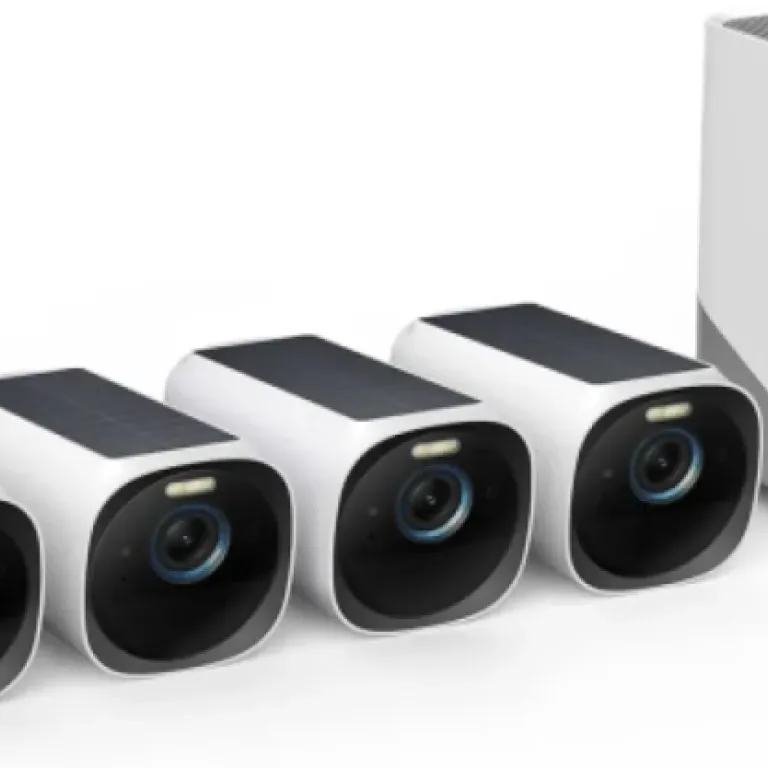
What the EufyCam S330 kit actually includes and promises
Pros
- 4K resolution with clear daytime image quality and useful zoom, according to buyers
- Integrated solar panels on each camera reduce charging needs in moderate‑activity, sunny locations
- Local storage on HomeBase with advertised expandability up to 16 TB and no mandatory subscription fees
Cons
- Battery can drain quickly in high‑activity or low‑sun areas, sometimes requiring wired power
- At least one detailed report of slow and unsatisfactory warranty support
- Night IR coverage and software features (like advanced scheduling or PC tools) leave room for improvement

Specifications
View full product page →| Brand | eufy Security |
4K, solar, and no subscription: what does this kit really offer?
The EufyCam S330 (also called eufyCam 3) 4‑camera kit targets people who want solid home surveillance without getting locked into monthly cloud fees. On paper, it checks a lot of boxes: 4K resolution, integrated solar panels on each camera, local storage via the HomeBase hub, AI face recognition, and a rated IP65 weatherproof design for outdoor use. With an average rating of 4.1/5 from over 3,000 Amazon reviews, buyers are mostly satisfied, but it’s not flawless.
What stands out is the combo of wireless installation and solar charging. Each camera runs on a built‑in battery that the small solar panel is supposed to top up with about two hours of sun per day. Several buyers mention that this setup lets them avoid climbing up ladders for frequent recharges, especially on cameras that get decent light and moderate motion activity. For people who hate subscriptions, the local storage and AI functions running on the base station are a clear selling point.
However, not all feedback is rosy. Among the reviews, there are reports of support and warranty frustrations, including one detailed case where a user sent back a faulty camera and waited months for a promised replacement that never arrived. Others mention that heavy activity zones can drain the battery quickly if you don’t provide wired power, and some users would like more polished software options such as better scheduling and PC management.
In my opinion, this kit looks like a strong fit for homeowners who want a mostly self‑contained, higher‑resolution system and are ready to spend a bit more upfront to avoid subscriptions. People who prioritize rock‑solid customer support or who have extremely busy, low‑sun locations might want to look closely at the trade‑offs before committing.
Is the EufyCam S330 worth the money compared to rivals?
The exact price isn’t listed here, but given the specs (4 cameras, 4K resolution, integrated solar, AI, and a HomeBase with expandable storage), this kit clearly sits in the mid‑to‑high price bracket for consumer security systems. You’re paying more upfront than for simple 1080p Wi‑Fi cams, but you’re also getting four units plus a hub and avoiding monthly subscription fees. Several buyers specifically highlight the no monthly fee aspect as a big advantage over Ring, Arlo, and Nest, where cloud storage and advanced detection often require ongoing payments.
On the value side, there are a few concrete points in its favor. First, 4K resolution genuinely brings more detail, and reviews back that up: people mention clear images and useful zoom for identifying details. Second, the integrated solar panels can save time and hassle if your placement and activity levels are reasonable, reducing ladder trips for battery swaps. Third, local storage expandable up to 16 TB is a rare feature in this segment; for someone who wants to keep weeks or months of footage from four cameras, that’s a big plus compared to systems that rely almost entirely on the cloud.
The downsides for value are not negligible, though. The kit is likely a significant investment, and some users mention needing wired power in busy areas to avoid fast battery drain, which can add to installation effort and potential electrician costs. Also, the negative support experience mentioned earlier puts a question mark over the long‑term peace of mind: if something fails, you might have to push to get a proper resolution. Finally, a few reviewers suggest software improvements, like better scheduling or PC‑based configuration, which you might already get in more mature ecosystems.
In my opinion, this kit offers good value for a specific profile: homeowners who want to cover multiple outdoor zones with 4K cameras, hate subscriptions, and appreciate local storage. If you just need one or two basic cameras and don’t mind paying a small monthly cloud fee, cheaper rivals might make more sense. But if the idea of a mostly self‑contained system with four solar‑assisted cameras appeals to you, the price premium is easier to justify.
Discreet, compact cameras with integrated solar panels
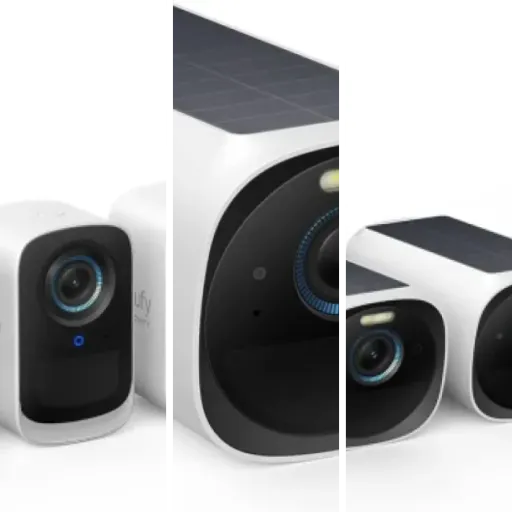
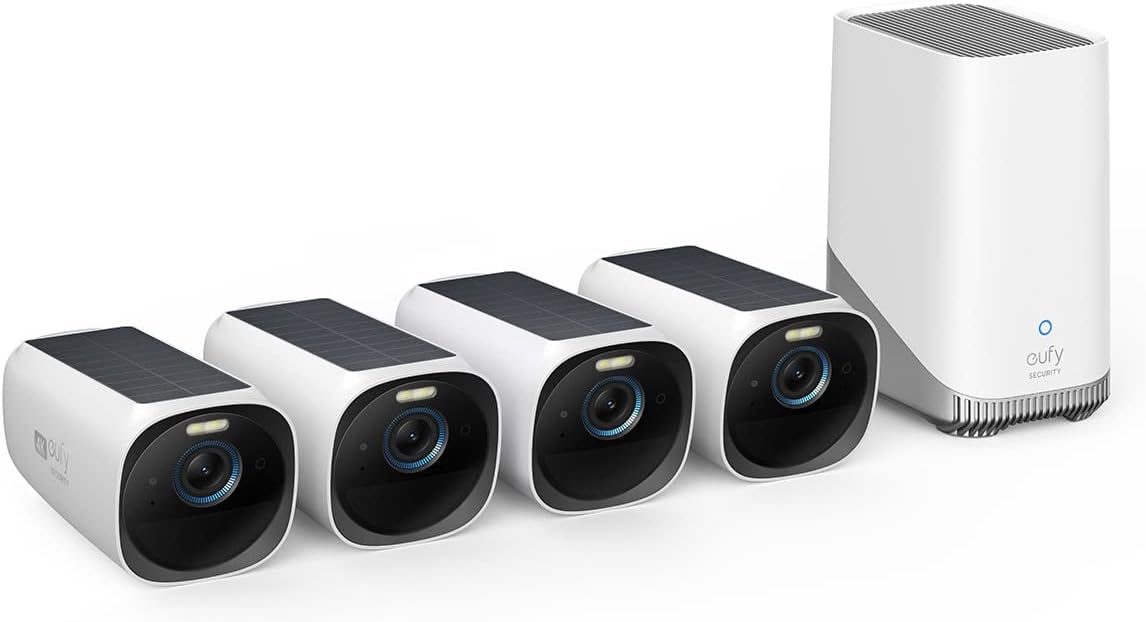
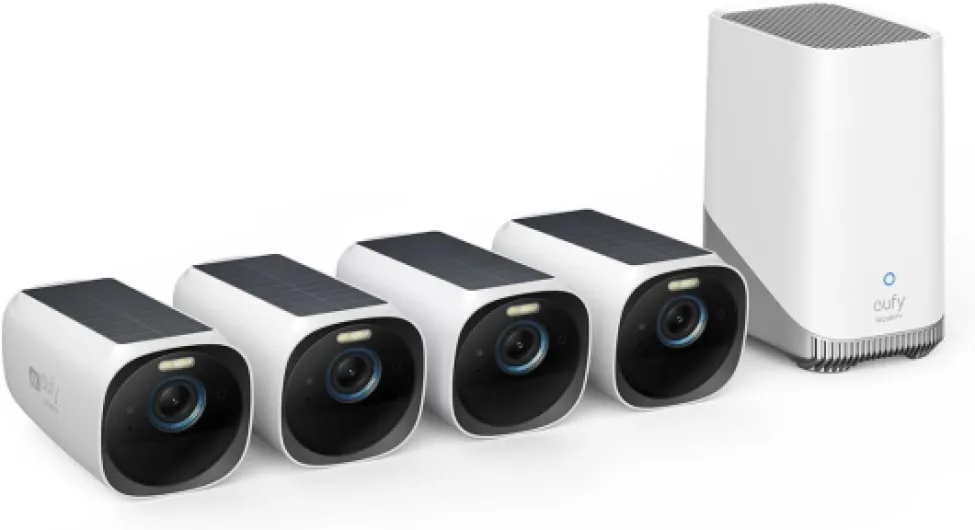
The EufyCam S330 cameras follow the usual modern smart‑cam look: compact, rounded white bodies with a black front face. Each unit weighs about 0.88 lb (14.1 oz) and measures roughly 5.04 x 2.52 x 2.52 inches, so they’re not tiny, but they’re small enough to sit under an eave or on a wall without dominating the facade. The form factor is listed as “dome”, though visually they’re closer to a rounded bullet camera with a fixed mount, designed for wall mounting outdoors.
The interesting part of the design is the integrated solar panel on each camera. Instead of having a separate panel with extra cabling, the panel is built into the camera housing. Several buyers highlight this as a strong point: fewer cables, cleaner look, and easier positioning. One reviewer even notes that a porch camera with only ambient light (no direct sun) stayed charged thanks to the panel, while another camera in direct sun handled many more alerts and still maintained around 70% battery in autumn. That suggests the physical design of the panel is at least practical in real‑world conditions for moderate activity zones.
Mounting is done via wall mounts that need to be tightened firmly. One detailed review warns that if you don’t really crank down the mounts, the cameras can slowly droop or move over time, especially outdoors where wind and vibrations can play a role. That’s not unusual for this type of hardware, but it does mean you shouldn’t treat the brackets too gently during installation. The wide 135° field of view should help cover larger areas with fewer blind spots, which partially compensates for the relatively fixed mounting angle.
In my opinion, the design is pragmatic: not flashy, but functional. The integrated solar panel and spotlight make each camera more self‑sufficient, and the overall size seems reasonable for 4K hardware and batteries. Someone looking for ultra‑discreet, almost invisible cameras might find these a bit chunky, but for a typical home installation where visibility itself can act as a deterrent, the physical design seems well suited.
Solar charging, battery life, and when you may need a cable
Eufy advertises that the EufyCam S330’s integrated solar panel needs only around two hours of sunlight per day to keep the camera running continuously. The idea is that you install it once, and the panel maintains the internal lithium‑ion battery. In practice, reviews suggest that reality depends a lot on sun exposure and motion activity. One buyer with a porch camera receiving mostly ambient light (no direct sun) reports that the panel still kept the camera charged, with only 1–2 alerts per week. Another camera in direct sunlight, handling 10–20 alerts per day, stayed around 70% charge even as fall reduced daylight hours.
On the flip side, a Spanish‑language review notes that in very high‑activity areas, the battery can drain quickly, and they recommend installing a wired power connection in those spots. That makes sense: 4K recording, frequent motion clips, and the spotlight all consume power. If a camera is constantly triggering or recording long events, the solar panel might not keep up, especially in winter or on a north‑facing wall with limited sun.
What this suggests is a simple rule: if a camera overlooks a calm area with decent sun, the solar panel should be enough most of the year. If it overlooks a busy street, a gate with constant traffic, or a shaded narrow alley, you should plan either to lower sensitivity and recording length, or to provide wired power if you want a “set and forget” setup. Several buyers say that once they tuned motion zones and sensitivity, battery drain improved significantly, because the camera stopped recording every minor movement.
In my opinion, the battery and solar story is good but conditional. The hardware clearly gives you flexibility (battery, solar, and optional wired power), but it isn’t magic: heavy use will still drain the battery faster than the panel can refill it in tough conditions. If you understand that and plan your placement accordingly, the system can be close to maintenance‑free; if you expect it to handle a busy street corner in deep shade without ever needing attention, you might end up disappointed.
Weather resistance, build, and support concerns
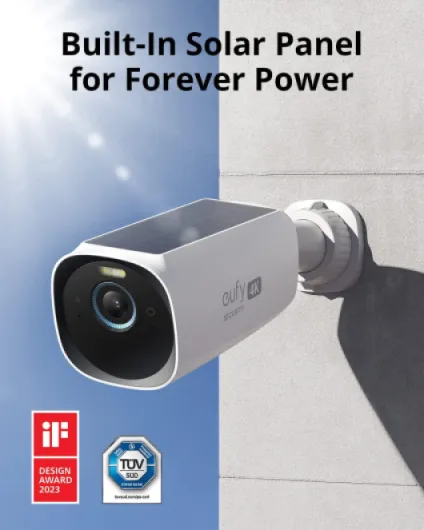
From a pure spec perspective, the EufyCam S330 cameras are rated IP65, meaning they’re protected against dust and low‑pressure water jets. That’s standard for outdoor consumer cameras and should be enough for rain, snow, and typical weather exposure when mounted under an eave or on a wall. The combination of plastic housing and integrated solar panel keeps things relatively lightweight at 0.88 lb per camera, which helps the mounts hold position as long as they’re tightened properly.
There aren’t many detailed reports of physical breakage in the public reviews provided, which usually suggests the housing and seals do their job in most installations. One user with thick insulated concrete walls and cameras on a garage and porch mentions no connectivity or reliability issues after several months, even as seasons changed from summer toward fall. That indirectly points to reasonable long‑term stability of both the wireless link and the outdoor components, at least over the medium term.
Where durability gets more complicated is on the support and warranty side. One verified purchaser describes a problematic camera that failed within about a month. They contacted support, who initially agreed to replace the unit and even had the buyer send the defective camera back at their expense. According to this review, five months later there was still no replacement, despite multiple escalations and confirmations that the returned camera had been received. Meanwhile, the same product and individual cameras were reportedly still available for sale. This kind of story understandably worries potential buyers about how issues are handled when something does go wrong.
In my opinion, the hardware durability looks decent for the category, with no widespread pattern of physical failures showing up in the comments. But the isolated report of a long, unresolved warranty case is a red flag for anyone who values quick, predictable support. If you’re installing this kit in a critical location where downtime of a single camera would be a big problem, it might be worth considering local retailer returns or extended warranties, or at least going in with realistic expectations that support experiences can vary.
4K image quality, AI detection, and app behavior in real life
On paper, 4K resolution at 30 fps with a 135° field of view should deliver a clear picture, especially for identifying faces and license plates at medium distances. Several buyers explicitly praise the daytime image quality, calling it “spectacular” and highlighting how easy it is to zoom in on recorded video to see more detail. That aligns with what you’d expect from a 4K sensor compared to the more common 1080p: more usable detail when you crop into the image, as long as lighting is decent and the bitrate is sufficient.
Night performance relies on a Starlight low‑light system plus infrared LEDs and a spotlight. Reviews are generally positive but not over the top. One user describes night vision as between “good and spectacular” and notes that IR coverage is strong close to the camera but less effective further out, suggesting that for large yards you might need additional IR illumination if you want full coverage. That’s fairly typical: 4K sensors and small IR arrays can struggle in very dark, wide spaces, but for driveways, porches, and entrances, buyers seem mostly satisfied.
A big part of performance here is the BionicMind AI and motion detection. The system can distinguish between humans and other motion, and it can learn to recognize familiar faces, labeling friends and family in the app. Reviews mention that person detection works well from different angles, not just full face shots. Motion sensitivity and activity zones are adjustable, which helps reduce false alerts from trees or passing cars. One detailed review mentions dealing with wind‑induced false triggers on a garage camera, then dialing back sensitivity to get it under control. That aligns with the usual tuning process on smart cams.
On the connectivity side, at least one user with thick insulated concrete walls reports strong signal from the HomeBase placed inside a pantry, with garage and porch cameras staying connected through multiple walls and a garage door. The app is often described as responsive, even over mobile data. In my opinion, performance looks solid for a Wi‑Fi‑based system, with the main limitations being typical ones: IR range at night and the need to tune motion settings carefully in tricky environments. For most home users, the balance of resolution, AI, and app controls seems well above basic 1080p competitors.
What the EufyCam S330 kit actually includes and promises
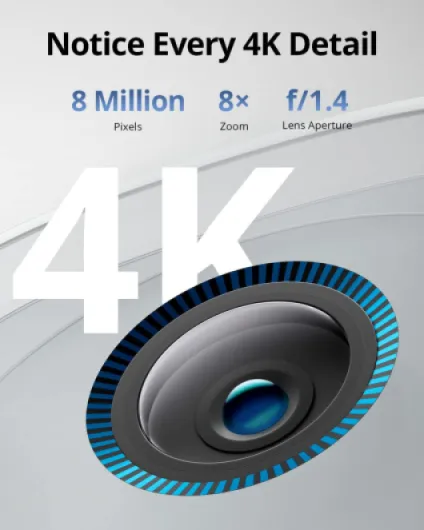
The EufyCam S330 (eufyCam 3) 4‑cam kit is built around four wireless outdoor cameras paired to a HomeBase hub. Each camera records in 4K resolution (MPEG‑4, up to 30 fps) with a 135° field of view, integrated spotlight, and built‑in solar panel. The cameras are battery powered (lithium‑ion batteries included), and the system connects via Wi‑Fi to your home network. The spec sheet lists an IP65 rating, which means it should handle rain and dust for typical outdoor mounting.
The HomeBase offers 16 GB of built‑in flash storage, and the manufacturer advertises expandability up to 16 TB via additional storage (for example, a hard drive). That’s a big difference compared to many Wi‑Fi cams that rely mostly on paid cloud plans. Here, the pitch is clear: no monthly fee for basic recording, person detection, and Eufy’s BionicMind AI for face recognition. Reviews confirm that the system runs without a subscription for core features, which is a key reason several buyers picked it over Ring, Arlo, or Nest.
On the smart side, the kit supports voice control through Amazon Alexa and Google Assistant. You can pull up camera feeds on compatible smart displays or control basic functions by voice. The mobile app (iOS/Android) is frequently mentioned as user‑friendly, with options to adjust motion sensitivity, draw custom detection zones, and review recordings stored on the HomeBase. One long review highlights that even on a mobile network, live view and navigation in the app stay reasonably quick.
In my opinion, the overall package is clearly positioned as a premium, all‑in‑one security solution for a house: four 4K outdoor cameras, smart alerts, and local storage that can be scaled up if you’re ready to add a drive. It’s not a budget kit, but for someone who wants to cover multiple sides of a property with one purchase and avoid recurring fees, the spec sheet looks coherent and fairly complete.
Pros
- 4K resolution with clear daytime image quality and useful zoom, according to buyers
- Integrated solar panels on each camera reduce charging needs in moderate‑activity, sunny locations
- Local storage on HomeBase with advertised expandability up to 16 TB and no mandatory subscription fees
Cons
- Battery can drain quickly in high‑activity or low‑sun areas, sometimes requiring wired power
- At least one detailed report of slow and unsatisfactory warranty support
- Night IR coverage and software features (like advanced scheduling or PC tools) leave room for improvement
Conclusion
Analysis score
The EufyCam S330 (eufyCam 3) 4‑cam kit looks like a solid choice for people who want a more serious home surveillance setup without getting locked into cloud subscriptions. On paper and in many reviews, the combination of 4K resolution, solar‑assisted battery power, and local, expandable storage delivers exactly what it promises: clear footage, flexible installation, and no recurring fees for basic features. Buyers often praise the image quality, the app’s ease of use, and the effectiveness of the AI for detecting people and recognizing known faces.
It’s not perfect. Battery life depends heavily on sun exposure and how busy each camera’s field of view is, and in very active, low‑light spots you should be ready to either fine‑tune settings or run a power cable. Night vision is described as good but not miracle‑level, especially at longer distances, and one detailed review raises serious concerns about how a warranty claim was handled. For a premium‑leaning product, that kind of support story is something to keep in mind.
In my opinion, this kit fits best for homeowners who want to cover several outdoor zones, value data staying local, and are comfortable paying more upfront to avoid monthly fees. If you just need a couple of simple indoor cameras or if top‑tier, always‑on customer support is your priority, there are simpler or more established ecosystems to consider. But if the feature mix lines up with your needs and you plan your camera placement intelligently, the EufyCam S330 offers a strong, fairly complete package.