Summary
Analysis score
Average of the criteria rated below
Is the Uninell UR3 worth it compared with bigger brands?
Slim body, dock with self-empty bin and pet-hair-friendly brush
Up to 180 minutes of runtime and smart recharge behavior
Build, maintenance and early signs of reliability
Cleaning behavior, suction and navigation in real homes (through reviews)
What the Uninell UR3 actually offers
Pros
- Strong spec sheet: 7000Pa suction, LiDAR navigation, 3.5L self-emptying station, and mopping in one device
- Very positive user feedback on ease of setup, mapping, and day-to-day cleaning performance on hard floors and carpets
- Multiple control options (app, remote, voice assistants, onboard buttons) and up to 180-minute runtime with auto recharge and resume
Cons
- Brand is relatively unknown, with limited long-term durability and support feedback
- Mopping function is basic and will not replace a thorough manual mop for ingrained stains

Specifications
View full product page →| Brand | uninell |
A high-spec robot vacuum that’s quietly climbing the rankings
The Uninell UR3 positions itself as a fairly ambitious robot vacuum: 7000Pa suction on paper, LiDAR navigation, a 3.5L self-emptying base, and a mopping function, all in one package. It sits in the mid-range of robot vacuums by price bracket, but its spec sheet looks closer to what bigger brands usually reserve for more expensive models. With a 4.9/5 average over a bit more than forty Amazon reviews, buyers seem very satisfied so far, at least in the short term.
The product targets typical household use: hard floors, carpets, pet hair, daily crumbs in the kitchen. The brand highlights a 180-minute battery life, multi-floor map saving (up to five floor plans), and full smart control: app, remote, voice assistants (Alexa, Google Home) and onboard buttons. The robot is relatively compact at 32 x 32 x 9.65 cm, and weighs just under 8 kg including the base, which is standard for this category.
Among the public comments, several verified buyers insist on two key points: ease of setup and mapping, and the convenience of the self-emptying station that reduces day-to-day maintenance. A few owners mention using it for older relatives or busy households, which suggests that the interface and automation are simple enough for non-tech-savvy users. Noise is also often described as reasonable, which lines up with the advertised 50–60 dB noise level.
In my opinion, the UR3 looks like a classic “convenience first” robot: it is not trying to reinvent anything, but piles on most of the modern features people now expect. The big question is whether this mix of strong suction, LiDAR, and self-emptying holds up over time. With limited long-term feedback so far, you mainly have the spec sheet and the early reviews to go on, but those are clearly leaning positive.
Is the Uninell UR3 worth it compared with bigger brands?
Even without a displayed price here, it is clear from its position in the rankings (around #49 in robotic vacuums on Amazon UK) and its feature set that the UR3 sits in the mid-range segment. You get LiDAR, a self-emptying base, high advertised suction, and a mopping function. With the big names, that combination often pushes prices quite high. Uninell is clearly trying to undercut them while offering a similar spec list. The 4.9/5 average rating over 42 reviews suggests that early buyers feel they got solid value for their money.
From a feature-to-price perspective, the UR3 is attractive: 3.5L self-empty station, multi-floor mapping, app + remote + voice control, carpet boost, and 180-minute runtime are usually found on more expensive models. Multiple users highlight that the self-emptying function and automation let them reduce manual cleaning to a weekly bin empty and occasional mop pad change. One buyer even bought it for their mother, with the explicit goal of saving her effort, and reports that she adapted to it easily, which speaks to perceived value in terms of time saved, not just hardware.
The main downside in terms of value is brand maturity and support. With an established brand, you often pay more but you usually get clearer access to replacement parts, long-running firmware updates, and more predictable warranty handling. With Uninell, that part is less transparent. If something goes wrong after a year, you might have to rely heavily on Amazon’s return mechanisms or the seller’s responsiveness, which can vary.
In my opinion, the UR3 offers strong value if your priority is maximizing features per pound and you are comfortable with a relatively new brand. You get a lot of automation and cleaning power for the apparent price bracket. If you prefer to minimize risk and want proven long-term reliability above all, a more established competitor might make more sense, even if that means sacrificing the self-emptying base or accepting lower suction specs at the same budget.
Slim body, dock with self-empty bin and pet-hair-friendly brush
The UR3 follows the classic round robot vacuum format with a low profile. At approximately 3.8 inches (9.65 cm) high, it should pass under many beds and sofas, which is a real advantage for people who hate dust bunnies in hard-to-reach areas. Several buyers explicitly mention that it gets into corners and under furniture better than they expected. The 32 x 32 cm footprint is standard and should let it navigate between chair legs and around table bases without too much trouble, especially with LiDAR guiding it.
The robot is sold in black, which tends to hide dust and scuffs better than white models but can show fingerprints and hair if the plastic is very glossy. The self-emptying station is not described in detail in the reviews, but it is clearly compact enough to sit against a wall in a hallway or living room, and includes the 3.5L bag or bin system. Users say it was "packed extremely well" and that assembly from box to first run took about ten minutes, which hints that the dock’s design is straightforward with few parts to clip together.
A notable design point is the tangle-free roller brush, which targets one of the most annoying issues with robot vacuums: hair wrapping. People with long hair or shedding pets usually spend time cutting hair out of the roller. Here, the brand claims a design that reduces tangles, and one review from a pet household reports that hair handling is good and maintenance reduced. It will not be magic – no brush is – but it is clearly a design focus.
In my view, the UR3’s design looks practical rather than stylish. There is no claim of premium materials or designer finishes; the priority seems to be a low height, a functional dock, and a roller that copes with hair. For a robot that is supposed to run daily and often unattended, that’s probably the right choice. The only real unknown is how the black plastics and moving parts will hold up cosmetically and mechanically after months of collisions with furniture legs and baseboards.
Up to 180 minutes of runtime and smart recharge behavior
The UR3 is advertised with a 2600mAh battery and up to 180 minutes of runtime, which the brand associates with roughly 2000 sq ft of cleaning on a single charge in standard conditions. That kind of figure usually corresponds to quiet or medium suction on mostly hard floors, so actual runtime at maximum 7000Pa suction will be shorter. Still, in the Amazon comments, owners describe the battery life as "really long" and say it can handle their home while they are out, which suggests that for average-sized flats and houses it is more than enough.
The robot includes an automatic recharge and resume cleaning feature: when the battery drops below about 15%, it returns to the dock to recharge, then resumes where it left off. This is now standard on mid-range and high-end robots, but it is still essential for larger homes. A reviewer mentions that the UR3 reliably finds its way back to the charging station without issue, which is not always the case with cheaper models that can get lost or stuck before docking.
Daily use scenarios mentioned in the reviews include running it in the morning before people wake up or scheduling it when the owner is out of the house. Nobody complains about the robot dying halfway through a normal cleaning routine, and there are no visible reports of sudden battery drops. That said, the product has not been on the market for years, so there is no long-term feedback on battery degradation or replacement availability.
In my opinion, the battery side looks well balanced: 2600mAh is not monstrous but, combined with efficient LiDAR navigation, it should be enough to cover a standard home in one or two cycles. The critical factor will be how much you rely on maximum suction and frequent carpet boost, which can cut runtime substantially. For very large multi-story houses with lots of carpets, you should expect the robot to need at least one recharge in the middle of a full-home clean, which the resume function is designed to handle anyway.
Build, maintenance and early signs of reliability
On the durability front, there is not a lot of long-term data yet, but a few points stand out. First, the UR3 weighs about 7.95 kg including the dock, which implies a fairly solid base and a robot that is not ultra-light. That can help stability and robustness in daily collisions with furniture. Buyers describe the unit as well packed and easy to assemble, with no mention of flimsy parts or misaligned components out of the box, which is already a good sign for manufacturing consistency.
The tangle-free roller brush is also an important factor for durability: less hair wrapping means less stress on the motor and less risk of damage when users forget to clean it. Several owners with pets or long hair in the household report less manual untangling than with previous robots they owned, even if it is not completely maintenance-free. The self-emptying station also helps keep the internal dust bin from being overfilled, which can otherwise strain the suction system over time.
In terms of electronics and software, the app is repeatedly described as stable and responsive, with quick Wi-Fi pairing. No reviewer mentions connection dropouts or mapping corruption so far. While that does not guarantee long-term reliability, it at least indicates that the firmware and companion app are mature enough for day-to-day use. The LiDAR navigation system and cliff sensors are also praised for working correctly, especially in houses with stairs, which is reassuring from a safety perspective.
In my view, durability is the main question mark with a lesser-known brand like Uninell. There is no visible pattern of failures or defects in the current comments, but forty-odd reviews are not enough to reveal long-term issues such as worn wheels, failing batteries, or LiDAR sensor faults after a year or two. If you are risk-averse, that’s the trade-off: you get strong features and a good spec sheet, but you also accept some uncertainty about spare parts availability and after-sales service once the initial warranty period ends.
Cleaning behavior, suction and navigation in real homes (through reviews)
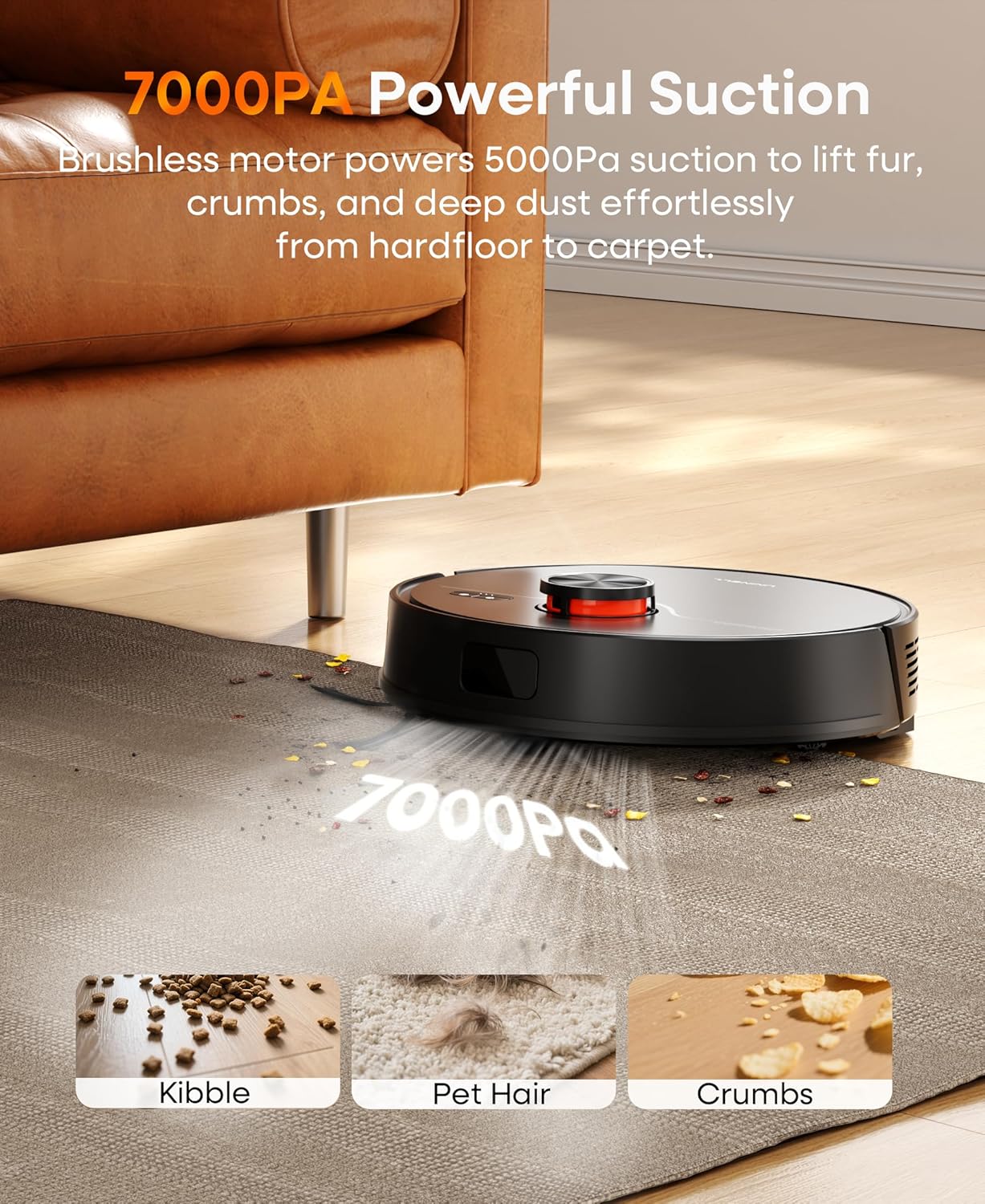
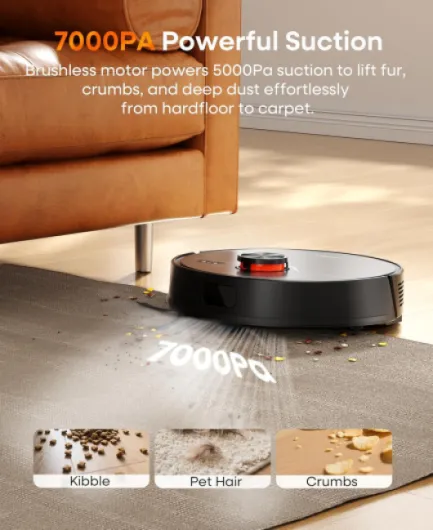
The performance story of the UR3 is built around three elements: high suction, LiDAR navigation, and carpet boost. The manufacturer advertises 7000Pa suction, which on paper is more than enough for typical household dust and debris. Multiple Amazon reviewers, including pet owners and families, say the robot "does a great job" and "picks up everything it should" on both hard floors and carpets. One comment specifically notes it copes well with crumbs in the kitchen and along walls, which are usual weak spots.
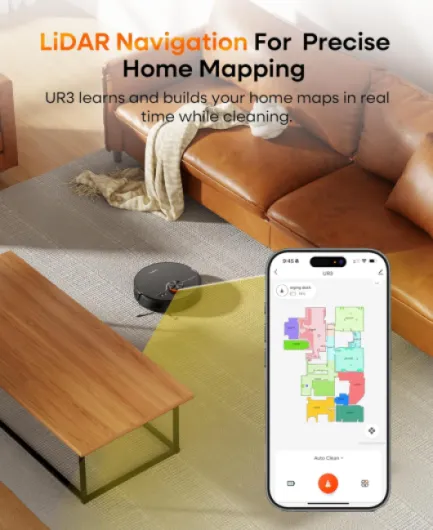
Navigation is handled by a LiDAR turret that performs 360° scans and builds a map quickly. Several buyers mention that after a simple setup, the robot maps the house and then follows a methodical path rather than random bumping. One user explains that it navigates around furniture and obstacles well and that cliff sensors prevent falls down stairs, which is important in multi-level homes. The ability to save up to five floor plans and set no-go zones lets you keep it away from pet bowls or delicate areas, something one review explicitly appreciates.
Performance on different surfaces appears solid in the comments: people report good results on hardwood, tiles and carpets, with the auto-carpet boost kicking in for deeper cleaning. Suction levels and water flow can be adjusted per room in the app, so you can, for example, set higher suction in the hallway where shoes bring in more dirt, and lower power in bedrooms. A few buyers highlight that the UR3 gets close to walls and into corners better than expected, though like all round robots it will still rely on side brushes and will never be perfect in square corners.
From an analytical point of view, the performance is promising but not flawless by definition: 7000Pa is a big number, but real-world cleaning always depends on brush design, airflow paths and dust bin shape. Still, with almost exclusively positive feedback so far and no recurring complaint about weak suction or bad navigation, the UR3 seems to deliver solid daily cleaning for typical households. The main unknown is how filters, brushes and sensors will behave after months of dust, which no current review can really answer yet.
What the Uninell UR3 actually offers
On paper, the Uninell UR3 is a 3-in-1 machine: it can sweep, vacuum and mop in one go thanks to its two-in-one dust box and water tank. The manufacturer announces up to 7000Pa suction, which is very high compared with many mainstream models that sit closer to 2500–4000Pa. It also includes a 20,000 RPM brush and an auto-carpet boost mode that is supposed to increase suction by 200% when it detects rugs or carpets. For households with pets or kids, this level of suction should be enough to handle daily debris and embedded hair, at least according to the buyers who say it “picks up everything it should”.
The robot uses LiDAR navigation with 360° scanning to build maps, and can store up to five floor plans. This is clearly aimed at multi-story homes or people who want detailed zoning: you can set no-go zones, adjust suction and water flow by room, and choose where and when it should clean. Several reviewers say it mapped their first room quickly and then started cleaning in an orderly pattern, not in random zig-zags, which is consistent with LiDAR behavior.
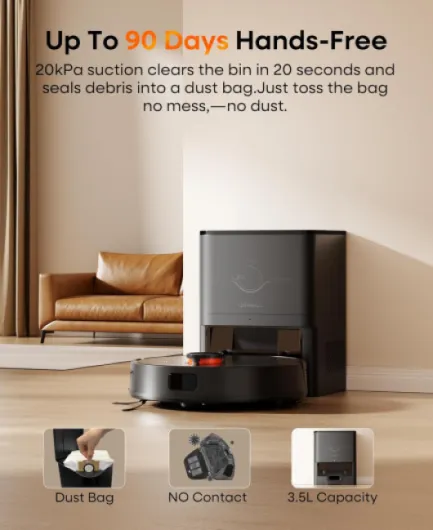
Another strong point is the 3.5L self-emptying station, advertised to hold up to around 70 days of dust in typical use. That obviously depends on how dirty the home is and how often it runs, but it puts the UR3 in the same category as the better-known self-emptying robots. Users like that they only have to empty the big bin roughly once a week or even less often, instead of after every run.
In my opinion, the UR3’s overall feature set is very complete for a robot vacuum at this level: self-emptying, LiDAR, strong suction, mopping, multi-floor mapping, and broad control options. There is nothing revolutionary, but you get most of the modern conveniences people expect. The downside is that with so many features crammed in, long-term reliability and spare parts availability are always question marks with a lesser-known brand, something you won’t see in the spec sheet.
Pros
- Strong spec sheet: 7000Pa suction, LiDAR navigation, 3.5L self-emptying station, and mopping in one device
- Very positive user feedback on ease of setup, mapping, and day-to-day cleaning performance on hard floors and carpets
- Multiple control options (app, remote, voice assistants, onboard buttons) and up to 180-minute runtime with auto recharge and resume
Cons
- Brand is relatively unknown, with limited long-term durability and support feedback
- Mopping function is basic and will not replace a thorough manual mop for ingrained stains
Conclusion
Analysis score
The Uninell UR3 is a very complete robot vacuum on paper: strong 7000Pa suction, LiDAR navigation with multi-floor mapping, a 3.5L self-emptying base, and integrated mopping. Public reviews are highly positive so far, with people praising the ease of setup, the clarity of the app, and the fact that it genuinely takes over day-to-day floor cleaning on hard floors and carpets. The tangle-free roller and carpet boost mode make it particularly suitable for homes with pets and mixed surfaces.
In my view, this model fits best for busy households that want a mostly hands-off cleaning routine, are comfortable with app control, and want self-emptying without paying flagship-brand prices. It also seems like a good option for older relatives or non-tech-savvy users thanks to the included remote and simple scheduling. The main trade-offs are the relative youth of the brand, the lack of long-term durability feedback, and the usual limitations of any robot mop (it freshens floors rather than replacing a deep manual mop).
If you prioritize a rich feature set and convenience and are willing to accept some uncertainty on long-term support, the UR3 looks like a solid bet. If you prefer proven longevity, ultra-robust service networks, or the assurance of a well-known logo on your dock, you might want to compare it directly with offerings from the established players, even if that means paying more or losing the self-emptying base at this budget.