Summary
Analysis score
Average of the criteria rated below
Is the PACEX100 Silent worth the money?
Design, size and installation constraints
Noise, night use and the reality of the “Silent” mode
Build quality, reliability and everyday handling
Cooling and dehumidifying: strong results if installed correctly
What the PACEX100 Silent offers on paper
Pros
- Strong 10,000 BTU (2,500 W) cooling that buyers say handles hot top‑floor rooms and large living spaces well
- Decent energy efficiency for a portable unit (SEER around 5, A+‑type rating) and uses R290 refrigerant
- Powerful dehumidifier mode (up to 24 L/day) with useful Real Feel humidity/temperature management
Cons
- “Silent” mode is still clearly audible; noise and compressor cycling can bother light sleepers
- Short, bulky hose and sensitivity to back‑pressure make installation tricky with high or awkward windows
- High purchase price compared with entry‑level portable ACs, while still keeping monoblock limitations (noise, hose, efficiency loss)

Specifications
View full product page →| Brand | De'Longhi |
Portable AC that actually cools – but not actually silent
The De'Longhi Pinguino PACEX100 Silent is a 10,000 BTU portable air conditioner aimed at people who want strong cooling in one or two rooms without installing a fixed split system. On paper it combines decent power (2,500 W cooling), an A++ style efficiency positioning, and a dehumidifier mode that can pull up to 24 litres of water per day. The average Amazon rating sits at about 3.9/5 from several hundred reviews, so buyers are mostly satisfied but not blown away across the board.
What stands out in the comments is a clear pattern: cooling performance is widely praised, especially in hot UK heatwaves and in difficult rooms like top-floor bedrooms or home offices under the roof. People mention going from 30 °C+ down to the low 20s in a reasonable time, sometimes even hitting 18 °C in mid‑size rooms. So in terms of raw cooling, the unit seems to get the job done for most users.
The controversial parts are elsewhere: noise, hose length and sensitivity to installation. The “Silent” branding creates expectations that many owners don’t share. Several reviews insist that, like every portable AC, it makes a clear background hum plus compressor noise. Some users sleep fine with it across the room; lighter sleepers often can’t. One negative review also highlights how picky the machine can be about hose routing, with cooling cutting in and out if the hose isn’t almost perfectly horizontal.
In my opinion, this is a product for people who prioritise effective cooling and are ready to accept weight, noise and hose constraints. If you expect near‑fan noise levels or plug‑and‑play hose routing in any window configuration, the compromises might feel steep. The rest of the analysis looks at design, real‑world performance, noise, durability and value compared with what you can reasonably expect from a premium portable AC.
Is the PACEX100 Silent worth the money?
The PACEX100 Silent sits in the upper price bracket for portable air conditioners. One buyer mentions paying around £700 new, while another grabbed a warehouse deal at about £360 and felt they got excellent value. The price is clearly higher than basic 9,000–10,000 BTU units from lesser‑known brands, and even among big names there are cheaper models. So the question is whether the extra cost is justified by performance, features and operating costs.
On the positive side, you get very solid cooling performance, a relatively efficient SEER (~5) for this product type, and a strong dehumidifier mode up to 24 L/day. Several owners compare it mentally to premium fans like Dyson models that don’t actually cool the air, and in that context they consider the PACEX100 a better investment for heatwaves. The fact that multiple reviews call it the best money they’ve spent for working from home or helping kids sleep in hot summers says a lot about perceived value when you really suffer from heat.
On the downside, you’re still dealing with the inherent limitations of a portable monoblock: noticeable noise, a hot exhaust hose, and efficiency losses compared with a proper split system. The “Silent” branding can also set expectations too high; some disappointed buyers seem to have imagined something much closer to fan noise levels. There’s also the risk that your specific room layout (high windows, limited hose routing options) will make installation awkward or even problematic, as seen in at least one very negative review.
In my opinion, the value is good if you tick a few boxes: you have a medium‑sized room you can close off, a reasonably convenient window for the hose, you accept fan+fridge‑like noise, and you plan to use it several weeks per year. Under those conditions, the higher upfront price is partly offset by better efficiency and the comfort it brings in extreme heat. If your budget is tight, your windows are awkward, or you’re extremely noise‑sensitive, there are cheaper or structurally quieter options (like fixed split AC) that might fit you better, even if they require more complex installation.
Design, size and installation constraints
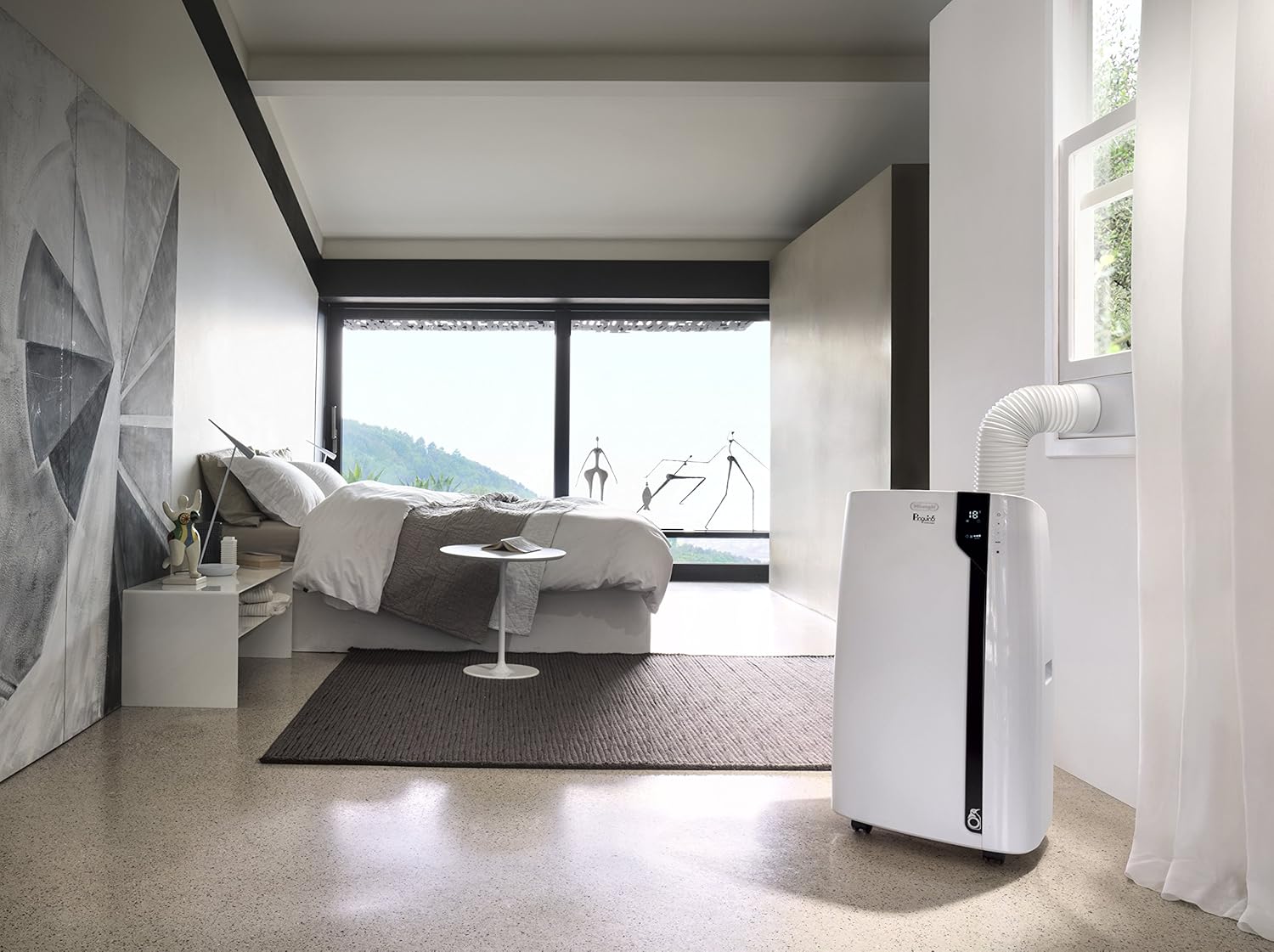
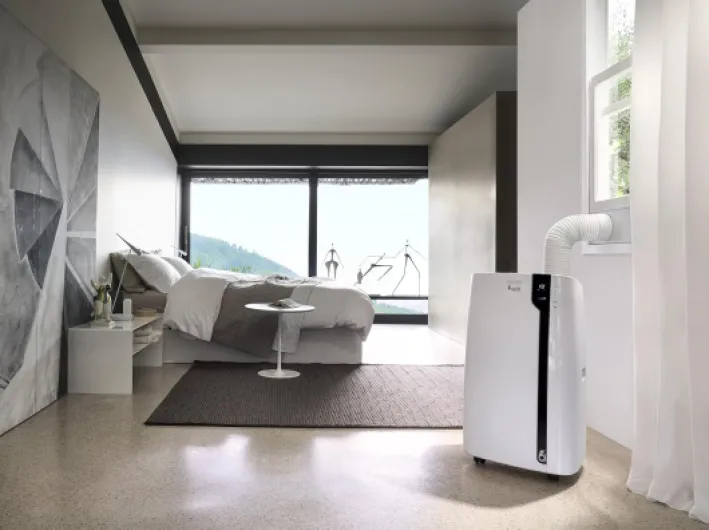
Visually, the PACEX100 Silent is described in the reviews as modern and fairly sleek for a portable AC. It’s a white monoblock tower with rounded lines and a top outlet flap that rises when you turn it on. Air is blown out through this upper vent, which can aim slightly upward and oscillate vertically. One user notes that airflow is always at a slight upward angle and never straight horizontally, which actually makes sense since hot air tends to accumulate higher in the room.
Size‑wise, this is not a small device. The dimensions are roughly 31.7 cm high x 17.3 cm wide x 15.2 cm deep according to the sheet, but those numbers are clearly swapped or mis‑typed in the listing; buyer comments make it clear that the unit is chunky and tall, more in the 70–80 cm height range typical for this category. The weight is around 30–32 kg, which several people mention: it’s portable thanks to the casters, but carrying it up stairs is a two‑person job for many. Once in the room though, users say the casters roll decently on hard floors and acceptably on normal carpet, even if a few would have preferred bigger wheels.
The exhaust hose is frequently mentioned. It’s relatively thick, reaches about 1.2 m when extended, and must be routed to a window or wall outlet. Some buyers find the supplied length fine for close‑by windows; others wish it were longer, especially if the window is high or offset. One positive review suggests checking your room layout and possibly ordering a longer compatible hose in advance. On the downside, the hose becomes warm in use, so any extra length left coiled in the room is lost efficiency and more heat radiating back inside.
Installation is described as simple but a bit fiddly. The window kit is okay for sash windows, less ideal for casement types. More than one user reports that connecting the hose to the rear port is stiff: screwing the adapter ring into the hose grooves takes some force and is easier with the hose held between your legs or with a second person helping. Once set up, the front LED display is bright and readable, and the remote (with AAA batteries included) gives access to all main functions, including some options not present on the top panel. Overall, the design seems solid and practical, but you need to accept the look and footprint of a big white appliance plus a large hose by the window.
Noise, night use and the reality of the “Silent” mode
Comfort with a portable AC is not just about temperature; it’s also about noise levels and sound profile. The PACEX100 carries the “Silent” label and DeLonghi advertises noise around 47–53 dB(A) in silent mode, while the spec sheet also lists 64 dB in some conditions. In the comments, people are very clear: it is quieter than some older portable units, but it is not silent in the everyday sense of the word.
Several owners compare the noise to a hotel room AC: the fan sounds similar to what you’d hear in a Premier Inn or similar mid‑range hotel, while the compressor adds a deeper hum comparable to a fridge kicking in. One detailed review explains that in silent mode at around 20–21 °C, across a fairly large bedroom (about 15+ feet away from the bed), the sound is a constant background hum that a medium or heavy sleeper can get used to. Two dogs in that household apparently sleep fine next to the unit. However, many lighter sleepers say they’d struggle to sleep with it close to the bed, especially when the compressor cycles on and off.
The Real Feel mode is another point. In theory, it manages temperature and humidity for ideal comfort, then goes to sleep when the target is reached. In practice, one long review notes that Real Feel tends to let the unit go completely quiet when it thinks the room is right, then wake up again with a sharp fan + compressor start when it needs to cool more. This big jump from silence to full noise can be more disturbing than a steady background hum. As a result, several people prefer using a fixed temperature (20–21 °C) and silent fan mode at night, which keeps noise more constant.
Display brightness and beeps are minor but relevant comfort points. The front LED remains fairly bright even in its dimmed state, so a few users recommend placing the unit out of direct line of sight if light disturbs your sleep. Every remote command triggers a short beep, which confirms actions but might be annoying if you like to make frequent adjustments at night. Overall, in my opinion, this is a unit you can sleep with if you’re not overly sensitive and if it’s placed on the other side of the room. If you’re a very light sleeper wanting near‑fan noise, you’ll probably find the “Silent” branding optimistic.
Build quality, reliability and everyday handling
From a construction point of view, the PACEX100 Silent is a 30+ kg appliance with an aluminium alloy core, a rotary‑scroll compressor and a solid plastic casing. Owners often describe it as sturdy and well built. The casing doesn’t feel flimsy in their reports, and the unit gives a general impression of a premium domestic appliance rather than a budget plastic box. Several reviewers mention that the machine looks and feels well made and that the wheels roll smoothly on hard floors without leaving marks.
There are a few practical aspects tied to durability. The exhaust hose is thick and reasonably robust, but its fittings are a bit of a double‑edged sword. On the one hand, the bayonet‑style locking system holds tightly once in place, reducing the risk of accidental disconnections. On the other hand, multiple users report that mounting or removing the hose adapters is stiff and often a two‑person job. Long term, that could mean more stress on the plastic if you constantly remove and remount the hose; this seems like a unit that prefers semi‑permanent installation rather than daily dismantling.
In terms of reliability, the global 3.9/5 rating out of more than 500 reviews suggests a mixed but mostly positive picture. Many owners who bought it in 2020 or earlier still report it working fine after multiple summers, which is encouraging. The most striking negative durability‑adjacent comment is the one from the buyer who experienced constant cycling and unusable behaviour due to hose back‑pressure. In their case, the machine technically wasn’t broken, but the design’s sensitivity turned it into a poor fit for their room, leading them to abandon the model and the brand. Beyond that, there aren’t widespread reports of catastrophic failures or leaks, at least in the visible feedback.
The unit comes with a limited warranty, which is standard for this category. Given the weight and complexity (compressor, refrigerant circuit), this is not a device you casually ship back and forth, so in my view it’s worth checking local after‑sales service quality and spare parts availability from DeLonghi before buying. Overall, build quality seems solid, but long‑term satisfaction clearly depends on correct installation and a room layout that doesn’t fight against the hose and ventilation requirements.
Cooling and dehumidifying: strong results if installed correctly
On paper, a 10,000 BTU (2,500 W) portable AC for up to 110 m³ should be able to handle most bedrooms, home offices and medium‑sized living rooms. The comments line up with that: cooling performance is one of the strongest points mentioned by owners. Several people describe using it in difficult situations: top‑floor rooms under uninsulated roofs, south‑facing bedrooms that bake all afternoon, or large open‑plan living/kitchen areas during 30–38 °C heatwaves. In those scenarios, users report going from about 30 °C down to 23–24 °C in very hot weather, and even down to 18–20 °C in milder conditions.
One buyer explains that in a 19 ft x 12 ft room with a 7 ft ceiling (roughly 25–26 m²), the unit keeps the space at 23–24 °C when it’s around 30 °C outside, and can hit 18 °C when it’s 20–25 °C outdoors. Another owner with a large open‑plan living room notes that the PACEX100 managed to cool it to around 18 °C even when both indoor and outdoor temperatures were 38 °C, without apparent struggle. This lines up with the spec sheet claim that it can handle up to about 110 m³, as long as the space is reasonably closed and the hose is well vented.
The dehumidifier mode is also often highlighted. With a rated capacity of up to 24 L/day, several reviews mention using it during humid or rainy periods or in damp rooms. The unit can also run in dehumidify‑only mode, which some people use between heatwaves to keep moisture and mould under control. One negative comment, however, points out that the same hose‑routing sensitivity applies in dehumidifier mode: if the hose has too much back pressure from bends or height difference, the unit may cycle oddly.
That brings us to installation. At least one buyer reports an annoying pattern: after about 30 seconds of cooling, the compressor stops, the fan drops to a whisper, then ramps up again, with this loop repeating endlessly. After troubleshooting, they concluded that even a gentle S‑curve in the hose, with the window higher than the rear exhaust port, was enough to disturb operation. In their case, the unit only behaved correctly with the hose almost perfectly horizontal, which is a serious limitation if your window is high. This seems to be an isolated but very frustrated report; other owners don’t mention such sensitivity, but it shows that hose setup is not optional. If you plan to place the unit far below the window with multiple bends in the hose, you may run into trouble.
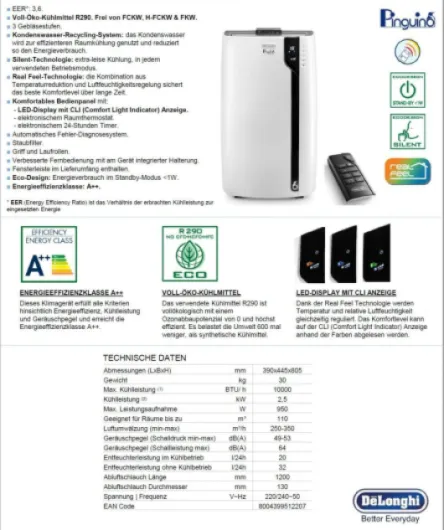
What the PACEX100 Silent offers on paper
The De'Longhi Pinguino PACEX100 Silent is a portable monoblock air conditioner rated at 10,000 BTU (about 2,500 W of cooling). The manufacturer claims it can handle rooms up to roughly 110 m³, which corresponds to about 40–45 m² depending on ceiling height and insulation. It runs on 230 V mains power and draws up to 2,500 W, so this is a fairly powerful domestic appliance, not a small gadget you forget in a corner.
It uses R290 (propane) refrigerant, which is now common in newer portable ACs because it has a much lower global warming potential than older gases. There’s no inverter compressor: it’s a classic on/off rotary-scroll type, which usually means more noticeable cycling between compressor on and off compared with higher‑end inverter units. The spec sheet highlights a Seasonal Energy Efficiency Ratio (SEER) of about 5 and an A+ to A++‑type energy class, which is decent for a portable unit and one of the selling arguments in the comments.
Function‑wise, this machine is not just an air conditioner. It also offers a dehumidifier mode (up to 24 L/day) and a simple fan mode. DeLonghi’s “Real Feel” technology is supposed to adjust both temperature and humidity to an “ideal comfort” target, and a climate light indicator (CLI) on the front changes colour to show whether the room is in a comfortable zone or not. Several buyers mention playing with Real Feel but many end up using manual temperature settings, especially at night, because they prefer a more predictable noise pattern.
In the box you get the unit, a single exhaust hose (around 1.2 m long), and a basic window kit with an adjustable plastic panel. Owners point out that this panel is clearly designed with sliding or sash windows in mind; for typical UK casement windows, improvisation or extra accessories may be needed. Overall, on paper this is a fairly high‑end portable AC positioned for home offices, bedrooms and living rooms, not a budget unit to move from room to room every day.
Pros
- Strong 10,000 BTU (2,500 W) cooling that buyers say handles hot top‑floor rooms and large living spaces well
- Decent energy efficiency for a portable unit (SEER around 5, A+‑type rating) and uses R290 refrigerant
- Powerful dehumidifier mode (up to 24 L/day) with useful Real Feel humidity/temperature management
Cons
- “Silent” mode is still clearly audible; noise and compressor cycling can bother light sleepers
- Short, bulky hose and sensitivity to back‑pressure make installation tricky with high or awkward windows
- High purchase price compared with entry‑level portable ACs, while still keeping monoblock limitations (noise, hose, efficiency loss)
Conclusion
Analysis score
The De'Longhi Pinguino PACEX100 Silent comes across as a powerful, fairly efficient portable AC that actually cools real‑world rooms, including tricky top‑floor spaces and large living areas. Buyer feedback is consistent on that point: if you install it correctly with a decent window setup and let it run ahead of time, it can drop temperatures from 30 °C+ to the low 20s and even down to 18–20 °C in many cases. The strong dehumidifier function is a useful bonus, especially in damp climates or for preventing mould.
The flipside is that it’s a large, heavy and noisy appliance by nature. The “Silent” label is more about being quieter than some competitors than about true quiet. Several people sleep fine with it across the room; others can’t stand the compressor cycling, especially in Real Feel mode where the jump from silence to full noise can be jarring. Installation also matters a lot: short, straight hose routing to a suitable window is almost mandatory. At least one buyer had a miserable experience because their high window forced an S‑shaped hose path, and the unit never behaved properly.
In my view, this model suits users who: really suffer in summer heat, have a medium‑to‑large room they can close off, can place the unit fairly close to a suitable window, and are ready to accept a steady background hum in exchange for real cooling. It’s less suited to people with awkward windows, very small budgets, or ultra‑strict noise tolerance at night. If you fit the first group, the PACEX100 Silent looks like a solid but not flawless choice with good long‑term comfort potential.