Summary
Analysis score
Average of the criteria rated below
Value for money: where this 7000 BTU unit sits in the market
Compact footprint, 24 kg weight and a basic white tower look
Build quality, energy efficiency and what the warranty suggests
Speeds, noise, timer and the reality of the "sleep" mode
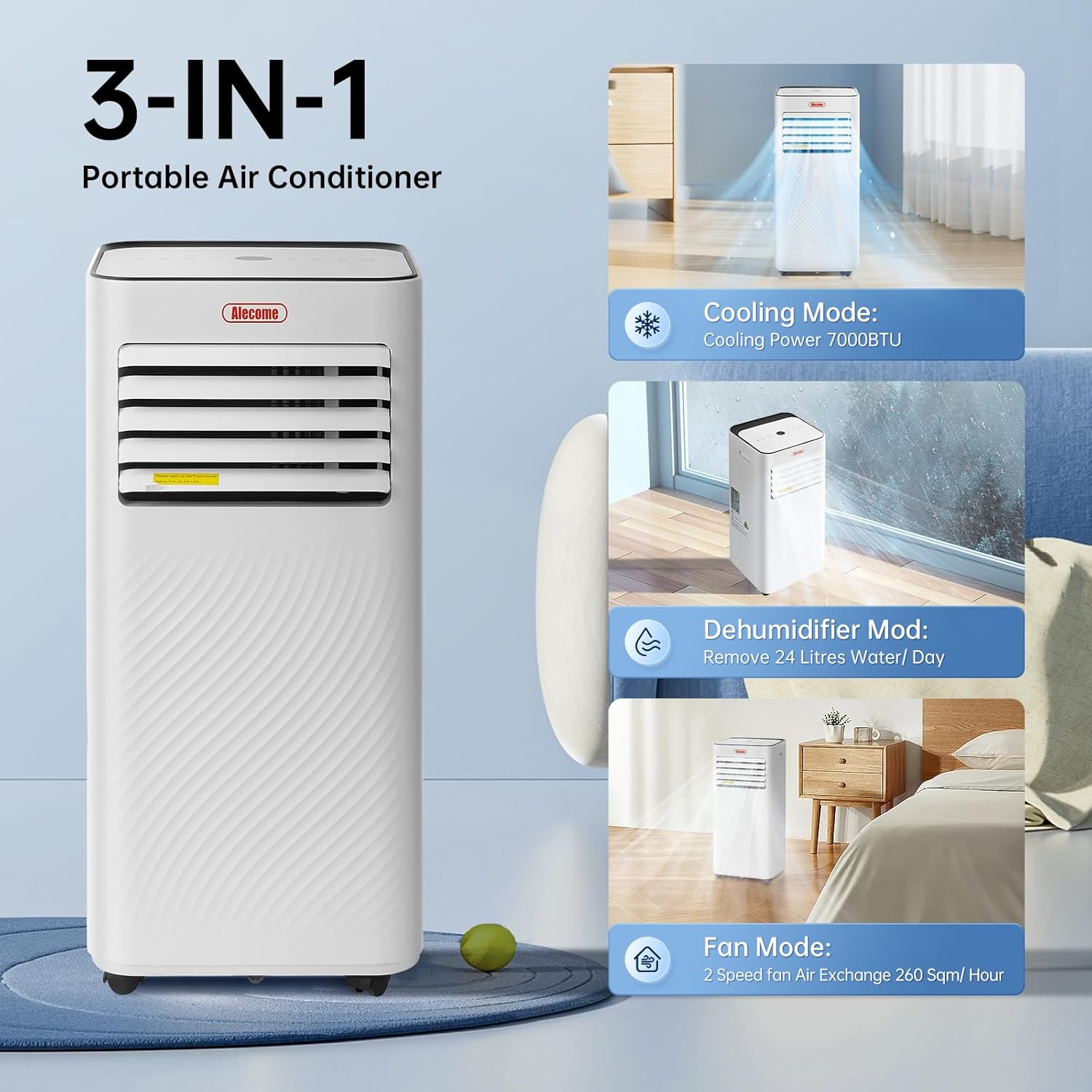
What this Alecome 7000 BTU unit actually offers
Cooling and dehumidifying: does it actually get the job done?
Pros
- Decent 7000 BTU cooling and effective dehumidifier for rooms up to about 20 m²
- A+ energy efficiency with R290 refrigerant and a realistic 16–32 °C thermostat range
- Complete package with exhaust hose, window kit, remote control and 24‑hour timer; some smart assistant compatibility reported by buyers
Cons
- Noise level around 65 dB and no true low‑noise sleep fan speed
- Cooling capacity can feel limited in larger or poorly sealed rooms compared to higher‑BTU models
- Only 1‑year warranty and basic build/features compared with more premium portable ACs

Specifications
View full product page →| Brand | Alecome |
A compact 7000 BTU unit that aims to cool and dry small rooms
The Alecome 7000 BTU portable air conditioner positions itself as a simple, compact solution for small spaces up to about 20 m² (around 215 ft²). On paper, it combines three main functions in one body: cooling, fan-only operation and dehumidification. It is clearly not trying to rival big split systems or high-end connected units, but rather to provide straightforward spot cooling where installing a fixed system is not possible or not worth the cost.
The spec sheet shows a 7000 BTU cooling capacity, an A+ efficiency rating, R290 refrigerant, and a 24-hour timer, with both an on-unit digital panel and a remote. The unit weighs 24 kg and stands 85 cm tall, with a fairly small 38 x 38 cm footprint, so it should be reasonably easy to move around on its castors as long as you stay on one floor. The manufacturer claims suitability for both residential and small commercial use: offices, shops, gyms, and general rooms.
Among the published Amazon reviews, the overall rating sits around 4.2/5 from just over forty comments, which suggests buyers are mostly satisfied but not unanimously impressed. Several users highlight that the cooling and dehumidifying functions do what they are supposed to do, especially during hot spells or for drying clothes. Others point out limitations such as noise, the reality of the so‑called "sleep" mode, and the importance of sealing the window properly to avoid losing cold air.
In my opinion, this positions the Alecome unit as a practical but not flawless option: the specs are decent for a small room, the energy rating is reassuring, and the feature set is fairly complete for the price bracket this type of product usually sits in. On the downside, the noise level and the slightly confusing marketing around fan speeds and sleep mode show that compromises are part of the deal. It looks like a sensible buy if you understand those trade‑offs from the start.
Value for money: where this 7000 BTU unit sits in the market
The exact price is not shown here, but judging by its 7000 BTU capacity, A+ efficiency, and basic feature set, the Alecome portable AC clearly targets the entry‑to‑mid range segment. In this category, you usually get around 7000–9000 BTU, a simple remote, basic timer, and sometimes a dehumidifier mode. More premium models add extra BTUs, quieter operation, more refined smart features or longer warranties. On paper, Alecome ticks several core boxes without pushing into high‑end territory, which usually means a relatively accessible price point.
The 4.2/5 rating from 43+ reviews is a strong indicator that buyers generally feel they get decent value. Positive comments highlight that it “works excellent” when the window seal is properly installed, and one person even calls it a “great bit of kit” for use on a narrowboat, with plans to keep using the dehumidifier in winter. Another user says they were hesitant after reading mixed reviews but ended up satisfied, especially enjoying the ability to control it with Alexa. These are signs that, for users whose needs match the product’s design (small rooms, decent sealing, acceptance of noise), the perceived value is good.
On the downside, there are a couple of elements that slightly reduce the value proposition. The sleep mode confusion — acting mainly as a dimmer and beep mute instead of a quieter fan speed — can feel like over‑promising. Also, the 65 dB noise level is typical but not low, so anyone specifically wanting a very quiet night‑time unit might feel short‑changed if they didn’t pay attention to that figure. Finally, the 7000 BTU capacity is fine for up to 20 m² but becomes marginal if you try to cool larger rooms; one reviewer’s “should have bought a more powerful model” comment illustrates this.
In my opinion, the Alecome 7000 BTU offers good value for small to medium rooms if it is priced in line with other 7000 BTU A‑class units. You get cooling, dehumidifying, a timer, remote control, and at least some level of smart integration, plus a full window kit in the box. There are more powerful or quieter options on the market, but they usually cost more and may require more involved installation. For renters, boat owners, or people in older houses who just want straightforward plug‑in relief during hot spells and a handy dehumidifier for damp days, this model seems like a sensible cost/benefit compromise, as long as you accept its noise and don’t expect premium‑grade features.
Compact footprint, 24 kg weight and a basic white tower look
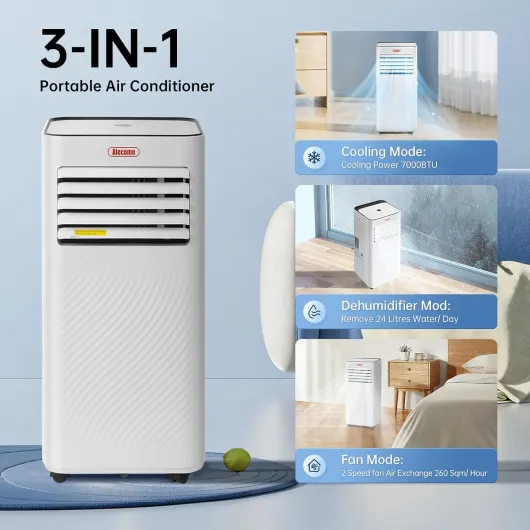
Visually and structurally, the Alecome 7000 BTU unit goes for a standard portable AC tower format: 85 cm high, 38 cm wide and 38 cm deep. That nearly square footprint is relatively compact, which is convenient in tight rooms where every bit of floor space counts. At 24 kg, it is not light in absolute terms, but comparable to many portable air conditioners with similar capacity. The presence of castors (wheels) should make it reasonable to roll around between corners of the same room or between adjacent rooms, as long as thresholds are low and floors are hard.
The colour is a simple white, which is the usual safe choice for appliances. It will blend into most interiors without standing out, but it also means you’re not getting any design statement here. There is a digital display on the front or top (depending on how you look at it) that shows key information like temperature and mode. One verified buyer notes that the sleep button mainly dims this display and mutes the beeps rather than changing the fan speed, which confirms that the design choices focus on simple visual comfort rather than advanced acoustic tweaks.
For installation, the spec sheet lists some window opening constraints: maximum height 87 cm, minimum width 310 cm, and minimum height 287 cm. These figures suggest that the supplied window kit is primarily intended for common vertical or possibly horizontal windows, not for very large patio doors or unusual openings. One user running the unit on a narrowboat explains that venting out of a hopper window works, but the area around the exhaust gets quite hot behind the unit, and they recommend an insulated or thermal exhaust hose for that kind of constrained environment.
In my opinion, the design is functional and unpretentious. It does not bring anything particularly new to the table, but it avoids obvious design mistakes: compact footprint, wheels, a clear display and a basic white shell that should age reasonably well visually. The main design limitations come from the nature of portable ACs themselves: you need to place the unit near a suitable window for venting, accept a visible hose and plan around the hot air output at the back. People expecting a discreet, wall‑hugging machine will likely be disappointed; those who just want a simple box that cools the air will probably find it acceptable.
Build quality, energy efficiency and what the warranty suggests
In terms of durability, there are a few hard data points and then what can be inferred. The unit is made by Zhejiang Oulun Electric Co., Ltd., a manufacturer that appears in various OEM products, and it comes with a 1‑year warranty against manufacturing defects (with terms and conditions). A one‑year warranty is fairly standard for portable air conditioners in lower and mid‑price tiers. It doesn’t scream premium, but it’s also not a red flag by itself. The A+ efficiency rating, R290 refrigerant, and rotary/scroll compressor suggest a modern design that should, in theory, be more efficient and environmentally friendlier than older R410A‑based units.
The listed annual energy consumption of 500 kWh is not a hard promise for everyone’s usage, but it gives a ballpark for moderate use across a season. If the machine is run heavily during long heatwaves or used frequently as a dehumidifier in winter, actual consumption will go higher. That said, R290 systems typically run at reasonable pressures and are widely used, which is a good sign from a reliability standpoint. The fact that the unit is corded electric with no inverter means it runs at fixed compressor speed; this is simpler tech than inverter systems, which can be a plus for long‑term reliability but also means less fine‑tuned power modulation.
The Amazon reviews do not highlight widespread failures, cracks or early breakdowns. The few detailed comments focus more on functional aspects (sleep mode behavior, need for better window sealing, hot exhaust hose) than on parts breaking or electronics dying early. That’s not a statistical guarantee, but for a product with over forty reviews and a 4.2/5 average, the absence of repeated durability complaints is a reasonably positive sign. One buyer planning to use the dehumidifier function in winter on their narrowboat indicates trust that the unit will handle seasonal use across the year.
In my opinion, the durability outlook is moderately reassuring but not extraordinary. You get a standard one‑year warranty, a fairly efficient R290 system, and no major red flags in user feedback. At 24 kg, there is enough heft to suggest a proper compressor and metal internals, even though the outer shell is likely mostly plastic like most competitors. It’s not marketed as a heavy‑duty industrial unit, so for regular home use in summer and occasional dehumidifying in shoulder seasons, it should hold up fine if treated decently (kept upright, filters cleaned, exhaust not kinked). People wanting a long‑term, near‑silent climate solution for daily, year‑round use would still be better served by a fixed split system, but for a mobile appliance, this looks acceptable.
Speeds, noise, timer and the reality of the "sleep" mode
The brand advertises three speed options: high, low and sleep, plus a thermostat range from 16 to 32 °C. There is also a 24‑hour timer accessible via the digital panel or the remote, which is useful to schedule start and stop times to match your routine or energy‑tariff windows. On paper, this gives enough flexibility to balance cooling power, noise and running time, at least between the high and low settings.
However, one detailed review clarifies a key point: the sleep mode is more of a cosmetic/comfort setting than a true third fan speed. According to that buyer, high and low speeds behave as expected, but pressing the sleep button simply dims the display and disables the beeping sounds when changing settings, while the fan speed remains unchanged. This is a bit disappointing if you were counting on an extra‑quiet mode for night use. The same user still considers the unit useful, especially given the dehumidification, but they clearly call out the sleep mode description as misleading.
The listed noise level of 65 dB is typical for portable air conditioners in this capacity class, which are rarely quiet machines. While there aren’t many precise acoustic descriptions in the reviews, the general tone suggests that buyers accept the noise as part of the compromise and focus more on whether the room becomes more comfortable. Some users mention sleeping with the unit running, which implies the noise level is tolerable for them, but that obviously depends on personal sensitivity and room layout. On paper, 65 dB is more like a loud conversation or a busy office than a whisper, so light sleepers should factor that in.
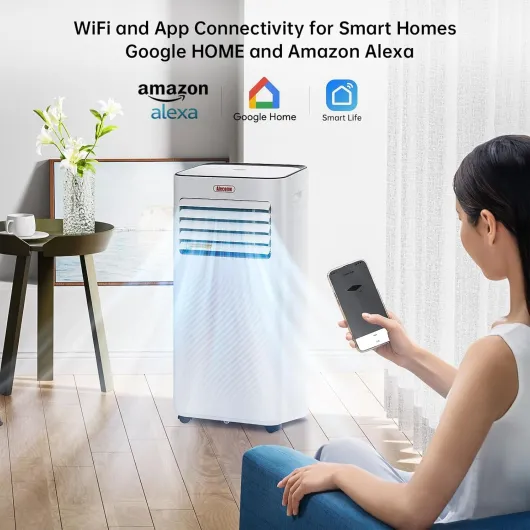
On the plus side, the timer and remote control seem to work as expected, and some comments highlight the bonus of Alexa integration for simple voice commands like turning the unit on or off. One buyer notes that the smart control is limited in scope, especially via Google Home or Alexa, and that deeper integration through Home Assistant would require more time and tinkering. In my view, the performance package is therefore a mix of solid basics (decent cooling, functional timer, workable remote, some smart features) and a couple of marketing stretches (sleep mode behaving like a dimmer). For someone who wants reliable cooling and doesn’t obsess over ultra‑quiet operation or full‑blown smart home control, it should be acceptable, but expectations around noise and sleep mode need to be realistic.
What this Alecome 7000 BTU unit actually offers
The Alecome OL-BKY20-A010MNF is described as a 4‑in‑1 or 3‑in‑1 device depending on the listing phrasing: air conditioner, fan, and dehumidifier are clearly mentioned, and some marketing adds a generic "air conditioning unit" label as a fourth role. On paper, the core is straightforward: 7000 BTU of cooling, an operating temperature range down to 16 °C, and a recommended room size of up to 20 m². That’s in the lower mid‑range of portable air conditioners, more suited to bedrooms, small living rooms, or home offices than to large open‑plan spaces.
Controls are handled either via a digital LCD panel on top of the unit or via the included remote control. The spec sheet mentions three power/fan levels and a 24‑hour timer, which lets you plan on/off cycles to avoid running the machine longer than needed. Some customer comments also talk about smart control via Alexa/Google Home and even integration with Home Assistant, which suggests there is a Wi‑Fi/app layer, even though it’s not heavily detailed by the brand. One buyer notes that the smart functions are somewhat basic through voice assistants, mostly covering on/off and temperature.
In terms of accessories, the package is relatively complete for a portable air conditioner: exhaust hose, hose connector, window kit adapter, window kit, screws, drain hose and user manual. A window seal kit is advertised, which is important to reduce hot air leaks around the exhaust. One review specifically explains that taking the time to adjust and even sew the seal to fit their window made a big difference in perceived performance, which underlines how crucial proper installation is for any mobile AC.
In my view, the feature set is solid but not exceptional: you get the essentials (cooling, fan, dehumidifier, timer, remote, window kit) without advanced niceties like true variable‑speed inverter technology or very detailed app control. For small rooms and for people who just want plug‑in cooling without major installation work, it ticks most of the boxes. For those looking for very quiet operation, ultra‑precise smart home integration or heavy‑duty cooling capacity, it looks more like an entry‑to‑mid range option than a top‑tier machine.
Cooling and dehumidifying: does it actually get the job done?
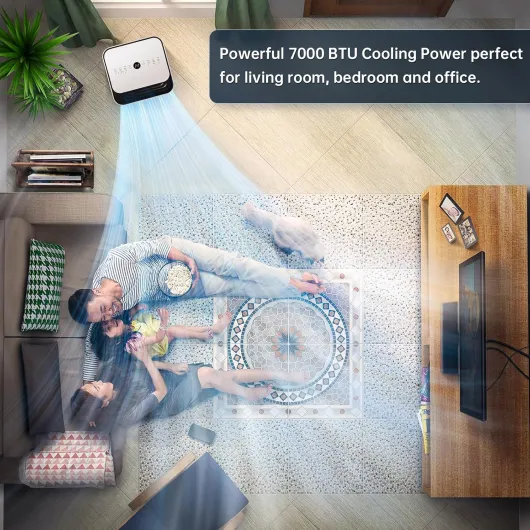
On paper, 7000 BTU of cooling power for up to 20 m² is realistic for a small bedroom, a modest living room or a home office in a temperate climate. The manufacturer claims the unit can bring the temperature down to 16 °C, which is more than enough for comfort if the room size matches the recommendation and the insulation isn’t terrible. The A+ energy efficiency and use of R290 refrigerant also suggest a reasonably modern design, with yearly energy consumption around 500 kWh according to the listing, though real consumption will obviously depend on how hard and how long it runs.
Looking at buyer feedback, several reviews describe the cooling performance as solid for its class. One owner mentioning a large room reports a drop of about 4 °C in three hours during a heatwave, and admits that they probably should have gone for a more powerful model for that specific space. That lines up with expectations: if you oversize the room relative to the BTU rating, cooling will be slower and less striking. Others who use the unit in more appropriate volumes, including one on a narrowboat, say that everything in front of the unit becomes noticeably cooler while the area behind it gets hot due to the exhaust and compressor.
The dehumidifier function gets positive comments as well. One buyer explicitly praises its usefulness not only on hot days but also for drying clothes on the dehumidifier setting, which implies that the moisture extraction is strong enough to speed up indoor laundry drying. Another review points out that the real benefit in hot UK weather is often the reduction in humidity, making temperatures above 25 °C feel far more tolerable. That’s consistent with the general advantage of air conditioning: by cooling and drying the air, it improves comfort even if the absolute temperature drop is moderate.
In my opinion, the unit’s effectiveness is good but dependent on realistic expectations. In a 10–15 m² bedroom or office with the window well sealed and the exhaust properly installed, the 7000 BTU capacity should be ample to get a clear cooling effect and a noticeable drop in humidity. Pushing it into bigger, open‑plan rooms or poorly insulated spaces will inevitably blunt its impact. The published 4.2/5 average rating suggests that most users feel it delivers on its promises when used within its design envelope, but it’s not a magic solution for every kind of room or heatwave situation.
Pros
- Decent 7000 BTU cooling and effective dehumidifier for rooms up to about 20 m²
- A+ energy efficiency with R290 refrigerant and a realistic 16–32 °C thermostat range
- Complete package with exhaust hose, window kit, remote control and 24‑hour timer; some smart assistant compatibility reported by buyers
Cons
- Noise level around 65 dB and no true low‑noise sleep fan speed
- Cooling capacity can feel limited in larger or poorly sealed rooms compared to higher‑BTU models
- Only 1‑year warranty and basic build/features compared with more premium portable ACs
Conclusion
Analysis score
The Alecome 7000 BTU portable air conditioner comes across as a practical, no‑nonsense solution for small rooms that need occasional cooling and dehumidifying. The spec sheet is coherent: 7000 BTU for up to 20 m², A+ efficiency, R290 refrigerant, 24‑hour timer, remote control and a full exhaust/window kit. The 4.2/5 average rating and the nature of the comments suggest that, for most buyers, it does what they expected: cools a correctly sized room, reduces humidity and makes hot, sticky days more bearable. The dehumidifier mode being useful for drying clothes is a nice real‑world bonus.
It’s not perfect. Noise at 65 dB is standard for this type of product but definitely not quiet, and the advertised three speeds are a bit misleading since sleep mode mostly dims the display instead of cutting fan noise. It’s also not the best match for big, open rooms or people who want near‑silent night‑time cooling. That said, the one‑year warranty, absence of strong durability complaints and overall user satisfaction indicate a reasonable level of reliability for home use.
In my opinion, this unit fits best for: renters, small‑room owners, boat or caravan users, and anyone who can’t or doesn’t want to install a fixed split system. If your main goal is simple, mobile cooling and dehumidifying for a bedroom, office or small lounge, and you’re fine with some fan noise, it looks like a solid candidate. If you need near‑silent operation, higher BTU capacity for large spaces, or more advanced smart features, it’s worth looking at more premium (and more expensive) alternatives.