Summary
Analysis score
Average of the criteria rated below
Value for Money: Where It Shines and Where It Feels Underwhelming
Design and Practical Setup: Compact Body, Tricky Windows for Some
Build Quality, Reliability, and Maintenance
Noise, Airflow, and Smart Features: Day-to-Day Performance
Specs and Features: What You Actually Get
Cooling and Dehumidifying: Does It Actually Cool the Room?
Pros
- Good cooling performance for small to medium rooms (up to about 30 m² claimed, many buyers satisfied in 10–20 m²)
- Rich feature set with WiFi/app control, timers, sleep mode, and auto-restart memory
- Includes both sliding-window bracket kit and fabric seal kit for various window types
Cons
- Noisy for bedroom use at night; typical 65 dB portable-AC sound level
- Venting for high or push-out windows can be awkward; hose is short and extension use may void warranty
- Heavier unit; wheels help on one floor but not convenient to carry between levels

Specifications
View full product page →| Brand | DR.PREPARE |
9000 BTU on Wheels: What This DR.PREPARE Unit Really Offers
The DR.PREPARE DCAC09F is a 9000 BTU portable air conditioner that tries to tick a lot of boxes for a household unit: cooling, dehumidifying, fan mode, WiFi control, and a window kit that is supposed to work with both sliding and push-out windows. On paper it targets rooms up to 30 m², which covers a typical bedroom, home office, or small living room. With a published 4.1/5 average from around 180 Amazon reviews, buyers are generally satisfied, but some recurring complaints show where the compromises are.
The strong points that stand out are the cooling power for the size, the dual window venting approach, and the smart control options (app, remote, touch panel, timers, Alexa/Home Assistant via the app). Several buyers say it cools a medium living room or a 12 m² bedroom quickly, and one review even notes that it freshens an adjacent landing or downstairs area. So in terms of raw cooling ability, it seems to do its main job properly when the room size and insulation are reasonable.
On the downside, this is not a silent machine and not the lightest either. The spec sheet lists 65 dB, which is typical for portable ACs but far from quiet. Reviews back this up: people describe it as clearly audible, and one buyer flatly calls it too loud for overnight use in a bedroom. Portability is also relative: at about 49 lb (around 22 kg), the wheels help on flat floors, but several comments say they would not want to carry it up and down stairs regularly.
In my opinion, this model targets a user who wants solid cooling in heat waves, is okay with some noise, and values WiFi/app control and flexible window options more than ultra-compact size or whisper-quiet operation. It’s not perfect, and the venting solution for casement/push-out windows gets mixed feedback, but for a typical sliding-window bedroom or lounge, the package looks coherent for the segment.
Value for Money: Where It Shines and Where It Feels Underwhelming
The price isn’t listed here, but one critical review mentions paying around £250 and feeling that was on the high side for what they got. Others, however, call it a good investment and highlight the relief during hot, humid evenings. With an Amazon average of 4.1/5 from about 184 reviews, the majority of users clearly think they got decent value, but there is a minority who expected more, especially in terms of window flexibility and noise for the cost.
On the positive side, the feature set is rich for a mid-range portable AC: 9000 BTU cooling, 4-in-1 modes, WiFi/app control, good sliding-window kit, sleep mode, child lock, auto-restart, and a reasonably efficient R-290 inverter-type system with SEER 16. A few buyers mention that they can cool a room all day using solar panels, which makes the running cost less painful. For someone who wants app control, flexible scheduling, and a unit that can both cool and dehumidify, the package is coherent and offers more than basic budget models that skip smart features.
On the downside, noise and venting limitations drag the perceived value down for some owners. If your home has high push-out windows, the included fabric seal and short hose may not be enough. One reviewer says the hose doesn’t reach their high windows, and using an extension would void the warranty, effectively making the unit hard to use in their house without DIY workarounds. For that kind of setup, the price feels less justified because you’re paying for a supposedly flexible system that still requires extra effort and materials.
In my opinion, the value is good but not unbeatable. If you have standard sliding windows or low casement windows and you’re fine with typical portable-AC noise levels, you get strong cooling, decent energy efficiency, and modern smart functions for a fair cost. If your windows are awkward or you are very sensitive to noise, you may find better value in either a quieter premium model or a fixed split system, even if the upfront cost is higher. This DR.PREPARE hits a solid middle ground, but it is not the bargain of the century.
Design and Practical Setup: Compact Body, Tricky Windows for Some
Design-wise, this DR.PREPARE unit sticks to a simple white tower-style look. Several buyers call it compact and modern, and one review specifically says it doesn’t take up much floor space in a living room. The dimensions support that: about 30 cm wide and under 30 cm deep, so it can sit close to a wall or corner without dominating the room. The control panel is on the top, with touch buttons and a display, which is practical when the unit is on the floor since you don’t have to bend all the way down to reach side controls.
The brand pushes the idea of portability with four casters and two side handles. In reality, comments describe it as heavier than expected but still manageable on one floor. People mention that rolling it around is fine, but it’s not the kind of unit you’d happily carry upstairs every day. In my opinion, that’s standard for a 9000 BTU AC: the compressor, motor, and casing will never be feather-light, and the roughly 22 kg figure is in the normal range.
The more interesting design aspect is the window venting system. For sliding windows, the plastic bracket kit is widely praised: multiple buyers say the fittings are actually good and stay in place, which is not always the case with cheaper kits. For push-out, casement, or awkward windows, the brand includes a long fabric window seal (often described as a “sock” or cover) with adhesive Velcro. Here, opinions are more divided. One critical review explains that you need to stick Velcro to your window frame, which locks you into that window and hurts the idea of pure portability. Same buyer also notes that the hose is quite short and doesn’t reach high push-out windows without an extension, which the manual warns against.
Some owners bypass the fabric kit entirely and build a DIY plywood board or similar insert, using the included hose adapter to make a rigid vent plate. One review explains this approach in detail and seems satisfied with the result. That tells me the hardware in the box is usable, but you might need a bit of DIY if your windows are non-standard or placed high. Overall, the design is compact and reasonably thoughtful for sliding windows; for casement and high windows, it’s workable but not plug-and-play, and the hose length is clearly a limitation.
Build Quality, Reliability, and Maintenance
In terms of build quality, the tone of the reviews is largely positive. Several buyers describe the unit as well-made and sturdy, with a compact but solid feel. One review explicitly contrasts it with other brands whose window fittings felt cheap, praising the DR.PREPARE kit for being robust and actually sealing properly on sliding windows. No widespread pattern of mechanical failure, leaks, or broken parts appears in the comments, which is reassuring for a device with moving parts and a compressor.
The published warranty is 1 year on materials and workmanship for the unit and 3 years on the compressor, which is decent for this price range. It’s not premium-level coverage, but it’s more than the bare minimum. One important detail: the manual reportedly warns that using an extension hose for the exhaust can void the warranty. That matters because at least one buyer with high push-out windows immediately wanted a longer hose. If you’re in that situation, there’s a trade-off between convenience and warranty safety.
Maintenance looks straightforward. The unit has a removable, washable mesh filter, designed to trap dust and pet dander, and buyers mention that this helps keep the air cleaner. Regular filter cleaning will matter a lot for long-term efficiency and to avoid airflow restriction. The auto-restart feature with memory also reduces stress on the electronics in areas with unstable power, since you don’t need to keep fiddling with settings after every short outage.
As for long-term durability, there isn’t enough multi-year feedback yet to draw hard conclusions, but the absence of repeated complaints about cracks, failing compressors, or wheels breaking is a good sign. People do highlight that the hose is stiff and can pop off fittings if forced, so handling it with some care is probably wise. In my opinion, for a mid-range portable AC made in China with a standard rotary/scroll compressor, the durability picture is respectable but not exceptional: solid feel, acceptable warranty, and no major red flags, as long as you respect the venting limitations and keep up with basic cleaning.

Noise, Airflow, and Smart Features: Day-to-Day Performance
Performance here is a mix of strong airflow and loud operation. The spec sheet lists 65 dB, which lines up with what buyers describe. Several comments state that it’s not quiet, especially when the compressor is running. One person measured around 58 dB on full fan speed with their own meter and still found it intrusive next to a bed. Another says it’s fine for daytime use in a living room but not something they’d run overnight in a bedroom without earplugs. So this is standard portable-AC noise: acceptable for daytime comfort, but not the right choice if you need near-silence while sleeping.
The fan itself is described as powerful, pushing air across a room effectively. Users note that the cold air “blasts out” and that the blower can throw air far enough to cover a lounge. There are two fan speeds, plus a dedicated fan-only mode for simple air circulation. Sleep mode is advertised at 45 dB, but real-world comments don’t dwell much on this; the main takeaway is that the compressor noise is the limiting factor for quiet use, not the fan alone.
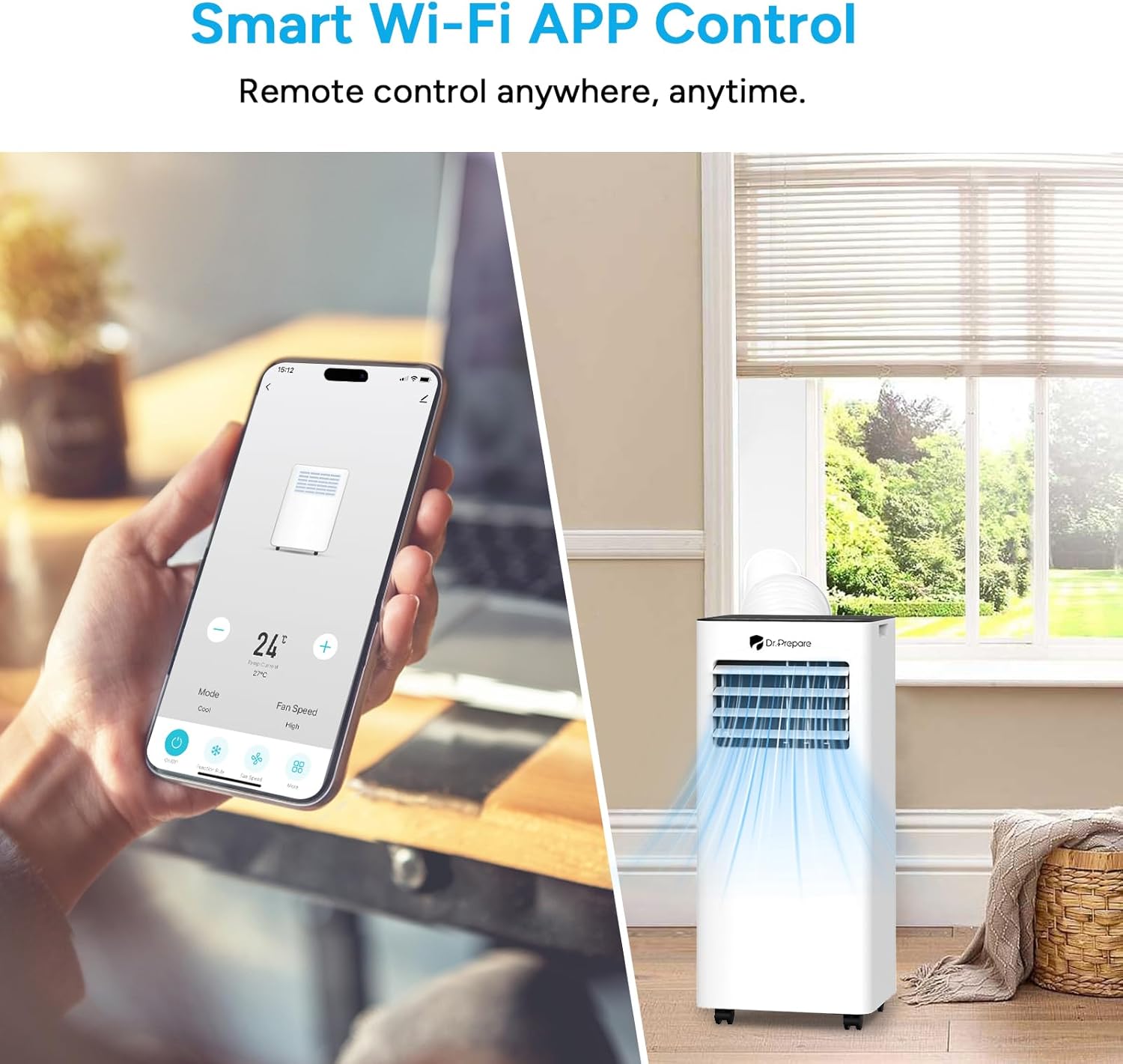
On the smart side, DR.PREPARE has done a decent job. The unit offers WiFi control via app, a 24-hour timer, and memory/auto-restart. One buyer says they basically never use the remote because the app is so convenient, especially for pre-cooling the room before arriving home or adjusting settings from bed. Another says the WiFi/Alexa integration works but feels like a gimmick for them; they would have been fine with the non-WiFi version if it had been in stock. That sums it up: the smart functions are a nice bonus, not a necessity, but they seem to work as advertised.
There’s also a child lock to prevent accidental changes and an auto-restart feature that remembers your last mode and temperature settings after a power cut, except in manual shutoff cases. In my opinion, the global performance profile is clear: strong, efficient cooling and airflow, solid smart features, but average-to-loud noise typical of portable ACs. If you accept the sound level, it performs well at its main job. If quiet operation is a priority, this model is not going to feel impressive.
Specs and Features: What You Actually Get
On paper, the DR.PREPARE DCAC09F is a 4-in-1 portable unit: cooling (9000 BTU), dehumidifier (up to 24.1 L/day), fan mode, and a sleep mode available in cooling. The brand claims it handles rooms up to 30 m², with an adjustable temperature range from 16°C to 32°C. That’s in line with what a 9000 BTU portable AC usually targets: bedrooms, offices, small lounges. Several reviews confirm that it cools a 12 m² bedroom or a medium lounge effectively, with one buyer reporting about a 5°C drop in a large lounge.
The footprint is relatively compact: roughly 28.9 × 30 × 67.3 cm (D×W×H), so it’s tall and slim rather than wide. It weighs about 49 lb, and the manufacturer includes four casters and side handles to roll it around on the same floor. In terms of accessories, the box contains the unit, remote (no batteries), exhaust hose, hose connector, window bracket kit for horizontal/vertical sliding windows (25.6–50 inches / 65–125 cm), a fabric window seal kit up to 157 inches for push-out/casement/awning/skylight windows, adhesive tape, a drain hose, and the usual manuals.
Energy-wise, it’s listed with a SEER of 16 and efficiency class A, plus an inverter-type compressor and R-290 refrigerant. R-290 is now common in newer portable ACs for better efficiency and lower environmental impact compared with older gases. Annual energy consumption is specified at 720 kWh, which looks reasonable for seasonal use, though the real figure obviously depends on how hard and how long you run it during summer. Voltage is 240 V and it’s a corded unit with no outdoor component needed.
On the usability side, it offers three control methods: touch controls on the top panel, a full-function remote, and WiFi/app control. The app lets you change temperature and modes remotely, set smart schedules, and integrate with smart home assistants according to some buyers. There’s also a 1–24 hour timer, sleep mode (quieter operation in cooling), child lock, and auto-restart with memory function after power is restored. The warranty is 1 year on the unit and 3 years on the compressor, which is decent but not outstanding in this category. Overall, the spec sheet is solid: nothing revolutionary, but it covers most features a modern portable AC should have.

Cooling and Dehumidifying: Does It Actually Cool the Room?
Effectiveness is where this DR.PREPARE model gets the most positive feedback. For a 9000 BTU portable AC, it seems to punch at or slightly above its weight. Multiple buyers say it cools a medium living room or a 12 m² bedroom quickly, even during heat waves. One owner reports that it not only handles the living room but also noticeably cools the landing nearby. Another mentions it dropped the temperature in a large lounge by about 5°C, which is a strong result for this power level, assuming reasonable insulation and a properly sealed vent.
The brand claims it is suitable for rooms up to 30 m². That figure is always optimistic, but the reviews suggest that in small to medium spaces it works well, especially when used proactively (for example, one buyer with solar panels runs it during the day to keep the bedroom cool before night). With the thermostat range of 16–32°C, you can aim for a fairly cool room if you’re willing to accept the noise. People consistently say it “blasts out cold air” and that the airflow from the blower is strong enough to reach across a room.
The unit also functions as a dehumidifier with a stated capacity of 24.1 L/day. There are fewer detailed comments on this mode specifically, as some buyers already own separate dehumidifiers and haven’t used it much. However, any compressor-based AC will inherently remove moisture while cooling, so for humid summer conditions the dual role should help comfort. One reviewer would have preferred a dedicated condensate container or tray to collect water more easily, which hints that managing drainage might require either routing the drain hose or dealing with internal tank emptying depending on the setup.
In my opinion, if your goal is to make a hot bedroom or office tolerable during a heatwave, this unit gets the job done as long as the venting is done properly and the room size isn’t oversized. Where it can feel less effective is in tricky houses with high push-out windows and poor sealing, like one critical reviewer describes. In that kind of layout, the hose length and vent kit limitations reduce the overall cooling impact. But in a typical 10–25 m² room with a normal window and a properly sealed exhaust, the cooling performance looks solid for the class.
Pros
- Good cooling performance for small to medium rooms (up to about 30 m² claimed, many buyers satisfied in 10–20 m²)
- Rich feature set with WiFi/app control, timers, sleep mode, and auto-restart memory
- Includes both sliding-window bracket kit and fabric seal kit for various window types
Cons
- Noisy for bedroom use at night; typical 65 dB portable-AC sound level
- Venting for high or push-out windows can be awkward; hose is short and extension use may void warranty
- Heavier unit; wheels help on one floor but not convenient to carry between levels
Conclusion
Analysis score
Overall, the DR.PREPARE 9000 BTU portable air conditioner looks like a solid, mid-range cooling solution for small to medium rooms, with the usual portable-AC trade-offs. The main strengths are clear: it cools effectively for its size, buyers consistently report strong airflow and noticeable temperature drops, and the feature list is complete with WiFi/app control, timers, dehumidifier mode, and a decent sliding-window kit. For a bedroom, office, or modest lounge with a standard window, it should handle heat waves well if you accept the noise.
The weak points are just as clear. Noise is typical for a portable AC but definitely not low; several users won’t run it while sleeping. The venting solution for push-out or high windows is less convincing: the short hose and fabric seal with Velcro feel like a compromise, and some owners had to resort to DIY boards to get a proper seal. At a roughly mid-range price, that can feel underwhelming if your windows are tricky or you hoped for a plug-and-play install everywhere in the house.
In my opinion, this unit suits people who want reliable spot cooling, decent efficiency, and smart control, and who have at least one suitable window they can dedicate to it. It’s especially interesting if you can power it cheaply (solar, off-peak) and don’t care about running it overnight. Those who are very noise-sensitive, or who live in a house full of high casement windows and hate DIY, should probably look at alternative models or even a fixed split system despite the higher installation cost.