Summary
Analysis score
Average of the criteria rated below
Value for money: where this Salange sits in the market
Compact, short‑throw design with rotating stand
Build quality, dust issues and brand trust
Image, smart features and wireless: how it should behave in real use
Specs overview: what this Salange projector promises on paper
Is it actually convenient for home cinema and everyday use?
Pros
- Native 1080p resolution with short‑throw lens (around 100" at 1.5 m), practical for small rooms
- Built‑in Android 14 with Wi‑Fi 6 and Bluetooth 5.4, reducing the need for extra streaming sticks
- Compact and light with rotating stand, auto focus and keystone/zoom for quick and easy setup
Cons
- Brightness and contrast only mid‑range; best limited to dark or dim rooms
- Mixed feedback on dust ingress and customer support, with at least one very negative experience

Specifications
View full product page →| Brand | Salange |
A compact smart projector that tries to do everything
The Salange Short Throw Projector 2026 positions itself as a kind of Swiss‑army knife for home cinema: compact body, Android 14 built in, short throw lens, Wi‑Fi 6, Bluetooth 5.4, auto focus, and a rotating stand. On paper, it aims at people who want a projector for the bedroom or living room without dealing with a separate streaming stick or a big ceiling mount. With a published average of 4.2/5 from more than 200 Amazon reviews, buyers are broadly satisfied, but there are a few recurring criticisms that are worth knowing before buying.
The brand advertises native 1080p resolution, support for 4K signals, and "600 ANSI" or "350 ANSI" brightness depending on which part of the product description you read, plus a claimed 15,000 lumens marketing figure. This mix of numbers can be confusing. In my opinion, what matters most is that several buyers say the image is bright enough for daytime use in a dim room, but this is clearly not a replacement for a high‑end living‑room TV in full sunlight. For movie nights with the curtains drawn, it should be fine.
On the smart side, Android 14 with built‑in apps (Netflix, Prime Video, YouTube mentioned in reviews) is a key argument. Some owners say this allowed them to put away their streaming sticks and use the projector alone. Others still prefer HDMI sources such as Fire Stick, PS5 or Switch, which are supported through the usual ports. In my view, that dual approach is the right way to see it: the built‑in OS is a convenience, not a guarantee that every app will be perfect forever.
There is also a less flattering side. One verified buyer accuses the brand of rebranding generic projectors, complains about build quality and poor customer support, and returned the product. This is a minority review compared with the many positive ones, but it raises a red flag about after‑sales service and consistency between units. Overall, this looks like a feature‑rich mid‑range projector that offers good capabilities for the price bracket, but it is not without compromises and risks, especially if you value spotless quality control and strong manufacturer support.
Value for money: where this Salange sits in the market
The exact price is not displayed here, but given the comments referencing “under two hundred quid” for a closely related Salange model, this projector clearly targets the budget to lower mid‑range segment. In that context, native 1080p, short throw, Android 14, Wi‑Fi 6, Bluetooth 5.4, auto focus, and keystone/zoom tools form a pretty rich feature set. Many competitors in this price area either lack a proper smart OS, don’t have short‑throw lenses, or use older wireless standards, so on paper the feature‑to‑price ratio looks strong.
What stands out from the reviews is that several verified buyers feel they are getting good overall quality for the money: they mention decent brightness, clean image, easy setup, and functional streaming apps. One person even compares the cost favorably to a monthly rail season ticket, implying that for the entertainment value delivered, the purchase is justified. At the same time, there is at least one buyer who considers it overpriced for what it is, pointing to generic branding and disappointing support. That shows how much expectations and tolerance for brand risk affect perceived value.
In my opinion, the main trade‑off is this: you are paying a relatively accessible price for a long list of modern features, but you are not getting the same level of brand reputation, build refinement and support that you would with a more expensive Epson, BenQ or LG. If you want rock‑solid quality control and a well‑known service network, you will likely need to spend more and maybe give up some integrated smart features in favor of an external streaming stick.
For buyers who are comfortable with smaller brands and mainly want a compact, flexible projector for home use, the value proposition looks good. The average 4.2/5 rating suggests most owners feel they got their money’s worth. The risk is that if you land on a problematic unit, resolving it might be more of a headache. So I would say: strong value if you accept a bit of lottery on support and long‑term durability; more questionable if you are risk‑averse and plan to rely on this as your main screen every single day.
Compact, short‑throw design with rotating stand
This Salange projector clearly aims to be small and easy to place. The dimensions are only 15.1 × 12.2 × 13.1 cm and the weight is about 1.11 kg. So it is closer to a large Bluetooth speaker than to a traditional home‑cinema projector. Several buyers describe it as easy to carry around the house or take on trips, which lines up with the manufacturer’s positioning as an indoor/outdoor mini beamer. The grey color and desktop form factor keep it fairly discreet in a living room or bedroom.
One of the more interesting design elements is the adjustable / rotating stand (the text mentions 180° and 270° rotation, depending on the line). The idea is that you can tilt the projector towards a wall, ceiling or screen without buying a separate tripod or mount. For casual bedroom use, pointing it at the ceiling for lying‑down viewing is a common use case, and here the hardware seems built for that. Combined with automatic keystone correction and zoom, you should be able to get a rectangular picture even when the projector is placed at an angle or off‑center.
From a layout perspective, the connectivity (HDMI, USB, audio jack, power) is grouped on the back or side, which is typical and avoids cable clutter around the lens. Ceiling mounting is officially supported as a mounting type, so there are likely standard screw threads underneath, although this is not detailed in the comments. The presence of a multi‑layer dust filter is also highlighted, which suggests Salange knows dust intrusion is a common annoyance for LCD projectors.
In my opinion, the design logic is clear: this is not meant to be a permanent, perfectly integrated home‑cinema machine, but a flexible, compact projector that can live on a shelf, coffee table, or suitcase. For that, the format, weight, and rotating stand are strong points. Those who want a sleek, metal chassis and ultra‑premium finish will not find that here; this looks more like functional, practical plastic housing focused on versatility over visual impact.
Build quality, dust issues and brand trust
Durability is where opinions diverge more sharply. The projector uses a typical plastic housing and LCD light engine, which is standard at this level. There is mention of a multi‑layer dust filter designed to protect the internals and make maintenance easier. In theory, that should help prevent dust spots on the image, a recurring weak point of many LCD projectors. However, one verified buyer explains they had to open the projector multiple times to remove dust from the image and still could not get everything out. They add that this is a common problem with many projectors, but it obviously affects perceived quality and long‑term satisfaction.
Another review is much harsher: the buyer calls the item poor quality, claims Salange is just rebranding generic projectors with cheap stickers, and says they received no response from customer support despite trying for two weeks. This person ended up returning the product and strongly advises against the brand. It is just one review among many positive ones, but it raises a serious question about after‑sales service and the consistency of the hardware. If you are unlucky and get a faulty unit, getting help may be more complicated than with a big established brand.
On the more positive side, several other buyers praise the product overall and mention being happy with both the projector and the customer service, though without going into detail. The average rating of 4.2/5 over more than 200 reviews suggests that most units do not suffer from catastrophic failures. Still, the existence of those negative experiences means this is not a risk‑free purchase, especially if you plan to use the projector heavily and move it around a lot, which increases the chances of dust ingress or mechanical shocks.
In my opinion, durability here is average for budget/mid‑range LCD projectors: fine for casual home use, but not built like a tank. The dust filter is a good sign, yet at least one owner still faced dust spots. If you are picky about a perfectly clean image and expect years of intensive daily use, you might want to consider a higher‑end brand with a stronger track record and more robust casing, even if that means paying more. If you are okay with occasional cleaning and accept some risk, this Salange should hold up reasonably well for weekend movie nights and sporadic gaming sessions.
Image, smart features and wireless: how it should behave in real use
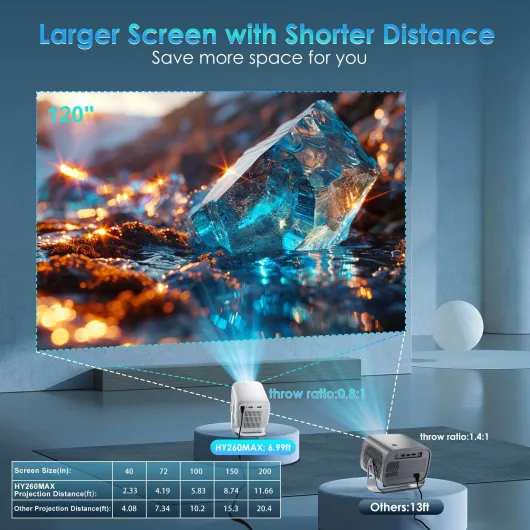
On the image side, the big selling points are native 1080p resolution, short‑throw projection, and AI‑assisted auto focus and keystone. One verified buyer reports projecting a sharp 75‑inch image at around 7.5 ft (roughly 2.3 m), which is consistent with the claimed throw ratio. Another review mentions that on a cloudy afternoon the image remained comfortably watchable on an off‑white wall, which indirectly supports the idea that the brightness is sufficient for non‑pitch‑black rooms, as long as you avoid direct sunlight. For evening sessions with the lights dimmed, 350–600 ANSI should be fine for 80–100 inches.
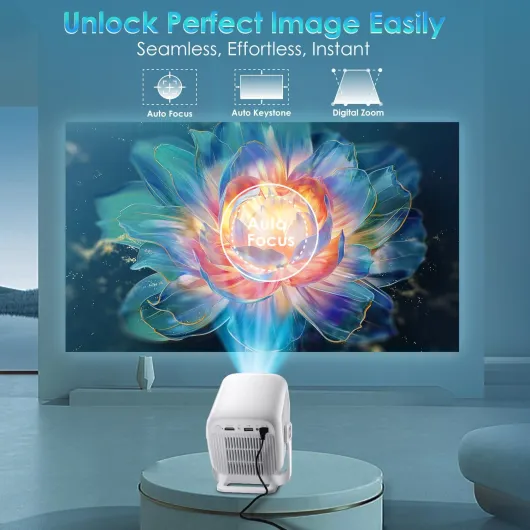
The auto focus and auto keystone are highlighted heavily. Salange advertises a 0.3‑second focus lock and ±50° keystone correction, with 4D/4P adjustment and 50% zoom via remote. Reviews mention electric focus or simple focus adjustment depending on the unit/version. In theory, this should make setup quick: place the projector, wait for it to focus, then fine‑tune with the remote. For users who move the projector often between rooms, that convenience matters more than squeezing the last bit of optical sharpness out of a manual lens.
On the smart side, the integrated Android 14 OS with built‑in apps is a clear performance advantage over basic “dumb” projectors. One buyer specifically says they were able to retire a nest of streaming sticks and just use Netflix, Prime and YouTube on the projector itself. Another used it while travelling to watch those same apps in different locations. Wi‑Fi 6 is praised in one comment for streaming a 4K nature documentary without any stutter, which fits with the theory: Wi‑Fi 6 offers better throughput and stability than older standards, especially on 5 GHz.
Fan noise and speaker quality are also mentioned. A review comparing it to a laptop says the fan is audible but not intrusive, which is typical for this type of device. The internal speaker is described as “fine for dialogue” or “fine, but you can connect a louder speaker via jack or Bluetooth”. So performance here is adequate for casual use, but anyone building a proper home theater will want at least a soundbar. Overall, in my opinion, the performance picture is positive for the price bracket: decent brightness for dark rooms, clean 1080p image, convenient auto adjustments, and streaming that seems to run smoothly for most users, provided you have good Wi‑Fi.
Specs overview: what this Salange projector promises on paper
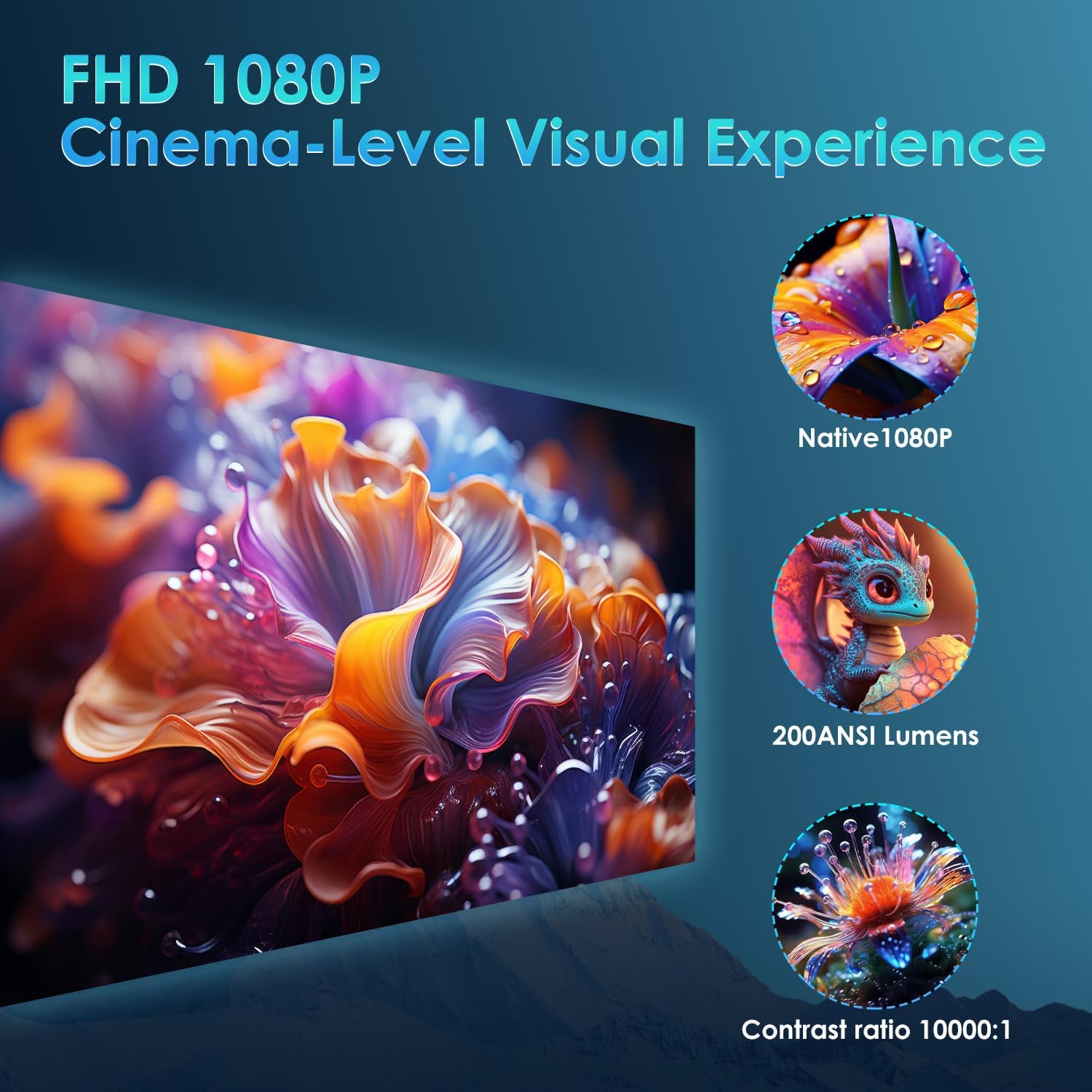
On paper, the Salange Short Throw Projector 2026 is loaded. It uses an LCD panel with native 1920 × 1080 pixels and advertises support for up to 4K (and even 8K signals in one line of the spec sheet, which is marketing more than anything). The real resolution is Full HD, which is already decent for a compact projector in this price range. The brand also claims a 0.8:1 short throw ratio: a 100‑inch image at around 1.5 m. That makes it interesting for small rooms where you cannot place the projector far from the wall.
The brightness data is less clear. The bullet points mention 600 ANSI lumens, while the technical table lists 350 ANSI lumens and a marketing figure of 15,000 lumens. ANSI values are the ones that matter; 350–600 ANSI puts it in the mid‑range of LED home projectors: fine for dark rooms, limited with lots of ambient light. The contrast ratio is given as 2000:1, which is standard for LCD projectors at this level and suggests decent but not cinema‑grade blacks.
Connectivity is fairly complete for a small unit: HDMI, USB, 3.5 mm audio jack, USB‑C mentioned in the description, plus Wi‑Fi and Bluetooth. The Wi‑Fi is Wi‑Fi 6 (dual‑band 2.4/5 GHz) and supports wireless screen mirroring from iOS, Android and Windows 10+ laptops. Bluetooth is announced as version 5.4, which is very recent and should give a stable link to speakers, headphones or soundbars. There is also an internal speaker (5 W in the detailed text, 12 W cited in one review for a related model; I would assume a modest mono or stereo setup adequate for casual viewing).
Finally, the projector integrates Android 14.0 NTV. That means you can install and run apps directly on the projector with an air‑mouse / Bluetooth remote, and there are dedicated streaming hotkeys. For users who do not want to juggle multiple remotes, this is a real plus. However, as always with integrated Android on projectors, app compatibility and update policy are big unknowns in the long run. In my opinion, the spec sheet is ambitious and quite complete for the size and price, but the brightness rating and long‑term software support are the two lines I would treat with the most caution.
Is it actually convenient for home cinema and everyday use?
Effectiveness here means: does this projector make it easy to watch content the way most people want to? Looking at the specs and the reviews, the answer is mostly yes, with some caveats. For home cinema, the combination of short throw, auto focus, keystone correction and zoom should let you fill a wall even in a small room without spending 10 minutes fiddling with settings each time. One buyer reports easily getting a clear 75‑inch image at a moderate distance, which is right in the sweet spot for many living rooms and bedrooms.
For streaming, the built‑in Android 14 and Wi‑Fi 6 make the projector quite effective as an all‑in‑one device. Several comments highlight how easy it is to start using it, connect via Bluetooth, and run Netflix, Prime or YouTube without extra hardware. The manufacturer itself still recommends using the built‑in apps or HDMI for copyrighted content, which is a polite way of saying that wireless casting from some services can be restricted. In practice, that is the case on many projectors and TVs; it is not unique to Salange. If you plug in a Fire Stick, game console or laptop via HDMI, you bypass most of those issues.
For gaming, the spec sheet does not provide a clear input lag value, so there is some uncertainty. However, Wi‑Fi 6 and Bluetooth 5.4 should at least reduce wireless latency and connection drops. For casual console gaming at 1080p/60, this kind of projector usually does the job. Competitive gamers would still be better off with a fast TV or a projector with a known low‑latency mode. The integrated speaker and headphone/speaker outputs also help make it a self‑contained device: you can quickly set up a game or movie night without having to assemble a full AV stack.
Overall, I see this Salange as effective for typical household scenarios: family movie nights, series in the bedroom, occasional gaming, and even some business or educational presentations thanks to wireless mirroring from laptops. It is not ideal for bright offices or heavy professional use, and the occasional complaints about dust and support show that it is not a bulletproof work tool. But for someone who wants a flexible, mostly plug‑and‑play projector for home use, it seems to get the job done with relatively little hassle, as long as you accept the limits of its brightness and brand maturity.
Pros
- Native 1080p resolution with short‑throw lens (around 100" at 1.5 m), practical for small rooms
- Built‑in Android 14 with Wi‑Fi 6 and Bluetooth 5.4, reducing the need for extra streaming sticks
- Compact and light with rotating stand, auto focus and keystone/zoom for quick and easy setup
Cons
- Brightness and contrast only mid‑range; best limited to dark or dim rooms
- Mixed feedback on dust ingress and customer support, with at least one very negative experience
Conclusion
Analysis score
Putting everything together, the Salange Short Throw Projector 2026 looks like a feature‑rich, compact projector that suits casual home cinema fans more than demanding videophiles. Native 1080p, short‑throw optics, Android 14, Wi‑Fi 6 and Bluetooth 5.4, plus auto focus and keystone, make it easy to drop in almost any room and start watching something quickly. Reviews generally confirm that the image is sharp enough, brightness is decent in dim environments, and the smart apps and wireless connections work smoothly for most people.
On the downside, the ambiguous brightness claims, modest contrast ratio, and a few reports of dust spots and weak customer service show the limits of this kind of budget/mid‑range LCD projector. It is not the best choice if you want a long‑term, heavily used main display, or if you are very sensitive to small image defects. Brand trust and support clearly lag behind the bigger names, and that is part of the price difference.
In my view, this Salange is a good fit if you want an affordable, all‑in‑one beamer for movie nights, bedroom streaming, and occasional gaming, and you are comfortable with a lesser‑known brand. It is less suitable for people who need guaranteed support, high brightness for daylight viewing, or pro‑level color and contrast. If you fall in the first group, the overall package and the mostly positive user feedback suggest you will get solid value; if you fall in the second, you might be better off saving up for a more established projector line.