Summary
Analysis score
Average of the criteria rated below
Value for money: where this Karl home unit sits in the market
Design, size and practicality in everyday placement
Everyday comfort: noise perception, airflow and controls
Build, weight and what can be inferred about longevity
Cooling, heating and noise: what to expect from the 12,000 BTU engine
What this Karl home portable air conditioner actually offers
Pros
- 12,000 BTU cooling capacity with heating, dehumidifier, fan and sleep mode in one unit
- WiFi app control, remote control and touch panel for flexible operation
- Covers up to roughly 450 sq ft, suitable for many bedrooms and living rooms
Cons
- Heavy at 28 kg and limited hose length around 1.5 m reduce placement flexibility
- Noise perception is mixed among buyers despite the “low noise” claim

Specifications
View full product page →| Brand | Karl home |
A 5‑in‑1 portable unit aiming to replace several appliances
The Karl home 12000BTU Portable Air Conditioner is presented as a multi-purpose climate unit rather than a simple cooler. On paper, it combines cooling, heating, dehumidifier, fan and sleep mode in one body, with WiFi control and a remote included. The brand targets people who want one machine they can move between rooms instead of juggling several devices or installing a fixed split system.
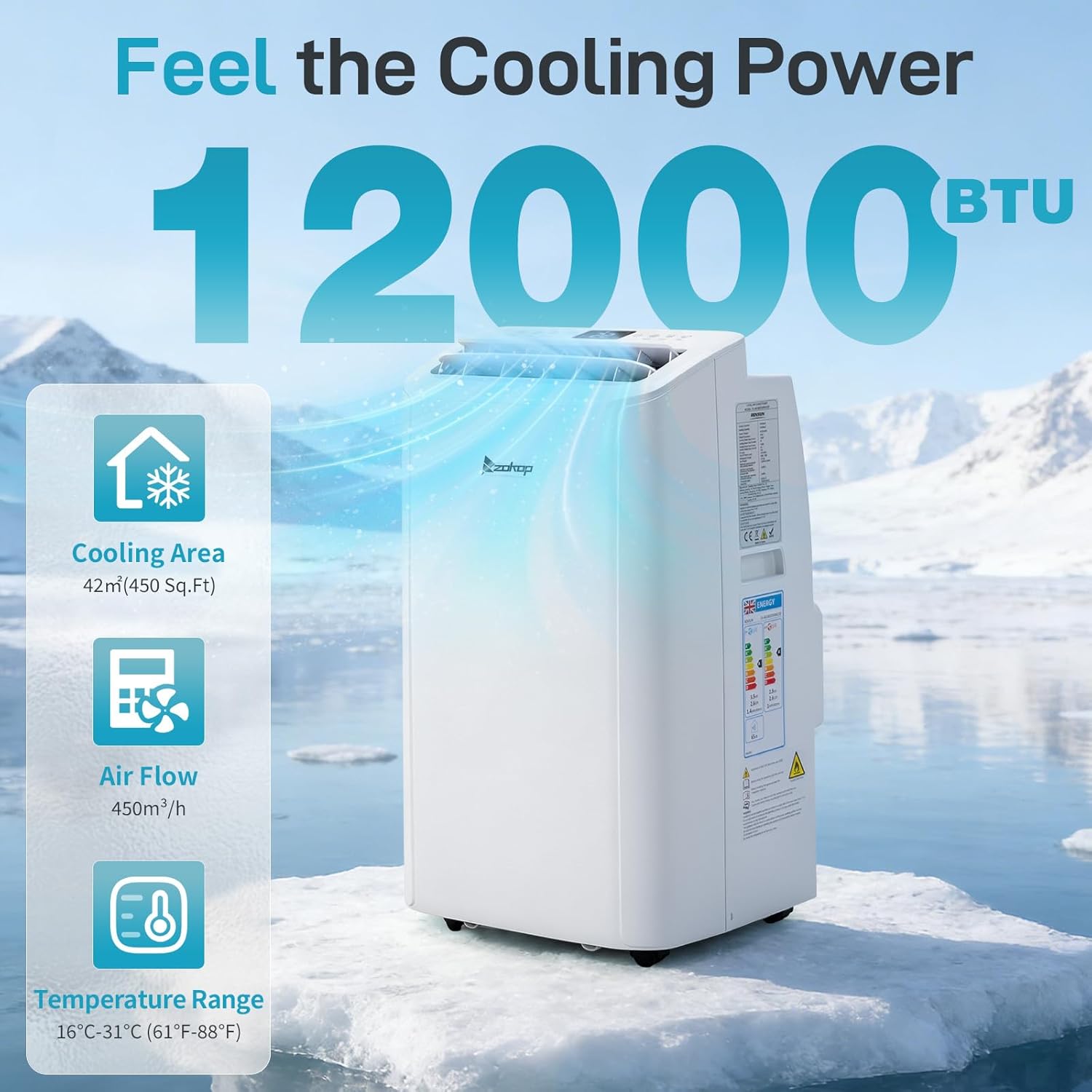
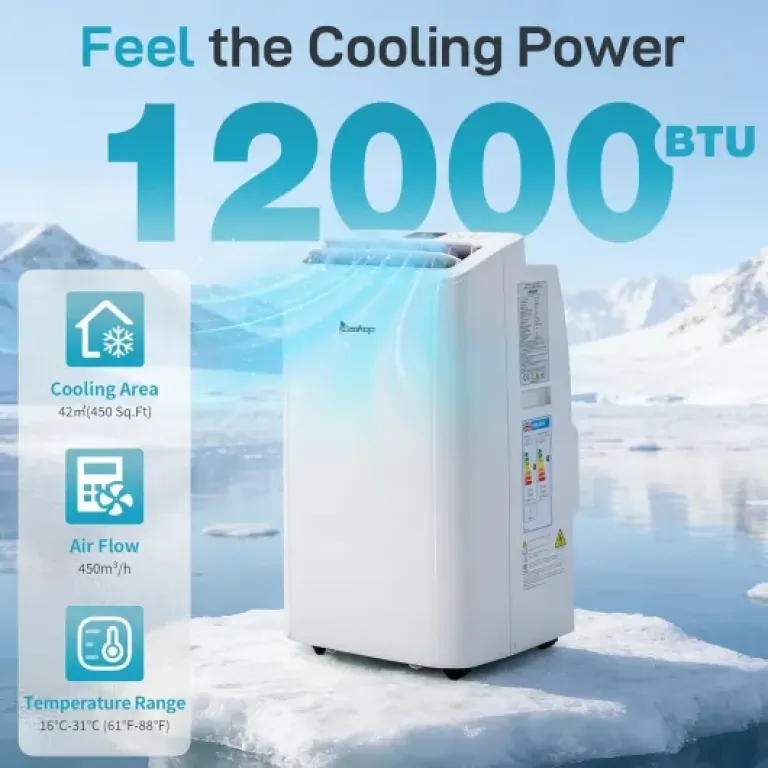
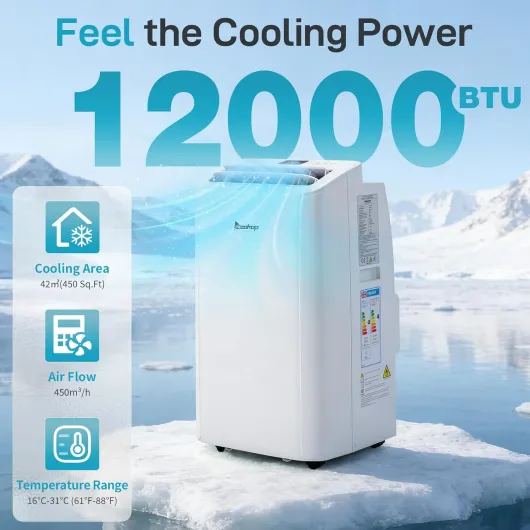
The spec sheet is quite dense for this category: 12,000 BTU cooling capacity, heating function, mesh filter, 24-hour timer, and a stated noise level of 45 dB. It’s designed for rooms up to about 450 square feet, which covers most bedrooms, typical UK/European living rooms, or a medium home office. It runs on 220 V, draws about 1000 W, and is rated energy class A, which is decent but not top of the line.
Among the published reviews, the unit sits at about 4.3/5 from a very small base (3 reviews). That means the feedback is rather positive, but it’s far from a large sample. One verified buyer describes it as the best portable AC they could find at this power level and price, especially highlighting the cooling efficiency and perceived noise. Another comment is much less forgiving on the noise and the weight, calling it “really really heavy” and “SO loud”. So the early feedback is mixed on comfort and acoustic performance.
In my opinion, this product positions itself as a practical, feature-rich option for renters or people who can’t install a fixed unit. The strong point on paper is the combination of power (12k BTU) and year-round use (heating + dehumidifier + fan). The main doubts come from the modest number of reviews, the conflicting noise impressions, and the unavoidable drawbacks of any 28 kg portable unit with a hot exhaust hose. It looks like a solid candidate if you accept the usual compromises of mobile air conditioners.
Value for money: where this Karl home unit sits in the market
The exact selling price is not stated here, but the feature set and the Amazon ranking (around 26th in Mobile Air Conditioners and 12,391th in Home & Kitchen) place this Karl home model in the competitive mid-range of portable ACs. For that segment, the combination of 12,000 BTU cooling, integrated heating, dehumidifier, fan, sleep mode, WiFi control and remote is quite comprehensive. Many rivals at similar prices either skip the heating function or don’t offer app control, so on paper the feature-to-price ratio looks strong.
Energy-wise, the unit is rated class A with a 1000 W draw. It’s not the most efficient machine on the market, but it’s also not a power hog for this capacity. In hot climates or during long heatwaves, the electricity usage will still be noticeable, like with any portable AC, but the 24‑hour timer and sleep mode help you limit wasted hours of operation. Being able to switch it on remotely via the app before you get home can also avoid running it all day just to come back to a cool room.
The small number of reviews (3 at the time of writing) is the main unknown for value. The average rating of 4.3/5 is good, and one buyer explicitly says that, after researching many units, this one offered the best compromise of power, noise and price they could find. However, with so few opinions, it’s hard to know if there are recurring issues that just haven’t shown up yet. The one strongly negative comment about noise also reminds that expectations matter a lot: someone thinking “low noise” equals nearly silent will be disappointed with almost any portable AC.
In my opinion, if this Karl home unit is priced in the typical mid-range for 12k BTU portables, the value is solid: you get year-round use (heating + cooling), smart controls, and enough power for medium-sized rooms. If the price climbs into the high-end bracket, then it competes with more established brands and possibly quieter split systems, and the argument becomes weaker. For renters or people who move often, though, the all-in-one nature and included window kit make it a practical purchase that can follow you from flat to flat without professional installation costs.
Design, size and practicality in everyday placement
The Karl home 12000BTU unit follows the usual design language of portable air conditioners: a rectangular white tower with vents and controls on the front and top. The brand mentions a modern white design with a side air outlet for efficient airflow distribution. Visually, this type of design tends to blend into most interiors because it looks like many other air treatment appliances (dehumidifiers, air purifiers, etc.). There’s no flashy color or aggressive styling here, which is a good thing if you want it to disappear in a corner of the living room or bedroom.
At 71.5 cm high, 42 cm wide and 35.7 cm deep, it’s not tiny, but for 12k BTU it remains relatively compact. On paper, the footprint is similar to a large dehumidifier or a narrow side table. For placement, you still need to respect the usual clearance around the unit so that the intake and exhaust are not blocked. The exhaust hose connects to the rear and goes to a window via the included kit. One buyer does mention the hose length of about 1.5 m as being on the short side, which is quite common for portable ACs but something to factor in if your window is far from your ideal placement spot.
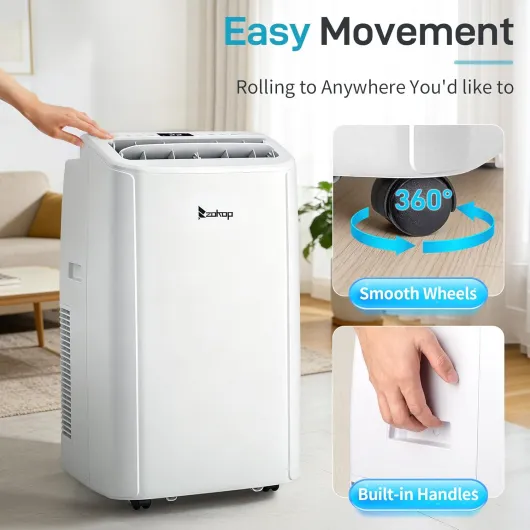
The device includes built-in caster wheels for mobility, which is essential at 28 kg. The spec sheet doesn’t mention side handles, but most units in this category have some form of recessed grip. Mobility here means “rollable on flat floors”, not something you carry up and down stairs without effort. The design is therefore practical for moving between, say, a living room and a bedroom on the same level, but much less handy for frequent floor changes.
In terms of usability, the controls combine a touch panel, a remote control and WiFi app support. That’s a plus compared to older models that only had a basic remote. With the app, you should be able to adjust temperature, mode and timer without getting up, and even when you’re not at home, as long as the WiFi connection is stable. Overall, the design looks functional and fairly discreet. In my opinion, it’s not here to impress visually, but to be a practical appliance that doesn’t clash with furniture, which fits the product’s purpose.
Everyday comfort: noise perception, airflow and controls
Comfort with a portable air conditioner comes down to several factors: noise, airflow direction, temperature stability, and how easy it is to control without constantly getting up. In this case, the Karl home unit tries to cover all these angles. It offers multiple modes (cooling, heating, dehumidifier, fan, sleep), a 24‑hour timer, and three control methods (touch panel, remote, and smartphone app). On paper, this should let you tweak the climate quite precisely and avoid abrupt changes, especially at night with sleep mode gradually adjusting settings.
Buyer feedback on acoustic comfort is clearly mixed. One verified customer, who even measured the sound level, talks about roughly 51 dB at close range with the compressor running and considers this reasonable, saying they can work next to it with noise-cancelling earphones and barely notice it. Another reviewer has the opposite impression and calls it very loud, even on low fan speed. This kind of split is typical for portable ACs: people used to total silence or split systems often find them noisy, whereas those who know this category accept the hum and airflow noise as part of the deal.
In terms of thermal comfort, the reported cooling time (about 7 degrees drop in half an hour in 16 m²) suggests the unit can create a noticeable difference quite quickly in a bedroom-sized space. Stronger airflow also means you may feel a direct cold draft if you sit right in front of the outlet. The side air outlet is supposed to help distribute air more evenly, but without adjustable louvres being described in detail, users will probably still need to experiment with placement to avoid blowing straight on the bed or sofa.
The control comfort looks solid: having a remote control and WiFi app means you can adjust temperature, fan speed and mode without getting up, which is important when the unit is in a bedroom and you want to fine-tune it from the bed. The 24‑hour timer lets you schedule start and stop times to avoid waking up cold at 4 a.m. or coming home to a stifling room. In my opinion, if you accept the usual level of noise and the visual presence of a 71 cm high appliance plus hose, the comfort package is convincing for both day and night use.

Build, weight and what can be inferred about longevity
The Karl home 12000BTU portable AC weighs in at 28 kilograms, which suggests a fairly robust internal structure: a proper compressor, heat exchangers, fan assemblies and a plastic shell thick enough to hold everything together. One buyer explicitly mentions that the build quality feels solid and that the design is clean. That kind of comment usually points to decent assembly and plastics that don’t feel flimsy, at least in the early days of ownership. There are no reports in the current reviews of cracks, leaks or sudden failures.
The housing is plastic, as with almost all portable ACs at this price and category. The filter is a simple mesh filter, which is easy to remove and clean but doesn’t offer advanced air purification. From a durability standpoint, a mesh filter is a good thing: as long as users remember to vacuum or rinse it periodically, it should protect the internals from excessive dust buildup. Neglecting filter maintenance is one of the main reasons portable ACs lose performance or get noisier over time, so the simplicity here is actually an advantage.
The unit is made in China, which is standard for this segment. The presence of caster wheels is important for durability because dragging or tilting a heavy compressor unit can stress the case and joints. The wheels should reduce that, as long as they are used on reasonably smooth floors. The window kit and hose are often the weak points on portable ACs, more than the core machine itself. Here, one buyer notes the 1.5 m hose length as a limitation, but there’s no complaint yet about hose quality. As with any portable AC, frequent bending and rough handling of the hose could shorten its lifespan, so careful installation matters.
Given the small number of reviews so far, there’s not much long-term feedback on failures or reliability issues. In my opinion, the combination of a fairly heavy chassis, straightforward filter design and standard components suggests average to good durability, provided users clean the filter, avoid blocking airflow, and don’t move the unit roughly. It’s not a premium pro-grade machine, but nothing on the spec sheet screams “fragile” either. As usual, the real test of longevity will be several summers of continuous use, which we don’t have data for yet.
Cooling, heating and noise: what to expect from the 12,000 BTU engine
On paper, the main selling point is the 12,000 BTU cooling capacity, which is a step above the very common 9,000 BTU portable units. For a well-insulated bedroom of 15–20 m², that should be more than enough headroom, allowing faster cooldown from high temperatures and more stable comfort during heatwaves. One verified buyer gives a concrete example: they report going from about 30 °C to 23 °C in around 32 minutes in a 16 m² room, which is perfectly in line with what you’d expect from this power level.
The device also offers a heating mode, which is a real plus if you want to justify having a big appliance in the room for more than three months a year. The brand doesn’t provide a separate BTU figure for heating, but typically it’s in the same ballpark or a bit lower than cooling capacity for this kind of reversible portable unit. Heating via this method is usually more of a backup or spot heater than a full replacement for central heating, but for a home office or small living room it can take the chill off in mid-season.
Dehumidification is another important part of the performance. While the exact litres per day are not specified, any 12k BTU compressor-based unit will inherently remove a fair amount of moisture when running in cooling mode. In very humid climates, using a dedicated dehumidifier mode can make the room feel more comfortable even without dropping the temperature too much. This can be especially useful in basements or ground-floor rooms that tend to be damp.
Noise is where the story gets more nuanced. The spec sheet states 45 dB, but portable ACs usually fluctuate depending on fan speed and compressor cycle. One customer measured about 51 dB at less than a metre, compressor running and fan on low, and considers that not loud at all, mentioning they can barely hear it with noise-cancelling earphones. Another user, on the other hand, describes the unit as “SO loud” even on low and complains about the weight. In my opinion, the safest assumption is that this unit behaves like most 12k BTU portables: clearly audible, potentially intrusive for very light sleepers, but acceptable for most people in a living room or home office. The “low noise” claim should be interpreted relative to similar devices, not relative to a silent fan or split AC.
What this Karl home portable air conditioner actually offers
In terms of core specs, the Karl home unit is a 12,000 BTU portable air conditioner with integrated heating. The advertised coverage is up to 450 square feet, which roughly corresponds to a 40–45 m² space, though portable units typically perform best in somewhat smaller rooms than the theoretical maximum. The device runs at 1000 watts, which is in line with this cooling capacity, and it’s powered by standard 220 V mains. The manufacturer claims an energy efficiency class of A and an annual energy consumption of 1.8 kWh, a figure that should be taken as a reference under specific test conditions rather than real-life usage.
The unit is described as 5‑in‑1: cooling, heating, dehumidifying, fan, and sleep mode. That means you can use it for summer heat, shoulder seasons when you just need a bit of extra warmth, and damp days where dehumidification is more important than temperature. Sleep mode is supposed to gradually adjust the temperature and lower the fan speed to reduce noise and avoid waking you up with sharp temperature swings. The control methods are varied: WiFi app control, infrared remote control, and touch panel on the top of the device.
Physically, the air conditioner weighs about 28 kg and measures 35.7 × 42 × 71.5 cm (D × W × H). That’s fairly typical for a 12k BTU portable unit: not compact in absolute terms, but small enough to fit in most room corners. The manufacturer includes a window kit, exhaust hose assembly, remote control and user manual. No drain pump is mentioned, so users should expect either a self-evaporation system with occasional manual draining or a gravity drain option, as is common in this category.
From the limited reviews, the cooling performance looks convincing for a bedroom-sized room. One buyer mentions going from 30 °C to 23 °C in about half an hour in a 16 m² room, which fits what you’d expect from 12k BTU in a small to medium space. Noise perception, however, is clearly subjective: one user finds it fairly quiet for this category, another finds it extremely loud even on low. In my view, anyone considering this device should assume typical portable AC noise levels, not miracle silence, despite the “low noise” marketing claim.
Pros
- 12,000 BTU cooling capacity with heating, dehumidifier, fan and sleep mode in one unit
- WiFi app control, remote control and touch panel for flexible operation
- Covers up to roughly 450 sq ft, suitable for many bedrooms and living rooms
Cons
- Heavy at 28 kg and limited hose length around 1.5 m reduce placement flexibility
- Noise perception is mixed among buyers despite the “low noise” claim
Conclusion
Analysis score
The Karl home 12000BTU Portable Air Conditioner positions itself as a versatile, all-season appliance: it cools, heats, dehumidifies and circulates air, with sleep mode, timer, WiFi app and remote control on top. On paper, the 12k BTU capacity and 450 sq ft coverage give it enough power for most bedrooms, living rooms and home offices, and one verified buyer’s experience in a 16 m² room fits that expectation. The build seems solid, the design is neutral, and the window kit plus hose mean you can get up and running without calling an installer.
It’s not without compromises. At 28 kg, it’s heavy, and the hose length around 1.5 m limits placement options. Noise is the main grey area: one user finds it acceptable for a portable AC, another calls it very loud. In my view, anyone considering this should assume standard portable AC noise levels, not the hush of a split unit, despite the “low noise” label. The small number of reviews also leaves some uncertainty about long-term reliability and potential recurring issues.
Overall, this model makes sense if you want a single, mobile unit for year‑round use, can’t or don’t want to install a fixed system, and are okay with the usual drawbacks of portable ACs (bulk, hose, audible operation). People who are extremely sensitive to noise, or who have the option to install a split system, might be better off looking elsewhere. For renters or those needing flexible room-to-room climate control, the Karl home 12000BTU looks like a good value mid-range option with a rich feature set.