Summary
Analysis score
Average of the criteria rated below
Value for money: strong starter kit if your expectations are realistic
Design: pocketable, simple and clearly aimed at beginners
Battery life: a strong point for casual shooting
Build quality and durability: feels decent for the price, but still a budget gadget
Image and video performance: decent in daylight, limited ambitions
What this little 4K camera actually offers
Pros
- Very simple to use with automatic settings, suitable for kids and complete beginners
- Lightweight compact body with 2000 mAh battery that buyers say lasts through several outings
- Comes bundled with 32 GB SD card, USB‑C cable and OTG adapter, offering good value as a starter kit
Cons
- Small 1/4" CCD sensor with JPEG-only output and digital zoom limits real image quality, especially in low light
- Marketing claims of 4K and 64 MP do not fully align with the modest technical specs
- Very limited manual controls and growth potential for users who want to learn more advanced photography

Specifications
View full product page →| Brand | QIVORO |
A cheap way to get kids off the smartphone camera
The QIVORO DC16H-TH is one of those small pink pocket cameras that clearly aims at kids, teens and beginners who want something more "real" than a phone, without diving into complex photography gear. It claims 4K video, 64 MP photos, 18x zoom, autofocus and anti-shake, all in a 200 g body with a 2.8" screen. On paper, it covers most of what casual users expect for holidays, parties and basic vlogging.
The average score hovers around 4.2/5 over a bit more than a hundred Amazon reviews, which suggests most buyers are satisfied, especially considering the budget position. Several verified buyers describe it as a "great little camera" for everyday photos, kids and travel, while also pointing out that it is not a professional device and works best in good light. That lines up with the modest 1/4" CCD sensor and JPEG-only output.
What stands out is how the brand bundles it: you get the camera, a 32 GB SD card, an OTG adapter, a USB‑C cable and a built‑in battery. For someone who just wants a ready-to-go camera without shopping for accessories, that is practical. There is no mention of RAW format, fast burst modes or advanced manual settings, so this is clearly aimed at novices rather than enthusiasts.
In my opinion, this model should be seen as a simple point-and-shoot: something to put in a kid’s backpack, use on a school trip, or keep as a backup camera when you do not want to risk a smartphone. If expectations stay at that level—basic photos, simple videos, easy sharing—its spec sheet and the published comments suggest it gets the job done reasonably well.
Value for money: strong starter kit if your expectations are realistic
The QIVORO DC16H-TH sits near the top of Amazon’s "All-in-One Digital Cameras" category (ranked 3rd), which indicates it sells well. The exact price is not shown here, but from the context and typical competitors, it clearly targets the budget segment. For that kind of money, you are getting a compact camera, a 32 GB SD card, an OTG adapter, a USB‑C cable, a built-in battery and basic features like autofocus, anti-shake, built-in flash and HDMI output. Several reviewers highlight that the bundle offers "great value for the money" and appreciate not having to buy extra storage separately.
In terms of raw image quality, it cannot compete with a modern mid-range smartphone. The small CCD sensor, JPEG-only capture, digital zoom and AVI video format keep it in the "decent but nothing more" category. However, its value is not just about image quality. For parents, one advantage is giving kids a dedicated camera instead of a phone, reducing distractions and the risk of damaging an expensive smartphone. For teens and students, it is an affordable way to learn basic photography concepts—framing, timing, simple video—without diving into complex gear.
There are trade-offs. The "4K 64 MP" marketing is clearly optimistic compared to the technical details, and anyone expecting real high-end resolution will be disappointed. There is also very little room for growth: no manual exposure, no RAW, limited control over shutter speed and ISO, and a fixed lens with only digital zoom. So in my opinion, the value is high if you treat it as a fun, simple device for casual photos and vlogs, and low if you expect it to be a serious camera for demanding work.
Considering the 4.2/5 average rating from over a hundred users, the majority of buyers seem to feel they got their money’s worth. They praise the ease of use, portability, battery life and included accessories. The main complaints are about focus not being perfect and some confusion around using video, which are typical for this class. If your budget is tight and your needs are basic, this QIVORO model offers solid value. If you can spend more, a better compact or even leveraging a decent smartphone might make more sense.

Design: pocketable, simple and clearly aimed at beginners
The design of the QIVORO DC16H-TH is clearly centered on portability and ease of use. At about 0.2 kg, it is very light, so throwing it into a bag or a kid’s small backpack should not be a problem. The compact form factor and 2.8" LCD screen make it closer to an old-school point-and-shoot than to a big camera. Several reviewers mention that it is easy to carry and that the size is convenient for everyday outings, which is exactly what the brand is going for here.
The color in this version is pink, which obviously targets a specific audience—kids, teens, or anyone who wants something a bit playful rather than a black, "serious" camera. The marketing also calls it a "retro" camera, though the spec sheet does not describe any physical dials or vintage-style elements beyond the general compact look. The interface is described in comments as intuitive and straightforward, with simple buttons and menus, which suits people who do not want to dig through complex settings.
On the front, you have the fixed lens with digital zoom and anti-shake system, along with a built-in flash. On the back, the 2.8" LCD handles both framing and menu navigation. There is no mention of a tilting screen or a front-facing display, so vlogging will likely be done by guessing framing or using wide angles. For a beginner camera, that is acceptable but not ideal for those who really care about framing themselves precisely.
In my opinion, the strength of the design lies in its simplicity: minimal controls, very light body, bright color, and a clear focus on "switch on and shoot". It does not try to mimic a DSLR or a premium compact, and it does not offer physical controls that advanced users might expect. For someone who just wants a basic device to give to a child or to use as a throw-in-the-bag camera, that straightforward design is a plus. For more demanding users, the design will probably feel a bit toy-like and limited.
Battery life: a strong point for casual shooting
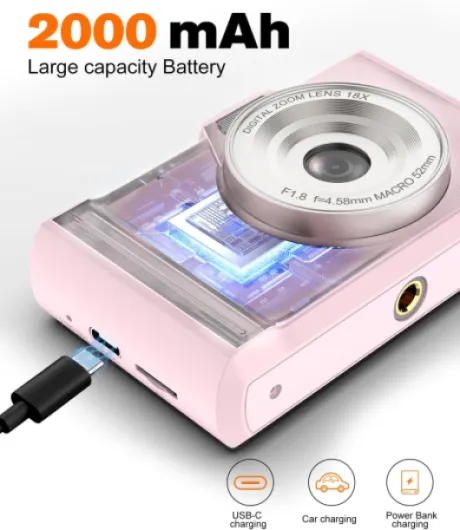
The QIVORO DC16H-TH comes with a built-in 2000 mAh lithium-ion battery, and the sheet talks about an average life of up to 48 hours. That figure likely refers to standby or very light use rather than continuous video recording, but it still indicates a larger battery than many small compacts in this price range. The brand even claims that it can "capture moments all weekend on a single charge". Strictly speaking, that will depend heavily on how much video you shoot, how often you use the flash and how bright you keep the screen.
Among the Amazon comments, several buyers say the battery life is "solid" or "long", noting that it lasts through several outings before needing a recharge. That fits with the 2000 mAh capacity and the relatively low-power hardware (small screen, modest sensor, no heavy processing). There are no recurring complaints about the battery dying too quickly, which is usually a red flag in cheap electronics. This suggests that, for typical casual use—some photos, short videos, power off between sessions—the battery should be more than enough.
Charging and data transfer are done via the included USB‑C cable, which is practical. You can plug it into a standard USB charger, a power bank, a laptop, or even some phones with reverse charging. The camera also has an auto-shutdown function that can be set to 1, 3 or 5 minutes to save power, which is useful if a kid forgets to turn it off. There is no mention of removable batteries, so if the internal cell wears out after a few years, replacing it might be complicated or not worth the cost compared to buying a new unit.
In my opinion, battery life is one of the reassuring parts of this camera. For a child or student who takes it to a weekend event or a short trip, the 2000 mAh capacity and auto-off function should avoid most battery anxiety. It is not a professional solution for full days of continuous filming, but for snapshots and occasional clips, the combination of capacity, low power draw and simple charging via USB‑C looks well balanced.
Build quality and durability: feels decent for the price, but still a budget gadget
The QIVORO DC16H-TH is made in China by Shenzhen Weizhike Technology Co., Ltd., and it clearly sits in the budget compact segment. The spec sheet does not detail the materials, but given the 0.2 kg weight and the price positioning, it is safe to assume a plastic body with simple construction. There is no mention of weather sealing, shock resistance or reinforced lens mechanisms, so this is not a rugged camera. Still, some reviewers mention that the build feels "sturdy" and "well-made" for the price, which suggests it does not come across as ultra flimsy in normal handling.
The included 32 GB SD card and accessories add convenience but not necessarily durability. Cheap SD cards can sometimes fail earlier than branded ones, though there are no systematic complaints about this in the comments. The lens uses digital zoom, which actually reduces the number of moving optical parts, potentially reducing mechanical failure risk compared to a retractable zoom lens. However, the small lens and internal electronics are still vulnerable to drops, sand, and moisture, like any non-rugged camera.
There is a 1-year manufacturer warranty, which is fairly standard for this category. That at least gives some protection in case of early defects. Among the published reviews, there are no widespread reports of catastrophic failures, cracks or dead units after a few uses. The main critiques focus more on focus performance and ease of use for specific functions, not on things breaking. That does not make it indestructible, but it is a good sign that the majority of buyers are not running into immediate build problems.
In my opinion, durability here is "good enough for a careful user", especially an adult or teen who treats electronics with some care. For younger kids who drop things often, I would not rely on it surviving heavy abuse; a silicone case or at least a wrist strap would be wise. The plastic construction and lack of weather sealing mean you should keep it away from rain, beaches and intense impacts. For the price, that is not surprising, and as long as expectations stay in line with "normal use" rather than "rough outdoor gear", the overall durability profile seems acceptable.
Image and video performance: decent in daylight, limited ambitions
On paper, the QIVORO DC16H-TH promises 64 MP photos and 4K video, but the technical details tell a more modest story. The camera uses a small 1/4" CCD sensor with 8-bit depth, JPEG-only stills and AVI video, plus a stated 1080p video capture resolution. There is a clear mismatch between the marketing labels and the hardware. Interpolation and upscaling are very likely involved to reach those big numbers, which is common in this price bracket. Still, several buyers mention that photo and video quality look sharp and vibrant in good lighting, with accurate colors and enough detail for family shots and holidays.
The autofocus system is described as hybrid, with single-servo AF and 19 focus points. For a cheap compact, that is actually a decent spec, and a number of reviews point out that autofocus feels quick and reliable for everyday use. One buyer does mention that focus "could be better", especially suggesting that it is safer to use it during the day, which fits the expected behavior of a small-sensor, budget camera: it does fine in bright conditions, and struggles more when light drops.
The lens is listed as a telephoto with 18x digital zoom and an aperture range of F2.8–F5.6. The spec sheet also mentions 18 mm minimum and maximum focal length, which implies that the zoom is purely digital, not optical. Digital zoom essentially crops the sensor and enlarges the image, which reduces detail and increases noise. For casual users who just want to get closer to a subject for social media or small prints, that might still be acceptable, but it is not comparable to a real optical zoom. The anti-shake feature should help limit blur from hand movement, which some reviewers say helps keep videos steadier when walking.
For video, the camera records in AVI, which is an older container and usually not as efficient as modern codecs. Combined with the basic sensor and digital zoom, it is best to see this as a tool for simple clips—vlogs, school projects, and quick memories—rather than serious content creation. In my opinion, the performance is aligned with the low-cost, beginner positioning: good enough for daylight snapshots and basic videos, underwhelming if you expect strong low-light performance, real 4K sharpness or high dynamic range. The 4.2/5 average rating suggests most buyers understand these limits and are still satisfied for their use cases.

What this little 4K camera actually offers
The QIVORO DC16H-TH is marketed as a compact all-in-one digital camera: stills and video, autofocus, built-in flash and a telephoto lens with 18x digital zoom. The brand advertises 4K and 64 MP, but the technical sheet also mentions 1080p video capture resolution and a 45 MP "total still resolution". In my opinion, that almost certainly means the sensor is lower resolution and relies on interpolation to reach 64 MP, and that 4K might be more of a marketing label than a robust high-bitrate format. For casual use it may be fine, but this is not a high-end imaging pipeline.
The sensor is a small 1/4" CCD with 8-bit depth, JPEG output and AVI video files. This is very typical of entry-level compact cameras: simple files, no RAW, no HEVC, no advanced color profiles. White balance is automatic only, exposure is program mode only, and shutter speed is fixed at 1/30 s according to the sheet, which is very limited compared to even basic mirrorless cameras. For a novice, the upside is that there is almost nothing to set up; the downside is that you cannot really grow your skills with manual controls here.
On the connectivity side, it uses USB for charging and data transfer, and has HDMI video output, which is a nice touch if you want to quickly show photos on a TV. The included USB‑C cable and OTG adapter mean you can plug it into a computer, smartphone or tablet to move files without extra purchases. Storage is handled by a 32 GB SD card included in the box, with a stated write speed between 10 and 30 MB/s, enough for light JPEG and AVI recording.
Overall, the feature set is very much "grab and shoot": automatic focus (single-servo AF), automatic white balance, built-in flash in fill mode, basic anti-shake, and a 2.8" LCD for framing. In my view, this is a reasonable package for kids, teens and adults who only want casual photos and simple vlogs. Anyone looking for real 4K quality, low-light performance or creative control should be realistic: this is an entry-level gadget, not a replacement for a modern smartphone flagship or a mirrorless body.
Pros
- Very simple to use with automatic settings, suitable for kids and complete beginners
- Lightweight compact body with 2000 mAh battery that buyers say lasts through several outings
- Comes bundled with 32 GB SD card, USB‑C cable and OTG adapter, offering good value as a starter kit
Cons
- Small 1/4" CCD sensor with JPEG-only output and digital zoom limits real image quality, especially in low light
- Marketing claims of 4K and 64 MP do not fully align with the modest technical specs
- Very limited manual controls and growth potential for users who want to learn more advanced photography
Conclusion
Analysis score
The QIVORO DC16H-TH is a straightforward, budget-friendly compact camera aimed squarely at kids, teens and beginners. It promises big headline numbers like 4K and 64 MP, but the technical details and user feedback show a more modest reality: a small 1/4" CCD sensor, JPEG-only stills, AVI video and digital zoom. In good light, buyers report sharp, colorful photos that are perfectly fine for family use, school projects and social media. Autofocus and anti-shake seem to work well enough for everyday snapshots, and the simple menus make it accessible even for complete novices.
Its real strengths are portability, ease of use, and the all-in-one bundle: 2000 mAh battery, 32 GB SD card, USB‑C cable and OTG adapter. For the price, that is a practical starter kit, especially if you want a dedicated camera for a child instead of handing over a smartphone. On the downside, image quality is limited by the small sensor and digital zoom, there are almost no manual controls, and the "4K/64 MP" claims should be taken with caution. It is not a tool for serious photographers or anyone who cares about low-light performance and fine detail.
In my opinion, this camera suits parents buying a first camera for kids, students needing a simple device for projects, and adults who want a cheap, light camera for casual outings. People who should probably skip it: anyone expecting smartphone-level processing, true 4K quality, or room to grow their photography skills. Seen as a basic point-and-shoot toy with some decent capabilities, it offers good value; seen as a true 4K camera, it will feel underwhelming.