Summary
Analysis score
Average of the criteria rated below
Value for money: who this camera still makes sense for
Design and handling: pocket size and very simple controls
Battery and connectivity: fine for casual use, not for power users
Build quality and reliability: classic IXUS feel with some caveats
Image and video performance: decent compact results with limits
Specs overview: what the IXUS 285 HS offers on paper
Pros
- Very compact and lightweight metal body with 12x optical zoom (25–300 mm equivalent)
- Simple, automatic operation appreciated by technophobes and casual users
- Optical image stabilization and 1080p video suitable for everyday photos and clips
Cons
- Small 1/2.3" sensor and modest aperture limit low-light and overall image quality
- Feature set feels dated versus modern smartphones and entry-level mirrorless cameras
- Reports of problematic units from some sellers (wrong regional version, defective on arrival)

Specifications
View full product page →| Brand | Canon |
A compact camera for people who want something simple
The Canon IXUS 285 HS is one of those compact cameras aimed at people who just want to press a button and get a decent photo, without diving into complex menus or carrying a bulky device. It offers a 20.2 MP BSI CMOS sensor, a 12x optical zoom covering 25–300 mm (full-frame equivalent) and Full HD 1080p video. On paper, it is clearly built for casual photography: holidays, family events, quick snapshots where a phone either feels too complex or simply not desirable.
With a weight of around 150 g and a thickness clearly in the "slip into any pocket" category, the IXUS 285 HS focuses on portability. Several buyers insist on how simple it is to operate and how it suits people who dislike smartphones or modern, feature-heavy cameras. One reviewer even bought it as a spare because they were worried this type of small camera might disappear from the market.
The average rating sits around 4/5 from close to two hundred Amazon reviews, which suggests overall satisfaction but also some clear issues. Positive comments focus on ease of use, image quality that is decent for the size, and the classic IXUS “point-and-shoot” experience. On the other side, there are complaints about included accessories (like a faulty memory card) and at least one very negative comment about receiving a Japanese-market unit that did not work properly.
In my opinion, this camera targets a precise audience: people who want a straightforward compact camera, don’t care about 4K or advanced manual controls, and value portability over cutting-edge specs. It is not trying to compete with modern mirrorless systems or high-end phones. It’s more like a familiar tool for users who liked compact cameras in the 2000s and want to keep that workflow.
Value for money: who this camera still makes sense for
The IXUS 285 HS sits in a tricky spot in today’s market. On one side, modern smartphones now offer strong cameras with computational tricks, large screens, and instant sharing. On the other side, there are entry-level mirrorless and advanced compacts that deliver far better image quality and control. This Canon aims at a specific niche: people who don’t want a smartphone camera workflow and don’t care about interchangeable lenses or 4K video, but still want something small and simple with a real zoom.
Among the reviews, several 5-star ratings highlight exactly that: compact size, ease of use, and decent image quality for everyday scenes. One buyer calls it "idiot proof" and says they bought it as a spare because they hate smartphones and find them too complicated. Another positive comment simply says it delivers quality pictures and is good value for money. This suggests that for users who prioritize simplicity and portability over features, the price feels justified.
On the other hand, a 3-star review written about a related IXUS model complains that the camera feels overpriced for what it offers, especially considering the limitations in macro focusing, the average flash performance, and the fact that they had owned similar cameras in the past for roughly half the price. They also note that you can’t use it as a webcam and that the output over HDMI/monitor was disappointing. Even if that review is for the IXUS 185, the overall product philosophy is similar enough that the criticism about value probably applies to the 285 HS too, at least partially.
In my opinion, the value proposition is very dependent on the buyer’s expectations. For someone who already owns a capable smartphone and cares about image quality, dynamic range, and flexibility, the IXUS 285 HS is likely underwhelming and overpriced. But for an older relative, a technophobe, or anyone who explicitly wants a small, dedicated camera with a long optical zoom and easy automatic operation, it still makes sense. If the price drops into a lower bracket, it becomes a more convincing option. At higher prices, it’s hard to ignore how much more you can get from either a mid-range phone or a basic mirrorless kit.
Design and handling: pocket size and very simple controls
The IXUS 285 HS follows the classic Canon IXUS design language: a slim rectangular metal body, here in silver, that aims to be both discreet and easy to slip into a pocket or small bag. At around 0.15 kg, it is clearly on the lightweight side, which matches the comments from buyers describing it as compact and easy to carry around. The lens barrel retracts fully into the body when powered off, leaving a flat, clean silhouette that is convenient for everyday carry.
The front is dominated by the 12x zoom lens, which covers 25–300 mm equivalent. That range suggests a design compromise typical of compact zoom cameras: the camera stays small while still giving a fairly wide angle for groups and landscapes, and enough reach for distant subjects like wildlife in a park or details on buildings. The top plate remains uncluttered, with the usual power and shutter buttons and a zoom rocker. Everything hints at a design that prioritizes simplicity over customization.
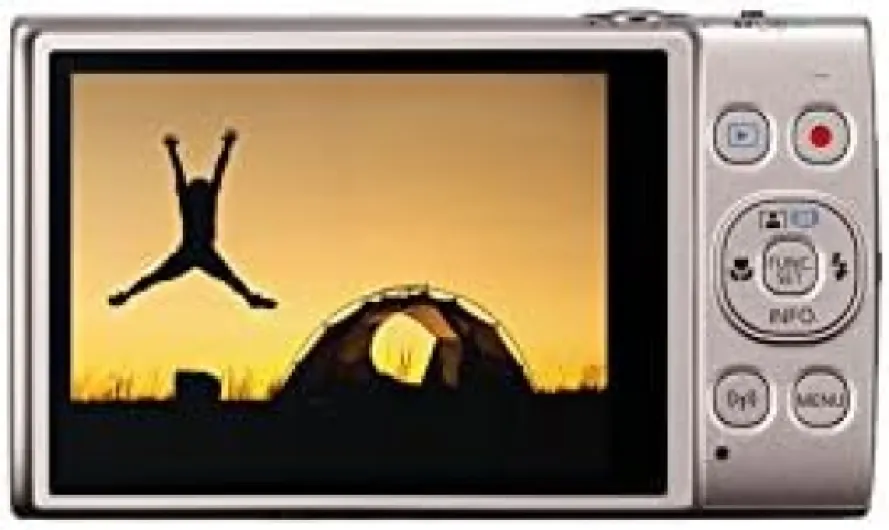
On the back, the 3-inch LCD occupies most of the space. Since it’s a fixed screen with capacitive touch, there’s no flip or tilt mechanism, which keeps the body thinner but limits flexibility for low-angle or selfie-style framing. For the target audience, that trade-off makes sense: fewer moving parts, lower cost, and a straightforward interface. The button layout is minimal, and reviews talking about the camera being "idiot proof" point to a user interface that is intended to be intuitive even for technophobes.
Visually, the silver finish gives it a more neutral look compared to brighter colors sometimes seen on compacts. It’s not trying to be a fashion accessory; it’s just a small camera that blends in. In my opinion, the design is functional, not flashy: good for someone who wants a traditional compact that feels familiar and doesn’t scream for attention, but people used to grips and dials from larger cameras might find it a bit too flat and minimalist.
Battery and connectivity: fine for casual use, not for power users
The Canon IXUS 285 HS uses the NB‑11L rechargeable battery, a small pack shared with several compact Canon models. The exact number of shots per charge is not listed in the provided specs, but similar Canon compacts with this battery often land in the 150–250 shots range under CIPA conditions. On paper, that means the camera should handle a light day of sightseeing or an evening event, but heavy shooters who constantly review images, use the flash, or record a lot of video will likely need a spare battery.
The box includes the battery, a dedicated charger and a cable, so you can charge it externally instead of keeping the battery inside the camera. For people coming from phones, this is both a plus and a minus: you can swap batteries quickly, but you can’t just plug a USB cable into the camera and treat it exactly like a smartphone. One negative review mentions receiving a unit with a Japanese charger and plug, which made the product unusable for them without adapters and raised concerns about regional compatibility; this looks like a seller issue rather than a technical fault with the IXUS 285 HS itself, but it’s something to watch for if you buy from third-party vendors.
On the connectivity side, the camera includes Wi‑Fi (802.11 b/g) and NFC for quick pairing with compatible smartphones and tablets. That allows wireless transfer of images and some remote control functions through Canon’s app, which is useful for people who want to share photos without removing the SD card. There is also a USB 2.0 port and a video out port, but the camera is not meant to act as a webcam. One reviewer trying a related IXUS reported only static images when connecting to a monitor and poor quality over that link, which is consistent with the product being designed as a standalone camera, not a streaming device.
In my opinion, the battery and connectivity package is adequate but basic. For casual holiday use, charging in the evening and maybe carrying one spare battery should be enough. For intensive all-day shooting or travel vlogging, the limited battery capacity and lack of modern USB‑C charging will feel dated. The Wi‑Fi and NFC functions are a nice bonus for quick sharing but don’t compensate for the more restricted power setup compared with current devices.
Build quality and reliability: classic IXUS feel with some caveats
The IXUS 285 HS features a metal body, which usually gives compact cameras a slightly more robust feel than full-plastic shells. The lens construction is listed as 9 elements in 7 groups, with aspherical elements and 6 diaphragm blades. For a small camera, that’s a fairly standard optical design that should hold up under normal use. There’s no mention of weather sealing, so this is clearly not meant for heavy rain, dust, or harsh outdoor conditions. It’s more of a city and holiday camera than a rugged adventure tool.
Among the Amazon reviews, most comments about longevity are indirect but positive. One buyer mentions having used a similar Canon IXUS since 2005 and being so satisfied with the experience that they bought this 285 HS as a backup, anticipating that small compacts might become harder to find. That kind of loyalty usually suggests the line as a whole has delivered reliable service over the years, at least under normal, careful use. There are no widespread patterns of mechanical failure, broken buttons, or lens errors reported in the visible comments.
However, not everything is perfect. One verified buyer reports receiving a Japanese-market unit that would not power on, with menus and documentation entirely in Japanese and a charger with a Japanese plug. They label it as defective and strongly advise against purchase. In my view, this is more a supply and distribution problem (wrong regional version, possibly refurbished or grey-market) than a structural flaw in the IXUS 285 HS design. Still, it shows that reliability is not just about engineering; it also depends on the seriousness of the seller and the correctness of the product version shipped.
In practical terms, I’d say the durability outlook is: fine if treated like a small electronic device, not a rugged camera. Avoid drops, sand, and moisture, use a small pouch, and the metal shell and retractable lens should last for years, based on the reputation of the IXUS line. People expecting GoPro-like toughness or weather sealing will be disappointed. The main risk seems to be ending up with a poorly sourced unit, so picking a reputable seller with clear EU/UK version labeling looks important.
Image and video performance: decent compact results with limits
Performance-wise, the IXUS 285 HS combines a 20.2 MP 1/2.3" BSI CMOS sensor, a 12x optical zoom and optical image stabilization. On paper, this should deliver usable photos in good light, especially at the wide end around 25 mm, where the aperture is f/3.6 and the lens is less demanding. The BSI design helps a bit with noise at higher ISOs, but the small sensor size still sets a clear ceiling on low-light quality compared with larger-sensor cameras or high-end phones.
The camera records video in 1080p (1920×1080) in MP4 format, which is perfectly fine for casual clips, family events, or simple travel footage. There is no 4K, no high-frame-rate slow motion, and no advanced log profiles. Buyers who commented on video generally describe it as "good" for everyday use, which matches what you would expect from a compact Canon with optical stabilization. The spec sheet lists around 30 fps for video, which is the usual 29.97 fps Full HD.
Autofocus is described as hybrid AF with 8 AF points and single-servo AF (AF‑S). This is a fairly basic system by current standards. It should handle static subjects and simple scenes without much trouble but won’t compete with modern phase-detect systems for tracking fast-moving subjects. One review written for a related IXUS model mentions some difficulty with macro focusing; given the similarity of concept, it wouldn’t be surprising if close-up performance on the 285 HS is also a bit hit-or-miss, especially at the telephoto end.
Overall, in my opinion, the performance is solid but not exciting: it gets the job done for snapshots, holidays, and simple videos, but it’s not built for action photography or night scenes. The strength is the combination of long optical zoom and stabilization in a small body. The weak points are the small sensor, limited aperture, and basic AF, which cap image quality and flexibility, especially compared to newer phones that use computational tricks to boost results.
Specs overview: what the IXUS 285 HS offers on paper
The Canon IXUS 285 HS is a compact digital camera with a 20.2 MP 1/2.3" BSI CMOS sensor and a 12x optical zoom lens (25–300 mm equivalent) with optical image stabilization. The aperture ranges from f/3.6 to f/7.0, which is pretty standard for this kind of small-sensor zoom compact. The camera records stills in JPEG (and RAW is mentioned on some spec lines, though IXUS models are generally JPEG-only in many markets) and video in MP4 at up to 1080p, with a listed continuous shooting speed around 30 fps for video, not for burst stills.
The screen is a 3-inch fixed LCD with 460,800 dots and capacitive touch input, which should make menu navigation and focus selection more straightforward than with older button-only IXUS models. There is no optical viewfinder; the camera uses the rear screen as the only framing option, and the viewfinder type is described as electronic in a generic way. Connectivity includes Wi‑Fi (802.11 b/g) and NFC, which allows quick pairing with compatible smartphones for image transfer and basic remote control. USB 2.0 and a video out port are present, but this is not designed to function as a plug-and-play webcam.
The camera uses SD/SDHC/SDXC cards, with support for UHS‑I, C10, U3 and V30 speed classes, which is more than enough for Full HD recording. Canon includes a battery (NB‑11L), charger, cable, strap and manual in the box. Some product listings also mention a memory card, but one buyer points out that their included card was unusable, so relying on your own SD card from a known brand looks safer.
On paper, this is a classic compact: small sensor, long zoom, optical stabilization, automatic exposure, Wi‑Fi, and simple operation. There is no interchangeable lens mount in reality, despite a confusing “compatible with Canon EF‑S” line in some technical fields, which clearly doesn’t match the IXUS product philosophy. In my view, the spec sheet positions the IXUS 285 HS as a straightforward travel and family camera rather than a tool for enthusiasts who want full manual control or high dynamic range.
Pros
- Very compact and lightweight metal body with 12x optical zoom (25–300 mm equivalent)
- Simple, automatic operation appreciated by technophobes and casual users
- Optical image stabilization and 1080p video suitable for everyday photos and clips
Cons
- Small 1/2.3" sensor and modest aperture limit low-light and overall image quality
- Feature set feels dated versus modern smartphones and entry-level mirrorless cameras
- Reports of problematic units from some sellers (wrong regional version, defective on arrival)
Conclusion
Analysis score
The Canon IXUS 285 HS is a straightforward compact camera aimed at people who want something small, simple and familiar. It offers a 20.2 MP sensor, a 12x optical zoom (25–300 mm), optical stabilization and Full HD video in a 150 g metal body that easily fits into a pocket. The 4/5 average rating on Amazon shows that many buyers are satisfied, especially those who value ease of use and have a history with the IXUS line. Comments about it being "idiot proof" and ideal for technophobes match the spec sheet: automatic exposure, basic AF, no complex controls.
It’s not a camera for enthusiasts. The small 1/2.3" sensor, modest aperture, simple AF system and lack of 4K or advanced features limit its potential. One negative anecdote about a Japanese-market, non-functioning unit also underlines the importance of buying from a reliable seller. And compared to what modern smartphones and entry-level mirrorless cameras offer, the value can feel weak if the price is high. In my opinion, the IXUS 285 HS makes sense mainly for users who dislike smartphones, want a dedicated device with a real zoom, and prioritize portability and simplicity above all.
If you fit that profile or you’re buying for someone who does, this camera can still be a sensible choice, especially at a discounted price. If you’re more demanding about image quality, low-light performance, or video capabilities, or you already own a good smartphone, it’s worth looking at other options.