Summary
Analysis score
Average of the criteria rated below
Value for money: who this projector suits best
Design and everyday practicality
What you get in the box and setup experience
Build, reliability and firmware considerations
Image performance and smart features
What the PUTRIMS P66 offers on paper
Pros
- Native 1080p with good perceived sharpness and claimed 1200 ANSI lumens for its size
- Official Google TV, Chromecast and Wi‑Fi 6 built in, so no extra streaming stick needed
- 30W integrated speakers and 360° rotating gimbal stand make it practical for flexible home use
Cons
- Despite 4K decoding claims, it remains a 1080p LCD projector, not true 4K
- No carry bag included, which limits portability unless you keep the box or buy a case

Specifications
View full product page →| Brand | PUTRIMS |
A compact projector aiming to replace your living room TV
The PUTRIMS P66 positions itself as a compact all‑in‑one home cinema box: Google TV built in, a 360° gimbal stand, 30W speakers, AI autofocus and 6D keystone, plus a claimed 1200 ANSI lumens and short‑throw optics. On paper, it is clearly trying to copy the formula of popular lifestyle projectors, but at a more accessible price point. With a listed Amazon rating of 4.8/5 from around 110 reviews, buyers seem broadly satisfied with what it offers.
Several published reviews insist on three main points: picture sharpness is judged very good for Full HD, setup is described as very simple thanks to autofocus and Google TV, and the built‑in speakers are viewed as stronger than the usual weak audio you often get in this category. A few users still recommend pairing it with external speakers for a more cinematic feel, which is normal for projectors.
On the technical side, the projector claims native 1080p with 4K decoding and HDR10 support, Wi‑Fi 6, Bluetooth 5.4, HDMI with ARC/CEC, and a throw ratio of 1.17:1 allowing a 100‑inch image at about 1.9 m. It weighs under 2 kg and includes a rotating stand, so it is clearly designed to move from room to room or go outdoors without a lot of fuss. According to the spec sheet, it can also act as a standalone Bluetooth speaker.
In my opinion, the promise is clear: a simple plug‑and‑play projector for Netflix, YouTube and console gaming without extra sticks or complex installation. It is not a high‑end cinema machine, but a lifestyle device for living rooms, bedrooms and occasional outdoor use. The strong user rating suggests it largely delivers on that brief, with a few caveats that are worth looking at if you care a lot about true 4K, colour accuracy or serious daylight usage.
Value for money: who this projector suits best
The price is not listed here, but the way buyers talk about the P66 makes it clear it sits in the budget to mid‑range for smart projectors. Several reviewers explicitly call it an excellent deal or say it “punches above its weight” compared with more expensive brands. They highlight that you get native 1080p, decent brightness, a strong built‑in speaker, Google TV, Chromecast, Wi‑Fi 6 and a 360° stand all in one package. In my opinion, that combination is fairly aggressive for the segment: many competing units force you to add a streaming stick or offer weaker speakers.
The main compromises, as far as one can infer, are that this is still a 1080p LCD projector and not a true 4K or high‑end DLP model, and that daylight performance will not rival a bright TV. If you are extremely picky about black levels, motion handling or absolute colour accuracy, there are better (and pricier) options from big names like Epson, BenQ or LG. But those typically cost significantly more once you add a separate streaming device and sound system. For many households, the P66 will be “good enough” or better for movies, series and casual gaming in a darkened room.
The strong Amazon rating of 4.8/5 across about 110 reviews suggests that most buyers feel they got solid value for their money. Users mention that it made their movie nights more enjoyable, that the brightness exceeded their expectations, and that setup was painless. There are very few negative remarks in the quoted comments; the only recurring minor criticism is the lack of a carry bag and the fact that, while the speakers are good, external audio can still improve the experience.
In my view, the P66 makes the most sense for three profiles: 1) people who want a simple, all‑in‑one Netflix/YouTube projector for a bedroom or living room, 2) families who like the idea of projecting on a ceiling or moving the setup between rooms, and 3) users looking for an affordable outdoor cinema option for summer evenings. It is less ideal for those who need perfect daytime visibility, professional presentations in bright offices, or serious competitive gaming. For everyone else, the spec sheet and user feedback point to a product with solid value, as long as you accept the limits of its category.
Design and everyday practicality
The P66 is a compact unit at 19.7 × 19.5 × 22.7 cm and about 1.95 kg. It is not pocket‑sized, but light enough to move between rooms or take to a friend’s house or a garden movie night without effort. Several buyers describe it as small and easy to relocate, which matches the numbers: it is closer to a small desktop speaker in footprint than to the big “traditional” home cinema projectors. The black finish gives it a discreet look that should blend into most living rooms or bedrooms.
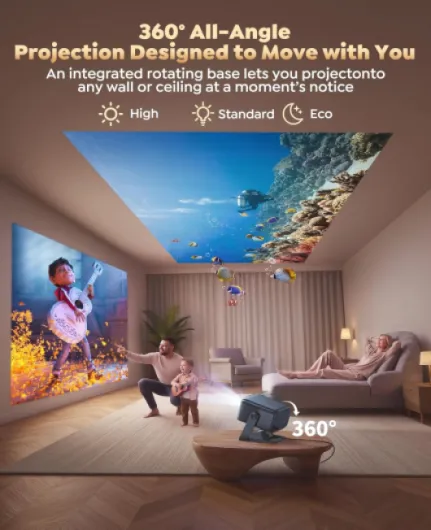
The standout design element is the integrated 360° rotating gimbal stand. Instead of stacking books or fiddling with screw‑in feet, you simply tilt the whole projector to aim it at a wall or ceiling. One review highlights how this makes it simple to point the image at the bedroom ceiling for kids, without complicated setup. This matches the marketing around projecting onto ceilings or from odd corners. In my view, this gimbal design is one of the most practical aspects of the P66, especially for renters or people who do not want to mount anything permanently.
Mounting flexibility is strong on paper: the projector supports ceiling, floor, tabletop, tripod and wall mounting, with a standard 1/4" screw hole at the base. That means it can go on a standard camera tripod or a ceiling bracket if you eventually want a more permanent installation. The short‑throw optics (1.17:1) also help, because you do not need a long room to get a big picture. This makes it especially suited to flats or small bedrooms where a TV might not fit or look good.
In terms of controls, you get a remote with Google TV voice control, including direct buttons for Netflix and YouTube according to one buyer. Control is also possible via the Google TV app and voice commands with Google Assistant. There is no carry bag in the box, and at least one user notes this as a minor downside, choosing to reuse the packaging for transport. Overall, the design is clearly focused on convenience and flexibility rather than ultra‑premium materials or ultra‑slim aesthetics, and that approach seems to match what buyers expect in this price bracket.
What you get in the box and setup experience
The box contents are fairly straightforward: the PUTRIMS P66 projector, a power cord, a remote control (batteries not included), a user manual and a small cleaning kit. One buyer explicitly notes the inclusion of a lens cleaning accessory and describes the overall packaging as neat and user‑friendly. There is no mention of excessive plastic or waste, but also no claim of eco‑friendly packaging, so it seems to be a standard consumer electronics presentation: protective but not premium‑luxury.
What stands out from buyer comments is that the product is geared toward a quick and simple setup. Several users say installation was fast, with the projector guiding them through connecting to Wi‑Fi, logging into Google accounts and updating apps. The autofocus and auto keystone further reduce the friction: there is no need to manually rotate dials to get a sharp image, which many casual users find annoying. One review even highlights that image alignment and focus adjust in seconds after moving the projector, which makes spontaneous movie nights or moving between rooms practical.
On the downside, at least one buyer regrets the absence of a carry bag or case. For a device marketed as portable and suited for outdoor screenings or travel, a basic soft case would make sense. Instead, users who want to take it on the road either have to keep the original box or buy a third‑party case. This is not a deal‑breaker, but it is worth factoring in if you plan regular transport: a separate bag adds a little extra cost.
In my opinion, the overall packaging and included accessories are coherent with the price segment: you get what you need to start watching (assuming you have AAA batteries for the remote and a Wi‑Fi network), without luxurious extras. The small touches like the cleaning kit are useful; the missing bag is a minor compromise. The important part is that the projector appears ready to go quickly, with no complicated assembly or cable jungle, which fits the target audience of people who just want a simple big‑screen solution for streaming and gaming.
Build, reliability and firmware considerations
Durability is harder to judge from a relatively small number of reviews, but there are a few indicators. The projector uses an LCD light engine with a claimed lifespan of 300,000 hours. This figure is clearly theoretical and far beyond any realistic use scenario, but it does indicate that the brand is confident in the LED light source longevity. Compared to older lamp‑based projectors that often needed bulb replacements after a few thousand hours, an LED/LCD combo like this should, in principle, last for many years of occasional use without light source maintenance.
The unit comes with a 3‑year warranty, which is above the bare minimum and a positive sign for a relatively unknown brand. A longer warranty does not guarantee perfect reliability, but it reduces risk for the buyer. None of the quoted reviews report early failures, dead pixels or serious build issues; most comments focus on performance and ease of use rather than defects. That said, the absence of complaints in a hundred or so reviews does not mean problems never happen, only that no major pattern has surfaced publicly yet.
One key point is the brand’s emphasis on a mandatory firmware update on first use, accessible via Settings > Advanced Settings > Online Upgrade. According to the manufacturer, this update brings system optimizations, EQ tuning and audio improvements. In my view, this suggests that early units may have had less refined audio or software, and that the company is actively tweaking things. For a tech product with Google TV, this is normal: software matures over time. It also means that anyone buying the P66 should plan to connect it to Wi‑Fi and perform that update before forming an opinion on sound or app stability.
Physically, the projector weighs under 2 kg and is designed to be moved around, but the lack of a dedicated carry bag means protection relies on how carefully it is handled. One buyer mentions keeping the original box for transport, which is a sensible workaround. The 360° gimbal stand is a moving part; long‑term, this is something that could wear if abused, but there is no sign of that yet in the feedback. Overall, with the 3‑year warranty, LED light source and absence of widespread complaints, durability looks reasonable for the price, as long as expectations are kept in line with a compact consumer projector and not a professional cinema machine.
Image performance and smart features
On the performance front, two aspects dominate the feedback: image quality for movies/series and the smart TV experience. Multiple reviews praise the P66 for sharp, bright images with vivid colours. One buyer notes that the picture is “bright, clear” with “vibrant colours” and that text remains easy to read, which suggests that for a Full HD projector, the optics and processing are doing a decent job. Another user says it genuinely feels like a cinema experience when projecting on a wall from their sofa. That kind of comment shows that, for casual home cinema, the perceived quality is high enough to replace or complement a TV.
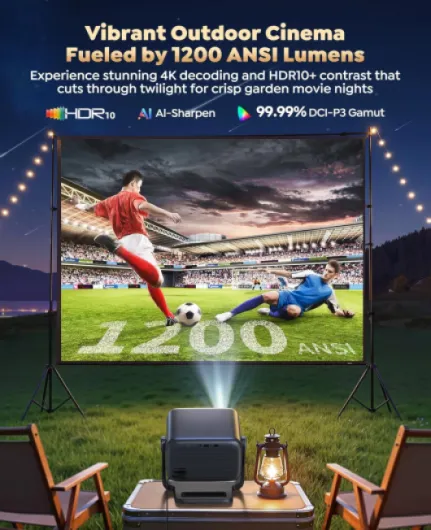
With a claimed 1200 ANSI lumens, the P66 sits in the upper range for compact LCD projectors in this segment, at least on paper. A few users mention that it works with some ambient light and does not require a fully dark room, although no one is calling it a daylight TV replacement. In my opinion, you should still expect best results in a dim room or at night, especially for dark scenes. The HDR10 support and 4K decoding are nice bonuses, but in this price range they are more about compatibility and slightly improved tone mapping than true HDR performance you would see on a high‑end TV.
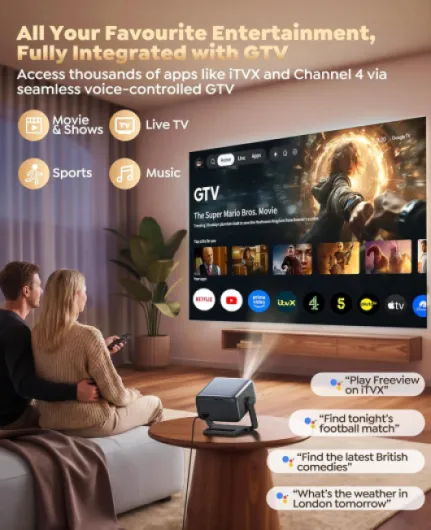
Smart performance looks like a strong point. The projector runs official Google TV, so the interface is familiar, app availability is broad, and updates are handled via the usual Google ecosystem. Several buyers highlight the ease of accessing streaming apps directly, without external sticks. Built‑in Chromecast also lets you mirror or cast from phones and laptops, which is handy for YouTube, photos or quick presentations. Wi‑Fi 6 support should, in theory, reduce buffering and help with 4K streams or cloud gaming, as long as your home network is up to it.
Another major plus in daily performance is the automation: AI autofocus and 6D keystone. Reviews repeatedly mention that the projector focuses and aligns the image in seconds, making it much quicker to move from room to room or adjust angles. The digital zoom (50–100%) allows some flexibility when you cannot move the projector but want to tweak image size. For console gaming, at least one review says gaming is enjoyable and responsive, but there is no detailed data on input lag. For casual console play and sports, it should be fine; for competitive e‑sports, a dedicated low‑lag gaming projector or monitor would still be safer.
What the PUTRIMS P66 offers on paper
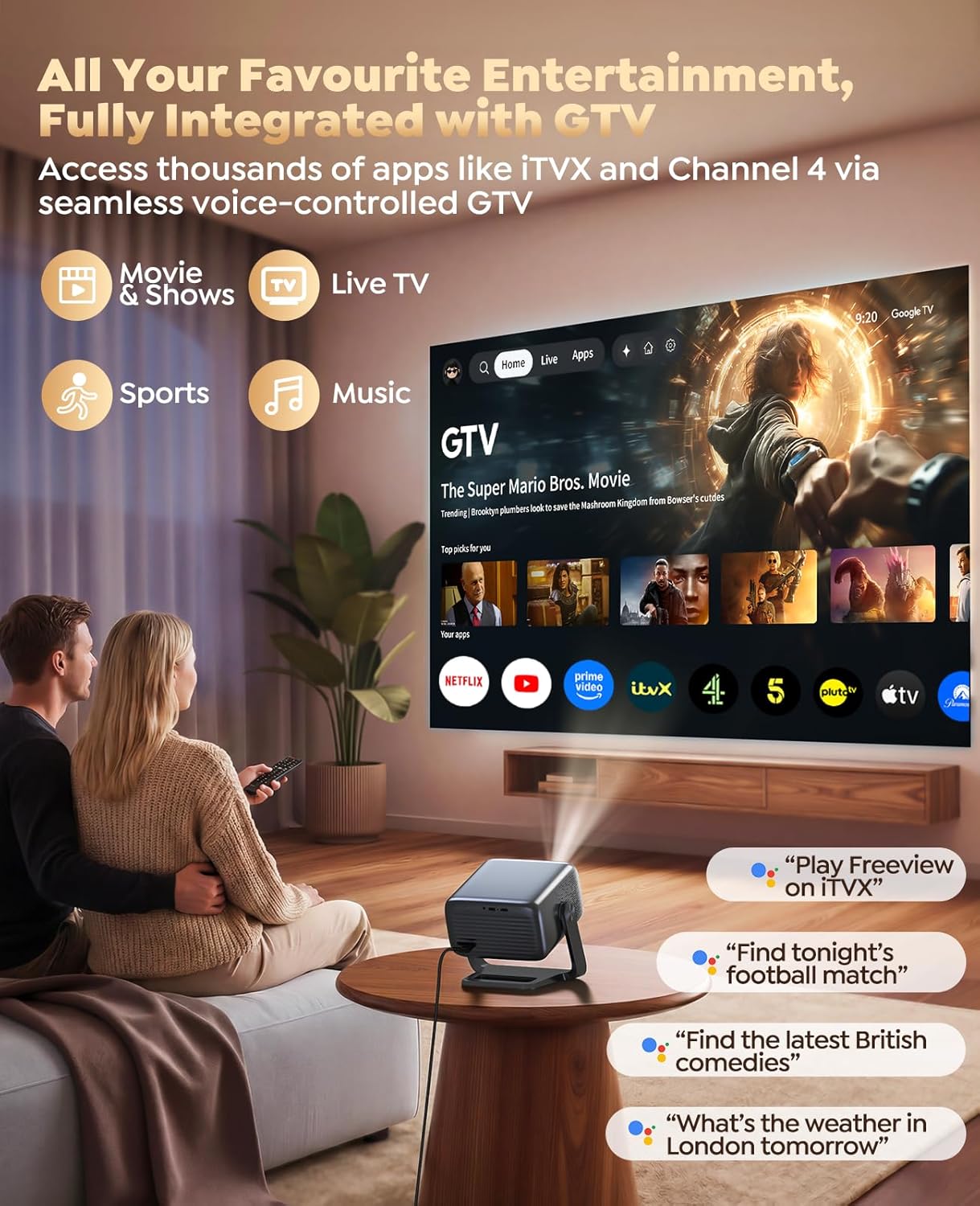
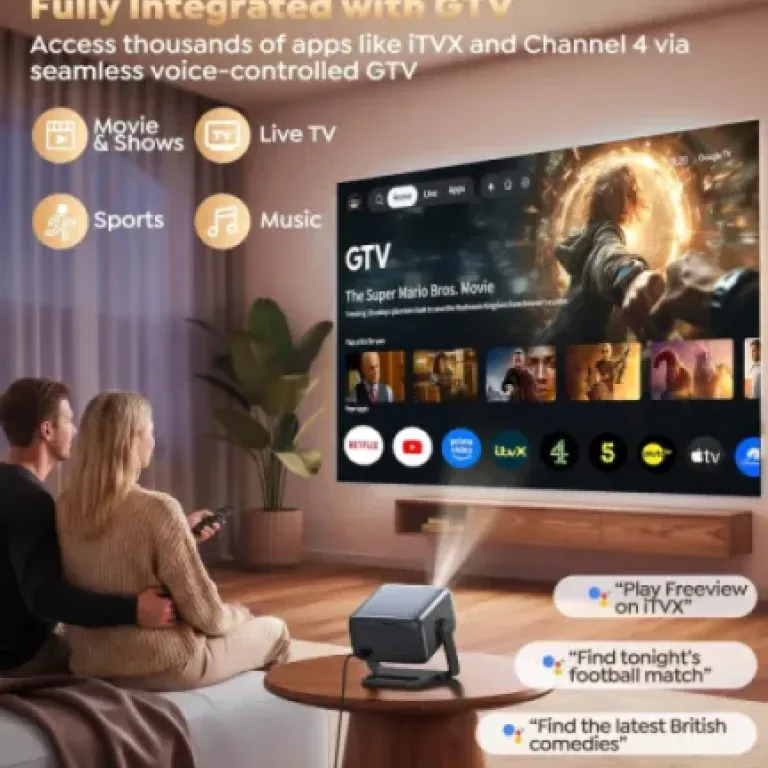
The PUTRIMS P66 is sold as a “Smart Projector with Google TV” and that is really the core of the product: it runs licensed Google TV, so it can access thousands of streaming apps directly, including Netflix, YouTube, iTVX and Channel 4 in markets where those are available. It also integrates Chromecast, so you can cast content from phones and laptops without plugging anything in. For many buyers, this means no Fire Stick or other dongle hanging off the back, which simplifies the setup.
On the display side, the brand advertises native 1080p (Full HD) resolution with 4K decoding and HDR10. There is some confusion in the spec line that also lists 3840×2160, but given the price segment and the description, this should realistically be treated as a 1080p LCD projector that can accept 4K input. The claimed brightness is 1200 ANSI lumens, with a 30,000:1 contrast ratio on paper. A few reviews mention that it holds up reasonably well with some ambient light, but like most projectors, it is clearly happier in dim rooms.
For ease of use, the P66 includes AI autofocus and 6D keystone correction, screen alignment and 50–100% digital zoom. Several Amazon comments mention that image alignment and focusing take only a few seconds and remove the usual manual fiddling with focusing rings and projector feet. The throw ratio of 1.17:1 means a big image in small rooms: around 100 inches at 1.9 m, up to a claimed 300 inches if you have the space, though in my view going that large will likely reduce perceived sharpness and brightness.
Connectivity is fairly complete for a compact unit: HDMI with ARC/CEC, USB ports for media or streaming sticks if needed, Wi‑Fi 6 for faster streaming, and Bluetooth 5.4 for both sending audio to headphones/speakers and receiving audio when used as a Bluetooth speaker. According to the brand, there is an important firmware update available via Settings > Advanced Settings > Online Upgrade that optimizes audio and system stability. In my opinion, this is a key step new owners should plan to do immediately, because firmware tuning often makes a real difference on budget projectors, especially for audio sync and app stability.
Pros
- Native 1080p with good perceived sharpness and claimed 1200 ANSI lumens for its size
- Official Google TV, Chromecast and Wi‑Fi 6 built in, so no extra streaming stick needed
- 30W integrated speakers and 360° rotating gimbal stand make it practical for flexible home use
Cons
- Despite 4K decoding claims, it remains a 1080p LCD projector, not true 4K
- No carry bag included, which limits portability unless you keep the box or buy a case
Conclusion
Analysis score
The PUTRIMS P66 Smart Google TV Projector looks like a well‑thought‑out compact projector for everyday home entertainment. It combines native 1080p resolution, a claimed 1200 ANSI lumens, a genuine Google TV interface, Chromecast, Wi‑Fi 6 and surprisingly beefy 30W speakers, all wrapped around a 360° rotating stand. User feedback is strongly positive, with many buyers praising the picture sharpness, ease of setup, and the convenience of streaming without extra sticks. The autofocus and 6D keystone reduce hassle and make it practical to move the projector between rooms or aim it at different surfaces, including ceilings.
It is not perfect. This is still an LCD 1080p device, despite mentions of 4K decoding, and its real comfort zone will be dim rooms rather than bright daylight. Audiophiles will likely still prefer an external sound system, and travelers may want to budget for a separate carry case. But with a 3‑year warranty, versatile mounting options and no obvious pattern of reliability issues in the public reviews, the risk seems limited for a lifestyle projector.
In my opinion, the P66 is a strong option if you want a straightforward, reasonably bright projector for movies, series and casual gaming, especially in small flats or bedrooms where the short throw and ceiling projection can really help. If your priority is razor‑sharp true 4K, reference‑grade colour or serious daytime viewing, a higher‑end model from established cinema brands will still be the better fit. For everyone else looking for a flexible, all‑in‑one big‑screen solution at a sensible price, this projector offers a convincing package.