Summary
Analysis score
Average of the criteria rated below
Is the Midea U-shaped 8,000 BTU worth the money?
U-shaped layout, compact body, and window flexibility
Noise, airflow, and day-to-day living with it
Build quality, warranty, and long-term reliability signals
Cooling capacity, noise, and smart control in real-world use
What this Midea U-shaped AC actually offers
Pros
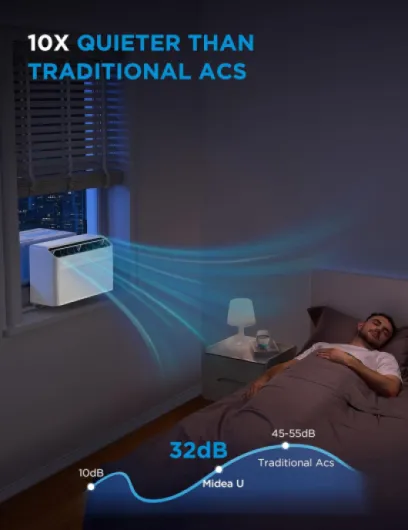
- Very low advertised noise (down to 32 dB) and U-shaped design that keeps most compressor noise outside
- Inverter compressor and ENERGY STAR efficiency with claimed 37%+ energy savings vs traditional units
- Smart control via Wi‑Fi, app, and Alexa/Google Assistant plus included remote
Cons
- Heavier and slightly more complex to install than basic window ACs; two-person install is safer
- Limited to single- or double-hung windows (22"–36" wide, min 13.75" high); not suitable for casement/slider windows

Specifications
View full product page →| Brand | Midea |
A quiet window AC that doesn’t kill your window
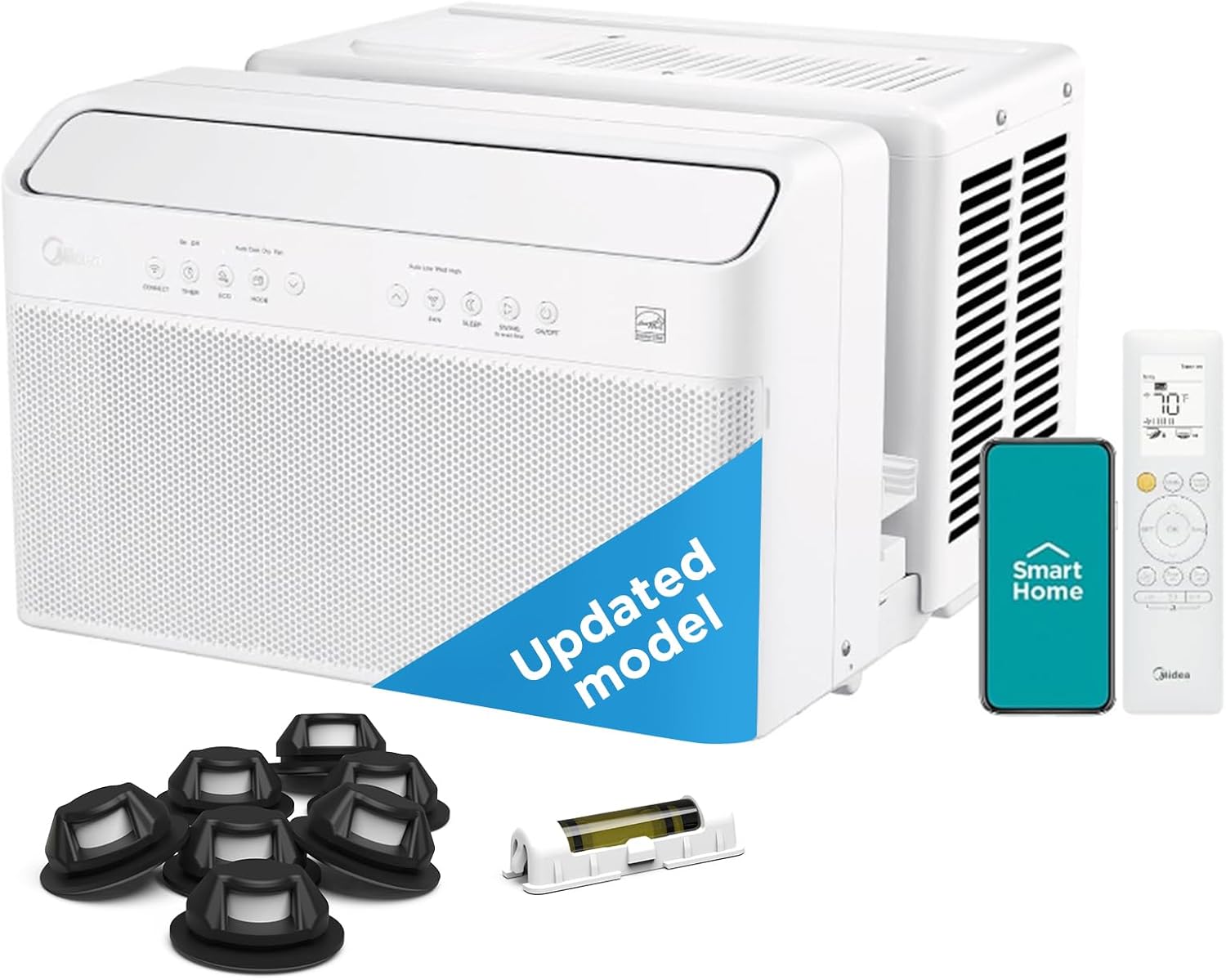
The Midea 8,000 BTU U-Shaped Smart Inverter window air conditioner targets people who want solid cooling for a bedroom or small living room without the usual window unit drawbacks: loud compressor noise, a fully blocked window, and clunky controls. On paper, it’s built for rooms up to 350 sq ft, which covers a typical bedroom, home office, or small studio. The spec sheet highlights three main angles: low noise (down to 32 dB), energy savings (claimed 37%+ vs traditional units), and smart control via Wi‑Fi and voice assistants.
In the Amazon comments, the tone is mostly positive: a 4.3/5 average from over 1,200 ratings is a strong sign that the concept works for a lot of buyers. People keep coming back to three recurring points: it’s much quieter than their old window AC, it cools quickly and evenly, and installation, while not feather-light, is manageable thanks to the bracket system. Some reviews even compare it favorably to units with higher BTU ratings in similar spaces, which suggests the inverter and airflow are doing their job.
It’s not perfect, though. Several buyers mention that the unit is heavier than a standard 8,000 BTU box and that installing it solo can be tricky, especially for people in upper floors or with weaker window frames. A few also mention quirks with the Midea app, like settings occasionally resetting after firmware updates or the need to reconnect Wi‑Fi. None of that seems catastrophic, but it’s worth knowing if you expect plug‑and‑forget smart features. The included remote softens the blow if the app annoys you.
In my opinion, this model looks like a good fit for users who care more about quiet, comfort and power bills than absolute purchase price. The spec sheet is solid for efficiency and noise, and the reviews confirm that the U‑shaped design is more than a gimmick. If you just want the cheapest 8,000 BTU you can find and don’t care about sound or smart control, there are simpler options. If you want a modern-feeling unit that doesn’t dominate your room acoustically or visually, this Midea deserves a serious look.
Is the Midea U-shaped 8,000 BTU worth the money?
The exact price isn’t listed here, but given the feature set and its #3 ranking in Window Air Conditioners on Amazon, it’s safe to say this Midea sits in the mid-range to upper mid-range for 8,000 BTU window units. You’re paying more than for a basic mechanical-dial AC, but you’re also getting an inverter compressor, smart controls, and that unusual U-shaped design. With a 4.3/5 average rating from over 1,200 reviews, buyers overall seem to feel they got fair value, which is a good sanity check.
On the value for energy savings, the claimed 37%+ reduction in power usage compared to traditional units is a big part of the pitch. Verified buyers with similar models mention seeing 30–35% drops in summer power bills after replacing older ACs. If your climate requires heavy AC use for months, that difference can add up quickly and offset the higher purchase price within a couple of seasons. The ENERGY STAR certification and SEER around 15 support the idea that this isn’t marketing fluff: on paper, it should genuinely be cheaper to run than entry-level 8,000 BTU units.
You also have to factor in the intangible value of quiet and comfort. For a bedroom, home office, or living room where you spend hours daily, cutting noise dramatically and keeping your window more usable are meaningful upgrades. The ability to control the unit via app or voice, schedule cooling, and pre‑cool before you arrive home all add small quality-of-life improvements. If you actually use those smart and comfort features, the cost starts to look more justified. If you never plan to connect it to Wi‑Fi and don’t care about sound, then you’re paying for features you won’t use.
In my opinion, this model offers good but not bargain-basement value. It makes sense for people who (1) run AC a lot, (2) are sensitive to noise, and (3) like smart home convenience. For someone who just wants the cheapest way to cool a rarely used room, a simpler non-inverter box will be more economical. But for a main living space where comfort and power bills matter, the combination of efficiency, quiet operation, and smart features makes the price/performance balance look reasonable.
U-shaped layout, compact body, and window flexibility
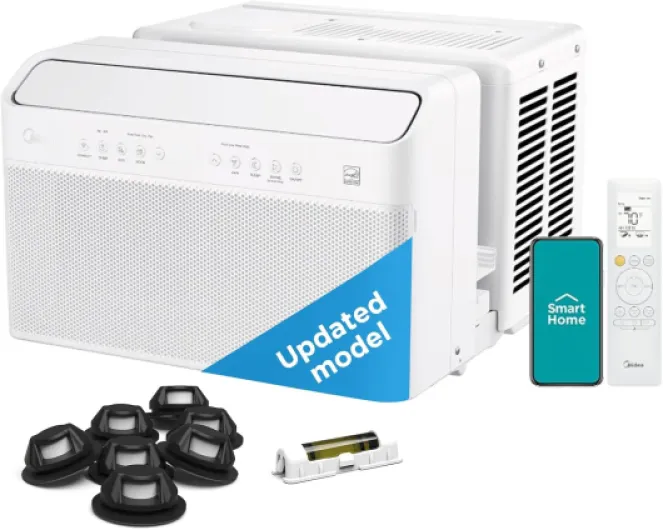
From a design standpoint, this unit is defined by its U-shaped form factor and relatively compact footprint. The dimensions are about 19.17" deep, 21.97" wide, and 13.46" high, with a weight around 55.6 lbs. That’s heavier than some basic 8,000 BTU units, but not outrageous for something with an inverter compressor and a robust mounting bracket. The white plastic exterior is pretty standard, and several buyers say it blends into typical white or light-colored window frames without calling too much attention to itself.
The way it sits in the window is where it differs from the pack. Instead of blocking the entire opening, the U-shaped channel allows the sliding sash to close down in the middle, leaving glass above the indoor section. This has a couple of consequences: you keep more natural light, and you can partially open the window for fresh air when the AC isn’t actively cooling. Multiple Amazon comments specifically mention appreciating that the room doesn’t feel as “closed off” as with a conventional box AC. There’s also an anti-theft feature linked to the closed window position, which is reassuring for ground-floor installs or city apartments.
The unit ships with a quick-snap bracket that attaches to the sill and supports the weight from below. Buyers generally describe installation as straightforward once they understand how the bracket, side arms, and window interact. However, several mention that the weight plus the U shape mean you’re still better off with two people, especially if you’re not comfortable leaning out of a window. The bracket is designed for single- or double-hung windows between 22" and 36" wide, with a minimum opening height of 13.75". So casement or slider windows are out, which is a real limitation if your home uses those.
In my opinion, the design is well thought-out for the use case it targets, but you have to accept some constraints: it’s specialized for standard vertical-slide windows, it adds a bit of complexity versus a classic “drop it in and screw the side panels” unit, and the weight makes solo installation more demanding. If your window fits the spec and you value light, view, and lower noise, the design looks like a net win. If you have non-standard windows or need to move the unit frequently, the shape and bracket could be more hassle than they’re worth.
Noise, airflow, and day-to-day living with it
When people talk about “comfort” with an AC, they usually mean two things: how quiet it is and whether the room feels evenly cooled without drafts or big temperature swings. On both points, this Midea U-shaped model comes out well in the public feedback. The manufacturer claims a sound level as low as 32 dB, and several buyers describe the noise as softer than a fridge hum on low fan. One reviewer explicitly notes that they no longer need to crank up the TV volume, and another says they often forget the unit is running at night. That matches what you’d expect from an inverter compressor plus the physical separation created by the U-shaped window design.
Airflow is rated at up to 215 CFM on high, which is reasonable for 8,000 BTU. Comments from buyers mention that cooling feels more consistent, without the harsh blasts of cold air followed by warm periods that are typical of non-inverter window ACs. The compressor ramps output to maintain the set temperature, which should reduce fluctuations and make the room feel more stable. People using it in bedrooms and home offices say it brings the room to a comfortable temperature quickly and then just keeps it there with minimal fuss. The ability to fine-tune fan speeds and modes (cool, dry, fan-only, eco, sleep, etc.) helps adapt the comfort level to different times of day.
The U-shaped layout and window flexibility also contribute to comfort in a broader sense. Buyers appreciate that the room doesn’t feel like a cave because the upper part of the window stays functional for light, and they can crack it for fresh air when the AC isn’t actively cooling. For people working from home or spending a lot of time in one room, that combination of quiet and daylight can matter as much as raw cooling power. The dust filter and dehumidifier function are small but useful bonuses: they won’t replace a dedicated air purifier or dehumidifier, but they do help keep the air from feeling sticky and dusty during humid days.
In my view, this unit is clearly aimed at bedrooms, offices, and living spaces where noise tolerance is low. If you’re trying to sleep, take calls, or watch movies without background roar, the comfort benefits over a cheap, loud window AC are important. The flip side is that you need to accept the slightly more involved installation and higher initial cost. For someone just cooling a garage or a rarely used guest room, those comfort perks might not justify the extra spend. But for a main living area where you care about quiet and steady temperatures, this model looks like a strong option.

Build quality, warranty, and long-term reliability signals
For durability, there’s not a huge list of exotic materials: the casing is primarily plastic, which is standard for window ACs in this price and power range. The unit weighs about 55.6 lbs, which hints at a fairly substantial internal structure, coil, and compressor for an 8,000 BTU model. Several buyers comment that the updated model feels sturdy and well made, not flimsy like cheaper units they’ve owned. The quick-snap bracket and side arms are also mentioned as feeling solid once installed correctly, which is crucial because they carry most of the load.
The refrigerant used is R-32, which is more efficient and has a lower global warming potential than the older R-410A. That doesn’t directly say much about durability, but it does indicate a relatively recent design that follows current regulations. The unit carries a two-year limited warranty from Midea for authorized purchases. That’s fairly standard coverage for window ACs, not particularly generous but not stingy either. Some competitors offer longer compressor warranties, but usually at higher price points or in larger capacity units.
Among the Amazon comments, most of the feedback around longevity is indirect: people talk about using similar Midea U units across multiple seasons without major issues, and about the unit continuing to run quietly and cool effectively. There are scattered mentions of issues like app quirks or needing to reseat the foam seals, but there isn’t a strong pattern of early mechanical failure or catastrophic leaks in the reviews tied to this family of products. That said, window ACs in general are vulnerable to installation quality: if the unit isn’t properly leveled to drain, or if the bracket isn’t securely attached, problems can show up that aren’t strictly the machine’s fault.
In my opinion, durability here seems decent but not bulletproof. You’re getting a mainstream brand with a well-established product line, a design that’s been iterated (this is an “updated” 8,000 BTU version), and a standard 2‑year warranty. I wouldn’t expect it to be indestructible, but with proper installation, periodic filter cleaning, and basic care, it should handle several summers without drama for most users. If you want rock-solid, 10-year no‑worry hardware, you’re probably looking at a different category (mini-splits or pro‑grade units) and a much higher budget.
Cooling capacity, noise, and smart control in real-world use
On the performance side, the numbers are straightforward: 8,000 BTU of cooling power, 710 W consumption, and an airflow of roughly 215 CFM on high and 150 CFM on low (according to the spec sheet). On paper, that’s appropriate for rooms up to about 350 sq ft, which matches the official recommendation. Multiple buyers report using similar Midea U units in 300–400 sq ft spaces and say the room goes from around 80°F down to the low 70s within minutes, which suggests the cooling capacity is enough for typical bedrooms and small living areas, assuming average insulation and sun exposure.
Where this model stands out is noise. The manufacturer advertises operation as low as 32 dBA, and several reviews describe the sound as quieter than a refrigerator on low fan. One buyer with a 10,000 BTU version mentions being able to watch TV or sleep without needing to raise the volume, which lines up with the idea that the compressor is mostly isolated outside the window by the U shape and the glass. The inverter compressor also avoids the loud on/off cycling that cheaper units have; instead it ramps output up and down, which should help keep both noise and temperature swings down.
On efficiency, the claimed 37%+ energy savings compared to traditional fixed-speed units are hard to verify without lab data, but there are reviews from users who state their summer electric bills dropped by around 30–35% after switching from older window ACs. That’s consistent with what an inverter and a SEER around 15 could reasonably deliver in a similar usage pattern. Features like ECO mode and sleep mode give more control over how aggressively it cools, which can help if you’re trying to cut consumption overnight or when you’re away.
The smart features add another layer to performance. Buyers report using the Midea SmartHome app to schedule cooling, adjust temperature remotely, and integrate with Alexa/Google Assistant. Some mention occasional annoyances, like the app forgetting settings after updates or needing to reconnect to Wi‑Fi, but these seem like sporadic software issues rather than fundamental flaws. In my view, if you value being able to pre‑cool the room before you come home or tweak settings from bed, the smart side is a real plus. Overall, in terms of cooling, noise, and energy use, this model looks strong for a compact window unit, as long as you’re comfortable dealing with an app that may not be perfect.
What this Midea U-shaped AC actually offers
On paper, the Midea MAW08V1QWT is a compact 8,000 BTU window air conditioner designed for rooms up to about 350 sq ft. The unit runs on standard 115 V power, draws around 710 W, and uses an inverter compressor instead of the usual on/off style. That’s what underpins the claimed 37%+ energy savings and the relatively high efficiency figure (SEER around 15 for a window unit is clearly above the basic models). It also carries an ENERGY STAR certification, which is a concrete reference point for those trying to keep their electric bill under control in summer.
The standout design choice is the U-shaped chassis. Instead of a box that sits entirely in the window opening, the Midea straddles the sill, with the compressor section outside and the indoor air handler “inside” the U. Your sliding window closes down into that U, which both helps seal the opening and uses the glass and frame as a noise barrier. According to multiple buyers, this setup lets them keep part of the window usable for light and a bit of fresh air, which is rare for window ACs. Midea even advertises an anti-theft mechanism that relies on the closed window to lock the unit and window together.
The product is also pitched as a smart appliance. It’s Wi‑Fi enabled, controllable via Midea’s SmartHome app on iOS and Android, and compatible with Alexa and Google Assistant. Reviews describe using voice commands for temperature changes and modes, as well as enabling eco or sleep modes from the couch or while away from home. There’s still a physical remote included, which several buyers appreciate as a backup when they don’t feel like opening the app or if guests are staying over.
In my view, the overall proposition is clear: this isn’t trying to be the cheapest 8k BTU box. It’s a mid‑ to upper‑tier window AC focused on quiet operation, flexible window use, and smart features, backed by a 2‑year limited warranty. For renters or condo owners who can’t install a mini‑split but hate the noise and bulk of classic window units, the spec sheet lines up well with the pain points people complain about in older designs.
Pros
- Very low advertised noise (down to 32 dB) and U-shaped design that keeps most compressor noise outside
- Inverter compressor and ENERGY STAR efficiency with claimed 37%+ energy savings vs traditional units
- Smart control via Wi‑Fi, app, and Alexa/Google Assistant plus included remote
Cons
- Heavier and slightly more complex to install than basic window ACs; two-person install is safer
- Limited to single- or double-hung windows (22"–36" wide, min 13.75" high); not suitable for casement/slider windows
Conclusion
Analysis score
Looking at the specs and the public reviews, the Midea 8,000 BTU U-Shaped Smart Inverter window AC comes across as a quiet, efficient, and fairly modern choice for small to medium rooms. Its strengths are clear: the U-shaped design that lets you keep more of your window, genuinely low noise levels for a window unit, and an inverter compressor that should save a noticeable amount on electricity compared to older on/off models. The 4.3/5 rating from over a thousand reviews suggests that for most buyers, it does what it promises.
It’s not aimed at everyone, though. Installation is a bit more involved than a classic box AC, and the weight makes a two-person setup the safer route. The smart features are useful but not flawless, with some users reporting minor app glitches. If you don’t care about quiet, don’t plan to use Wi‑Fi control, or just need the cheapest possible cooling, this will feel like overkill. But if you’re cooling a bedroom, office, or main living room where you value low noise, steady comfort, and better energy efficiency, this Midea model looks like a solid pick with a sensible balance of performance and running cost.