Summary
Analysis score
Average of the criteria rated below
Energy use, smart features and overall value for money
Design, form factor and window kit: clever core, fussy details
Build quality, reliability and known weak points
Cooling, heating and noise: strong output with some quirks
What the Midea Duo 14,000 BTU actually offers
Real‑world comfort, airflow and dehumidification
Pros
- Dual‑hose and inverter design provide strong, efficient cooling compared with typical portable ACs
- Quieter than many competitors, with advertised 42 dB low‑noise operation and positive user feedback on sound levels
- Wi‑Fi, app control, and Alexa/Google Assistant support enable automation and potential energy savings
Cons
- Window kit and hose clips are reported as fragile and costly to replace
- Mixed reliability feedback, including some compressor and noise issues within the first year
- Heavier and bulkier hose assembly can limit placement flexibility and make moving the unit harder

Specifications
View full product page →| Brand | Midea |
A portable AC that tries to behave like a mini split
The Midea Duo 14,000 BTU (12,000 BTU SACC) sits in a tricky category: portable air conditioners are often seen as a last resort because they tend to be loud, inefficient, and weak compared with window units or mini splits. This model tries to break that pattern with a dual‑hose design, inverter compressor, and Wi‑Fi control. On paper, it targets rooms up to about 550 sq.ft., with a claimed sound level as low as 42 dB and energy use around 1300 W at 115 V.
In the Amazon comments, it pulls a 3.8/5 average from more than 6,500 reviews, which is solid but not flawless. There are a lot of 5‑star reviews praising quiet operation and strong cooling, but also a noticeable number of complaints about reliability issues, window kit fragility, and some odd startup noises. That mix suggests good engineering ideas, but maybe not perfect quality control or accessories.
The spec sheet highlights several selling points: a dual hose‑in‑hose system, variable‑speed inverter technology, smart app and voice control (Alexa and Google Assistant), and relatively compact floor dimensions for a 14k BTU unit. At about 75 lb, it is not light, but it stays within the usual range for a serious portable AC with this capacity.
In my opinion, this product is interesting if you want a portable unit that behaves closer to a window AC or a small heat pump in terms of efficiency and comfort, and you’re willing to deal with a slightly more complex setup and the quirks mentioned in the reviews. It’s not the cheapest 14k BTU portable AC out there, but the feature set is clearly a step above the basic models.
Energy use, smart features and overall value for money
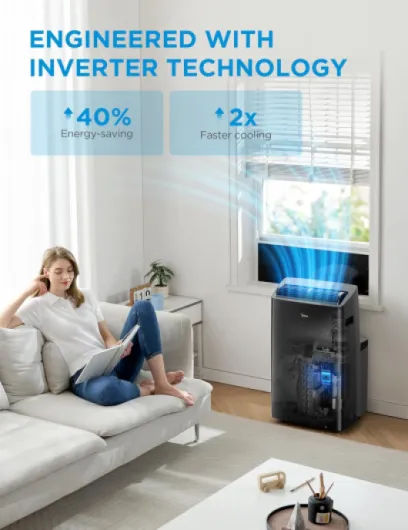
Value on a unit like this is tied heavily to energy efficiency and features. The Duo has a listed SEER of 8.9, which is not on par with a high‑end mini split but is strong for a portable AC, especially combined with the dual‑hose system. Midea claims more than 40% energy savings compared to the U.S. federal standard for portable ACs, and several owners anecdotally back this up with lower electric bills compared with running central AC. One reviewer estimates that their daily energy use with the Duo is less than half of what their older central system consumed under similar weather conditions.
The inverter compressor is a major reason for this: instead of slamming on at full power and then shutting off repeatedly, it ramps up and down to maintain temperature. That reduces peak current draw and tends to smooth out comfort. One user who monitors their usage mentions running the unit on a standard 15A circuit along with some small loads without tripping breakers, as long as large surge devices like a laser printer are not on the same line. For people in apartments or older houses where circuit capacity is limited, that’s a practical advantage.
Smart control adds another layer of value. With Wi‑Fi, app control, and voice integration, you can schedule the unit, pre‑cool before you get home, or tie it into a broader home automation setup. One owner controlling it through Home Assistant says that using external sensors and logic, they run the unit only a quarter to a third of the time they would if they relied on the internal thermostat alone. That kind of control can translate directly into lower bills and more consistent comfort, especially in spaces that heat up unevenly.
On the downside, the price is usually higher than basic 12k–14k BTU portables without inverter or dual‑hose systems, and the 1‑year limited warranty is fairly standard rather than generous. The 3.8/5 average rating shows that not everyone feels they got perfect value, mainly due to reliability concerns and accessory fragility. In my opinion, if you simply want the cheapest way to blow cold air, there are more affordable units. But if you care about noise, energy use, and smart features, and you’re willing to invest a bit more and possibly add an extended warranty, the Duo offers a reasonable balance of performance and running costs.
Design, form factor and window kit: clever core, fussy details
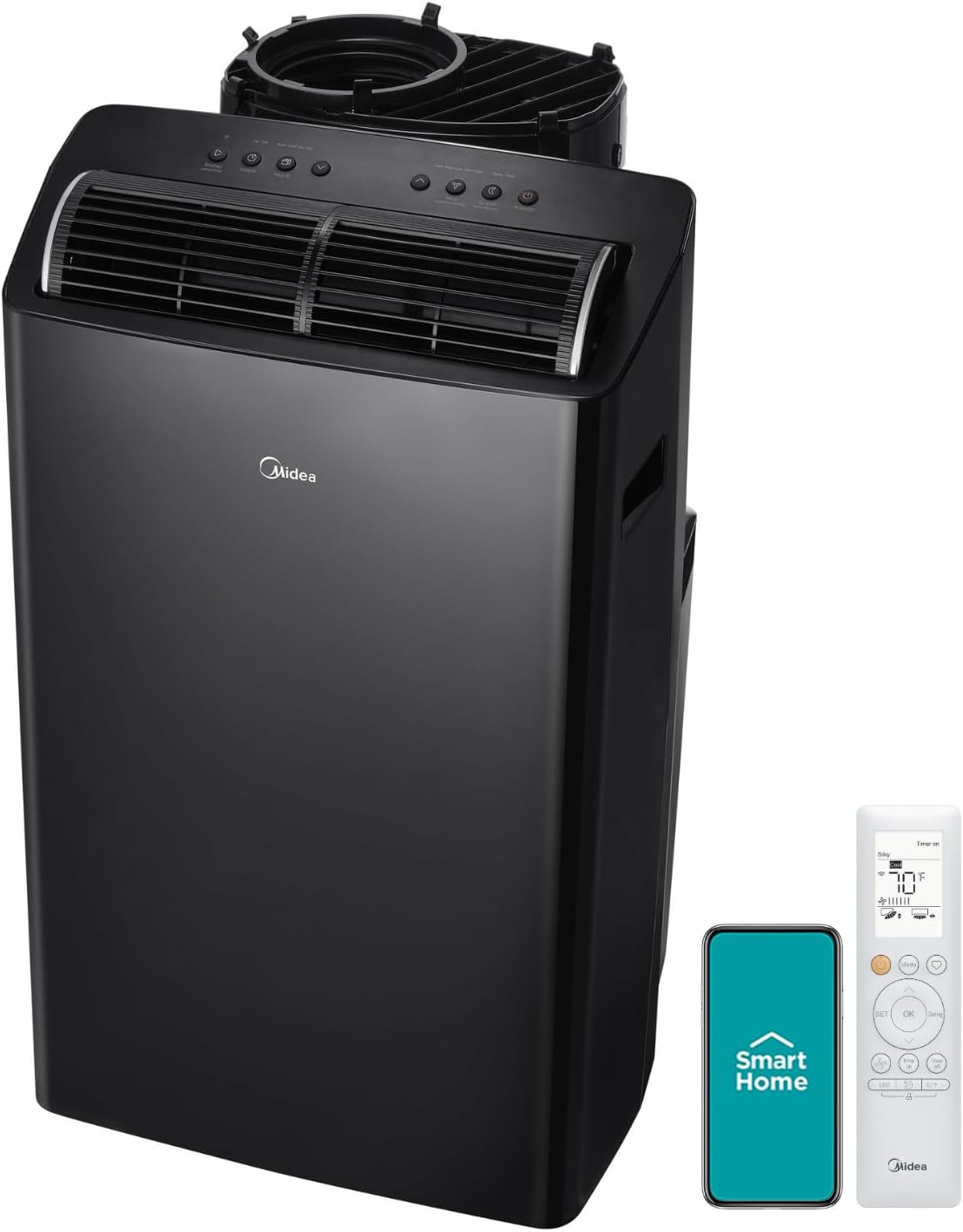
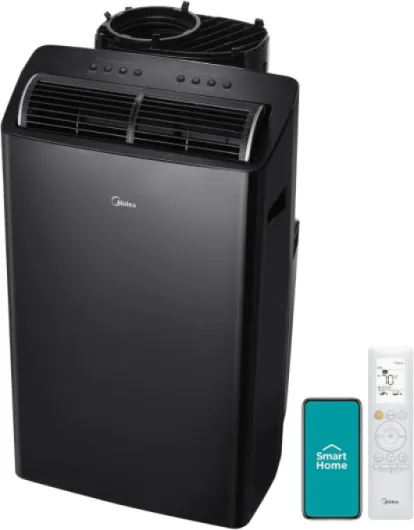
Physically, the Midea Duo 14,000 BTU measures about 16.73" deep, 19.53" wide, and 32.48" high, with a weight around 75 lb. So it’s a fairly tall, slim tower compared with the boxier portables out there. The black finish gives it a more discreet look in a living room or bedroom, though several buyers note that the glossy surfaces show fingerprints and pet paw prints very quickly. The unit rides on casters, which helps if you need to roll it between a bedroom and a living room on the same floor, but at this weight it’s not something most people will want to carry up and down stairs regularly.
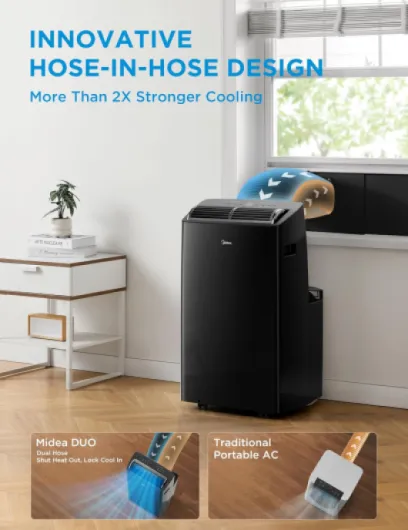
The most distinctive design element is the integrated hose tower. Instead of two separate hoses snaking out the back, Midea combines intake and exhaust into one large hose that telescopes from the unit to the window kit. Reviews highlight that this hose is wide, thick, and quite stiff. That’s good for insulation and airflow, but it makes the unit harder to pivot or push flush against a wall; you have to respect the bend radius and the direction of the window.
The window kit is where opinions split. Some owners say installation is straightforward: the sliders and adapters click together, and it’s easier than the usual twist‑lock hoses. Others complain the plastic clips and brackets feel fragile, and a few report breaking parts during setup or moving the unit. Replacement window pieces from Midea are reported to be relatively expensive, so clumsy or frequent relocation can have a cost. People with non‑standard windows (tilt‑out, casement) often resort to DIY solutions like acrylic panels or custom splitters to fully separate intake and exhaust air streams.
On the control side, the LED display on the unit is basic but readable, and there’s a remote with a backlit screen, which several reviewers like for low‑light use. One recurring comment is that the icons for fan speeds and modes are not intuitive (symbols instead of plain labels), and the generic manual shared across multiple Midea models doesn’t always match exactly, which can make first setup a bit confusing. In my opinion, the core hardware design is well thought out for performance, but the accessories and user interface could be clearer and sturdier.
Build quality, reliability and known weak points
Durability is where opinions start to diverge more clearly. On one side, many buyers praise the build quality of the main chassis and internal design, calling it solid and well thought out. They like the rotary fan system, the compact form factor for the capacity, and the general feeling that this is a more substantial machine than cheap single‑hose units. On the other side, there are enough reports of mechanical issues and fragile accessories to raise some questions about long‑term reliability.
Several comments mention mechanical noises on first use: rattling from refrigerant lines touching each other, high‑pitched metal‑on‑metal squeaks from the compressor, or buzzing that suggests the compressor is struggling or freezing up. In at least one detailed review, the owner describes how the unit emitted a loud buzz and periodically stopped cooling after about eight months, suspecting compressor freeze‑up. They ended up going through Midea customer service and received a refund instead of a repair, which indicates that, at least in some cases, the manufacturer prefers replacement or refund over field servicing a complex portable unit.
The window kit and hose connections are another weak point. Multiple buyers say the plastic clips and mounts are easy to break if you apply too much force or move the unit frequently, and replacement parts from Midea can be relatively costly. One user notes that the hose assembly itself feels flimsy and expensive to replace, advising others to purchase an extended warranty because of this. Others have had no such problems, which suggests the parts are adequate if treated gently but not over‑engineered.
On the positive side, several people call out responsive customer service. There are cases where damaged window slides were replaced quickly under warranty, and in one case, a malfunctioning unit received a full refund after some back‑and‑forth. At the same time, at least one buyer was annoyed that their support ticket was auto‑closed after a few days without response, so the experience is not uniformly perfect. In my opinion, if you’re considering this AC, it’s sensible to factor in the 1‑year limited warranty, consider a retailer’s protection plan if the price is significant for you, and plan to install and move the unit carefully to avoid stressing the fan, hoses, and window kit.
Cooling, heating and noise: strong output with some quirks
In terms of raw performance, the Duo’s 14,000 BTU (12,000 BTU SACC) rating and dual‑hose setup should put it near the top tier of portable units for a single room. Several owners cooling spaces in the 300–400 sq.ft. range during heat waves report that it keeps the room comfortable without needing central air, even in hot, dry climates. One buyer in a roughly 350–400 sq.ft. room mentions running it at 78°F and finding the actual room temperature a couple of degrees below the setpoint, which suggests the thermostat tends to read slightly high.
There are also comments about using it in larger or more open floor plans. In open living rooms around 500 sq.ft. with doors and obstructions, some users say the unit can handle the space, but they often supplement with circulation fans (e.g., Vornado, Dreo) to push cool air into corners. When people try to cool spaces way beyond the specified 550 sq.ft. or difficult areas like big garages, the feedback is predictable: it helps, but it doesn’t perform miracles. On paper, the SACC rating and wattage simply don’t support cooling a full 1,000+ sq.ft. area effectively.
Noise performance is a big selling point. The advertised 42 dB in quiet mode is very low for a portable AC, and many reviews back this up by calling it “super quiet” or the quietest AC they’ve had. Owners often say that, on low fan, they could sleep or watch TV in the same room without being bothered. However, a recurring theme is a brief high‑pitched whine when the compressor spins up, and a few units have shown rattling or squeaking noises on first runs that some buyers managed to work around by switching modes or letting the machine run for a while. That points more to quality control variance than a design flaw, but it’s something to be aware of.
Heating performance (on the heat‑capable version of this platform) gets surprisingly good comments. One owner in an 850 sq.ft. condo in a mild climate uses it as the only heat source and says the unit can keep the place warm, using around 1,000 W of electrical power to produce roughly 3,500 W worth of heat output. They also note that heating mode generates a lot of condensate but the built‑in pump handles it as long as you route a drain hose. In my opinion, if you’re in a moderate climate and want both cooling and heating from a single device on a standard 15A circuit, this performance profile is quite attractive, as long as you understand that heating efficiency will drop sharply when outdoor temperatures get near freezing.
What the Midea Duo 14,000 BTU actually offers
On paper, the Midea Duo 14,000 BTU is a 14k BTU portable air conditioner with a SACC (Seasonally Adjusted Cooling Capacity) of 12,000 BTU, aimed at rooms up to 550 sq.ft. It runs on standard 115 V power and draws about 1300 W. The unit uses an inverter compressor rather than a simple on/off design. That means it can vary its speed to match the cooling demand instead of constantly cycling, which should help with both comfort and electricity consumption.
A key point is the dual hose-in-hose design. Instead of a single hose that exhausts indoor air and pulls hot air back in through cracks, this design uses concentric hoses to both intake and exhaust air from outside. Several buyers say this noticeably improves cooling power compared with their previous single‑hose units, especially in well‑sealed rooms. Midea advertises more than twice the cooling speed and strength compared with conventional portables, which lines up with many user impressions when the unit is sized correctly for the room.
The spec sheet also pushes the noise level: as low as 42 dB in certain conditions, which is closer to a quiet fan than a typical portable AC. Multiple reviews confirm that, while it’s not silent, it is quieter than many competing models, especially in lower fan modes. Some owners place it a few feet from a TV or in a bedroom and say it doesn’t drown out conversation or sleep, aside from a brief high‑pitched whine when the compressor ramps up.
Finally, there’s the smart side. The Duo includes Wi‑Fi, works with the Midea app on iOS and Android, and supports Alexa and Google Assistant. At least one owner integrates it with Home Assistant and uses external temperature sensors to automate on/off cycles more efficiently than the built‑in thermostat. In my opinion, that combination of dual hose, inverter, and smart control is the main reason to consider this unit over cheaper portables with similar raw BTU numbers.
Real‑world comfort, airflow and dehumidification
Effectiveness is more than just BTU numbers; it’s about how comfortable the room feels and how evenly the cool air is distributed. The Duo’s air duct system is advertised as projecting air up to 26 feet, combined with a 102° swing for flexible airflow direction. Several owners confirm that the unit throws cool air strongly across a room when the vent is fully open, especially upward. One buyer notes that the cold air mainly shoots upwards and that you don’t feel much if you sit directly in front at ground level, but the room still cools quickly. That fits the design choice: less direct draft on your legs, more mixing of air in the room.
For room coverage, comments suggest that in the 200–400 sq.ft. range, the Duo can easily maintain set temperatures even in hot weather, especially if you start it early in the day. A reviewer who uses it to avoid running an older, inefficient central AC says it keeps their bedroom or living room comfortable while noticeably cutting their overall electricity use. They emphasize a common AC strategy: turn it on when it’s still relatively cool so the unit maintains temperature rather than fighting a fully heated space.
As for dehumidification, there is a dedicated dehumidify mode, and several owners mention using the unit in humid climates with good results. Water handling depends a lot on mode: in cooling, many portables re‑evaporate some condensate through the exhaust; in heating, there’s usually more liquid water to manage. One heat‑mode user describes routing a thin drain hose across a room to a shower drain, helped by the internal condensate pump. The presence of that pump is a clear advantage if you plan to use heating or heavy dehumidification regularly, since you don’t have to rely on gravity drainage alone.
Air quality features are basic: there’s a dust filter but no advanced HEPA or activated carbon stage. Owners don’t complain much about odors or dust, which suggests the filter does its basic job, but this is not an air purifier. In my opinion, the Duo is effective at its core tasks—cooling, some heating (on the appropriate model), and dehumidifying—provided the room size is within spec and you help with airflow in complex floor plans. If you expect it to dry and cool a massive open space or fix underlying ventilation problems, it will feel underwhelming, but for a single room or small apartment zone, it generally seems to get the job done.
Pros
- Dual‑hose and inverter design provide strong, efficient cooling compared with typical portable ACs
- Quieter than many competitors, with advertised 42 dB low‑noise operation and positive user feedback on sound levels
- Wi‑Fi, app control, and Alexa/Google Assistant support enable automation and potential energy savings
Cons
- Window kit and hose clips are reported as fragile and costly to replace
- Mixed reliability feedback, including some compressor and noise issues within the first year
- Heavier and bulkier hose assembly can limit placement flexibility and make moving the unit harder
Conclusion
Analysis score
The Midea Duo 14,000 BTU stands out in the portable AC crowd by combining a dual‑hose layout, an inverter compressor, and smart controls. Public reviews show that, in rooms up to about 400–500 sq.ft., it can cool quickly and quietly, often replacing or reducing the need for central air in smaller homes or apartments. Noise levels are lower than most portable competitors, especially on low fan speeds, and the dual‑hose design helps avoid the negative pressure and hot air infiltration that plague single‑hose units.
It’s not without flaws. The window kit and hose hardware are a recurring weak point, both in terms of fragility and fit with non‑standard windows. Reliability feedback is mixed: many units run smoothly, but there are enough reports of odd noises and compressor or buzzing issues to justify considering an extended warranty if the price is high for your budget. The 1‑year standard warranty and the need for careful handling of the accessories mean it’s not a set‑and‑forget appliance.
In my opinion, this model fits best for renters or homeowners who want a relatively quiet, more efficient portable solution and who are comfortable with some DIY tweaking for window setups or smart home integration. If you have a simple need, a small room, and don’t care about energy use or app control, a cheaper single‑hose unit might be fine. If you want near‑mini‑split comfort without permanent installation, are okay paying a bit more, and will treat the hardware gently, the Midea Duo 14,000 BTU is a solid candidate.