Summary
Analysis score
Average of the criteria rated below
Is the Midea U-shaped 10,000 BTU worth the money?
U-shaped layout, real window use, and installation quirks
Build quality, moving parts, and long-term considerations
Noise, energy savings, and smart control in everyday use
What this 10,000 BTU U-shaped AC actually offers
Cooling efficiency and real-world comfort feedback
Pros
- Very quiet operation for a window AC, with an advertised 32 dB noise level and many reviews confirming low noise
- Inverter compressor and SEER 15 efficiency, with claims of 30–35% energy savings versus older fixed-speed units
- U-shaped design preserves part of the window for light and ventilation while helping block outdoor compressor noise
Cons
- Heavy unit and bracket system make installation more demanding, especially for one person
- Smart app and Wi‑Fi features can be finicky according to some users, with occasional reconnect or settings issues

Specifications
View full product page →| Brand | Midea |
A quiet window AC that doesn’t hog your whole window
The Midea 10,000 BTU U-Shaped Smart Inverter window AC targets a pretty clear crowd: people who want strong cooling for a medium room, but hate the usual window-unit problems—noise, blocked light, and clunky controls. On paper, this model tries to solve all three with its U-shaped design, inverter compressor, and full smart-home integration via Wi‑Fi, Alexa, and Google Assistant. It’s rated for up to about 450 sq ft, which covers most bedrooms, home offices, and small living rooms.
What stands out immediately is the combination of specs and user feedback. You’re looking at 10,000 BTU, a claimed noise level down to 32 dB, and an ENERGY STAR–style efficiency claim of more than 35% energy savings over traditional window units. In the Amazon comments, the tone is mostly positive, with a 4.3/5 average over more than a thousand ratings, and a lot of people insisting this is far quieter and more efficient than their old boxy AC.
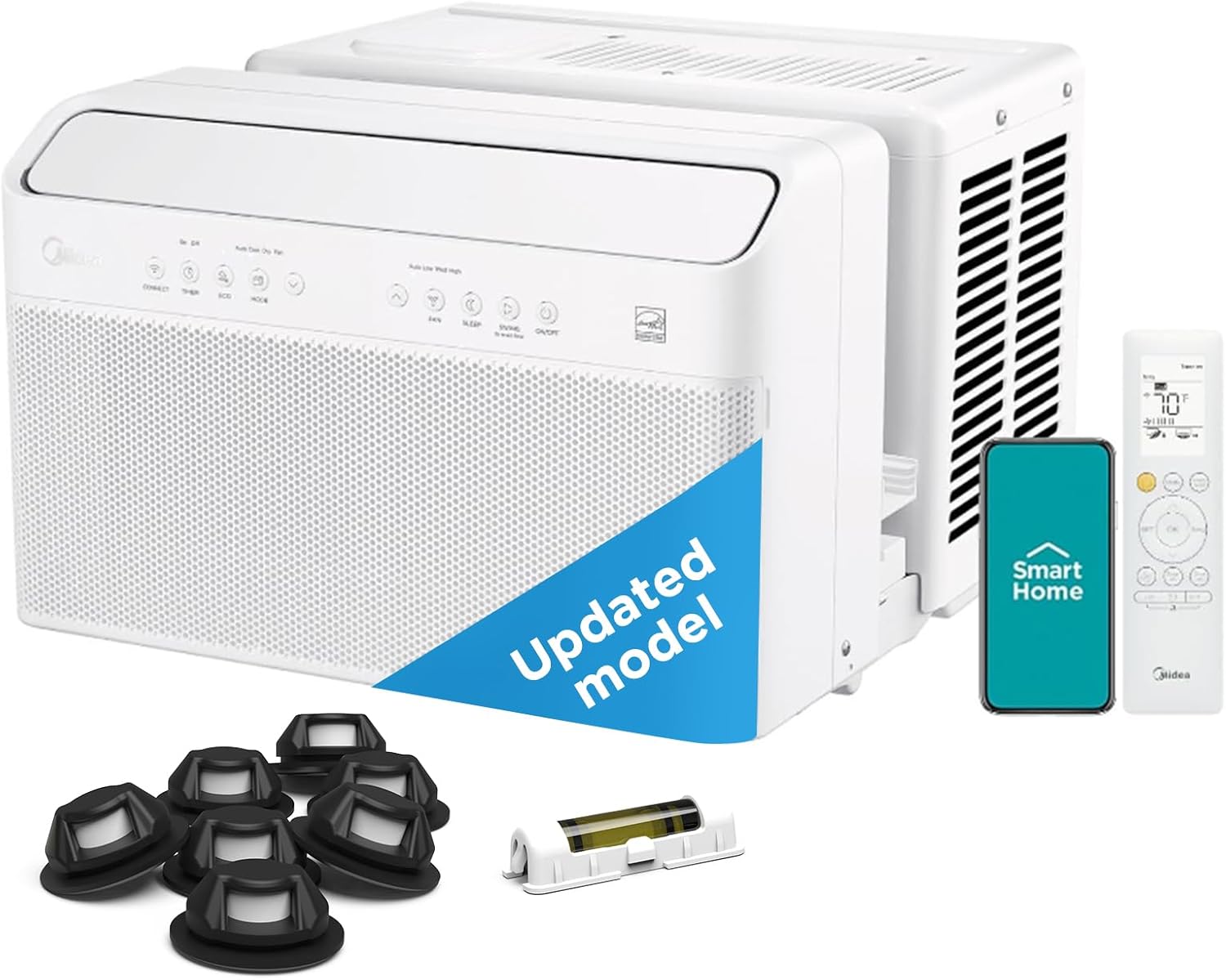
The other angle is practicality. The unit weighs about 57 pounds, uses a quick-snap bracket, and is designed for single- or double-hung windows between 22" and 36" wide with at least 13.75" of height. So it’s not a tiny device you throw in any random opening; it clearly aims at permanent seasonal installation in a standard North American window. The manufacturer includes a remote, bracket, and basic sealing materials, and buyers often mention being able to get it mounted in under an hour once they understood the bracket system.
In my opinion, this AC sits in an interesting spot: not the cheapest, not the most basic, but with a spec sheet that looks strong for comfort-focused users who care about noise and power bills. It’s not perfect—some reviews mention app quirks and the weight making solo mounting a bit stressful—but if you’re trying to cool a 350–450 sq ft room without turning it into a noisy cave, this model clearly deserves a serious look.
Is the Midea U-shaped 10,000 BTU worth the money?
The exact price isn’t listed here, but this model clearly sits in the mid-range to upper mid-range of window ACs. You pay more than for a basic 10,000 BTU box, but you’re getting several upgrades: inverter technology, a very quiet design, real smart-home integration, and the U-shaped layout that preserves window use. The Amazon rating of 4.3/5 from over 1,200 reviews suggests that most buyers feel they’re getting their money’s worth, even if a few run into app or installation annoyances.
On the savings side, the manufacturer claims over 35% energy savings versus traditional units, and at least one detailed review mentions around 30–35% lower summer electric bills compared to an older AC. If someone runs the AC many hours per day for months, those savings can add up and gradually offset the higher upfront cost. For light or occasional use, the payback is slower, and a cheaper dumb unit might look more attractive purely in short-term dollars.
Comfort has a value too. Multiple buyers highlight how quiet it is and how it doesn’t dominate the room visually or acoustically. For a bedroom or a work-from-home office, that can be a big deal. Instead of shouting over a roaring compressor or losing your window entirely, you get a quieter room and some remaining access to fresh air and natural light. If that matters to you, paying a bit more makes sense. If noise and window view don’t bother you, then you’re paying for features you won’t really appreciate.
In my opinion, the value proposition is strong for users who: 1) keep the AC running a lot, 2) care about noise and power bills, and 3) are comfortable with a Wi‑Fi/app-based device. It’s less compelling for people who just want the cheapest unit to use a few weekends each summer, or for those with incompatible windows. Overall, considering the efficiency, smart features, and positive user feedback, I’d rate the value as good rather than cheap: you’re not getting a bargain bin product, but you are getting a lot of function for the likely asking price.
U-shaped layout, real window use, and installation quirks
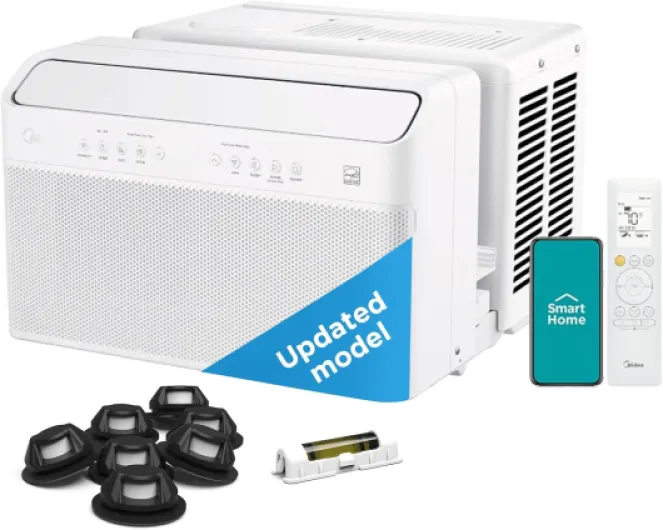
The most distinctive point here is the U-shaped design. Instead of filling the entire window, the unit sits like a saddle over the sill: the compressor and condenser coil are outside, the indoor fan and evaporator coil are inside, and the window pane drops down in the middle. According to many reviewers, this has two practical outcomes: the window can still be opened partially for fresh air, and you keep more natural light and outside view than with a big rectangular box.
Dimensions are roughly 19.17" deep, 21.97" wide, and 13.46" high. The manufacturer specifies it will fit single-hung or double-hung windows 22"–36" wide with a minimum opening height of 13.75". That’s fairly standard, but not universal. If someone has very narrow or non-standard windows (like sliders or casements), this model simply won’t be suitable. In my opinion, checking those dimensions carefully before purchase is mandatory, especially in older buildings with odd window sizes.
Installation is built around a quick-snap bracket: you mount the bracket on the sill, then rest the AC on it and secure the side arms. Several buyers say installation took them about 20–60 minutes. Some people mention doing it solo, but others strongly recommend a second person because the 56.9 lb weight is not trivial and you’re leaning out a window. The unit includes foam and sealing pieces to limit air leaks, and comments often mention feeling that the unit sits solidly once everything clicks into place.
Design-wise, the style is plain white plastic, relatively clean and modern, without flashy accents. The indoor portion is compact, so it doesn’t protrude as much into the room as some traditional units. There’s also an anti-theft mechanism tied to the closed window, which locks the sash when the unit is installed—a small but sensible detail for ground-floor apartments. Overall, I’d say the design is functional more than pretty, but the U-shape genuinely changes how much the AC dominates the window space, which many buyers seem to appreciate.
Build quality, moving parts, and long-term considerations
The housing here is primarily plastic, with the usual metal internals you’d expect in a window AC. At 56.9 pounds, it’s not lightweight, which actually suggests a reasonably solid internal frame and compressor rather than an ultra-thin shell. Several reviewers mention that the updated model feels sturdy and well put together, with the bracket and sidearms holding the unit securely in the window once everything is tightened and sealed.
From a mechanical point of view, inverter compressors can be gentler on components over time because they avoid constant hard starts. That can reduce stress on the compressor and electrical parts, which is one reason many higher-end AC systems use inverter technology. That said, more electronics and Wi‑Fi connectivity also mean more potential failure points: control boards, sensors, and the wireless module. Among the comments, you do see the occasional report of app or connectivity issues, but widespread hardware failure reports are not prominent in the sample described here.
The AC uses R32 refrigerant, which is common in newer units and generally considered more efficient and slightly better environmentally than older R410A, though that mainly matters when talking about servicing or disposal. The included two-year limited warranty from the original purchase date is decent but not exceptional; some brands offer longer coverage on compressors. The condition that it only applies to authorized purchases is important, so buying from random gray-market sellers could complicate warranty support.
In my view, durability here looks solid but not bulletproof. The design and weight suggest something that isn’t flimsy, and the bracket system gives it a stable base, which is key when you have a heavy object hanging out a window. At the same time, it’s still a plastic-bodied, mass-market window AC, not a commercial-grade unit. If someone takes care during installation, keeps the filter clean, and avoids banging or overloading the bracket, there’s no obvious red flag on lifespan. People looking for decade-plus service life might still want to temper expectations, but for a modern residential window AC, the durability picture seems reasonable.

Noise, energy savings, and smart control in everyday use
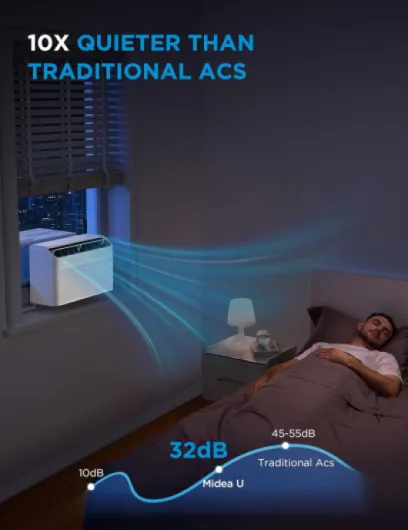
Two performance claims dominate here: very low noise and energy savings. The published sound level goes as low as 32 dB, which is closer to a quiet library than a typical window AC. Many reviewers back this up in plain terms, saying that on low fan it’s quieter than a refrigerator, and that they can watch TV or sleep without constantly hearing the compressor. One buyer explicitly mentions no longer needing to turn the TV volume up when the AC runs, which is a common complaint with older units.
On the energy front, the manufacturer advertises more than 35% savings compared with traditional non-inverter window units and highlights an ENERGY STAR–level efficiency. One detailed review claims a roughly 30–35% reduction in their summer electricity bill compared to a previous 8,000 BTU unit. That’s just one case, but it lines up with what you’d expect from an 890 W, 10,000 BTU inverter AC with a SEER of around 15: not ultra-premium efficiency like a top-tier mini-split, but clearly better than the cheapest on/off window boxes.
The smart side is also a big part of the performance story. The AC is Wi‑Fi enabled and works with the Midea SmartHome app, Alexa, and Google Assistant. According to users, the app allows remote on/off, mode changes, scheduling, and in some cases monitoring energy use. Several buyers appreciate being able to turn the unit on while away so they arrive to a cooled room. Some comments, however, mention occasional app quirks, like settings being forgotten after firmware updates or needing to reconnect the AC once in a while. The overall tone is still positive, but if someone hates dealing with apps entirely, they should be ready to rely mainly on the remote and panel controls.
In my opinion, this model’s performance is best suited to people who care about long-term running costs and noise more than sheer upfront price. The combination of quiet operation, decent SEER, and flexible app/voice control makes it a solid fit for bedrooms, home offices, and any room where you actually want to hear yourself think. It’s not the simplest "plug and forget" unit because of the Wi‑Fi and bracket system, but for users willing to spend a bit more time on setup and app pairing, the performance package looks strong for day-to-day living.
What this 10,000 BTU U-shaped AC actually offers
On paper, the Midea MAW10V1QWT is a 10,000 BTU window air conditioner aimed at rooms up to about 450 square feet. It runs on standard 115 V power, draws about 890 W in cooling mode, and is advertised with a SEER of 15 and “more than 35% energy savings” compared with classic fixed-speed window units. It also uses an inverter compressor, which means it should ramp power up and down instead of constantly turning on and off, usually translating into smoother temperatures and better efficiency.
The big design difference versus a classic window unit is the U-shape. Instead of a full rectangle blocking the whole opening, the machine straddles the window sill and leaves a gap where the window slides down in the middle. According to the manufacturer, this helps the glass act as a sound barrier between the noisy outdoor compressor and the indoor blower. Several reviewers back this up, describing the noise level as closer to a fridge hum than a typical window AC. The 32 dB spec is very low for this category, at least in theory.
This model is also positioned as a connected appliance. It supports Wi‑Fi and works with the Midea SmartHome app on iOS and Android. Buyers say they can remotely switch the AC on, change modes, schedule operation, and integrate it with Alexa or Google Assistant for voice control. That’s clearly a step above the usual basic IR remote and front-panel buttons you see on cheaper window units. The unit still includes a physical remote and an electronic control panel, so you’re not stuck if the app misbehaves.
In my view, the spec sheet paints a picture of a mid-to-upper range window AC that tries to compete on three points: noise, energy savings, and smart control. Cooling power is solid for its class but not extreme; the focus isn’t on pushing BTUs to the max, it’s on making 10,000 BTU more livable and cheaper to run day to day. Given the strong sales rank in window ACs and the 4.3/5 average rating, the concept seems to resonate with a lot of buyers who are tired of loud, dumb window bricks.
Cooling efficiency and real-world comfort feedback
In terms of raw numbers, 10,000 BTU is appropriate for spaces up to roughly 450 sq ft under normal conditions—think a typical bedroom plus office, or a small living room. Several verified buyers report using it in the 350–400 sq ft range and describe very fast temperature drops, like going from around 80°F to the low 70s in under 10–15 minutes. That lines up with what you’d expect from a 10,000 BTU inverter unit with decent airflow in an average-insulated room.
The inverter compressor is a key factor in perceived comfort. Instead of cycling hard on and off, it should modulate output to maintain set temperature more steadily. Multiple reviews mention that the unit doesn’t blast cold air in short bursts but keeps the room at a more consistent temperature. That tends to feel less drafty and usually also cuts down on noise spikes, because the compressor isn’t constantly restarting at full power.
On paper, the AC also functions as a dehumidifier, though no specific pints-per-day figure is listed here. Window ACs naturally remove moisture as they cool, and several users mention their rooms feeling much less muggy on hot days. The built-in dust filter is washable, and some comments appreciate the filter reminder feature, which nudges you when it’s time to clean it. Keeping that filter clean is important to maintain both cooling performance and airflow.
From an analytical standpoint, the combination of 10,000 BTU, inverter tech, and user reports of quick cooling suggests that, for a typical 300–450 sq ft bedroom or office, this unit should be more than adequate. It’s not meant to cover huge open-plan spaces or whole apartments; people trying to cool very large or poorly insulated areas with a single window unit may find the limits of any 10k BTU model. But within its intended room size, the feedback points to strong, efficient cooling that feels steady rather than harsh or uneven.
Pros
- Very quiet operation for a window AC, with an advertised 32 dB noise level and many reviews confirming low noise
- Inverter compressor and SEER 15 efficiency, with claims of 30–35% energy savings versus older fixed-speed units
- U-shaped design preserves part of the window for light and ventilation while helping block outdoor compressor noise
Cons
- Heavy unit and bracket system make installation more demanding, especially for one person
- Smart app and Wi‑Fi features can be finicky according to some users, with occasional reconnect or settings issues
Conclusion
Analysis score
This Midea 10,000 BTU U-Shaped Smart Inverter window AC aims for comfort over bare-minimum functionality, and it mostly delivers on that goal. On paper, it brings together strong cooling for rooms up to about 450 sq ft, very low advertised noise levels, and better-than-average energy efficiency thanks to its inverter compressor and 15 SEER rating. In the published reviews, many buyers back this up, especially on the quiet operation and more stable room temperature compared with older on/off units. The U-shaped design is more than a gimmick: it lets you keep part of your window usable and helps the glass block a lot of the compressor noise.
It’s not perfect. The unit is heavy, installation is more involved than dropping a small box in the window, and some users mention occasional app or Wi‑Fi quirks. The warranty is decent but not outstanding, and people who don’t care about smart features or low noise can probably find cheaper 10,000 BTU models. Still, in my opinion, the overall package is convincing. For bedrooms, home offices, or any room where you care about quiet, efficiency, and remote control, this AC looks like a solid choice. If you just want the lowest upfront price or have non-standard windows, you might want to look elsewhere.