Summary
Analysis score
Average of the criteria rated below
Is the A119 Mini 2 good value for money?
Compact, discreet design with a practical GPS mount
Supercapacitor power and parking mode behavior
Heat resistance, storage cards and long-term reliability
Image quality, Wi‑Fi and voice control: where it shines and where it’s just okay
What the VIOFO A119 Mini 2 offers on paper
Pros
- Compact, discreet design with GPS built into the mount and removable camera body
- 2K 60 fps recording with STARVIS 2 sensor and HDR for improved night and high-contrast scenes
- Supercapacitor power and good heat tolerance, with 24/7 buffered parking mode when hardwired
Cons
- Single-channel only, no option to add a rear camera
- Wi‑Fi transfers and app experience reported as slow and somewhat cumbersome by some buyers
- Requires high-endurance microSD and optional hardwire kit, which raise the overall cost

Specifications
View full product page →| Brand | VIOFO |
A compact 2K dash cam that tries to cover all the bases
The VIOFO A119 Mini 2 sits in a busy segment: compact single-channel dash cams around 2K resolution with GPS and parking mode. On paper, this model tries to tick a lot of boxes without going into the very high price range: 2K 1440p at 60 fps, STARVIS 2 IMX675 sensor, HDR at 30 fps, GPS included, Wi‑Fi, voice control and 24/7 buffered parking mode if you hardwire it. With a 4.3/5 average from over 1,700 Amazon ratings, buyers are mostly satisfied, but a few recurring complaints do appear in the comments.
The brand leans heavily on two technical arguments: the latest Sony STARVIS 2 sensor for low light and a supercapacitor instead of a lithium battery for better heat resistance and longevity. Several reviews from hot climates mention that adhesion and basic operation hold up in high temperatures, even after long periods in the sun. That doesn’t mean it’s immune to every heat-related issue though: at least one user notes that the image can go a bit soft in extreme heat, which is believable for a compact camera stuck to a windshield.
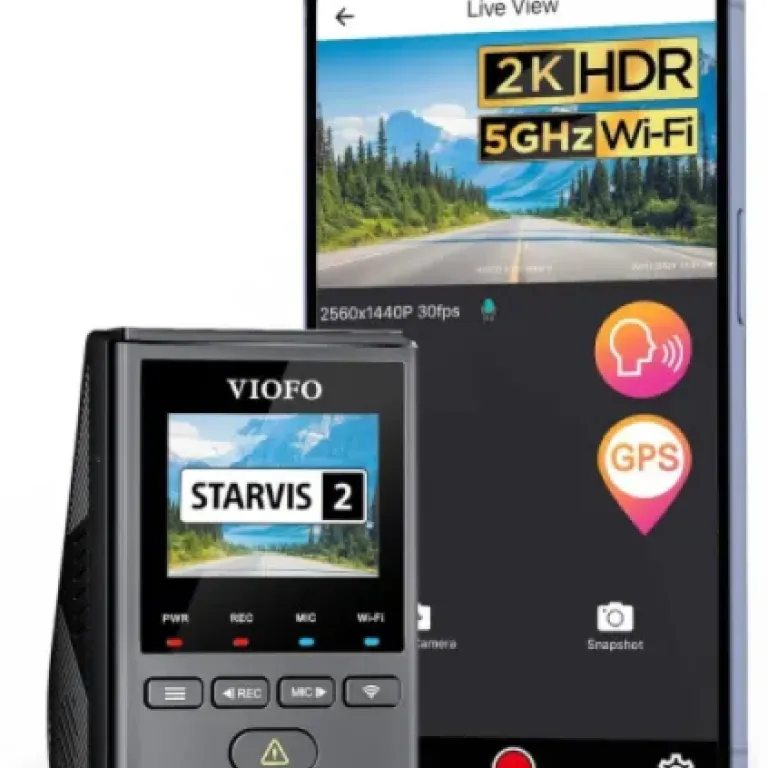
On the usage side, people highlight the small size, the fact it hides easily behind the rear-view mirror, and the presence of GPS in the mount. Voice control and Wi‑Fi are seen as practical, but not flawless. One buyer complains about accidental activation of Wi‑Fi and recording commands, and another finds the Wi‑Fi app pairing and transfer process a bit clunky and slower than expected for a 5 GHz connection. That’s typical of mid-range dash cams: the app usually works, but it’s rarely as smooth as a smartphone camera.
Overall, the A119 Mini 2 looks like a solid single-channel option for drivers who mainly care about front coverage with decent detail, fairly strong night performance and reliable parking mode, as long as they accept some compromises: no rear camera support, some quirks with voice control and Wi‑Fi, and the need to use a good high-endurance microSD card to avoid recording problems. In my opinion, its position is clear: a feature-rich, compact front camera for people who want serious protection without going into multi-channel high-end setups.
Is the A119 Mini 2 good value for money?
The A119 Mini 2 sits in the mid-range of dash cams: more expensive than the simplest 1080p models, cheaper than 4K dual-channel kits with rear cameras and cloud features. The exact price isn’t displayed here, but one Canadian review mentions around CAD $150–$180, which usually translates to a similar or slightly lower figure in USD. For that level, you get 2K 60 fps, HDR, a recent STARVIS 2 sensor, GPS included, dual-band Wi‑Fi, voice control, buffered parking mode (with hardwire kit) and support for up to 512 GB cards. On paper, the feature-per-dollar ratio is solid, especially considering the supercapacitor design.
Looking at the 4.3/5 rating from over 1,700 reviews, buyers are mostly positive. Many 5‑star comments praise the compact size, video quality “as expected” for a mini dash cam, and the sense of security from always-on recording and parking surveillance. One senior driver specifically mentions that it brings peace of mind and highlights straightforward installation and helpful after-sales support from VIOFO. That kind of feedback suggests the product delivers what most people in this price bracket expect: reliable evidence capture rather than cinematic footage.
On the downside, there are a few compromises that affect perceived value. First, this is strictly a one-channel camera with no rear-camera option, which limits its long-term upgrade path. Second, some users are not impressed by Wi‑Fi speed and app ergonomics, which reduces the benefit of having 5 GHz on the spec sheet. Third, you need to add the cost of a good high-endurance microSD card and, if you want full 24/7 parking mode, the HK4 hardwire kit and possibly installation. Once you factor those in, the total budget is noticeably higher than the camera price alone.
In my opinion, the A119 Mini 2 offers good value if your priority is a robust front-only dash cam with strong core functions: decent image quality, GPS, serious parking features and heat-resistant hardware. It’s less compelling if you want a polished phone app, cloud backup or multi-camera coverage. For many everyday drivers who just want a reliable “silent witness” in the front windshield and are okay with a bit of DIY or paying for a hardwire install, the trade-off remains attractive.
Compact, discreet design with a practical GPS mount
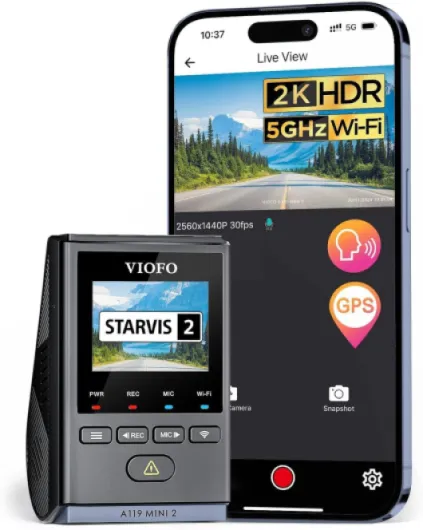
Design-wise, the A119 Mini 2 focuses on being as discreet as possible. The dimensions (about 1.63 × 1.81 × 2.93 inches) and the wedge-shaped body make it easy to tuck behind or next to the rear-view mirror. Several buyers explicitly appreciate that once installed, the camera is almost invisible from the driver’s seat and doesn’t block the view. One review even describes ending up with only a couple of inches of visible wire after routing, which is typically what people look for in a daily-use dash cam: set it and forget it, without cluttering the windshield.
The GPS module is integrated into the mount rather than the camera body, which has two practical consequences. First, the adhesive mount stays on the windshield while the camera can slide off for storage, which one reviewer likes because they can remove the camera without touching the mount. Second, if you ever need to replace the mount or move it to another vehicle, the GPS and power connection are still handled through that single piece. The box includes a spare mount sticker and two static windshield stickers, which should make repositioning or transfer easier without scraping adhesive directly off the glass.
The physical controls are kept to a minimum, with a 1.5" LCD screen for framing and menus, and the rest managed by the app or voice commands. Buyers who comment on installation generally describe it as straightforward: stick the mount, connect the included car charger via USB‑C, and optionally route the cable behind trim using the supplied plastic tool. The small form factor and light weight (around 15.8 ounces total package) suggest that the mount doesn’t have to bear much load, which likely helps with long-term adhesion on the windshield.
In my opinion, the design is one of the strong points of this model. It’s not flashy, but it’s practical: small footprint, hidden cables if you take a bit of time, and a removable camera on a GPS base. The only real limitation from a design perspective is inherent to the product line: this is a one-channel camera with no option to add a rear module later. So it’s best suited to drivers who are sure they only want front coverage and prefer a very discreet install over a more modular, multi-camera setup.
Supercapacitor power and parking mode behavior
The A119 Mini 2 doesn’t use a conventional internal battery. Instead, it relies on a supercapacitor, which is mainly there to safely close files and shut down when external power is cut. That design choice usually means two things: better heat resistance and longer overall lifespan, but no ability to run standalone for long once the car is off. The operating range announced (roughly 5°F to 149°F) matches what you’d expect from this type of component. Multiple buyers in hot areas mention that the camera has handled high cabin temperatures without losing adhesion or failing, which fits the advantages of a supercapacitor architecture.
For normal driving, the camera will be powered either by the 12 V cigarette lighter adapter or by a hardwire kit. For 24/7 parking mode, VIOFO sells the HK4 hardwire kit separately. This kit allows the camera to detect ignition status and switch between driving and parking profiles. One Crosstrek owner gives a fairly detailed account: they wired the HK4 to specific fuse slots for ACC and constant battery, and the camera then automatically enters parking monitoring after the ignition is turned off. They state that this setup gives their spouse peace of mind, since the car is watched even when parked.
Parking mode itself offers three behaviors: Auto Event Detection with 15 seconds of pre-buffer (recording 15 seconds before and 30 seconds after an event), low bitrate continuous recording, and time-lapse (mentioned in the product description). That kind of buffered event capture is very useful for hit-and-run scenarios, because it shows what led up to the impact, not just the moment of shock. The trade-off is power consumption: low bitrate and time-lapse reduce the load on the battery compared to full-quality recording, but the dash cam will still draw from the car battery whenever parked.
In my opinion, the power design is coherent: the supercapacitor avoids many long-term reliability issues and the hardwire option unlocks serious parking surveillance. The flip side is that you need to be aware of battery health. One reviewer mentions planning to unplug the system if leaving the car unused for several days, which is a reasonable precaution for any always-on dash cam. If you want full 24/7 protection, it’s worth considering either a dedicated battery pack or at least setting parking mode timers and voltage cut-offs through the hardwire kit, so you don’t drain the car battery in rare long-parking situations.

Heat resistance, storage cards and long-term reliability
Durability is one of the main selling points of the A119 Mini 2, mainly thanks to the supercapacitor and the compact body. The manufacturer explicitly warns about extreme temperatures and positions the camera for operation from 5°F to 149°F. Among the reviews, several users mention high outside temperatures (around 100°F, so likely hotter inside the car) and say the adhesive mount has held up and the camera continues to function. That suggests that the combination of a light body, good adhesive and supercapacitor is doing its job for windshield installation in harsh climates.
However, one reviewer points out that in extreme heat, the video image can become slightly blurry. That doesn’t necessarily mean the hardware is failing; it could be temporary softness from sensor or lens heating. Still, it’s a reminder that even if the camera survives the temperature, performance might not be at its best in the hottest conditions. This is a common compromise across dash cams: tiny optics and sensors right up against glass in direct sun will always be pushed to their limits.
The other big durability factor is the memory card. VIOFO spends a lot of space insisting on using high-endurance, Class‑10 or UHS‑I cards, and even recommends their own industrial-grade microSD range from 64 to 512 GB. They explicitly connect low-quality cards to potential recording failures or the camera randomly stopping recording. One customer who is otherwise satisfied mentions slow Wi‑Fi transfers even with a branded SanDisk performance card, which suggests that not all mainstream cards are ideal for constant dash cam workloads. In practice, continuous loop recording at high bitrate is demanding, so using a cheap card is often the first cause of corruption or missing clips.
In my opinion, the A119 Mini 2 looks well thought out in terms of physical durability: supercapacitor instead of battery, a mount that can withstand heat, and a small form factor that doesn’t put too much stress on the adhesive. The weak link, as usual, is the storage medium and user maintenance. Formatting the card every few months, as one senior user advises, and choosing a proper high-endurance microSD are key to avoiding nasty surprises. If you’re willing to follow those basic habits, the camera should offer a reliable long-term experience for daily commuting and parked monitoring.
Image quality, Wi‑Fi and voice control: where it shines and where it’s just okay
On the image side, the A119 Mini 2 aims higher than basic 1080p dash cams. It offers 2K 2560×1440 at 60 fps and up to 2592×1944 at 30 fps. According to several buyers, daytime video quality is clearly above cheaper models, with enough detail to usually read plates and road signs, although one 4‑star review notes that plates are not always razor-sharp and sometimes require a closer look. That’s consistent with a mid-range 2K sensor: better than Full HD, but not magic. One reviewer who did a more technical write-up describes day and night video as “good” and comparable to similarly priced and specced dash cams.
At night, the camera leans on its STARVIS 2 IMX675 sensor, f/1.6 aperture and DOL‑HDR. Comments suggest that night footage is quite usable, with license plates often readable, though one buyer mentions that in the presence of strong lights and reflections the reliability drops. That’s a known limitation for most dash cams: reflective plates, headlights and signboards can blow out parts of the image. The HDR mode, limited to 30 fps, should help balance bright and dark areas in tunnels or at night, but you trade some fluidity compared to 60 fps.
Regarding Wi‑Fi and voice control, the experience is mixed. On paper, the dual-band Wi‑Fi (2.4/5 GHz) should give faster transfers than older 2.4 GHz-only models. One review confirms that the app is convenient for changing settings and viewing footage. But another buyer complains that connecting requires bouncing between the app and phone Wi‑Fi settings, and that transferring a 3‑minute clip can take several minutes, which feels slow. That could be due to the memory card, phone, or software, but it shows that the 5 GHz spec alone doesn’t guarantee a snappy experience. On the voice side, users like the idea and the list of commands is quite complete (lock video, take photo, toggle Wi‑Fi, audio, screen), yet one person reports that Wi‑Fi and recording sometimes turn on by themselves, suggesting accidental trigger or sensitivity to background speech.
In my opinion, the A119 Mini 2 delivers solid core performance for its category: video that is clearly usable for evidence in most conditions, decent night performance for a compact 2K cam, and advanced extras like HDR and GPS. However, it doesn’t reach the crispness and low-light clarity of more expensive 4K dual-channel systems, and the smart functions (Wi‑Fi, voice) feel more like useful add-ons than perfectly polished features. If your priority is reliable recording rather than a flawless app experience, the balance remains attractive.

What the VIOFO A119 Mini 2 offers on paper
The A119 Mini 2 is a single-channel dash cam designed strictly for the front windshield. It records up to 2560×1440 at 60 fps or 2592×1944 at 30 fps, with HDR available at 30 fps. The lens offers a 140° field of view and an f/1.6 aperture with a 7‑element glass construction, which should help with sharpness and low-light performance. The sensor is a Sony STARVIS 2 IMX675, a newer generation chip promoted for better dynamic range and lower noise, especially at night. In short, on paper this is clearly positioned above basic 1080p models, but still below 4K flagships in terms of raw resolution.
The camera uses a supercapacitor rather than a battery, with an operating temperature range advertised from about 5°F to 149°F. That’s a strong point for drivers in very hot or very cold regions, since supercapacitors generally handle temperature swings and long-term use better than small lithium batteries. Several reviews from hot areas back this up by mentioning that the camera has stayed stuck to the glass and kept working through hot summers, which is often a weak point of cheaper dash cams.
Feature-wise, the A119 Mini 2 includes:
- GPS module in the mount for speed, route and time logging.
- 5 GHz + 2.4 GHz Wi‑Fi for app control, live view and file transfer.
- Voice control for actions like taking photos, locking clips, toggling Wi‑Fi and audio.
- Parking modes (with optional HK4 hardwire kit): auto event detection with 15s pre-buffer, low bitrate continuous recording, and time-lapse options.
- G‑sensor & loop recording to automatically lock files in a collision.
Storage is via microSD card up to 512 GB, but VIOFO is very clear: they strongly recommend their own industrial high-endurance cards, and warn that low-quality or incompatible cards can cause recording failures or stop-recording issues. One detailed review from a senior driver even shares some basic usage tips, like formatting the card regularly and wiping the lens monthly, which suggests that with minimal upkeep the camera should remain stable. In my opinion, the overall feature set is solid for a mid-range single-channel dash cam, but you need to budget for a quality microSD card and possibly the hardwire kit if you want to exploit the 24/7 parking mode properly.
Pros
- Compact, discreet design with GPS built into the mount and removable camera body
- 2K 60 fps recording with STARVIS 2 sensor and HDR for improved night and high-contrast scenes
- Supercapacitor power and good heat tolerance, with 24/7 buffered parking mode when hardwired
Cons
- Single-channel only, no option to add a rear camera
- Wi‑Fi transfers and app experience reported as slow and somewhat cumbersome by some buyers
- Requires high-endurance microSD and optional hardwire kit, which raise the overall cost
Conclusion
Analysis score
The VIOFO A119 Mini 2 positions itself as a compact, front-only dash cam that tries to cover the essentials properly rather than chase flashy specs. On paper and in most reviews, it succeeds: 2K 60 fps with a modern STARVIS 2 sensor, usable night performance, GPS built into the mount, supercapacitor power for heat resistance, and a real buffered parking mode if you pair it with the HK4 hardwire kit. The small wedge design makes it easy to hide behind the mirror, which many owners appreciate for daily driving.
It’s not flawless. Wi‑Fi and the app seem functional but a bit clunky, voice control can mis-trigger for some users, and this model will never give you rear coverage or cloud features. Image quality is described as good rather than mind-blowing: plates are usually readable but not always crystal clear, especially at night or in extreme heat. You also need to budget for a proper high-endurance microSD card and, ideally, a hardwire kit to unlock its full potential.
In my opinion, the A119 Mini 2 suits drivers who want a discreet, reliable, front-only dash cam with serious parking protection and don’t mind a slightly rough app experience. It’s a good fit for commuters, seniors, and anyone parking in public areas who values evidence over gadgets. If you’re after a full front+rear setup, ultra-smooth smartphone integration or 4K-level sharpness, you should look at higher-end or dual-channel options instead.