Summary
Analysis score
Average of the criteria rated below
Value: four solar cameras and 1TB local storage for the money
Design: classic bullet look with 360° coverage in mind
Battery and solar: how “wire-free” it really is
Durability and weather resistance: built for outdoors, with solid support backup
Performance: image quality, app behavior, and motion alerts
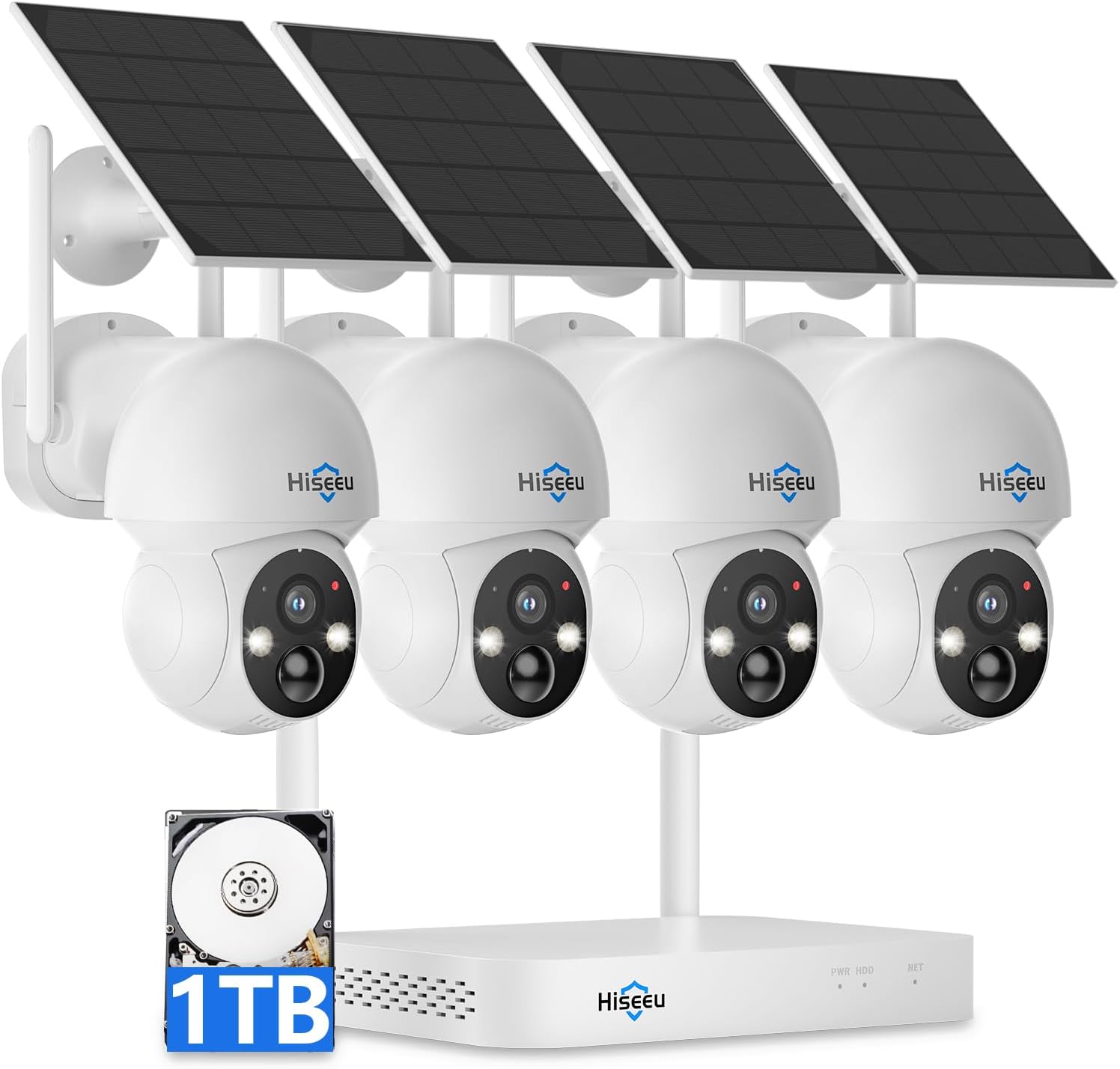
What this Hiseeu solar kit actually includes
Pros
- Four 4MP pan/tilt outdoor cameras with color night vision and up to 65 ft range included in the base kit
- Solar-powered with internal batteries, reducing or eliminating the need for manual recharging once installed
- 1TB NVR for local recording and no mandatory subscription fees, with cameras pre‑paired for easier setup
Cons
- App quirks such as channel‑based notifications, SD default for live view, and awkward iPad toolbar layout
- Limited smart home ecosystem integration compared to higher‑end brands with more polished software

Specifications
View full product page →| Brand | Hiseeu |
A solar security kit that tries to do everything at once
The Hiseeu Solar Camera Wireless Outdoor kit goes after a pretty clear goal: provide a full home security setup without running power cables, paying subscriptions, or juggling multiple apps. On paper, it’s quite loaded for the price bracket: 4MP resolution, four solar-powered cameras, a 1TB NVR for local recording, dual-band Wi‑Fi (2.4 GHz and 5 GHz), and pan/tilt with 360° coverage. It’s sold as a complete package with NVR, HDMI cable, and cameras already paired, so the pitch is “mount, plug the base into power, and you’re in business.”
Among the Amazon comments, the tone is mostly positive: a 4.3/5 average from just under a thousand reviews suggests that buyers are generally satisfied, with regular praise for image quality, solar convenience, and responsive customer service. Several users say they moved from a mix of random cameras to this unified system and appreciate having everything in one app plus on the NVR. That’s a big step up for anyone who currently has three different apps and no central recording.
It’s not all rosy, though. A few detailed reviews point out software quirks: notifications only showing “channel #” instead of your custom camera name, the need to manually switch live view from SD to HD in the app, and awkward use on iPad where the app’s toolbar covers part of the controls. Those are not deal‑breakers for everyone, but they matter if you mainly view cameras from a tablet. Some buyers also mention that instructions could be clearer, especially for first‑time users of NVR systems.
In my opinion, this kit looks like a pragmatic solution: not the most high‑end hardware on the market, but a well‑equipped set aimed at people who want solar power, no monthly fees, and an all‑in‑one box. The real question is whether the combination of 4MP cameras, solar panels, and local 1TB storage is strong enough to justify picking it over simpler single Wi‑Fi cams or more premium brands. The rest of the analysis focuses on that: what it offers on paper, how buyers describe it in real life, and where the compromises seem to sit.
Value: four solar cameras and 1TB local storage for the money
Value is where this kit tries to stand out. You’re getting four 4MP pan/tilt outdoor cameras, each with solar power, plus an NVR with a 1TB hard drive, HDMI cable, and all cameras pre‑paired. There’s no mandatory subscription, and the system records locally by default. Compared to buying four separate Wi‑Fi cameras from big brands and then paying monthly for cloud storage, the cost over a few years can tip strongly in favor of this kind of local‑storage kit, even if the upfront price is higher than a single standalone cam.
The Amazon rating sits at 4.3/5 across 900+ reviews, which is decent for this category. Buyers regularly mention that the price was a key factor in their choice and that they feel they received good value. Comments use phrases like “fair price,” “won’t break the bank,” and “best bang for the money,” which is exactly what you want to see for a budget‑conscious product. People coming from older Hiseeu wired systems also say this solar upgrade met their expectations without costing as much as some premium ecosystems.
Of course, lower price comes with some trade‑offs. The app is functional but not polished, there are quirks like channel‑based notifications and SD default for live view, and the system doesn’t integrate into broader smart home platforms the way some higher‑end brands do. If you expect deep integration with HomeKit, Google Home, or Alexa routines, this kit is not advertised as that type of product. You’re basically buying a self‑contained security island: cameras + NVR + app, with strong value inside that bubble but limited external links.
In my opinion, for someone who wants multi‑camera coverage, solar power, and local recording without ongoing fees, this kit offers strong value. It’s not the cheapest single‑camera solution, but that’s not the point. The sweet spot here is a homeowner who wants to cover several zones (front door, driveway, backyard, side yard) in one shot, and who is okay trading some app polish and ecosystem integration for a more affordable, subscription‑free package.
Design: classic bullet look with 360° coverage in mind
Visually, this kit sticks to a straightforward security look. The cameras use a bullet form factor with an integrated pan/tilt mechanism and a separate solar panel. The spec sheet mentions wall‑mount installation with screws, and several reviews confirm that the physical mounting process is simple: drill a couple of holes, screw in the bracket, and you’re done. There’s no attempt to hide the fact that these are security devices. If you want something discreet or decorative, this isn’t it; if you like the deterrent effect of visible cameras, the design fits that use case well.
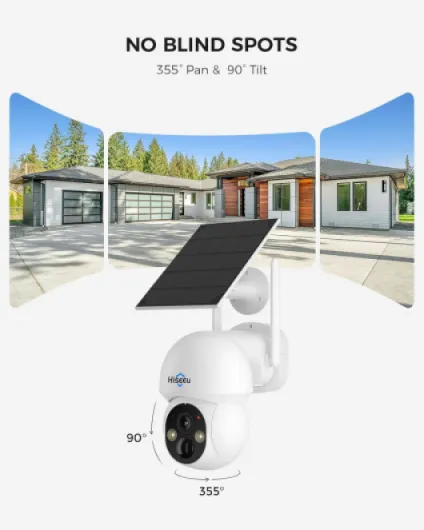
The key part of the design is the pan and tilt capability. Hiseeu lists 355° field of view horizontally and 90° vertically, which means a single camera can cover a very wide area when controlled from the app. Buyers repeatedly mention how much they appreciate being able to pan, tilt, and in some cases digitally zoom from their phone. Instead of mounting multiple fixed cameras to cover a yard or driveway, you can angle one camera around as needed. Of course, motion detection is still tied to the current view; you’re not getting full 360° capture all at once, but for manual monitoring, it’s a big advantage.
The NVR itself is a compact box that sits near your TV or monitor, connected via HDMI. One reviewer specifically says they recommend using a small monitor during setup and for occasional checking, which is a realistic way to think about it: the system is designed to be used both via the app and via a direct screen connection. That boxy, utilitarian design is typical for NVRs and doesn’t try to be a living‑room showpiece, but it does its job: housing the 1TB HDD and providing physical control and playback.
In my opinion, the overall design is functional and geared toward practicality rather than aesthetics. The cameras are meant to be seen, the solar panels need exposure, and the NVR sits near your router or TV. If you’re okay with a “security system” look on your walls and you value pan/tilt control and solar panels more than sleek styling, this kit lines up with that mindset. If you’re chasing minimalism and hidden cameras, this is the opposite direction.
Battery and solar: how “wire-free” it really is
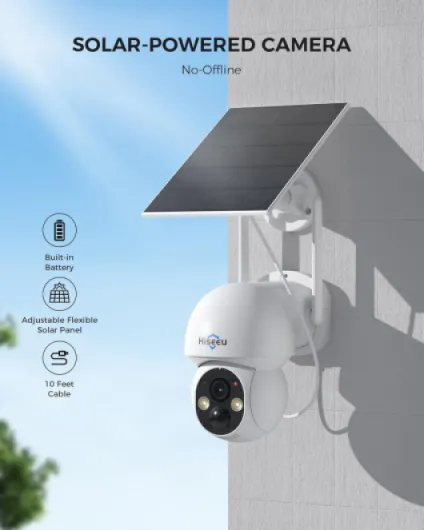
The big selling point of this kit is the “wire‑free solar powered” angle. Each camera uses an internal lithium‑ion battery (one battery required per camera, included according to the listing) and a dedicated solar panel. Hiseeu claims that only about two hours of sunshine are needed to provide energy for a full day of recording, which, if accurate, is quite efficient. The idea is clear: once mounted, you shouldn’t have to climb a ladder to charge these things, as long as the panels get decent sun exposure.
Several reviewers back up the general idea that battery life is a non‑issue when the solar panels are properly installed. One user explains that they ran two cameras for roughly two weeks without connecting the solar panels at all, and the batteries still had plenty of charge left. Once they attached the solar panels, they say the batteries stayed at full. Another buyer likes that they no longer need to manually recharge, which was a hassle with previous battery‑only cameras from elsewhere. That kind of feedback suggests the combination of battery capacity and solar input is reasonably dimensioned for typical motion‑based recording.
Of course, the performance of any solar setup depends heavily on where you live and how you mount the panels. The spec sheet doesn’t promise miracles in deep shade or in constant bad weather. If your cameras face north under an overhang, even a good panel will struggle. But the claim that two hours of sun is enough for a day of motion‑triggered use sounds plausible for a low‑power 4MP sensor with efficient standby. Buyers in the comments don’t seem to complain about batteries dying constantly, which is usually the first thing people shout about if it happens.
In my opinion, the battery/solar side looks like one of the strong points of this kit. It turns a potentially annoying maintenance task (recharging multiple cameras) into something you only think about during installation. If you have spots with poor sun exposure, you might need to plan the panel placement more carefully or accept less margin. But for standard outdoor walls or deck areas with some direct sun, this system should realistically deliver the “install and forget” style power that many people want.
Durability and weather resistance: built for outdoors, with solid support backup
Durability is always a concern with outdoor electronics, and Hiseeu leans on an IP66 waterproof rating for these cameras. IP66 means the housing is dust‑tight and protected against powerful water jets, so on paper it should handle heavy rain, snow, and general outdoor grime. The brand also highlights a “sturdy casing and sealed structure” designed to keep moisture and dust away from the internal components. Combined with the fact that the system is aimed at permanent outdoor installation, it’s reasonable to expect a decent lifespan under normal conditions.
In the Amazon comments, there’s no flood of complaints about water ingress or cameras dying in the first storm, which is a good sign. One reviewer with a cabin mentions the base unit inside and a camera about 100 feet away, with no mention of weather‑related issues, despite the kind of environments cabins usually face. While that’s not a lab measurement, it suggests that the hardware is doing its job in real‑world outdoor setups. Another buyer describes the build as “solid” right out of the box, which matches the advertised focus on a robust enclosure.
A more interesting angle on durability is how the company handles the cases where something does go wrong. One customer explicitly reports a faulty solar panel; they contacted Hiseeu customer service, and a replacement panel was shipped at no charge. That kind of response doesn’t magically improve the hardware, but it does reduce the risk of being stuck with a half‑working system if a component fails early. Several reviews praise the support team by name, describing step‑by‑step guidance for setup issues and quick resolution of problems.
In my opinion, the combination of IP66 rating, metal‑looking bullet housings, and decent support response paints a reassuring picture. It’s still a budget‑friendly kit, not industrial‑grade hardware, so expecting it to survive a decade of harsh coastal storms without a hiccup might be optimistic. But for typical home use—rain, snow, summer heat—it seems realistically equipped. The safety net of responsive customer service also matters here: even if a solar panel or camera turns out to be a dud, there’s evidence that Hiseeu doesn’t just leave buyers hanging.
Performance: image quality, app behavior, and motion alerts
On the performance side, the big promise is clear 4MP video with color night vision and low lag. Several buyers comment that the picture is sharp and “clear,” especially compared with older 1080p or mixed systems they had before. For a security setup, 4MP is a decent middle ground: more detail than 1080p, without the bandwidth and storage hit of 4K. On paper, 4MP at 65 feet of night range should be enough to recognize faces and license plates at typical driveway distances, as long as the scene is lit reasonably or the camera’s low‑light mode does its job.
Latency and connectivity also get highlighted in the reviews. One user notes that there is “very little lag” compared to their previous cameras, and another mentions that the dual‑band 2.4G/5G Wi‑Fi support seems to help with stability and range. That’s consistent with the spec: dual‑band support gives more flexibility in crowded Wi‑Fi environments. The NVR‑centric architecture should also help, since cameras aren’t streaming directly over the main home Wi‑Fi for every connection. In practice, buyers with cameras about 100 feet from the base unit report solid signal, which is reassuring for typical home layouts.
Where performance gets a bit more mixed is on the software side. One detailed review points out three annoyances: notifications only show the channel number instead of the custom camera name; the app defaults live view to SD, so you have to manually switch to HD every time for the clearest picture; and on iPad, the app’s toolbar sits at the top and partially covers controls, with no option to move it. None of that breaks the core function—motion detection and recording still work—but it’s the kind of day‑to‑day friction that can get irritating if you check your cameras often on a tablet.
In my opinion, the hardware performance (image quality, range, night vision) looks solid for the price, and the main limitations are software polish and app UX. If you’re okay with a slightly clunky interface and a few naming quirks, you get decent 4MP video, pan/tilt, and responsive alerts without paying for cloud storage. If you’re expecting the smoothness of top‑tier brands with highly refined apps, the experience here may feel a bit rough around the edges.
What this Hiseeu solar kit actually includes
This kit is built around a fairly classic NVR setup, but with solar-powered, wireless cameras instead of wired PoE bullets. You get four 4MP outdoor cameras, each with its own solar panel, plus an NVR that comes preloaded with a 1TB hard drive. The box also includes an HDMI cable, a network cable, and a user manual. The cameras are already paired to the NVR from the factory, so buyers say the initial pairing step is basically skipped: you just connect the NVR to power and a monitor or TV, and the cameras show up once they’re powered.
The cameras themselves are 4MP (so 2560×1440 class) with color night vision, pan and tilt control (advertised 355° horizontal, 90° vertical), and motion-triggered recording. Hiseeu mentions a night vision range of up to 65 feet and a maximum system capacity of 10 channels, meaning you can add up to six more compatible cameras later. The system uses Wi‑Fi (2.4 GHz and 5 GHz supported) and the app control goes through Eseecloud, which is a fairly common platform for budget NVR kits. According to several comments, the app is straightforward enough once you get used to it, though the interface is more functional than polished.
On the connectivity side, one important point: the NVR basically creates its own internal network for the cameras, which is a key difference from standalone Wi‑Fi cams. A few reviewers mention that this offloads some traffic from their home router because the cameras talk primarily to the NVR, and only the NVR then needs access to the internet for remote viewing. If your home Wi‑Fi is already overloaded with smart gadgets, this architecture can be a real plus. At the same time, it does mean you’re managing a small dedicated box rather than just using a phone app with cloud storage.
Overall, on paper this is not a barebones kit. You get: four solar bullet cameras, a local recorder with 1TB, a dual‑band Wi‑Fi link, and pan/tilt/color night vision in one bundle. In my opinion, that positions it as a mid‑range, feature‑rich system aimed at homeowners who want a central hub and local storage, without going all the way to pro‑grade wired systems. If you just need one indoor cam, this is overkill; if you want a multi‑zone outdoor setup with no subscription, it starts to look pretty logical.
Pros
- Four 4MP pan/tilt outdoor cameras with color night vision and up to 65 ft range included in the base kit
- Solar-powered with internal batteries, reducing or eliminating the need for manual recharging once installed
- 1TB NVR for local recording and no mandatory subscription fees, with cameras pre‑paired for easier setup
Cons
- App quirks such as channel‑based notifications, SD default for live view, and awkward iPad toolbar layout
- Limited smart home ecosystem integration compared to higher‑end brands with more polished software
Conclusion
Analysis score
The Hiseeu Solar Camera Wireless Outdoor kit positions itself as a practical, budget‑friendly way to secure a property with multiple cameras, and it largely delivers on that idea. On paper you get a lot: four 4MP pan/tilt cameras with color night vision, solar power to avoid manual charging, and a 1TB NVR for local recording and centralized management. Among the published reviews, buyers often highlight clear video, reliable motion alerts, and the comfort of not paying for cloud storage. The dual‑band Wi‑Fi support and NVR‑centric architecture also make sense if your home network is already crowded.
It’s not perfect. The app has quirks—channel‑number notifications, default SD live view, clumsy iPad layout—and it doesn’t pretend to be a fully integrated smart home solution. The design is utilitarian rather than discreet, and there’s no guarantee that solar will be flawless in very shady locations. But the general tone of the comments is that the system “gets the job done” and that Hiseeu’s customer service is responsive when issues appear, which helps offset some of the rough edges.
In my opinion, this kit suits people who want a complete, multi‑camera outdoor setup with no subscriptions, who are okay with a functional but slightly clunky app, and who value solar power more than deep smart‑home integration. If you only need one camera or care a lot about premium app polish and ecosystem features, there are better fits elsewhere. If you want four outdoor zones covered, like the idea of mounting once and forgetting about charging, and you’re watching your budget, this Hiseeu system is a solid candidate.