Summary
Analysis score
Average of the criteria rated below
Value for money compared with typical mini projectors
Compact form factor and 270° rotating stand
Accessories and setup experience from the box contents
Build, noise level and maintenance over time
Image quality, brightness and smart features in practice
What this ZDK smart projector actually offers
Pros
- Native 1080p resolution with HDR10+ and support for 4K input in a compact, portable body
- Integrated Android 14 with WiFi 6 and Bluetooth 5.2, allowing direct streaming and easy connection to external speakers
- 270° rotating stand with auto keystone and electronic focus for quick, flexible setup on walls or ceiling
Cons
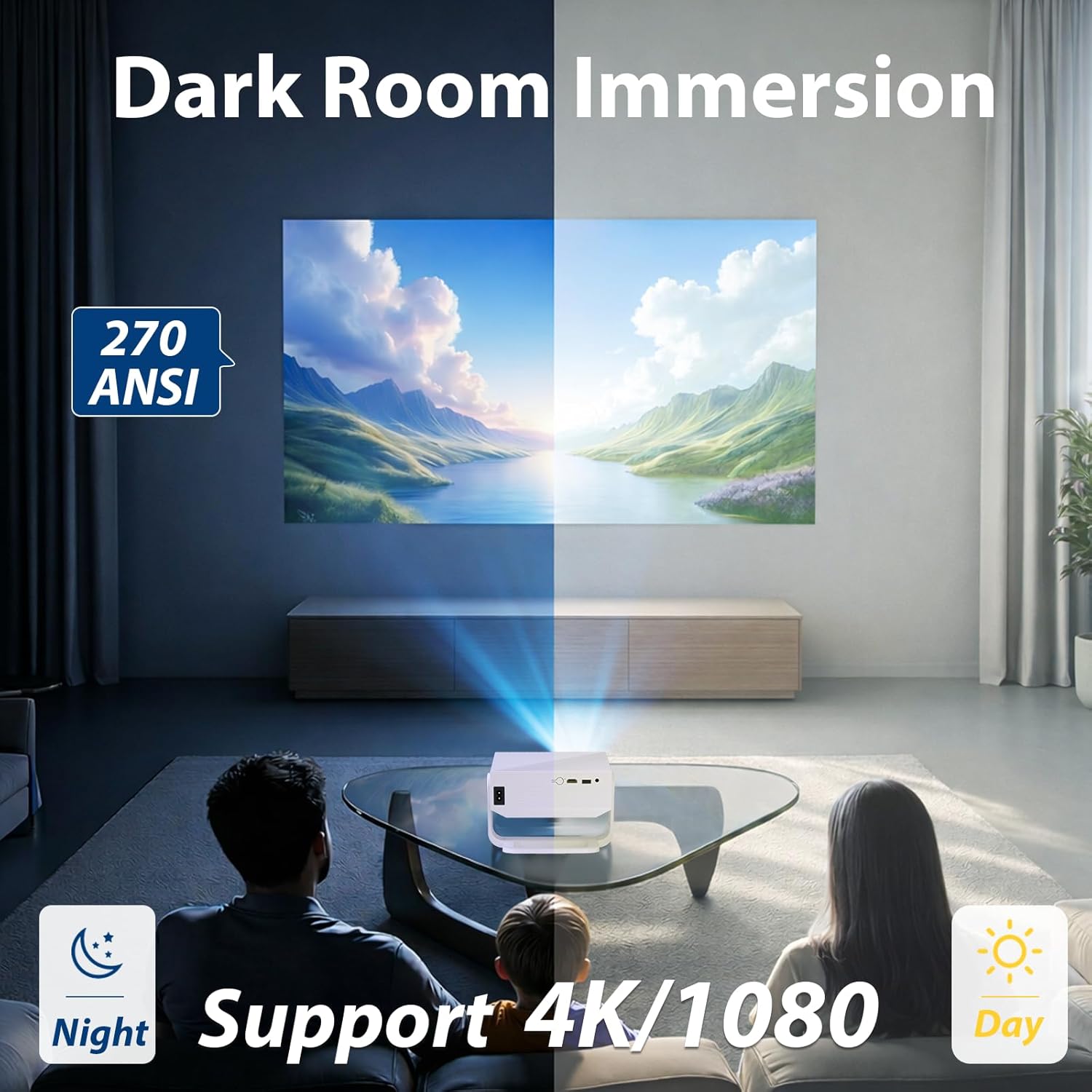
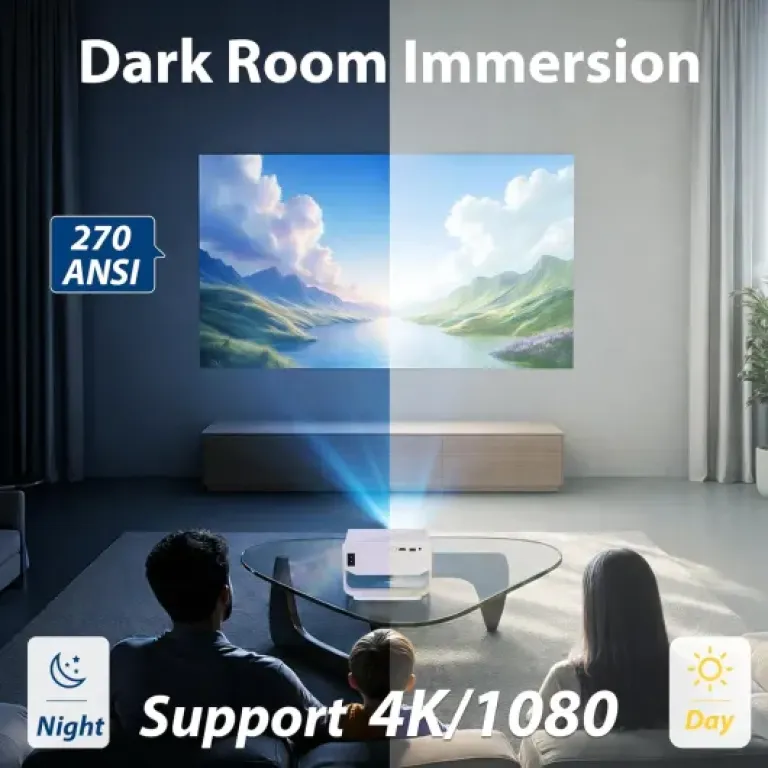
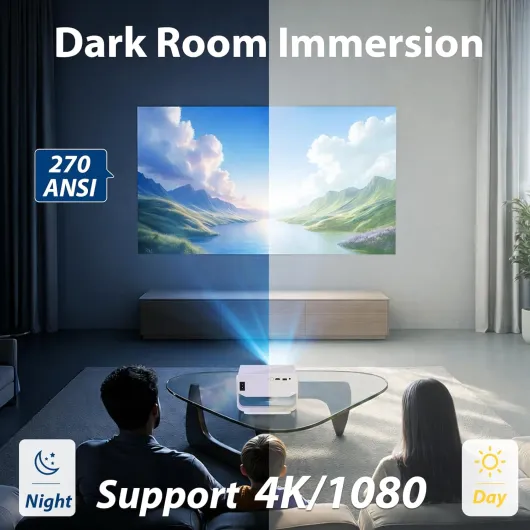
- Modest 270 ANSI lumens limits comfortable use to dark rooms or nighttime viewing
- Built-in speaker likely too weak for users who care about sound quality, making external audio almost mandatory

Specifications
View full product page →| Brand | ZDK |
A compact smart projector aiming to replace your TV
The ZDK 2026 Smart Projector positions itself as a small all-in-one cinema box: Android TV on board, native 1080p resolution, support for 4K input, WiFi 6, Bluetooth 5.2 and a rotating 270° stand. On paper, it targets people who want a simple way to watch Netflix-style content, mirror a phone, plug in a console or laptop, and move the projector easily between rooms or even outside. The published customer feedback is very positive so far, with a 5.0/5 average from a few dozen reviews, which is rare in this category.
Technically, the projector uses an LCD panel with a stated native resolution of 1920 × 1080 and advertises 270 ANSI lumens of brightness. That’s not home-cinema-enthusiast level, but for bedroom or dim living-room use it should be sufficient if you manage ambient light. The brand also pushes the idea of comfort and ease of setup with automatic keystone correction, electronic focus and ultra-quiet operation around 30 dB, which is roughly the noise level of a quiet room according to general acoustic references.
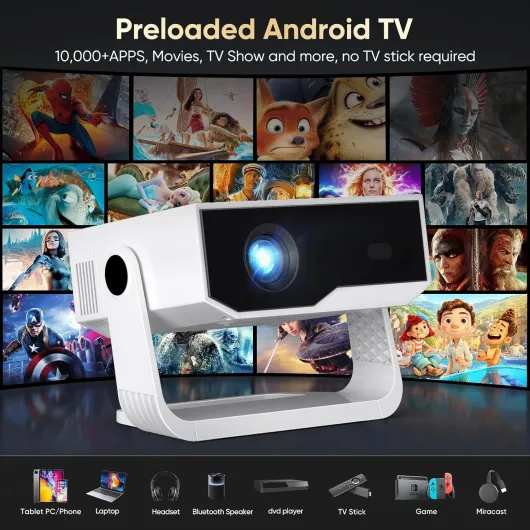
Another strong angle is the integrated Android 14 system, with the promise of 10,000+ downloadable apps and pre-installed licensed streaming apps. That means no mandatory external Fire TV Stick or Chromecast, fewer cables and a cleaner setup. Several reviewers highlight that WiFi and Bluetooth pairing feel straightforward for them, and that the device is easy to handle for non-technical users. In my opinion, that’s one of the core selling points: less tinkering, more watching.
It’s not perfect on paper: 270 ANSI lumens clearly limits optimal use to darker environments, and the built-in speaker is unlikely to rival a soundbar. But between the rotating stand, low weight (about 0.8 kg mentioned in the description), and broad connectivity (HDMI, USB, WiFi 6, Bluetooth 5.2, screen mirroring via the Transcreen app), it looks like a practical small projector for casual home cinema, gaming sessions on a console like PS5, or outdoor movie nights when the sun is down.
Value for money compared with typical mini projectors
In terms of value, this ZDK projector sits in the growing segment of compact smart projectors that try to replace both a TV box and a traditional beamer. The strong points on paper are clear: native 1080p resolution, support for 4K input, Android 14 with a large app library, WiFi 6, Bluetooth 5.2, auto keystone, electronic focus and a 270° stand. Many cheaper mini projectors at similar brightness levels either lack a true Android TV-style system or cut corners on connectivity. Here, you get a fairly complete feature set.
The overall user satisfaction is high: 5.0/5 from a bit more than fifty reviews, with repeated praise for picture quality, ease of use, wireless features and portability. Buyers describe it as a great projector for the price, with clear images and simple setup. That doesn’t automatically guarantee long-term reliability or perfect performance in every scenario, but it does indicate that, for now, people feel they get their money’s worth. For movie lovers who want a simple bedroom projector to watch streaming content, the feature/price balance looks good.
On the downside, the brightness of 270 ANSI lumens is modest. If you plan to watch a lot of content in a bright living room during the day, you’ll probably be disappointed regardless of the brand at this lumen level. Also, the built-in speaker, while convenient, is unlikely to satisfy anyone looking for powerful sound; the positive comments about Bluetooth speakers indirectly show that many users end up pairing external audio. In my opinion, you should factor in the cost of at least a small Bluetooth speaker or soundbar if you don’t already own one.
Compared with more expensive models from big brands (Epson, BenQ, etc.), you give up higher brightness, advanced image processing and often better quality control. Compared with ultra-budget projectors that advertise unrealistic lumen counts and lack proper Android TV, you gain a more coherent package that seems to satisfy real buyers. Overall, assuming the actual selling price stays in a reasonable mid-range bracket, I see this projector as offering solid value for people prioritizing portability, smart features and ease of use over raw brightness and high-end cinema performance.
Compact form factor and 270° rotating stand
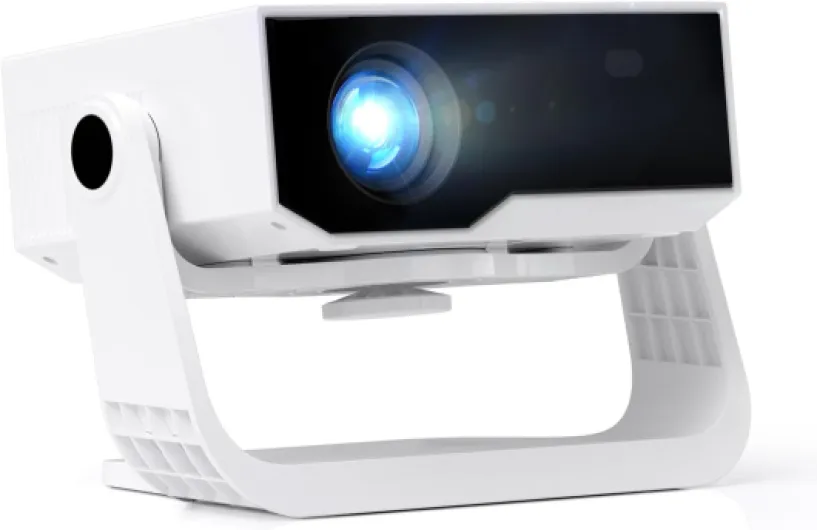
The design of the ZDK 2026 projector is clearly oriented toward portability and easy placement. It comes in a white colour, with a compact rectangular body and an integrated 270° rotatable stand. That stand is one of the key distinctive elements: instead of stacking books or fiddling with a separate tripod, you can theoretically tilt the projector up to project on a wall or even on the ceiling. For bedroom use, projecting onto the ceiling while lying down is precisely the kind of use case the brand highlights.
The declared weight of about 0.8 kg and the relatively small footprint mean it should be simple to move from room to room or to take to a friend’s place or camping. Several reviews mention that the projector is small, lightweight and easy to set up, which fits with the spec sheet. The mounting options are quite broad: tabletop, tripod, wall mount and ceiling mount are all listed, so users who want a more permanent installation can use a standard projector mount, while others can just put it on a piece of furniture.
From a styling point of view, one reviewer notes that the projector has a modern look that blends into room décor. There are no flashy RGB lights or aggressive gaming design, which will please people who want something discreet in a living room or bedroom. Control-wise, you get physical buttons on the unit, a remote control and the option to use a smartphone app, which is practical if the projector is ceiling-mounted or placed in a hard-to-reach position.
In my opinion, the design choices make sense for the target: small apartments, bedrooms, casual outdoor use. The 270° stand and automatic keystone correction go hand in hand: tilt it roughly where you want, let the projector adjust the image shape, and you’re ready. It’s not a premium metal chassis or an ultra-slim design, but as a compact plastic box that focuses on flexibility and ease of placement, it looks coherent and practical.
Accessories and setup experience from the box contents
The packaging of the ZDK 2026 is fairly complete for a consumer projector. You get the projector itself, a power cable, an HDMI cable, a remote control, a user manual and a lint-free cleaning cloth for the lens. There is also mention of an adapter included. The only obvious omission is batteries for the remote, which are explicitly stated as sold separately. For a first setup, that means you can plug in a laptop, console or streaming stick immediately via HDMI without needing to buy extra cables.
The included HDMI cable is a practical touch, especially for people who are not heavily equipped with spare cables. The lens cleaning cloth is also useful, considering that fingerprints or dust on the front lens can quickly degrade perceived sharpness. Combined with the removable dust filter, it shows at least some attention to maintenance in the package. The manual is mentioned but not described in reviews, though given the positive comments around ease of setup, it’s likely that the instructions are clear enough for most users.
Several buyers emphasize how easy and quick it is to get the projector up and running. Comments mention that setup is a breeze, WiFi connects easily and Bluetooth pairing with speakers works as expected. This suggests that the initial experience from opening the box to starting a movie is straightforward: plug in, pick a source (Android apps, screen mirroring, HDMI), adjust focus electronically, let auto keystone do its thing, and you’re done. In my opinion, that aligns with the all-in-one positioning of the device.
It’s also worth noting that the mounting versatility (tabletop, tripod, wall, ceiling) means the packaging could have included a basic tripod or ceiling mount, but it doesn’t. So if you plan a permanent ceiling installation, you will need to budget for a separate mount. Still, for a compact projector in this segment, the accessories are decent and cover the essentials, especially for casual users who want to start projecting movies or games without hunting down extra cables on day one.
Build, noise level and maintenance over time
For durability, there are a few concrete elements worth noting. First, the projector uses an integrated dust filter design to protect the lens and internal optics. The filter is described as easy to remove and clean, which is important for LCD projectors: dust spots can appear on the image over time if the optics are not well protected. Having a removable filter means you can maintain the device without opening the chassis or doing complicated operations, which should help keep picture quality consistent and extend the life of the unit.
The brand also insists on a quiet ventilation system, announcing around 30 dB of noise. That’s roughly the level of a quiet room, at least on paper. Several reviews state that the projector runs quietly and doesn’t disturb movie viewing, which supports the idea that fan noise is under control. For long sessions like films or series binges, that matters more than people often think, especially in a bedroom where you are closer to the device.
In terms of physical robustness, user comments mention that the projector feels well-built for its size and that it travels easily. There are no recurring complaints about broken parts, overheating or sudden failures among the published reviews so far. That said, there is also no long-term feedback over many months or years in the public comments yet, so it’s hard to draw conclusions about very long lifespan. As with most compact projectors, you can reasonably expect that careful handling and regular dust filter cleaning will be key to keeping it running well.
The advertised brightness of 20,000 lumens in the description clearly refers to non-ANSI marketing lumens, while 270 ANSI lumens is the more realistic standard value. There is no stated lamp or LED lifespan in hours, which is a bit of a missing spec; many competitors list 20,000–30,000 hours for their LED light sources. In my opinion, the device looks decent in terms of durability for a small home projector, but if you want rock-solid long-term reliability and professional-grade build, you’d have to look at higher-priced brands with more detailed longevity data.
Image quality, brightness and smart features in practice
On the performance side, the combination of native 1080p resolution, HDR10+ support and 270 ANSI lumens gives a mid-range profile. Full HD at this price bracket is standard today, and reviewers consistently describe the picture as clear and sharp for its size. One buyer specifically mentions that the image is crisp and bright enough for home theater or everyday video viewing, which lines up with what you’d expect from 270 ANSI lumens in a dim environment. This is not a daylight-beating projector; it is more for dark rooms or nighttime outdoor use.
The spec sheet highlights HDR10+ as picture enhancement. On paper, HDR10+ can improve contrast and perceived dynamic range, but with 270 ANSI lumens and an LCD panel, expectations should stay moderate: you’re not getting OLED-like blacks. Still, buyers seem satisfied with contrast and overall image quality in real use, especially considering the compact form factor. The advertised minimum throw distance of 4.6 feet for a 40-inch image and maximum of 15.8 feet for up to 240 inches gives flexibility, though, in my opinion, the sweet spot will be around 80–120 inches where 1080p resolution and brightness balance best.
In terms of responsiveness, WiFi 6 is a good sign for streaming and screen mirroring. Reviewers say WiFi connects easily and phone mirroring works, which suggests the software side is at least sufficiently optimized. For gaming, the brand mentions lag-free gaming with WiFi 6, but there is no explicit input lag figure. So for casual console gaming on PS5 or Switch it will probably be fine, but competitive players sensitive to latency might prefer a monitor or a higher-end projector with measured low input lag.
Finally, the smart features: Android 14, app downloads, built-in licensed apps and the Transcreen mirroring app. Several buyers praise how easy it is to use and set up, and one comment notes that the projector is very suitable for both indoor and outdoor movie nights due to its versatility with Android, iOS, Windows, TV sticks, HDMI and USB. In my opinion, that’s the real strength: instead of being just a dumb projector, this device behaves like a small Android TV box with projection, which simplifies everyday use even if some very advanced users might still prefer their own streaming stick for updates and app support.
What this ZDK smart projector actually offers
The ZDK 2026 Smart Projector is essentially a mini home cinema hub. It claims native Full HD 1080p resolution (1920 × 1080 pixels) and accepts 4K input signals, which are then downscaled to 1080p. For content, it runs Android 14 with access to a large app library, and the description insists on pre-installed licensed apps, which usually means you can launch major streaming services directly without extra hardware. For people who don’t want additional dongles, that’s a concrete plus.
On the connectivity side, it offers HDMI, USB, WiFi and Bluetooth. WiFi 6 should give more stable streaming and less buffering if your router and internet connection are decent. Bluetooth 5.2 is used primarily to link external speakers or soundbars, something several buyers explicitly mention doing without trouble. There is also app control and a specific “Transcreen” app for screen mirroring and remote control from a phone, which is meant to simplify compatibility with both iOS and Android devices.
For projection, the brand announces a brightness of 270 ANSI lumens, a minimum image size of 40 inches and a maximum of 240 inches, with throw distances from 4.6 to 15.8 feet. In my opinion, going anywhere near the maximum 240 inches with 270 ANSI lumens is optimistic; realistically, most users will probably stay around 80–120 inches in a dark room to keep a decent image. The automatic keystone correction and electronic focus are supposed to deliver a rectangular, sharp picture quickly, regardless of small angle variations, which buyers often appreciate in their comments.
The package is straightforward: projector, power cable, HDMI cable, remote control (batteries not included), user manual and a lint-free cleaning cloth for the lens. It weighs around 0.8 kg and the dimensions listed are roughly 195 × 146 × 134 mm in one place and 15.4 × 18 × 22.6 cm in another, so it’s clearly compact, even if the exact measurements are a bit inconsistent. Overall, the presentation is that of a versatile, portable projector that tries to balance features, simplicity and price rather than chasing high-end image specs.
Pros
- Native 1080p resolution with HDR10+ and support for 4K input in a compact, portable body
- Integrated Android 14 with WiFi 6 and Bluetooth 5.2, allowing direct streaming and easy connection to external speakers
- 270° rotating stand with auto keystone and electronic focus for quick, flexible setup on walls or ceiling
Cons
- Modest 270 ANSI lumens limits comfortable use to dark rooms or nighttime viewing
- Built-in speaker likely too weak for users who care about sound quality, making external audio almost mandatory
Conclusion
Analysis score
The ZDK 2026 Smart Projector comes across as a practical little home cinema machine rather than a spec monster. You get native 1080p, 270 ANSI lumens, Android 14 with streaming apps, WiFi 6, Bluetooth 5.2, auto keystone, electronic focus and a 270° rotating stand in a compact body around 0.8 kg. Published buyers are very satisfied overall, repeatedly highlighting the clear picture, simple setup, quiet operation and the convenience of wireless connectivity and built-in apps.
In my opinion, it suits people who want an easy projector for bedroom movies, relaxed console gaming, and occasional outdoor screenings after dark. The integrated Android system means less cable clutter and no mandatory extra dongle, and the rotating stand plus automatic corrections make it friendly for users who don’t want to fiddle with manual adjustments. As long as you manage ambient light and accept that the internal speaker is only a starting point, it seems to deliver what most casual users expect.
Those who should probably look elsewhere are users who need high brightness for daytime viewing, home cinema enthusiasts chasing perfect blacks and colour calibration, or people who want long-term, professional-grade reliability with detailed warranty and lifespan specs. For the typical home user wanting a compact, smart, and relatively affordable projector with strong user feedback, the ZDK 2026 looks like a sensible option that gets the essentials right without pretending to be high-end.