Summary
Analysis score
Average of the criteria rated below
Is the Midea 5L Air Cooler good value for money?
Tall tower format and practical controls
Plastic build and treated water tank: decent but nothing premium
Build longevity and maintenance considerations
Airflow, noise, and features: does it run well day to day?
What this Midea 5L Air Cooler actually is (and is not)
Cooling effect: better than a fan, but not real AC
Pros
- Strong airflow (up to 1600 m³/h / 944 CFM) with 75° oscillation in a tall tower format
- 3‑in‑1 use (fan, humidifier, evaporative cooler) with 5 L tank and included ice packs
- Low noise on lower speeds and convenient features: remote control, 7‑hour timer, no bright lights at night
Cons
- Not a real air conditioner: limited impact on whole‑room temperature, especially in humid climates
- Relatively tall and heavy for storage (about 1 m high and 7.9 kg)
- Instruction manual described as unclear by at least one buyer, making some features less obvious

Specifications
View full product page →| Brand | Midea |
A budget way to cool down without full air conditioning?
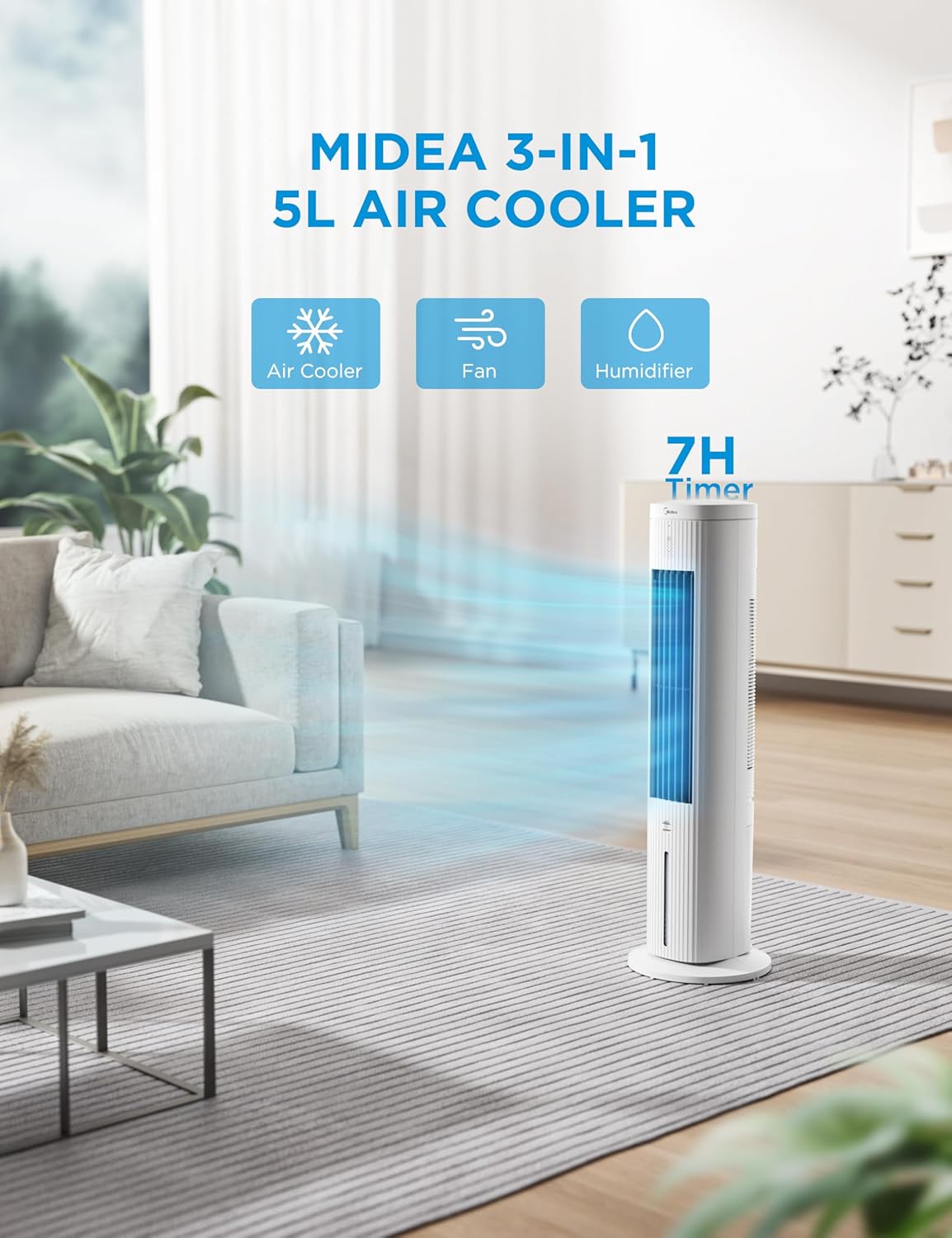
The Midea 5L Air Cooler sits in that grey area between a simple tower fan and a real portable air conditioner. On paper, it offers a lot for a modest power draw: 55 W, a 5 L water tank, evaporative cooling with ice packs, and a quoted airflow of 1600 m³/h (about 944 CFM). The brand presents it as a 3‑in‑1 unit: fan, humidifier, and air cooler, plus some air purification thanks to negative ions and a treated water tank. With a height of around 1 meter and a weight of 7.9 kg, it’s clearly meant as a floor‑standing appliance for bedrooms, offices, and living rooms.
Among the published reviews, the general tone is positive. The average rating of 4.4/5 over roughly a hundred reviews suggests that most buyers feel it gets the job done in hot weather, at least compared to a basic fan. Several verified purchases describe it as a strong alternative to a portable AC unit when the budget or space does not allow for a compressor‑based machine. Others are more cautious and remind that this is not an air conditioner and will not bring room temperature down like a heat pump or refrigerant‑based system.
In my opinion, that’s the key context to keep in mind. This is an evaporative cooler with tower‑fan form factor: it blows air across a wet medium and water/ice to produce a cooler breeze and a bit more comfort. It will not turn a 30 °C room into a 22 °C room in a few minutes, but it should provide a more pleasant airflow than a standard fan, especially at close to medium distance. The spec sheet also pushes convenience: remote control, 7‑hour timer, three speeds, and an oscillation of 75° to share the airflow around the room.
So the real questions are simple: how effective is this type of product in a typical flat or house, is the noise level reasonable, and does the build and feature set justify the price bracket where it sits? Looking at the technical details and the various comments, the Midea MAC25JRWUK looks like a solid, if not perfect, compromise for people who want a bit more than a fan but can’t or don’t want to go for a real AC unit.
Is the Midea 5L Air Cooler good value for money?
The price is not displayed here, but given the specs and how buyers talk about it (some mention buying it during a Black Friday deal and still considering it good value at full price), it clearly sits in the mid‑range of tower fans/evaporative coolers. For that, you get a 55 W tower unit with a 5 L tank, 3 speeds, 2 modes, 7‑hour timer, remote control, oscillation, and some extra features like negative ions and silver‑ion tank treatment. The average rating of 4.4/5 from 97+ reviews suggests that most people feel they got their money’s worth.
Where the value really shows is for users who wanted something more effective than a simple fan but cheaper and simpler than a portable AC. Several reviewers explicitly say they couldn’t afford an AC unit and turned to this cooler instead, and they sound satisfied with the comfort improvement. Others call it a “fantastic bit of kit” and highlight how quickly it made a room feel more bearable during hot weather. The low power draw is also part of the value equation: 55 W is far lower than the 700–1000+ W you see on compressor‑based air conditioners, so running costs should stay modest even if you leave it on for hours.
The main limitation for value is expectations management. A few users were somewhat disappointed by how little effect ice cubes and ice blocks seemed to have on overall room temperature. That’s not really a flaw of this particular model; it’s just how evaporative cooling behaves, especially in more humid climates. But if someone buys it expecting full AC‑style cooling for an entire large room, they might judge the price more harshly. For people who understand that they are paying for a strong fan with a cooling boost and a decent feature set, the price/performance ratio looks solid.
In my opinion, this Midea unit hits a good balance: you pay more than for a barebones tower fan, but you gain stronger airflow, water‑based cooling, a timer, remote, and some air‑quality tweaks. There are certainly cheaper fans and much more powerful (and costly) portable ACs, but in the middle, this is a sensible compromise. The 2‑year warranty and mostly positive feedback back up the idea that you’re not throwing money at something flimsy. So as long as you buy it with realistic expectations, the value for money is quite convincing.
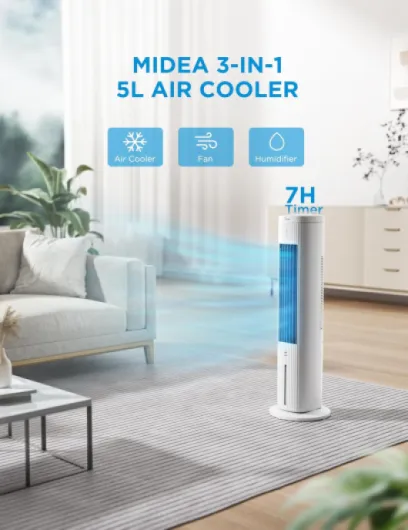
Tall tower format and practical controls
Design‑wise, the Midea air cooler goes for a modern, neutral look: a white tower roughly 100 cm tall and 31 x 31 cm at the base. At 7.9 kg, it’s not feather‑light, but it’s still manageable, and the built‑in handle mentioned in the description should make it easier to move between rooms. Several reviews mention that it is “tall enough to fan over a bed,” which is one of the main practical benefits of the tower design: you get airflow at body and head height without having to put the unit on a table or stand.
The control layout is fairly straightforward. There is an intuitive touch panel with an LED display on the top, plus a remote control included in the box. Buyers highlight the convenience of the remote, especially for bedroom use: one review notes that being able to adjust speed and swing from bed is a real plus. Another positive point that appears in the comments is that the unit can run with no light during the night, so you don’t have a bright display keeping you awake. That’s a small detail but important for people sensitive to LEDs in the bedroom.
The oscillation is specified at 75°, which is standard for tower fans. Combined with the quoted airflow of 1600 m³/h, this should allow the unit to cover a sofa area or a double bed area without having to be pointed manually all the time. There is also a static mode if you prefer directed airflow. From a design perspective, this is nothing revolutionary, but it lines up well with what people expect from a mid‑range tower fan: a slim footprint, enough height, and a swing function that actually moves a decent amount of air.
In my opinion, the design is one of its stronger points: neutral color, tower layout that doesn’t look out of place in a living room, and controls that match modern expectations. The downside is the size and weight for storage: one buyer notes that it’s relatively heavy and tall, which can be annoying if you plan to put it away for the winter in a small cupboard. So it’s better suited to someone who will leave it out or has enough storage space rather than someone in a very cramped studio.
Plastic build and treated water tank: decent but nothing premium
The spec sheet is clear: the Midea air cooler is made of plastic, with a freestanding tower form factor. That’s standard in this category; metal housings are rare at this price and power level. The plastic approach keeps weight under 8 kg despite the height and water tank. Reviews generally describe the unit as well made and solid for the price. One buyer calls it “excellent quality for the price,” which suggests that, visually and mechanically, it doesn’t feel flimsy or badly finished for a typical home environment.
The water tank is where Midea tries to stand out a bit. The brand highlights a silver‑ion treatment on the inner wall of the tank, meant to slow down bacterial growth and keep the water fresher. For an evaporative cooler that may run for hours with standing water, that’s a sensible choice. On paper, this should reduce bad smells and slimy deposits compared to a completely untreated tank, as long as the user still does basic cleaning. There is no detailed breakdown in the reviews about long‑term hygiene, but the absence of complaints about foul smells or heavy mould in the comments is at least a neutral sign.
The internal “large‑air wet curtain” mentioned in the description is likely a standard evaporative pad. There isn’t much user detail about its thickness or how easy it is to remove and clean, which is a bit of a blind spot. With evaporative coolers, the pad is a wear part: dust and limescale can clog it over time, especially in hard‑water areas. So even if the external plastics are solid, long‑term performance can depend on how easy that pad is to maintain or replace. In my opinion, this is one of the limits of buying based only on the spec sheet: you have to assume it’s a typical pad unless the brand clearly advertises otherwise.
Overall, the materials look aligned with the price segment: functional plastic shell, treated tank, standard evaporative internals. Don’t expect a premium metal chassis or ultra‑thick plastics, but nothing in the reviews suggests creaky panels or parts breaking quickly. For a unit rated at 55 W and meant for residential use, the material choices are logical and help keep cost and weight under control.
Build longevity and maintenance considerations
Durability for an evaporative cooler is as much about design and maintenance as it is about raw materials. The Midea unit comes with a 2‑year manufacturer warranty, which is reassuring for an appliance in this segment. That suggests the brand is reasonably confident about the motor, electronics, and pump lasting at least through a couple of summers. Among the reviews, there are no widespread complaints about early failure, broken parts, or severe quality issues, which is usually a good sign when a product has close to a hundred ratings.
The plastic construction has pros and cons for longevity. On the plus side, plastics don’t rust, and the weight stays manageable at 7.9 kg. If the housing is reasonably thick and well‑assembled, it should handle normal moving around the house. A few buyers describe it as “well made” and “excellent quality for the price,” which hints that the plastics don’t feel super flimsy. On the downside, plastic housings can scratch and yellow over time, and any rough handling (knocking it over, dragging it on rough floors) could lead to cracks. So it’s better treated as a semi‑stationary appliance rather than something you constantly drag between rooms multiple times a day.
The water system and evaporative pad are the more delicate part long‑term. The silver‑ion treatment on the tank walls should help reduce bacterial growth, but it doesn’t eliminate the need for periodic cleaning. If water is left standing for days in warm weather, any cooler can develop slime or odours, regardless of coatings. The reviews don’t dive into maintenance routines, which leaves some uncertainty, but that’s typical: most buyers only comment when something goes very wrong. For people in hard‑water areas, limescale can clog nozzles and pads over time, so using filtered water or doing occasional descaling would be wise to preserve performance.
In my opinion, if you treat the Midea air cooler as a seasonal appliance, clean the tank from time to time, and avoid physical abuse, it should last a few summers without drama. The 2‑year warranty covers early defects, and the absence of recurring complaints about breaks or leaks in the public comments is reassuring. It’s not a lifetime machine with industrial‑grade components, but for the price and category, the durability outlook is decent, provided the user is willing to do basic maintenance.
Airflow, noise, and features: does it run well day to day?
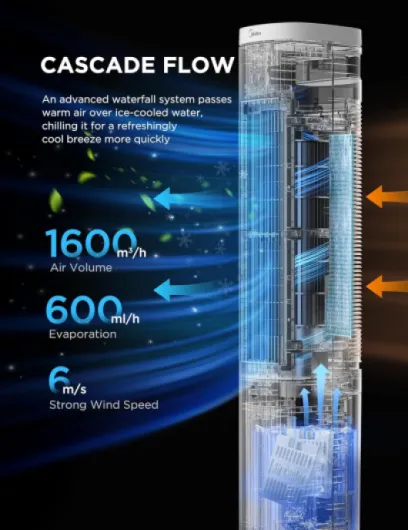
On paper, the performance of the Midea air cooler is shaped by three main factors: airflow, noise level, and feature set. The unit is rated for an airflow capacity of 944 CFM (1600 m³/h) and a maximum wind speed of 6 m/s. For a 55 W tower cooler, those figures are solid. Several reviews back this up indirectly, describing it as a “powerful fan” and noting that even the lowest fan setting is “quiet but powerful for night.” The three speed levels give some flexibility between gentle breeze for sleeping and stronger airflow for daytime heat.
The quoted noise level is 30 dB, though that figure is usually for the lowest setting and measured under ideal lab conditions. In the real world, buyers describe noise as “well within reasonable levels” and “much quieter than my existing tower fan.” One user mentions that at full speed it’s “a little noisy” but still not enough to disturb sleep. That’s a pretty good sign for a device that moves this much air. For people sensitive to noise, the low setting seems to be the sweet spot for nights, while medium and high are more for daytime when background noise is less of an issue.
Feature‑wise, the 7‑hour timer, oscillation, and remote control round out the performance picture. Being able to set a shut‑off time is handy both for sleep and for limiting energy use. The 75° automatic oscillation helps distribute airflow across a bed or sofa, while the option to keep it static lets you focus cooling on one person. Reviews highlight the usefulness of the remote, especially in bedrooms, and the fact that the unit can operate without bright lights at night is often mentioned as a plus. The two operation modes (normal and natural) give a bit of variety; the “natural” mode usually simulates gusts by varying fan speed, which some people find more comfortable.
In my opinion, this is where the Midea model earns its positive rating. For a modest power draw, it offers strong airflow, acceptable noise levels, and practical features that actually get used. There is no Wi‑Fi or app control, but in this price range that’s not a major loss. If your priority is a simple, reliable way to move a lot of air with the option of water‑based cooling, the performance package looks convincing, as long as you keep your expectations realistic about whole‑room temperature drops.

What this Midea 5L Air Cooler actually is (and is not)
On paper, the Midea 5L Air Cooler (model AC100-25JR / MAC25JRWUK) is an evaporative air cooler packaged in a slim tower format. It draws 55 W at 220 V, offers three fan speeds, two operation modes (normal and natural breeze), a 7‑hour timer, and 75° automatic oscillation. The water tank holds 5 litres, and Midea supplies two ice packs that can be frozen and placed in the tank to boost the cooling effect. The brand advertises a maximum airflow of 1600 m³/h and a maximum wind speed of 6 m/s, which is substantial for a 55 W appliance.
Very important point: this is not a refrigerant‑based air conditioner. There is no compressor, no exhaust hose, and no heat being pumped outside. It’s closer to a fan that passes air over a wet curtain and cold water, which can make the air feel cooler on your skin, especially in drier conditions. Several buyers underline this distinction clearly: one 5‑star review explicitly says it is an excellent fan but “NOT Air Con” and warns that it will not cool the room in the same way or drop ambient temperature like a proper AC.
Midea also pushes an air quality angle. The cooler is supposed to release negative ions (quoted at 2500 cm³), which, in theory, help dust particles clump and fall out of the air, and the inner wall of the tank is treated with silver ions to limit bacterial growth and keep the water fresher. There is no serious third‑party lab data in the comments about how much difference that makes, but on paper it’s at least more than a barebones water tank. For a residential unit meant for bedrooms and offices, this is a nice extra, even if it should be considered a bonus rather than a full air purification system.
The manufacturer claims suitability for rooms up to 70 m². In my opinion, that figure is optimistic for real cooling effect: for actually changing how a big room feels, this type of 55 W evaporative cooler is usually more comfortable in small to medium spaces or used near the user (bed, desk, sofa). As a fan distributing air in a larger room, the 1600 m³/h airflow is decent, but buyers should expect spot cooling and improved comfort rather than a true “climate control” experience.
Cooling effect: better than a fan, but not real AC
Effectiveness is where expectations often clash with reality for this kind of product. On the positive side, several buyers report that the Midea air cooler clearly improves comfort in hot weather. One review during a heatwave says the cool air it circulates is “amazing” and even mentions that they haven’t needed to use the cooling (water) function yet, which suggests that the plain fan mode already feels strong enough. Another user measured, with a simple thermometer, an indoor temperature of 25 °C while it was 31 °C outside, claiming that with the fan on low they felt cool enough, and on high they would be “shivering.” That’s anecdotal but gives an idea of perceived impact in a typical home.
On the other hand, some comments are more down‑to‑earth. A 5‑star reviewer emphasizes that it’s “not air con” and says it will not cool the room itself or circulate air like a full AC unit. Another 4‑star buyer found that adding ice cubes and ice blocks in the water tank had limited effect and admitted being somewhat disappointed by that aspect, while still acknowledging that the room felt fresher and the fan was powerful. This matches what one would expect from a 55 W evaporative cooler: you get a cooler breeze, especially in direct airflow, but you shouldn’t expect a dramatic drop in ambient temperature across a whole large room.
From a technical standpoint, the claimed maximum airflow of 1600 m³/h and wind speed of 6 m/s are quite decent numbers for a tower form factor. Combined with the 75° oscillation, this should be enough to make a noticeable difference in a bedroom, office, or living room area if you position the unit reasonably close. The 5 L tank, with ice packs, is advertised as giving up to 12 hours of cooled operation, which, if accurate, means you can run it through most of the day or night without refilling, though the real cooling intensity will obviously depend on room temperature and humidity.
In my opinion, the effectiveness is good as long as you see it as a “strong fan with a cooling boost,” not as a substitute for a 9,000–12,000 BTU portable air conditioner. Buyers who seem happiest are those who wanted to make sleeping or working in hot weather more bearable without dealing with vents, hoses, or high electricity bills. Those hoping for AC‑like performance sometimes sound a bit underwhelmed, especially about the ice‑boosted mode. So it does its job, but the job is spot cooling and comfort, not full climate control.
Pros
- Strong airflow (up to 1600 m³/h / 944 CFM) with 75° oscillation in a tall tower format
- 3‑in‑1 use (fan, humidifier, evaporative cooler) with 5 L tank and included ice packs
- Low noise on lower speeds and convenient features: remote control, 7‑hour timer, no bright lights at night
Cons
- Not a real air conditioner: limited impact on whole‑room temperature, especially in humid climates
- Relatively tall and heavy for storage (about 1 m high and 7.9 kg)
- Instruction manual described as unclear by at least one buyer, making some features less obvious
Conclusion
Analysis score
The Midea 5L Air Cooler is basically a beefed‑up tower fan with water‑based cooling and a few extra tricks. It doesn’t behave like a true air conditioner, and several buyers insist on that point, but it clearly offers better comfort than a standard fan for many people. With 55 W power draw, 1600 m³/h airflow, a 5 L tank, and a 1 m‑tall tower format, it’s built to sit in a bedroom, office, or living room and push a solid stream of air at a comfortable height. The remote control, 7‑hour timer, and dark‑room‑friendly display make it especially suited for night‑time use.
In my opinion, it fits best for users who: live in a small to medium space, want relief during warm spells, don’t have the budget or setup for a portable AC, and are happy with spot cooling rather than full climate control. If you’re expecting to drop a large room from 30 °C to 22 °C just by adding ice to the tank, you’ll likely find it underwhelming. If you mainly want a quiet, strong tower fan that can send a cooler breeze over your bed or sofa and run cheaply for hours, it looks like a good pick. The average 4.4/5 rating, 2‑year warranty, and lack of recurring quality complaints support the idea that it’s a solid, if not spectacular, piece of kit for the money.