
Summary
Analysis score
Average of the criteria rated below
Value for money: niche solution with clear trade-offs
Slim, bladeless, and adhesive-mounted: design strengths and limits
Cordless 6000 mAh battery and wireless charging
Build quality, adhesive mounting, and long-term reliability
Cooling and noise: what to realistically expect
What this 3‑in‑1 portable wall unit actually offers
Pros
- No-drill adhesive wall mounting, good for renters and temporary setups
- Integrated 6000 mAh battery with USB‑C charging for cordless use up to several hours
- Slim, lightweight, bladeless design with remote control and multi-surface mounting
Cons
- Specs are inconsistent and do not clearly indicate real AC-level cooling performance
- Generic branding and vague data reduce confidence in long-term reliability
- Adhesive mounting may be less secure on some surfaces and over long periods

Specifications
View full product page →| Brand | Generic |
Cordless wall AC that sticks to the wall: clever or gimmick?
This “Portable Air Conditioner, 3 in 1 Cooling Fan & Bladeless Wall Mount AC” is clearly trying to solve a common problem: how to cool a small room when you can’t drill holes or install a real split system. On paper, it mixes several ideas in one product: wall-mount form factor, adhesive installation, a 6000 mAh battery for cordless use, and a bladeless front for safer airflow. It targets bedrooms, home offices, rentals, RVs, and even camping, according to its description.
Unlike a classic mobile AC with a compressor and exhaust hose, this unit behaves more like a compact, wall-mounted cooling fan. The spec sheet mentions 220 W power, 150 sq ft coverage, three airflow speeds, and very low noise (4 dB claimed, which is basically silence on paper). It’s also light at about 580 g and only 4.3 inches deep, with a 45 cm width, so it should fit above a bed or desk without taking over the wall.
The brand is listed as “Generic”, and the model as “12000 BUT AC”, which already raises an eyebrow: the “12000 BUT” label looks like someone tried to reference BTU cooling power but ended up with a typo. That kind of inconsistency is something many buyers usually associate with white‑label products resold under random names. It doesn’t automatically mean it’s bad, but it does call for a careful look at what is actually offered.
In my opinion, this product sits halfway between a fan and a real AC. It promises instant cooling in 10 seconds, wireless charging, and no‑drill wall mounting, which is attractive for renters and small rooms. At the same time, some specs look optimistic or unclear, and the generic branding doesn’t inspire a lot of confidence. It’s the kind of device that could be handy if your expectations are realistic and you understand you’re not getting a full‑blown split system with outdoor unit and proper heat extraction.
Value for money: niche solution with clear trade-offs
The price is not displayed here, but we can still look at the value proposition relative to what it offers and what it clearly does not. You’re getting a wall-mounted, bladeless fan-style unit with a built-in 6000 mAh battery, remote control, and adhesive mounting. You’re not getting a true split-system AC with an outdoor unit, proper BTU-rated cooling, or serious dehumidification. So the right comparison is with portable fans, evaporative coolers, and small wall-mounted fans, not with full-blown air conditioners.
Against a basic desk fan or tower fan, this unit brings some extras: wall mounting without drilling, cordless operation, and a remote. That can justify a higher price if you really need those features, especially in rentals where drilling is forbidden or in RVs where space is tight. On the other hand, a well-known portable AC brand will usually provide clear BTU ratings, power consumption data, and exhaust options, and will actually reduce room temperature. This generic model doesn’t clearly demonstrate such capabilities, so paying “real AC” prices for it would not make much sense.
The energy efficiency rating of A+++ and the claimed 1000 kWh annual consumption look out of place for a 220 W, battery-powered device used seasonally. I would not factor those numbers heavily into a value judgment. The more meaningful specs are its dimensions, battery capacity, and convenience features. If the price is close to mid-range tower fans plus a basic wall-mount kit, it could be a fair deal for renters and campers. If it’s priced near compact true AC units from known brands, then in my opinion the value drops sharply because the performance gap is huge.
In my opinion, the value is very context-dependent. For someone who just wants more comfortable airflow above a bed or desk, can’t drill walls, and likes the idea of cordless use during outages, this could be a practical gadget if found at a reasonable price. For someone expecting serious room cooling in a hot climate, the lack of transparent cooling specs means you’re better off investing in a known portable AC or mini-split, even if it means more installation hassle and a higher upfront cost.

Slim, bladeless, and adhesive-mounted: design strengths and limits
The design is built around a bladeless front and wall-mounted form factor. The bladeless approach is similar in concept to tower fans that push air through a slot, which is usually safer for kids and pets and easier to wipe down. The housing is ABS plastic, available in black or white, and the overall footprint is 45 cm wide, 20 cm high, and 20 cm deep. With a profile of around 4.3 inches, it’s meant to sit close to the wall and avoid sticking out like bulkier portable AC units.
The unit can be mounted both vertically and horizontally, and the kit includes adjustable angle brackets to direct airflow. That’s useful if you want to blow air along the ceiling, directly at the bed, or across a desk. The manufacturer recommends avoiding direct sunlight for better performance, which is usual for any cooling device, but here it also matters for the adhesives, which can weaken with sustained heat. The weight of about 580 g is light enough that good adhesive strips can realistically hold it on tile or painted drywall, as long as the surface is clean and the installation is done carefully.
A key part of the design is the no‑drill, adhesive‑only mounting system. For renters, this is a big plus because it avoids holes in walls, anchors, or landlord complaints. The downside is that adhesive solutions can be sensitive: if the wall is dusty, textured, or slightly moist (bathroom, poorly ventilated kitchen), adhesion might be weaker. Among similar products, buyers often report mixed results with adhesive mounts; some are happy, others see the unit detach over time. So while the concept is attractive, I’d treat the mounting as something you may want to reinforce if you plan to leave it up permanently.
In my opinion, the design clearly prioritizes ease of placement and discretion over heavy-duty robustness. The low depth, light weight, and simple look make sense for a bedroom or a home office where you want something that blends in and doesn’t look like an industrial appliance. But the generic branding and slightly confusing model naming (“12000 BUT Cooling Fan & Bladeless”) give the impression of a low- to mid-range device rather than a carefully engineered HVAC product. Visually and functionally, it should work fine as a neat wall fan with a modern look, but it doesn’t scream premium construction.
Cordless 6000 mAh battery and wireless charging
One of the most original aspects of this device is its integrated 6000 mAh battery, combined with what the description calls “wireless charging” and USB‑C recharging. The manufacturer claims up to 8 hours of cordless operation. With 220 W listed power, that runtime would only be possible at a much lower effective draw or at low speed, because a 6000 mAh battery at typical voltages simply cannot sustain 220 W for that long. So the 8‑hour figure should be seen as a best-case scenario at minimum fan speed rather than a promise at full power.
The “wireless charging” mention is a bit vague. It could mean the unit can sit on a charging base or use some kind of contact pad, or it could just be a loose marketing term. The spec sheet also clearly lists USB‑C recharging, which is a strong point: you can plug it into common phone chargers, power banks, or a laptop port, as long as the power output is sufficient. For camping or during a power outage, that flexibility is useful. You could, for example, run it cordlessly at night and top it up during the day from a solar power station or a large power bank.
On paper, the 6000 mAh capacity is more typical of a portable fan than of a serious AC. Many battery-powered desk fans with similar capacity run between 3 and 10 hours depending on speed. So it’s reasonable to expect something similar here: a few hours of strong airflow, longer runtime on the lowest speed. The lack of detailed consumption figures per mode means you can’t accurately predict runtime, but at least the presence of a battery provides some resilience if the power goes out or if you’re in an RV without constant shore power.
In my opinion, the battery setup is one of the practical advantages of this product. It makes the wall-mount form factor more flexible, since you’re not limited to placing it near an outlet or routing a cable along the wall. The flip side is that the marketing around “wireless charging” and 8-hour runtime feels a bit optimistic and not very transparent. I’d see it as a cordless fan with decent battery backup, not a device you can run at max speed all night without thinking about charging or power draw.
Build quality, adhesive mounting, and long-term reliability
The construction is based on ABS plastic, which is common for small appliances: light, inexpensive, and reasonably resistant to bumps and scratches. With a listed weight of around 580 g, the housing doesn’t need to be massively reinforced to stay in one piece. There’s also a 2‑year product warranty and a country of origin listed as USA, which, if accurate, is reassuring on paper for support and returns. However, the generic branding and slightly chaotic spec details suggest it may actually be a rebranded import, so expectations for long-term support should stay modest.
From a durability angle, the no-drill adhesive mounting is both a strength and a potential weak spot. Adhesive brackets avoid wall damage, but they depend heavily on surface condition and installation care. Over time, factors like humidity, heat, and dust can weaken adhesive bonds. On smooth, clean tile or painted drywall, a 580 g unit is not especially heavy, so good-quality adhesive should hold, but if the manufacturer cut corners on the adhesive strips or if the wall has texture, you could see gradual loosening. In similar wall-mounted gadgets, some buyers end up reinforcing the mount with extra double-sided tape or even small screws where allowed.
There is no detailed information about internal components: no mention of motor type, bearing quality, or expected lifetime. That makes it hard to gauge how many seasons of daily summer use it can handle before noise or vibration increases. The claimed 4 dB noise suggests a focus on quiet operation, which usually goes hand in hand with better-balanced fans and reasonable motor quality, but given the other inconsistent numbers, that claim alone isn’t a solid durability indicator.
In my opinion, this product should be seen as a light-duty, seasonal appliance rather than an HVAC unit you expect to run 24/7 for years. The 2‑year warranty is a plus, but the generic brand and confusing specs lower my confidence in long-term robustness compared with established AC brands. For occasional use in a bedroom, office, or RV during warmer months, the ABS shell and low weight are probably fine. If you want something to run heavily every summer for many years, I’d lean toward a better-documented mobile AC or a proper split system, even if the installation is more involved.
Cooling and noise: what to realistically expect
Performance is where marketing claims and realistic expectations can easily diverge. The product description promises “instant cooling” within 10 seconds, three speed settings, and coverage up to 150 sq ft. It also lists a noise level of 4 dB, which is basically unrealistic for any fan with moving air; typical quiet fans are more in the 25–35 dB range at low speed. So that 4 dB figure looks more like a placeholder than a serious acoustic specification. Still, the presence of a “whisper-quiet sleep mode” suggests the lowest speed should be relatively discreet.
The power rating is 220 W at 110 V, which is fairly high for a simple fan but very low for a real 12,000 BTU AC unit. There’s no clear BTU rating, no mention of a compressor, and no exhaust hose or outdoor unit. That strongly indicates we’re dealing with a circulation/cooling fan, possibly with some evaporative or Peltier element, not a proper air conditioner that can drop room temperature by several degrees in hot weather. So, the phrase “covers spaces up to 150 sq ft with consistent temperature control” should be read as “moves air effectively in a 150 sq ft room” rather than “replaces a 12,000 BTU split system”.
In similar products, buyers usually report that such devices are good at providing a local cooling sensation when pointed at you, especially at a desk or in bed, but struggle to cool an entire room if the outside temperature is very high. Without published reviews quoted here, the safest assumption is that this unit will behave like a strong, directional fan: it should feel cooler in front of it, but it will not compete with a full AC in a heatwave. The three speed settings allow some tuning between noise and airflow, which is standard.
In my opinion, the strong point for performance is the combination of directional airflow, wall height, and bladeless outlet. Mounted above a bed or desk, it should provide more comfortable airflow than a small desk fan on the floor. On the downside, the inconsistent spec numbers (fake‑looking 4 dB noise, ambiguous 12000 “BUT”) and absence of real cooling metrics (no BTU, no airflow in CFM, no COP) make it hard to trust the performance claims. I’d classify its performance potential as decent for personal cooling, but underwhelming if you expect it to behave like a true AC unit.

What this 3‑in‑1 portable wall unit actually offers
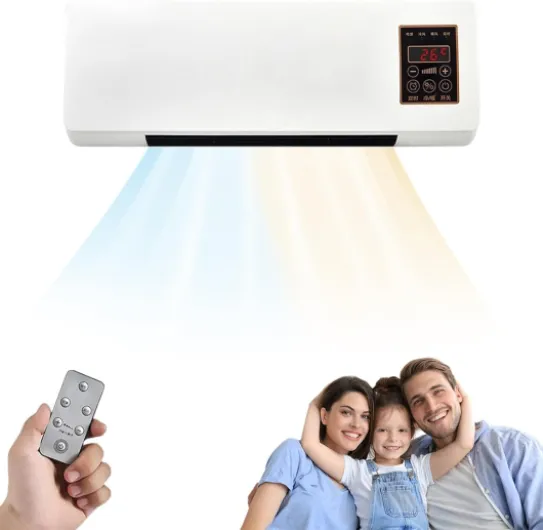
The product is presented as a 3‑in‑1 device: cooling fan, bladeless wall AC, and air circulation unit. In practice, the operating modes listed are “Air Circulation” and “Cooling”, with three speed settings from a quiet sleep mode to a stronger airflow mode. The manufacturer claims it can handle rooms up to 150 sq ft, which corresponds to a small bedroom, office, or RV interior. There’s no mention of a compressor, refrigerant, or exhaust hose, so it looks more like an advanced fan or evaporative cooler than a real refrigerant‑based air conditioner.
The package is simple: one wall‑mounted unit, an adhesive mounting kit, and a user manual. No outdoor unit is required, and the installation type is described as “split system” in the spec sheet, which is confusing because a traditional split system always has an outdoor compressor. Here, the term seems to be used more as marketing shorthand for a wall‑mounted indoor device. The product is powered by a 6000 mAh battery and can also be recharged via USB‑C, with a claimed cordless runtime of up to 8 hours.
The unit weighs about 580 g (around 3.3 lbs is mentioned elsewhere) and measures 20 × 45 × 20 cm. That’s compact enough to mount above a bed, beside a desk, or in a narrow kitchen space. The manufacturer highlights a slim 4.3‑inch profile and multi‑surface mounting (tile, wood, drywall) with vertical or horizontal orientation. There’s a remote control for adjusting speeds and modes from the bed or sofa, which is standard but still handy at this price range.
On paper, the key selling points are clear: no drilling, cordless operation, and quick installation. In my opinion, the positioning is more “upgrade over a tabletop fan” than a replacement for a 9000–12000 BTU real AC unit. The spec sheet even lists an annual energy consumption of 1000 kWh and an A+++ efficiency rating, which sounds out of place for a 220 W, battery‑powered device. That kind of mismatch suggests the data might be generic or copied from other appliances, so I’d see those numbers as vague rather than reliable engineering info.
Pros
- No-drill adhesive wall mounting, good for renters and temporary setups
- Integrated 6000 mAh battery with USB‑C charging for cordless use up to several hours
- Slim, lightweight, bladeless design with remote control and multi-surface mounting
Cons
- Specs are inconsistent and do not clearly indicate real AC-level cooling performance
- Generic branding and vague data reduce confidence in long-term reliability
- Adhesive mounting may be less secure on some surfaces and over long periods
Conclusion
Analysis score
This “Portable Air Conditioner, 3 in 1 Cooling Fan & Bladeless Wall Mount AC” is, in reality, closer to a versatile wall-mounted fan with a battery than a full air conditioner. Its strong points are clear: no-drill adhesive mounting, a slim and light wall form factor, 6000 mAh battery with USB‑C charging, and a bladeless outlet that should be safer and easier to clean. For renters, students, RV owners, or anyone who can’t or doesn’t want to drill into walls, that combination is practical. Mounted above a bed or desk, it should provide more focused airflow than a small table fan, with the bonus of cordless operation during outages or camping.
On the downside, the spec sheet is inconsistent: odd “12000 BUT” naming, improbable 4 dB noise, and vague efficiency and consumption numbers. There’s no clear evidence of real AC-grade cooling (no BTU rating, no compressor, no exhaust), so expecting it to cool an entire room like a standard 9000–12000 BTU unit would likely lead to disappointment. The generic branding also raises questions about long-term support and spare parts, even though a 2‑year warranty is listed.
In my opinion, this product makes sense if you treat it as a wall-mounted, battery-powered cooling fan for small spaces, not as a true air conditioner. It suits people who prioritize easy installation, portability, and quiet personal airflow over strong temperature drops. If your main need is serious room cooling in hot weather, better-documented mobile ACs or mini-splits from established brands will be a more reliable, if less convenient, investment.