Summary
Analysis score
Average of the criteria rated below
Value for money: where this DREO sits in the market
Design and ergonomics: compact, modern, and fairly thoughtful
Everyday comfort: use, mobility and smart control
Build, reliability and support: early signals
Cooling and noise: good for small rooms, mixed beyond that
What this DREO 7500 BTU unit actually offers
Pros
- Smart features: Wi‑Fi app control plus Alexa, Google Home and Siri integration with routines support
- Quiet for a portable AC, with sleep mode and noise isolation system (advertised 46 dB)
- Well-equipped universal window kit and caster wheels for easy installation and movement
Cons
- Cooling power limited to 7500 BTU, better suited to small rooms than large spaces
- Exhaust hose only 1.5 m, some buyers may need extensions for convenient placement

Specifications
View full product page →| Brand | DREO |
A compact smart AC aiming to make heatwaves bearable
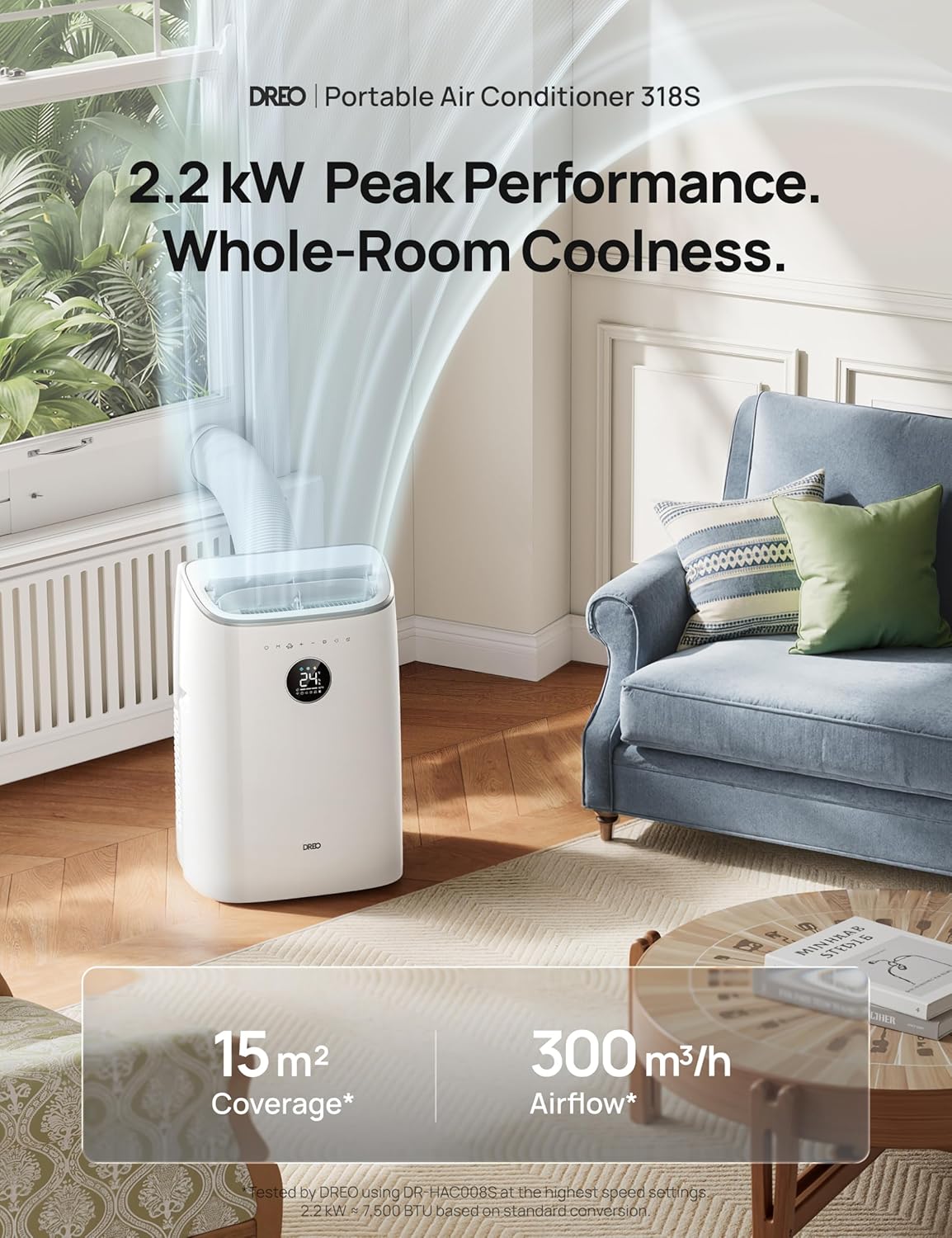
The DREO 7500 BTU Portable Air Conditioner positions itself as a small-room cooling solution with a strong focus on smart features and ease of use. On paper, it targets bedrooms and home offices up to about 20 m², with 7500 BTU (around 2.2 kW) of cooling power, a 3‑in‑1 Cool/Fan/Dry design and a fairly compact footprint. The average rating sits around 4.2/5 from several dozen Amazon reviews, so buyers are mostly positive but not unanimous.
What stands out immediately is the mix of traditional portable AC specs with connected features: Wi‑Fi, app control, and compatibility with Alexa, Google Home and Siri. Some reviewers highlight the smart integration as a key reason they chose this model, especially the ability to trigger cooling via routines when a room reaches a certain temperature. That’s a clear step up from basic units that only offer a physical panel and a simple remote.
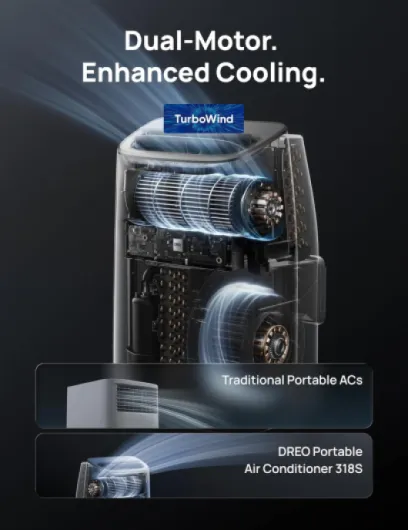
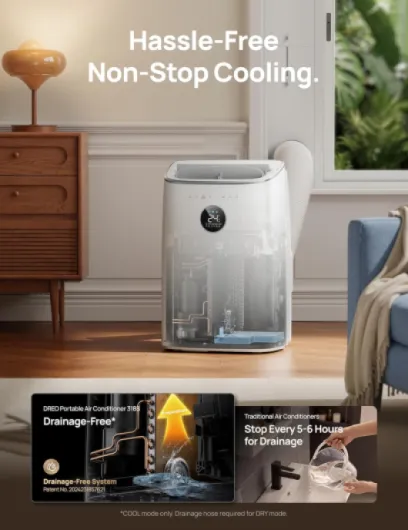
DREO also pushes two technical promises: a so‑called drainage‑free system, advertised as handling up to 90% humidity by evaporating condensate, and a noise isolation system claimed to keep sound down to 46 dB in quiet mode (with 61 dB sound power listed in the specs). A few comments confirm that noise is relatively low compared with other portable ACs they’ve owned, while still clearly audible, which is exactly what you’d expect from this type of product.
On the downside, there is at least one very negative review saying it “couldn’t cool a small bedroom” and calling it garbage, which shows that performance is not universally praised. Others, however, say a 4 m² or 9 m² bedroom can get genuinely cold in roughly half an hour. In my opinion, the picture is clear: this is a connected, compact AC that seems to work well for small, enclosed rooms, but it’s not a miracle machine for large or poorly insulated spaces.
Value for money: where this DREO sits in the market
The exact selling price isn’t specified here, but given the specs and the brand’s positioning, this DREO 7500 BTU model likely sits in the mid-range of portable ACs. At that level, value for money comes down to how much you care about smart features versus raw cooling capacity. Many competitors offer 9000–12000 BTU for similar or slightly higher prices but often skip Wi‑Fi, voice control, or a refined window kit. Here, you’re clearly paying for connectivity, design, and convenience as much as for BTUs.
Looking at the 4.2/5 average rating from around 60+ reviews, buyers are broadly satisfied. Positive comments emphasize quiet operation (for a portable AC), strong cooling in small rooms, and very practical smart integration with Alexa and Google Home. The universal window kit and relatively quick installation (one person mentions about 15 minutes) also contribute to perceived value, because poorly fitting kits can be a real pain and reduce performance. For renters or people with unusual windows, having sealing cloth, sliding panels and wall‑hole fittings in the box is a real plus.
On the negative side, there is that single very harsh 1‑star review claiming it couldn’t cool a small bedroom. Even if it’s an isolated case, it highlights the main risk of a 7500 BTU unit: if your room is large, badly insulated or sun‑exposed, you may feel underwhelmed. Another minor criticism is the short exhaust hose (1.5 m), which might force some buyers to buy extra hose and a joiner, slightly increasing the total cost. Also, for those who don’t care about smart features, a higher‑BTU non-connected model might offer more brute cooling for a similar budget.
In my opinion, the value proposition is clear: this is a good deal if you want a smart, relatively quiet, compact AC for a small bedroom or office, and you’ll actually use the app and voice control. If your main priority is maximum cooling power per euro for a big living room, you’ll probably find better options in higher BTU models, even if they’re dumber. As long as it’s priced in line with other mid-range portable ACs, the DREO 7500 BTU offers solid value for its intended use case.
Design and ergonomics: compact, modern, and fairly thoughtful
The DREO 7500 BTU unit goes for a clean, white, rounded design that several buyers describe as modern or even futuristic compared with older, boxier portable ACs. The dimensions (35.5D x 38.5W x 63H cm) keep it relatively compact for an air conditioner, especially one with a full 3‑in‑1 feature set. It’s still a big appliance, as one reviewer points out, but that’s simply the nature of portable ACs: you’re moving a compressor and heat exchanger around, so it will never be tiny.
One notable design choice is the top-opening vent that blows air upwards and can oscillate left to right. A reviewer specifically calls out that this helps push cool air towards the ceiling first, letting it then drop down more evenly across the room. That’s a step up from front-only vents that blow cold air at your knees. For small bedrooms or home offices, that airflow pattern should help avoid cold drafts on one side of the room while the rest stays warm.
The front LED display and touch controls are another highlight. Buyers say the display clearly shows the key information, and the touch buttons (for fan speed, temperature, sleep timer, etc.) are responsive without noticeable lag. That matters when you’re adjusting settings in the dark or half-asleep. The unit also comes with a magnetic remote control, which is a clever touch: you can stick it to the body of the AC so it doesn’t disappear into the bed or sofa cushions.
Despite being heavy at around 22.5 kg, the unit includes smooth caster wheels that reviewers find helpful when moving it from room to room. One buyer explicitly notes that the wheels make it manageable to move around the apartment despite the bulk. In my opinion, the design is well thought out for typical use: discrete enough for a bedroom, simple interface, and practical airflow. It’s not revolutionary, but for this product category, it’s a solid, user‑friendly design.
Everyday comfort: use, mobility and smart control
Comfort with a portable AC is not only about raw cooling; it’s also how easy it is to live with day to day. Here, the DREO unit has several strong points. First, the caster wheels and 22.5 kg weight combination mean it’s heavy but still manageable to roll from room to room. One reviewer explicitly notes that, although the unit is big and bulky as expected, the wheels are very useful to move it around an apartment. For someone wanting to use it in the living room during the day and the bedroom at night, that mobility is important.
The user interface seems well received. Buyers describe the touch buttons as responsive and the front LED display as clear, providing instant feedback on temperature, mode, and timer settings. The sleep timer and sleep mode are also mentioned as useful features, especially for bedroom use: you can set it to run for a certain number of hours or let it adjust temperature gradually overnight. Combined with the top‑blowing vent and oscillation, this should help prevent cold air from blasting directly onto the bed while still keeping the room comfortable.
Smart control adds another layer of comfort. Several comments highlight the ease of using Alexa or Google Home to control the unit, including full access to settings via voice. One buyer mentions using an Echo device that senses room temperature to create routines: the AC kicks in automatically when the room reaches a predefined temperature. That’s particularly handy if you come home after work and want the room already cooled without leaving the unit running all day. The DREO app also offers monitoring of temperature and humidity and a customizable sleep curve, which can help fine‑tune comfort over the night.
The window kit and installation also play into comfort. One user says that going from box opening to operation took about 15 minutes, and that the accessories kit covers multiple window types. Another appreciates that the package includes attachments suitable for common UK windows, which often cause headaches with generic kits. The main ergonomic downside mentioned is the 1.5 m exhaust hose length, which one reviewer finds a bit short; they suggest that some people may want to add a joiner and extra 150 mm hose. In my opinion, as long as expectations are aligned with its small‑room focus, this DREO scores well on overall comfort and ease of living with it.
Build, reliability and support: early signals
In terms of durability, there isn’t a long history yet, since the model’s start year is listed as 2026. That means long‑term reliability data is limited. However, we can look at a few indicators: construction details, warranty, and how people talk about build quality in the early reviews. The unit uses a mesh filter, which is standard for this category and usually easy to clean. Regular filter cleaning is important for both performance and lifespan, so the fact that it’s a simple mesh is a practical choice rather than a fancy but fragile solution.
The product comes with a 24‑month limited warranty, which is slightly better than some cheaper portable ACs that only offer 12 months. DREO also insists on its "superb customer service" and mentions expert support available around the clock. While that’s marketing language, the existence of a two‑year warranty is a concrete point: if the compressor or electronics have early issues, you’re at least covered for the first couple of summers. None of the published reviews explicitly mention catastrophic failures or breakages in the short term, which is a good sign, though the sample size is still modest.
Build-wise, buyers tend to describe the unit as solid and well finished, with a smooth, curved body that doesn’t feel flimsy. The caster wheels are highlighted as functional and sturdy enough to handle moving the 22.5 kg unit across floors. The window kit is also often mentioned positively, suggesting that the panels and sealing cloth are not overly fragile. Since the refrigerant is R‑290 (propane), which is increasingly common for environmental reasons, servicing or recharging in the distant future would likely follow standard procedures for modern units, though most home users never do that themselves.
Given the price bracket and the spec sheet, my view is that durability is likely decent but nothing out of this world. It’s a residential portable AC made in China, with a standard plastic chassis and conventional components. The two‑year warranty and lack of widespread complaints about build quality in the early reviews are reassuring, but anyone expecting industrial‑grade durability is aiming too high. With normal care (filter cleaning, avoiding kinks in the hose, not running it in extreme conditions beyond its spec), it should last several seasons, which is about what you’d reasonably expect in this segment.
Cooling and noise: good for small rooms, mixed beyond that
Performance is where opinions diverge a bit. On paper, 7500 BTU for up to 20 m² is on the lower-middle end of portable ACs, which often sit in the 9000–12000 BTU range. That means this DREO is clearly aimed at small bedrooms, offices, or studio corners, not big open‑plan living rooms. Several positive reviews confirm that for compact rooms, the cooling feels strong: one buyer says their roughly 4 m² bedroom went from unbearable heat to actually feeling cold in about 30 minutes. Another mentions a 9 m² room where the unit is described as quiet and well-suited.
However, there’s also a 1‑star review stating the unit couldn’t cool a small bedroom at all. This is an outlier compared with the majority, but it shows that results can vary depending on insulation, direct sun exposure, and ventilation of the exhaust. Portable ACs are very sensitive to how well the hot air is expelled outside and how sealed the room is. If the hose is poorly installed or the window gap leaks hot air back in, performance drops fast. In my opinion, expecting this model to overcome a badly insulated, sun‑exposed large room is unrealistic; it’s sized for modest spaces.
On the noise side, DREO advertises a noise isolation system that brings sound down to 46 dB (with 61 dB sound power in the specs). Several reviewers call it one of the quieter portable ACs they’ve used. One mentions that you can still hear it, but it doesn’t disturb concentration and quickly fades into the background. That’s exactly the sort of comment you’d expect given the numbers: not silent, but relatively soft for a compressor‑based unit. For bedroom use, it should be acceptable for many people, especially with the sleep mode engaged, though light sleepers may still find it noticeable.
The 2.5 L/h dehumidification is quite strong on paper and is likely a big part of why some users feel comfortable quickly: removing humidity often helps more than dropping temperature a few extra degrees. The unit also claims a drainage‑free system up to 90% humidity, using sensors and a pump to evaporate condensate. For typical European summer humidity, that should mean very little manual draining, which is a big convenience win. Overall, the performance picture is clear: solid cooling and moisture removal in small enclosed rooms, with relatively low noise for a portable, but you shouldn’t expect miracles in challenging spaces.
What this DREO 7500 BTU unit actually offers
On paper, the DREO DR-HAC008S is a fairly straightforward portable air conditioner with a modern twist. Cooling power is listed at 7500 BTU (2.2 kW), aimed at rooms up to 20 m². It runs on 230 V mains power, pulls about 800 W, and is rated energy class A, which is decent for a portable AC but not exceptional. These units are rarely energy champions anyway; the interest here is the mix of power and flexibility for renters or people who can’t install a split system.
The device is marketed as a 3‑in‑1 machine: Cooling, Fan, and Dry (dehumidifier). Within each mode, there are three sub‑functions or levels, giving a bit more control than the usual low/medium/high approach. The manufacturer claims a dehumidification capacity of 2.5 L/h, which is quite high on paper and should help in muggy climates or top‑floor flats that get sticky in summer. Several buyers mention being comfortable in small bedrooms, which fits with that spec sheet.
Control options are a strong part of the pitch: you get app control, voice control (Alexa, Google Home, Siri), a touch panel, and a remote. One user highlights that the Alexa connection lets them control every aspect of the unit and even set routines based on room temperature with newer Echo devices. For people already running a smart home, that’s a real draw. The DREO app also adds features like monitoring temperature and humidity and customizing a sleep curve.
In terms of hardware, the unit weighs about 22.5 kg and measures 35.5 × 38.5 × 63 cm. It comes with a 1.5 m exhaust hose, a universal window kit that includes sealing cloth for casement windows, sliding panels, and wall‑hole fittings, plus a magnetic remote. Some reviewers appreciate that the kit actually covers common UK window types, which is not always the case with portable ACs. Overall, the spec sheet paints a picture of a compact, moderately powerful, very connected unit that focuses on small‑room comfort rather than brute-force cooling for large spaces.
Pros
- Smart features: Wi‑Fi app control plus Alexa, Google Home and Siri integration with routines support
- Quiet for a portable AC, with sleep mode and noise isolation system (advertised 46 dB)
- Well-equipped universal window kit and caster wheels for easy installation and movement
Cons
- Cooling power limited to 7500 BTU, better suited to small rooms than large spaces
- Exhaust hose only 1.5 m, some buyers may need extensions for convenient placement
Conclusion
Analysis score
The DREO 7500 BTU Portable Air Conditioner is, in my view, a solid small‑room unit with a strong emphasis on smart control and everyday convenience. The spec sheet fits bedrooms and home offices up to around 20 m², and the reviews suggest that in compact, reasonably insulated rooms (4–9 m²), it can cool quickly and comfortably. The noise levels seem relatively low for a portable AC, and the combination of top-blowing vent, oscillation, sleep mode and timer makes it quite suitable for night use for many people.
The main trade‑off is clear: you get smart features (Wi‑Fi, Alexa/Google/Siri, app), a decent dehumidification capacity and a well-thought-out window kit, but only 7500 BTU of cooling. For its target use—small bedrooms, offices, or rented flats where installing a split is not possible—that’s usually enough. For large, sun‑exposed living rooms or poor insulation, it’s probably not the ideal choice. The isolated very negative review underlines that mismatch of expectations more than a systematic defect.
If you prioritize connected control, quiet operation (for this category), and easy installation, this DREO model makes sense and offers good overall value. If you just want raw power and don’t care about voice commands or smartphone apps, you might be better served by a higher‑BTU, less feature‑rich unit. Overall, it’s a competent, modern portable AC that seems to get the job done for the right type and size of room.