Summary
Analysis score
Average of the criteria rated below
Value for money: 5‑in‑1 features vs. compromises
Design: compact footprint, classic portable AC look
Durability, maintenance and what the 1‑year warranty really means
Cooling, heating and noise: what to expect from 12000 BTU and 1300 W
What this KOMORE 12000 BTU actually offers on paper
Real‑world effectiveness: room coverage, auto mode and dehumidification
Pros
- Strong feature set: 5‑in‑1 (cooling, heating, fan, dehumidifier, auto) plus Wi‑Fi, remote and 24 h timer
- 12000 BTU cooling and 9000 BTU heating suitable for rooms around 18–23 m²
- R290 refrigerant and A energy efficiency class for a relatively efficient portable unit
Cons
- Only 1‑year manufacturer warranty, shorter than some competitors
- Non‑inverter compressor and around 54 dB in sleep mode, so not especially quiet
- 30 kg weight makes it bulky to move frequently despite wheels and handles

Specifications
View full product page →| Brand | KOMORE |
A 5‑in‑1 unit aiming to cover a whole room on its own
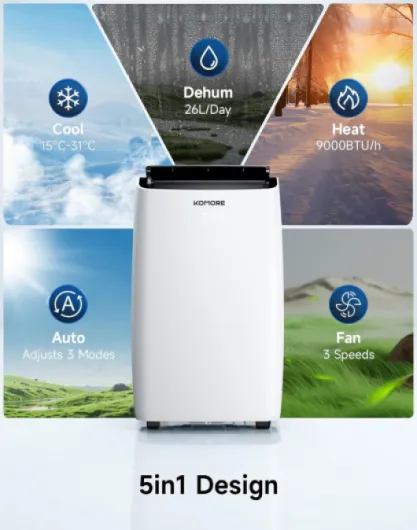
The KOMORE 12000 BTU portable air conditioner is clearly trying to be the all‑in‑one climate box for a small to medium room. On paper, it combines cooling, heating, fan, dehumidifier and auto mode in a single 30 × 44 × 71 cm tower that weighs about 30 kg. The brand advertises coverage for 18–23 m², which roughly corresponds to a normal bedroom, a small living room or a home office. Instead of a separate heater for winter and AC for summer, the idea here is one machine you roll where you need it.
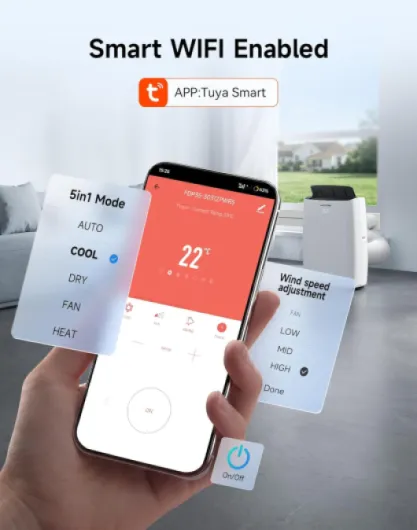
It is also positioned as a more modern portable AC with Wi‑Fi and app control (Tuya Smart), touch controls and a remote. The spec sheet highlights a 2026 revision with reinforced packaging and “enhanced noise reduction”, plus the use of R290 refrigerant and an A energy efficiency class. In theory, that should make it a bit less power‑hungry than older mobile units of similar power, and a bit less annoying to live with day to day.
Among the comments, buyers mainly look at three things: whether it actually cools or heats a room of the advertised size, whether the noise level is manageable, and whether installation with the window kit is straightforward. The manufacturer claims 54 dB in sleep mode and a 400 m³/h airflow, which is decent for a 12000 BTU machine but not out of the ordinary. Expectations should be set: it’s still a mobile AC with a compressor, not a silent fan.
In my opinion, this product targets people who rent or cannot install a fixed split system, but still want both cooling and heating in one plug‑in appliance. The feature list is packed for this category, but the unit is not ultra‑compact or ultra‑light, and there is no inverter, which usually limits fine‑grained efficiency and noise. It looks like a solid mid‑range option: not minimal, not premium, but with enough functions to justify a serious look if you need something flexible for a single room.
Value for money: 5‑in‑1 features vs. compromises
In terms of value, this KOMORE model tries to justify itself by combining cooling, heating, fan, dehumidifier, auto mode, Wi‑Fi, remote control and sleep mode into a single package. If you were to buy a separate heater, a dehumidifier and a simpler portable AC with no Wi‑Fi, you could easily end up spending a similar total amount and take more floor space. Here, the added value is clearly in the multi‑function approach and the smart control options (Tuya app, remote, touch controls, timer, memory function). For users who actually plan to use both heating and cooling and appreciate remote control from a phone, the feature set looks good for a mid‑range device.
Where the value is more debatable is on efficiency and noise. The A energy class is positive, but the lack of inverter technology means it won’t be as efficient or as quiet as some higher‑end split systems or premium portable units that can modulate compressor speed. The 54 dB sleep mode is acceptable but not especially quiet; people who are very sensitive to noise at night might have to compromise between comfort and silence. If your main goal is ultra‑low energy use and near‑silent operation, this kind of portable AC is simply not the right category, and the money might be better put into a permanent split system if installation is possible.
On the other hand, for renters and people in older buildings where drilling walls for a split unit is not allowed, a device like this often ends up as the only realistic solution. In that context, the value improves: you get a reasonably strong 12000 BTU cooling capacity, 9000 BTU heating, an included window kit requiring no drilling, and the convenience of wheels and handles to move it seasonally or between rooms. The R290 refrigerant is also a plus from an environmental standpoint compared with older gases, which might matter to some buyers.
In my opinion, the overall value is solid but not spectacular. It’s not the cheapest 12000 BTU portable on the market, but the combination of Wi‑Fi, 5‑in‑1 functionality, auto mode and a dehumidifier with 1.1 L/h capacity gives it a stronger feature list than many basic units. The main trade‑offs are the 1‑year warranty, non‑inverter design and typical portable‑AC noise levels. If you accept those inherent limitations and need a flexible, non‑permanent solution for a single room, the price‑to‑features ratio looks quite reasonable. If you can install a split and plan to run it heavily every summer, long‑term value will almost always favor the fixed system instead.
Design: compact footprint, classic portable AC look
Visually, this KOMORE model sticks to the classic white tower design that blends into most interiors but doesn’t try to be decorative furniture. The dimensions are 30 cm deep, 44 cm wide and 71 cm high, so the footprint is relatively narrow but a bit wide compared to some very slim units. In a small room, it will still take a visible corner next to a window for the exhaust hose, but it’s not a giant floor hog either. At 30 kg, it is on the heavier side for a 12000 BTU portable, so the design choice of adding four universal wheels and side handles is essential for moving it between rooms.
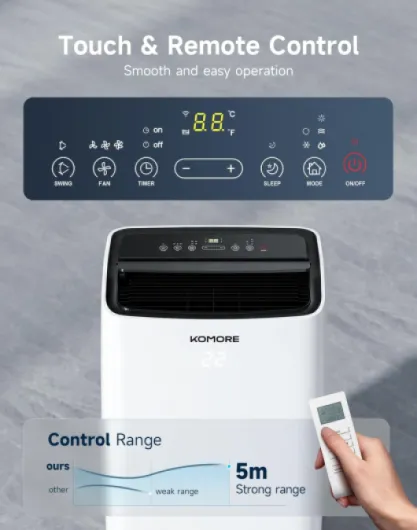
The control layout is fairly straightforward: a touch panel on the top of the unit, which is easy to reach when standing, and a front LED display that shows the temperature from across the room. In my opinion, this is more practical than top‑only indicators you can’t see from the sofa or bed. The brand also mentions that the touchscreen feedback lasts five seconds when swing mode is activated, which is a small detail but suggests some thought put into making the controls readable without being permanently bright at night.
Airflow management is handled by a vertical swing function that adjusts the direction of the air to improve cooling coverage. The spec sheet also lists “4 Way Swing” as a feature, but the description mainly insists on vertical movement; in practice, portable units often have fixed horizontal louvers with motorized vertical swing or the opposite. Without physical inspection, it’s hard to be certain, but users can expect at least basic oscillation to avoid a fixed draft in one spot. This is useful in smaller rooms where you sit close to the unit and don’t want cold air blowing constantly on one side of your body.
Another practical design element is the cord and plug storage panel at the back. Portable ACs are notorious for messy hoses and dangling cables, so being able to tuck the cord and press the plug into a dedicated recess should keep things tidier when the unit is off‑season or moved to another room. Overall, the design looks functional and neutral: nothing flashy, but the combination of visible temperature, wheels, handles and hose management is in line with what people usually expect from a mid‑range portable AC meant for regular relocation around the house.
Durability, maintenance and what the 1‑year warranty really means
When it comes to durability, there are a few objective clues and a lot of inference. The KOMORE unit comes with a 1‑year manufacturer warranty, which is standard for many portable ACs but not particularly generous. In my opinion, a product meant to be used heavily during summers (and possibly winters, with the heating function) would be more reassuring with a 2‑ or 3‑year warranty on the compressor. That said, a one‑year coverage still protects against early failures and obvious defects, and the brand explicitly invites users to contact a dedicated customer service team for queries, which is at least a sign they expect some after‑sales interaction.
In terms of build expectations, the 30 kg weight hints at a fairly robust compressor and chassis rather than an ultra‑light plastic shell. The 2026 model is said to have reinforced packaging, which indirectly acknowledges that shipping damage was probably an issue before. Better packaging reduces the risk of dents, cracks or internal shocks during transport, which can affect long‑term reliability. Among typical portable AC reviews, complaints often revolve around broken casters, cracked housings near the hose connection, or leaks at the drain port. A heavier unit with decent wheels and handles has a better chance of surviving regular moves between rooms without those issues, though nothing is guaranteed.
Maintenance is a big factor for longevity. Here, the brand promotes a removable air filter that you can clean with water and neutral detergent, and stresses the need to let it dry thoroughly before reinserting. Regular filter cleaning helps the compressor breathe properly, preventing overheating and maintaining airflow. The unit also has a water level indicator and can be drained periodically or continuously via the supplied drain hose. Letting condensate sit too long or ignoring full tanks is a common cause of problems in these devices, from mold smells to pump or float failures, so the presence of clear indicators and an easy drain option is important.
From a usage pattern perspective, most portable ACs like this perform best when they’re not moved daily up and down stairs or across very rough floors. The KOMORE design with universal wheels and side handles should help reduce shocks when repositioning, but at 30 kg, it is still a heavy appliance. In my opinion, if you treat it as a semi‑fixed unit (mostly staying in one room with occasional relocation) and follow the basic maintenance steps—clean the filter monthly in peak season, check and drain condensate, avoid kinking the exhaust hose—the expected lifespan should be reasonable for a mid‑range portable AC. The short warranty is the main downside here, and cautious buyers might consider using a surge protector and possibly an extended retailer warranty if available.
Cooling, heating and noise: what to expect from 12000 BTU and 1300 W
On paper, 12000 BTU/h of cooling for 18–23 m² is a sensible pairing. In a normal insulated bedroom or office of around 20 m², this level of power should be enough to bring the temperature down in a reasonable time, especially if you start early rather than waiting for the room to become an oven. The 400 m³/h airflow is in the typical range for this BTU class: not aggressive like a large commercial unit, but enough to circulate air across a medium room. For heating, the advertised 9000 BTU/h is clearly lower, so you can expect slower temperature rise in winter than the drop you get in summer with cooling, but still usable as a backup or inter‑season heater.
The energy efficiency class A is a plus for a 1300 W machine. It does not use an inverter compressor, which usually means on/off cycles rather than continuous modulation, so efficiency and noise will likely fluctuate as the unit reaches the set temperature. For people who plan to run it many hours per day during a long heat wave, a proper split system would still win on power consumption, but for occasional use in a rental or a room without fixed AC, this rating is decent and should keep electricity bills under better control than older class C or D portables.
Noise is always a key point with portable ACs. This model highlights ≈54 dB in sleep mode (cooling only), which is fairly standard for this category: quieter than many older or cheaper units, but not whisper‑quiet. In a bedroom, that level will be audible, especially for light sleepers, but for many people it will be acceptable background noise. The brand also mentions “enhanced noise reduction” for the 2026 model, which suggests that earlier versions may have had complaints about sound levels and they tried to refine the design. Among typical Amazon comments for similar devices, buyers often say they get used to the hum over time but still notice compressor kicks when it cycles.
Another performance aspect is dehumidification at 1.1 L/h. In humid climates or basements, this can make a real difference in perceived comfort, even if the temperature isn’t extremely high. The unit can either collect condensate in an internal reservoir that you drain periodically, or you can connect the supplied drain hose for continuous draining. For people who want to avoid frequent emptying, running a permanent drain line to a floor drain or outside window can make the unit more hands‑off. Overall, performance looks solid but not revolutionary: strong enough for one room, with the usual compromises of mobile ACs in terms of noise and energy use compared with fixed systems.
What this KOMORE 12000 BTU actually offers on paper
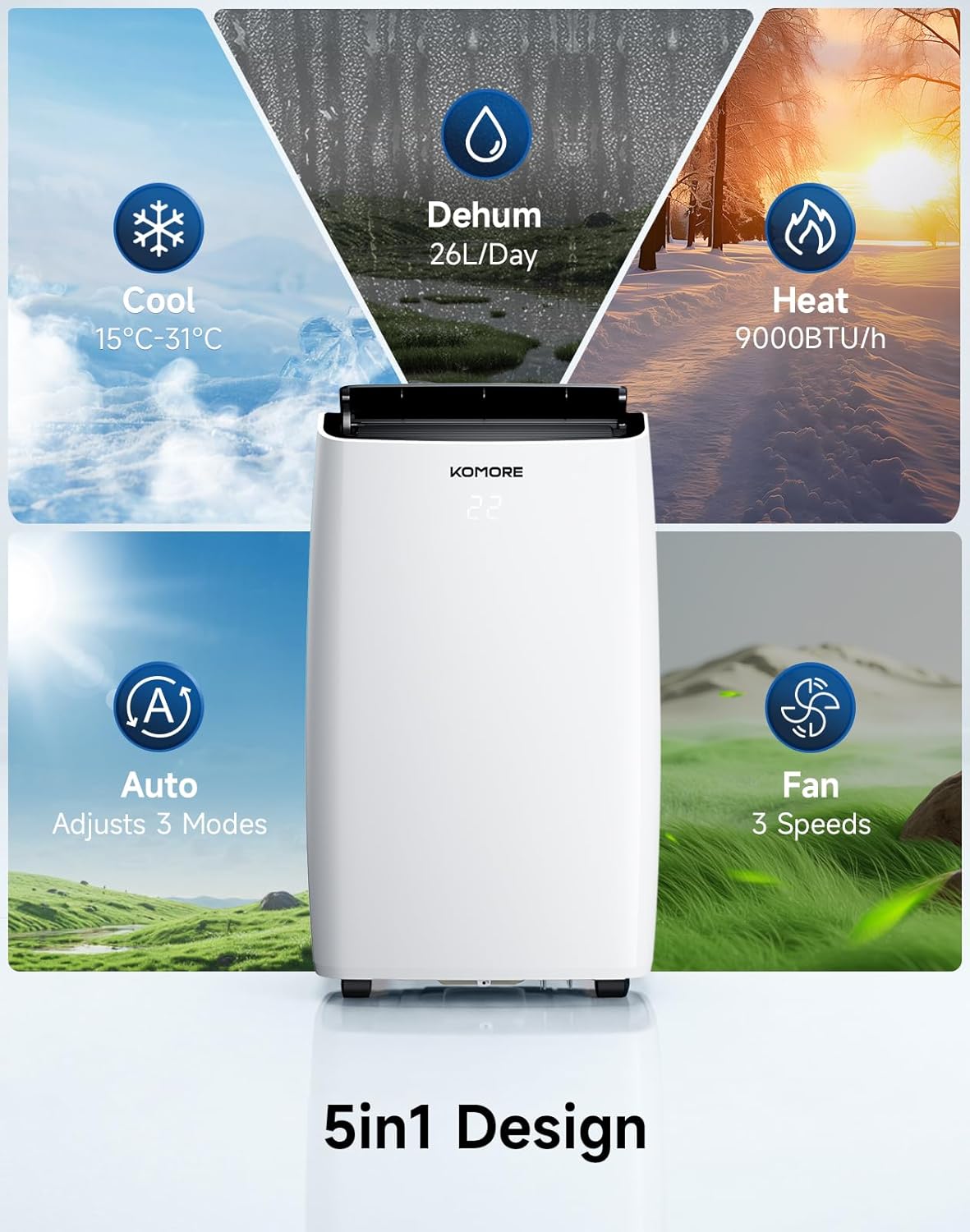
On the technical side, the KOMORE unit delivers 12000 BTU/h cooling capacity and 9000 BTU/h heating capacity, powered by a 1300 W compressor running on 220 V. The advertised coverage of 18–23 m² matches a typical European bedroom or small living room with normal ceiling height. There are three fan speeds, an auto mode that switches between cooling, fan and heating based on room temperature, and a dehumidification mode rated at 1.1 L/h. For a portable, that dehumidification figure is quite reasonable and should help in humid climates or basements.
The machine is presented as a 5‑in‑1: cooling, heating, fan, dehumidifier and auto, with sleep mode as an extra profile rather than a full mode. Sleep mode works only in cooling, with a noise figure around 54 dB and a temperature that slowly rises before the unit shuts off after 6 hours. There is also a 24‑hour timer, useful to start or stop the unit automatically, which can help control energy usage. The temperature range from 15 °C to 31 °C is standard and gives enough flexibility for most users, whether you want a cool bedroom or just take the edge off a chilly office.
Control options are one of the clearer strong points: touchscreen panel on top, front LED temperature display, remote control (around 5 m range), and Wi‑Fi control via the Tuya Smart app over 2.4 GHz. The unit has a memory function to restore previous mode and temperature after power cycles. For a portable AC in this price/feature segment, that’s a fairly complete control package. Many cheaper models skip Wi‑Fi or rely only on a basic remote.
From a practical standpoint, the package includes a window exhaust kit: a retractable hose (up to 1.5 m), hose connector, window exhaust adapter, a 620 mm baffle plate and screws. It’s designed for horizontal or vertical sliding windows, with no drilling required, which fits most flats with standard sliding sashes. The brand also mentions a cord and plug storage panel on the back to tidy cables, plus universal wheels and side handles for moving the 30 kg chassis. Overall, the spec sheet paints a picture of a feature‑rich but conventional 12000 BTU mobile unit focused on flexibility more than cutting‑edge efficiency.
Real‑world effectiveness: room coverage, auto mode and dehumidification
Effectiveness here comes down to whether this unit can comfortably handle the 18–23 m² it claims, and how smart its modes are in everyday use. With 12000 BTU and 400 m³/h airflow, it should be able to cool a typical 20 m² room in a temperate climate without too much struggle, provided the window kit is installed properly and the room isn’t a glass greenhouse in direct sun all day. Several buyers of comparable portable units mention that poorly sealed windows and long exhaust hoses can ruin performance, so taking the time to fit the included baffle plate, hose connector and adapter cleanly is key to getting the best out of it.
The auto mode is a nice addition on paper. It uses internal temperature sensors to switch between cooling, fan and heating automatically, aiming to maintain a target comfort zone without the user constantly changing modes. In my opinion, this is especially useful in spring and autumn when outdoor temperatures fluctuate during the day, or in offices where people forget to switch from heating to cooling. For people who just want to set a comfortable temperature and forget, auto mode plus the 24 h timer can make daily use more straightforward and also help avoid leaving the unit running longer than necessary.
As a dehumidifier, 1.1 L/h is decent. In a very damp basement of around 20 m², this can noticeably reduce humidity over a few hours, which in turn helps the cooling feel more efficient because dry air feels less heavy. Some reviews of similar models state that people end up using dehumidification mode even in mild temperatures just to get rid of that sticky feeling indoors. For allergy‑prone users, the removable filter that you can wash with water and neutral detergent is another practical point to maintain cleaner airflow, as long as you remember to clean it regularly.
One limitation is that sleep mode only works in cooling, not heating. That means in winter, you won’t get the same stepped temperature increase and quieter profile at night. If you plan to use this mostly for summer cooling in the bedroom, that’s not a big deal, but if you expected a quiet night‑time heater, you’ll need to manage expectations. Overall, if the room size matches the 18–23 m² envelope and the window kit is sealed well, this unit should get the job done in terms of comfort. In larger, open‑plan spaces or rooms with poor insulation, it will probably feel more like a spot‑cooler or supplementary heater than a full replacement for central HVAC.
Pros
- Strong feature set: 5‑in‑1 (cooling, heating, fan, dehumidifier, auto) plus Wi‑Fi, remote and 24 h timer
- 12000 BTU cooling and 9000 BTU heating suitable for rooms around 18–23 m²
- R290 refrigerant and A energy efficiency class for a relatively efficient portable unit
Cons
- Only 1‑year manufacturer warranty, shorter than some competitors
- Non‑inverter compressor and around 54 dB in sleep mode, so not especially quiet
- 30 kg weight makes it bulky to move frequently despite wheels and handles
Conclusion
Analysis score
This KOMORE 12000 BTU portable air conditioner from KOMORE positions itself as a practical 5‑in‑1 unit for people who want cooling, heating, dehumidification and fan functions in a single appliance. On paper, it has what you’d expect for a serious room unit: enough power for 18–23 m², a 400 m³/h airflow, Wi‑Fi and app control, a 24 h timer, and a decent A energy class. The 2026 revision with enhanced noise reduction and reinforced packaging suggests the brand is iterating on real customer feedback, which is reassuring.
It’s not perfect. The 1‑year warranty is on the short side, the non‑inverter design means average, not stellar, efficiency and noise, and at 54 dB in sleep mode, light sleepers may still find it noticeable. The 30 kg weight also means you’ll appreciate the wheels and handles, but you won’t be joyfully carrying it up stairs. In my opinion, this is best suited to renters, flat dwellers and anyone who can’t install a split system but still wants serious cooling and some heating in a single room, with the convenience of smart control and a built‑in dehumidifier.
If your priority is absolute silence and top‑tier energy savings, a fixed inverter split will be a better investment where installation is allowed. If you need a flexible, plug‑and‑play solution that can follow you between rooms or moves home with you, this KOMORE unit offers good value for the feature set, as long as you keep your expectations realistic about the usual noise and efficiency compromises of portable ACs.