Summary
Analysis score
Average of the criteria rated below
Value for money: good, but not a steal
Design and ergonomics: compact tower with some odd choices
Build quality, maintenance and long‑term concerns
Noise, modes and daily performance: solid, with some quirks
What the Pelonis 5L cooler actually is (and what it isn’t)
Cooling effectiveness: good spot relief if you manage expectations
Pros
- Strong, comfortable airflow with oscillation and directional blades for effective spot cooling
- Low power draw (55 W) and 5 L tank make it cheap to run and practical for UK heatwaves
- Sturdy build, removable tank and simple controls, with a 2‑year warranty
Cons
- Does not truly cool room temperature like an air conditioner, only makes the airflow feel cooler
- Remote control is weak and strictly line‑of‑sight, with no smart home integration or auto‑restart on power
- Ice pack integration is clumsy and only two packs are included, making refills less convenient

Specifications
View full product page →| Brand | Pelonis |
A budget-friendly way to suffer less in UK heatwaves
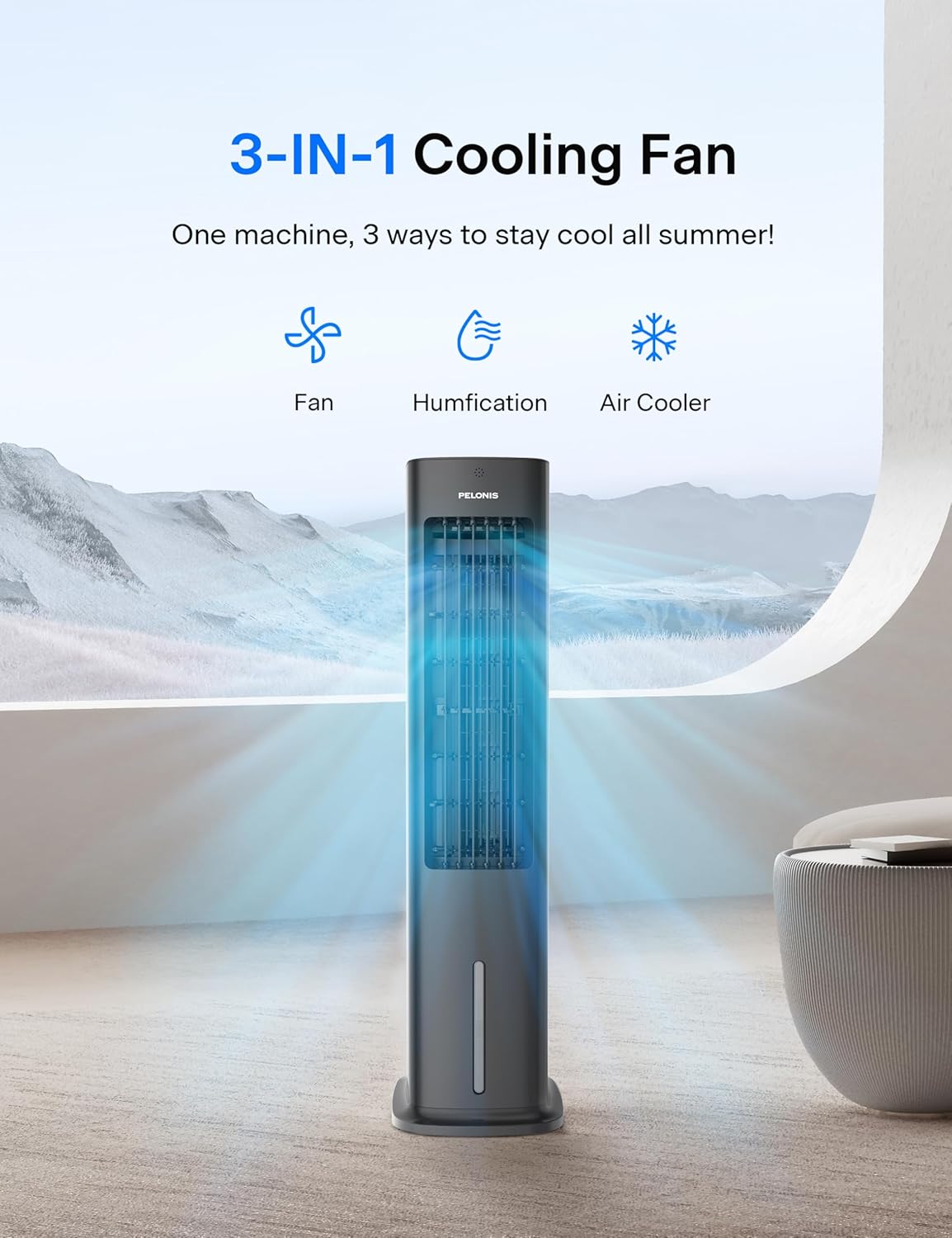
The Pelonis 5L Evaporative Air Cooler aims at a very specific need: dealing with those few brutal UK heatwaves without spending hundreds on a portable air conditioner. On paper, it’s a 3‑in‑1 tower unit (fan, evaporative cooler and basic humidifier) with a 5‑litre tank, remote control, 3 speeds, oscillation and a 7‑hour timer. It runs at 55 W and is rated at 28 dB minimum noise, so clearly positioned as an energy‑saving alternative to traditional AC rather than a full cooling system.
In the Amazon comments, the overall tone is positive: a 4.3/5 average rating over more than 500 reviews suggests that buyers are mostly satisfied, while still pointing out a few design shortcuts and quirks. Several people insist on a key point: this is not an air conditioner and will not drop a room from 30°C to 22°C. It’s essentially a stronger, wetter fan that makes you feel cooler, especially when you use cold water and the included ice packs.
The manufacturer pushes hard on ease of use for UK homes: no installation, freestanding 85 cm tower, small footprint (29.5 × 23 cm base) and a 5 L removable tank that’s supposed to last up to around 10 hours. With a claimed energy saving of “up to 80% vs AC”, it clearly targets renters, people in small flats, and anyone who can’t or doesn’t want to vent a portable air conditioner out of a window.
In my opinion, the interest of this product is straightforward: if you accept the limits of evaporative cooling, it looks like a solid middle ground between a cheap desk fan and a noisy, expensive AC unit. The rest of the analysis digs into design, performance, day‑to‑day practicality, durability and value, based on the specs and what verified buyers report.
Value for money: good, but not a steal
Price moves around, but one reviewer explicitly mentions paying around £96 and feeling that “£80 feels like a more reasonable price” given the bare‑bones feature set. Another compares it favourably to a Pro Breeze bladeless fan that cost about £140, saying the Pelonis is better in their view and significantly cheaper. Taking those comments together, it positions this cooler as a mid‑range option: clearly above cheap £30 fans, but below full‑blown portable AC units and high‑end designer fans.
For the money, you get: a 5 L tank, two ice packs, remote control, 3 speeds, 3 modes, oscillation, timer, and an evaporative cooling system with a honeycomb filter. Energy consumption at 55 W is very low, so running costs are negligible compared to AC. Several buyers emphasise that this is a more cost‑effective alternative to buying an air conditioner, especially for UK summers where extreme heat is relatively rare but brutal when it hits. One reviewer who bought it after the hot summers of 2021 and 2022 specifically calls it more economical than investing in AC for occasional heatwaves.
On the downside, you don’t get any smart home features, no app, no voice control, and no auto‑restart on power. One critical review argues that at this cost, Alexa control should have been included, and also complains that the remote is weak and that the indicator lights are poorly placed. They also wish for more ice packs in the box (four or six instead of two) to allow constant rotation between freezer and tank. In their opinion, the feature set feels slightly thin for the asking price, even though they still recommend the product overall.
In my view, the value is solid but not mind‑blowing. You’re paying for a reasonably robust tower evaporative cooler that does what it says: stronger and cooler than a basic fan, cheaper and simpler than an AC. If you absolutely need real room‑cooling, you’d be better off stretching the budget for a proper air conditioner. If you mainly want better comfort around the sofa or bed during a few hot weeks a year and you’re fine with adding ice and water, this Pelonis model offers good bang for the buck, especially when discounted under the £100 mark.
Design and ergonomics: compact tower with some odd choices
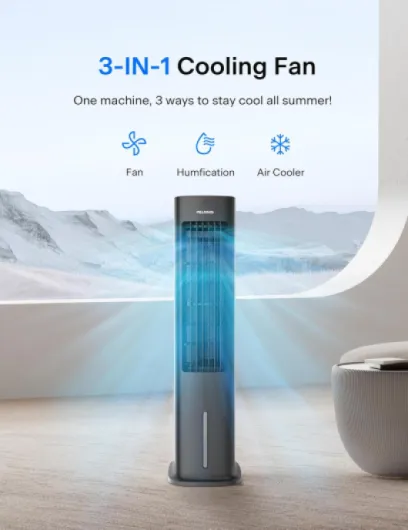
Visually and structurally, the Pelonis cooler is a classic black tower design aimed at blending into a corner of a room. At 85 cm tall, it’s high enough for the airflow to reach people on a sofa or bed without having to put it on a table. The footprint is small, which several reviewers appreciate for flats or small bedrooms. One buyer specifically highlights the “small footprint in a flat” as a strong point, noting that it fits easily without dominating the room.
The controls are placed on top of the unit, with physical buttons for power, oscillation, speed, modes, timer and the humidifier/cooling function. Indicator lights show which settings are active. A verified buyer praises this layout for being straightforward and clear, saying the lights help confirm each choice. However, another review criticizes the fact that you can’t see the settings unless you stand right next to and above it, since the lights are on the top panel rather than on the front. In practice, that means you can’t check speed or mode at a glance from the sofa.
Ergonomically, Pelonis includes a built‑in handle for portability, and multiple comments describe the unit as easy enough to move between rooms, although it naturally gets heavier when the 5 L tank is full. The remote is simple but basic: one buyer calls it “line of sight only” with poor range, so you apparently need to point it quite directly at the unit. There’s no display on the front, no temperature readout, and no fancy design touches. In my opinion, this fits the product’s positioning: functional and relatively discreet, but with some compromises in user feedback and remote convenience.
One recurring criticism is how the ice packs integrate with the design. A detailed review explains that the ice packs don’t have a proper slot or dedicated housing; you just throw them into the tank, where they float around. The buyer calls them an “afterthought” and ended up buying extra smaller ice packs to fill the space. This doesn’t break the product, but it does make the cooling workflow slightly clumsier than it could have been. Overall, the design is solid and practical, but clearly focused on cost control rather than polish.
Build quality, maintenance and long‑term concerns
On the durability front, the Pelonis cooler uses a mix of metal and plastic according to the spec sheet. Several buyers explicitly describe it as “solid and sturdy” and “good quality, not cheap feeling”. That’s a positive sign for a device that will likely be dragged between rooms and used intensively for a few hot weeks per year. There are no widespread reports of units falling apart quickly, and the overall 4.3/5 rating after hundreds of purchases suggests that catastrophic failures are not common.
The 5‑litre water tank is fully removable, which multiple reviewers like because it makes filling and cleaning easier. One person says the water container is a “good size” and “fully removable”, and also mentions that assembly and cleaning are very easy. The honeycomb filter and detachable components should, in theory, make maintenance straightforward. However, one user notes that the water in the trough can become milky or cloudy fairly quickly, and expresses concern about how healthy that might be long‑term if not cleaned regularly. That comment underlines a basic reality of evaporative coolers: you need to empty and rinse the tank and filter often, especially in warm conditions, to avoid buildup.
Warranty coverage is 2 years, with EU spare part availability listed as 1 year. For a product in this price bracket, a 2‑year warranty is decent but not outstanding; it’s basically what you’d expect from a mid‑range small appliance. There are no strong patterns in the reviews about motor failures, pump issues or electronics dying early, at least among the comments visible. Most complaints are about design quirks (ice packs, remote, smart features) rather than things breaking.
In my opinion, if you treat it as a seasonal appliance, store it dry when not in use, and actually clean the tank and filter when the water starts to look off, it should hold up reasonably well. It’s not a heavy‑duty industrial cooler, but for typical home use a few weeks a year, the build and feedback point to respectable durability. The main long‑term risk is probably neglecting hygiene and letting scale or biofilm accumulate, which is more about maintenance habits than the product itself.
Noise, modes and daily performance: solid, with some quirks
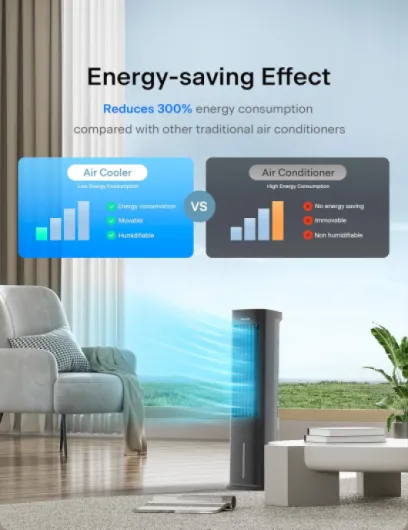
From a technical angle, the Pelonis cooler runs at 55 watts, which is very low compared to portable AC units that often sit between 700–1200 W. This fits the brand’s claim of up to 80% energy savings versus traditional air conditioning. The noise spec is given as 28 dB, which likely corresponds to the lowest speed in sleep or natural mode. Buyers generally describe it as “fairly quiet for its size” and “quieter than a portable air‑con”, which is consistent with a mid‑range tower fan level of noise rather than a whisper‑quiet bedroom appliance.
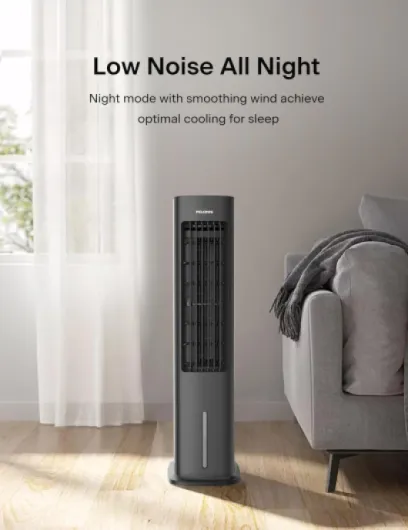
In everyday use, the 3 speeds and 3 modes (natural, sleep, normal) give some flexibility. One reviewer, however, says they “don’t understand the Night setting” because it feels basically the same as the mid‑range setting in terms of noise, so if you’re very sensitive to sound at night, you may end up sticking to the lowest speed anyway. Another buyer says that in a lounge with the TV on, you should expect to turn the TV volume up a bit when using higher speeds, which is pretty standard for any fan that moves a decent amount of air.
The timer is advertised as 7 hours, and one detailed review clarifies how this actually works: the control panel has 1h, 2h and 4h buttons that can be combined, but the maximum continuous setting is effectively 4 hours in one go, with the 7‑hour claim coming from summing the individual options. That’s a bit of marketing spin, but still useful if you want the unit to shut off after a few hours of sleep or while you’re out. The automatic 60° oscillation plus manual tilt are often praised; multiple reviewers highlight that the oscillating blades and up/down directional blades are very handy to spread the airflow without having to move the whole unit.
There are some performance‑related annoyances. One buyer notes the remote has poor range and requires pointed line‑of‑sight, which undermines the “control from bed or sofa” promise a bit. Another critical point is that the cooler does not start blowing automatically when power is restored; you have to press the power button on the unit or remote. This means you can’t fully automate it with a smart plug or Alexa routine, which one reviewer clearly regrets. In my view, these are minor but real usability gaps in an otherwise competent performer for its category.
What the Pelonis 5L cooler actually is (and what it isn’t)
On paper, the Pelonis PFC50A4AWGBUK is a personal evaporative cooler designed for indoor use in bedrooms, living rooms and offices. It stands 85 cm tall, with a compact footprint of 29.5 cm depth by 23 cm width, and uses a 5‑litre water reservoir. The brand advertises three main functions: a regular fan mode, an evaporative cooling mode (using water and optionally ice packs), and a simple humidifier effect as water evaporates into the air. It’s powered at 220 V, draws 55 W, and offers three speeds plus three modes (natural, sleep, normal).
Airflow is listed at 330 m³/h in the marketing description, though the spec table oddly mentions “500 microlitres per minute” which clearly doesn’t line up with standard airflow units. Either way, buyers repeatedly mention in reviews that the airflow is strong enough to be felt across a typical bedroom or small living room, so in practice it behaves like a decent tower fan with added cooling from water evaporation. Oscillation is 60° automatically, and the vertical direction can be adjusted manually with up/down blades to spread air more evenly.
The cooler includes two reusable ice packs that you can pre‑freeze and drop into the tank to boost the cooling effect. Several buyers mention that using ice packs plus chilled water gives a clearly colder breeze compared to plain fan mode, especially during the first part of the water cycle. However, many also remind others that it doesn’t cool the whole room in the way an air conditioner would. It makes the airflow itself cooler and more comfortable, which is good for spot cooling when you’re sitting or sleeping nearby.
From a feature standpoint, you get a remote control, a timer that goes up to 7 hours (via 1h/2h/4h buttons that can be combined), auto‑swing, and different modes including a night/sleep mode. There is no smart home integration, no Wi‑Fi, no app, and it does not auto‑start cooling when power is restored, which a few tech‑savvy users point out as a limitation for automation. In my view, this is clearly a “simple but complete enough” tower cooler rather than a connected gadget.
Cooling effectiveness: good spot relief if you manage expectations
The key question for a device like this is simple: does it actually make you feel cooler? According to a large number of reviews, the answer is yes, as long as you understand that it’s not an air conditioner. One verified buyer explicitly writes that it’s “better than a straight fan” but stresses you need to manage expectations and not expect car‑style AC on full blast. Another buyer in a one‑room flat says “it works”, highlighting that the water‑cooling effect is noticeable and that the oscillating blades plus directional vanes do a good job of moving air around.
Several comments describe the airflow as strong and comfortable. One person states they can feel the air across a fairly sized room, and another notes that the airflow is “very good” with a small footprint. When users add cold water and the supplied ice packs, they report a clear difference in perceived coolness, especially during UK heatwaves. One enthusiastic review even mentions that it “saved” them during a late‑May heat wave, and that once ice water is in, it cools them down very quickly with noticeably cold air.
On the limitations side, multiple people insist it does not really cool down the room temperature in a measurable way; instead, it cools your skin via evaporation and airflow. That’s consistent with how evaporative coolers work, especially in relatively humid UK conditions. Another buyer points out that in a lounge with a TV, you may need to turn the volume up a bit on higher speeds, so while it’s quieter than portable AC, it’s not silent in real use. There are also a couple of remarks about the night setting feeling similar to the mid speed rather than a truly hushed mode, which can matter for light sleepers.
In my opinion, the effectiveness is decent to good for personal cooling at close to medium range. The 3 speeds, oscillation, and directional blades give enough flexibility to aim the airflow where you need it, and the evaporative function adds a real boost compared to a plain fan, especially if you’re willing to bother with ice packs and chilled water. If your goal is to drop the temperature of a whole large room by several degrees, this is the wrong type of product. If you mainly want a strong, cooler breeze on the sofa, at a desk or next to the bed during a heatwave, the feedback suggests it does the job.
Pros
- Strong, comfortable airflow with oscillation and directional blades for effective spot cooling
- Low power draw (55 W) and 5 L tank make it cheap to run and practical for UK heatwaves
- Sturdy build, removable tank and simple controls, with a 2‑year warranty
Cons
- Does not truly cool room temperature like an air conditioner, only makes the airflow feel cooler
- Remote control is weak and strictly line‑of‑sight, with no smart home integration or auto‑restart on power
- Ice pack integration is clumsy and only two packs are included, making refills less convenient
Conclusion
Analysis score
The Pelonis 5L Evaporative Air Cooler sits in a realistic middle ground: it’s more effective than a basic fan, far cheaper and simpler than a portable air conditioner, and largely does what buyers expect once they understand the limits of evaporative cooling. The airflow is strong, the cooling effect with cold water and ice packs is noticeable, and the 85 cm tower format with oscillation works well for spot cooling in bedrooms, lounges and home offices. Noise is reasonable for the amount of air it moves, and several users highlight that it feels sturdy and well‑built.
It’s not perfect. The remote is basic and fussy about line‑of‑sight, the indicator lights are awkwardly placed on the top, the ice packs feel like an afterthought, there’s no smart integration, and the timer marketing is slightly optimistic. Like all evaporative coolers, it won’t genuinely lower room temperature in a big way, and you do need to stay on top of cleaning the tank and filter to avoid murky water. In my opinion, it suits people in small to medium UK homes who want a low‑running‑cost way to feel cooler during heatwaves, are willing to refill water and ice, and don’t care about Wi‑Fi or app control. If you’re hoping to turn a hot flat into a fully chilled space, you should look at real AC instead; if you mainly want a stronger, cooler breeze on a budget, this Pelonis model is a sensible choice.