Summary
Analysis score
Average of the criteria rated below
Value for money against other portable ACs
Design and ergonomics: compact, mobile, but with some airflow quirks
Build quality, leaks and long‑term prospects
Noise, airflow and energy use: what to expect day to day
What this Alecome R290 8000BTU unit actually offers
Cooling effectiveness in real rooms
Pros
- Good cooling power for small to medium rooms (8,000 BTU, effective down to around 20 m²)
- Energy class A with R‑290 refrigerant, more eco‑friendly than older gases
- Complete package with remote, 24‑hour timer, castors, window seal kit and drain hose
Cons
- Noticeable noise level, often compared to a large fan or hotel air conditioning
- Single‑hose design reduces overall efficiency and can pull warm air into the home
- Isolated report of water leakage suggests drainage setup needs care

Specifications
View full product page →| Brand | Alecome |
A small 8000 BTU unit that punches above its weight on paper
The Alecome R290 8000BTU portable air conditioner is clearly aimed at people who want to cool a flat, bedroom or small office without drilling walls or installing a full mini‑split system. It is a single-block, 0.6‑ton unit with 8,000 BTU of cooling power, a quoted SEER of 18 and an energy class A rating. It uses R‑290 (propane) refrigerant, which is a more climate‑friendly gas than the old R‑410A, and runs off standard mains power with a stated power draw of 2300 W. On paper, it is sized for rooms up to about 20 m², which covers a lot of bedrooms, home offices and small living rooms.
Among the published reviews, the general tone is positive: a 4.4/5 average from 23 ratings is a decent result for a budget‑oriented portable AC from a lesser‑known brand. Several buyers describe noticeable temperature drops during heat waves, with comments about bringing a bedroom from around 25 °C down below 20 °C over a few hours. Others mention using it for living rooms and open kitchen areas during days at 30 °C and above. That suggests that, in real homes, the 8,000 BTU rating is not just theoretical, as long as expectations stay reasonable for the room size.
It’s not all rosy: there are recurring remarks about noise, which is common for portable air conditioners where the compressor sits inside the room. One reviewer compares the sound level to a large 20‑inch fan or typical hotel air conditioning. Another calls it "so noisy" while still acknowledging strong cooling. There is also an isolated mention of water leaking at the bottom even with the outlet closed, which hints that the condensate management system might need careful setup in some cases. These are not deal‑breakers for everyone, but they matter if you are sensitive to background noise or want something to run quietly at night.
In my opinion, this unit sits in the "practical tool" category: not a high‑end climate solution, but a compact, wheeled appliance that should handle European and UK summer peaks in a bedroom or small lounge. The spec sheet is fairly standard for 8,000 BTU, but the use of R‑290 and the included window seal kit are clear plus points. The main questions are whether the noise and the inherent limits of single‑hose portable ACs fit your expectations. If you understand those trade‑offs, it looks like a solid option for renters and anyone who cannot or does not want to install a fixed mini‑split.
Value for money against other portable ACs
The exact price is not shown here, but one buyer explicitly mentions paying around £220, which gives a ballpark. For an 8,000 BTU portable air conditioner with R‑290 refrigerant, a remote control, timer, window kit and energy class A, that sits in the competitive budget to mid‑range segment. The Amazon ranking (around 175 in Mobile Air Conditioners and 117k in Home & Kitchen) suggests it is not a bestseller from a big name, but it still moves enough units to have a meaningful set of reviews.
On the value side, you have several clear positives: a 4.4/5 average rating from 23 reviews, repeated comments about strong cooling even in 30–40 °C heat, and multiple buyers saying they would consider buying another for a second room. People describe it as a "life saver" during heat waves and "fantastic" for quickly cooling a bedroom or keeping a living room comfortable. One review even calls it the best £220 they have spent, which, while subjective, indicates that the perceived benefit relative to cost is high for users who were suffering in hot rooms.
The trade‑offs are typical of this price range and format: noise comparable to a large fan or hotel AC, the efficiency limitations of a single‑hose system, and the fact that the compressor sits inside the room. There is also the small risk of issues like the isolated water leak report. More expensive units from bigger brands might bring better acoustic engineering, more refined controls and stronger after‑sales service, but they usually cost significantly more, especially if you move into dual‑hose or split‑system territory.
In my opinion, if your main goal is to cool one or two specific rooms in summer without permanent installation, this Alecome R290 8000BTU looks like good value. You get honest cooling performance, a more eco‑friendly refrigerant, and the necessary accessories to vent hot air through most common window types. The compromises (noise, hose aesthetics, single‑hose inefficiency) are the same ones you see across the category. If you can tolerate those and just want to sleep or work in a cooler room during heat waves without calling an installer, the price‑to‑comfort ratio is hard to ignore. If you are building a long‑term, whole‑home climate solution, you should treat this more as a stopgap or supplementary device rather than the final answer.
Design and ergonomics: compact, mobile, but with some airflow quirks
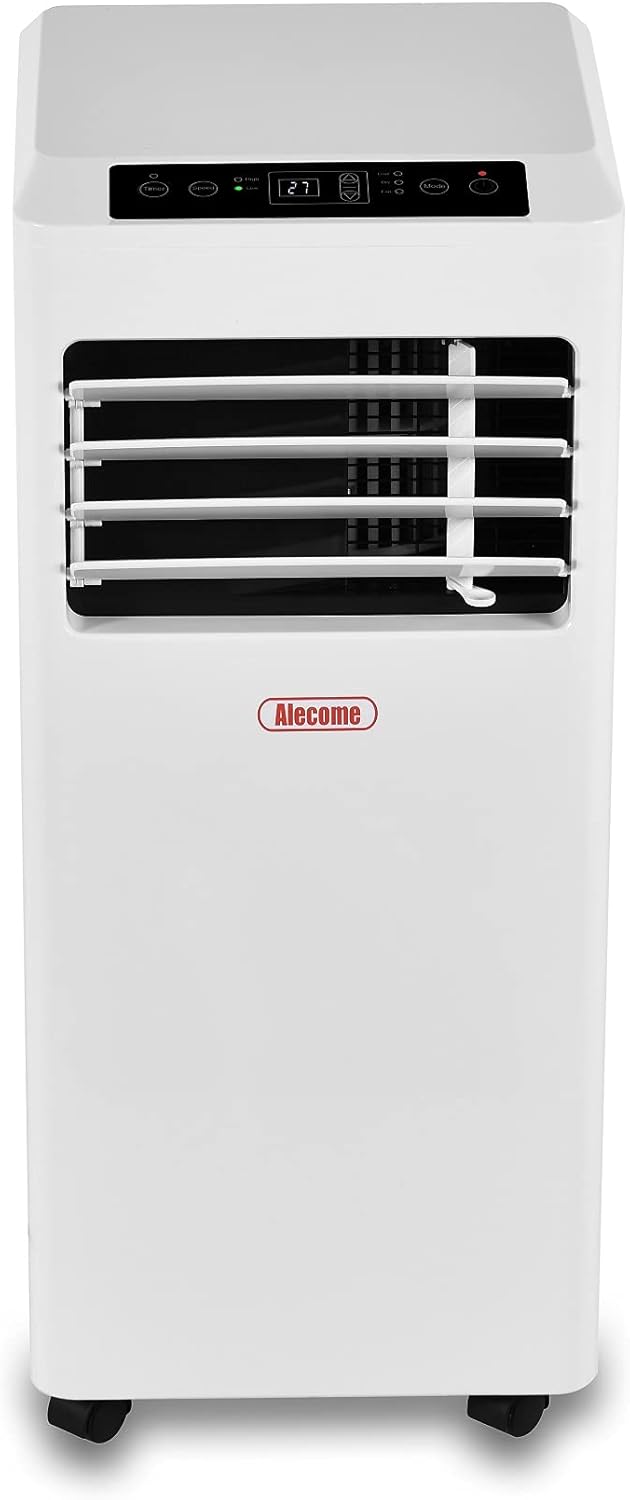
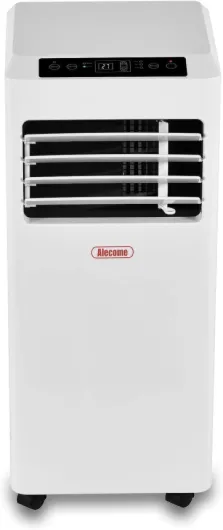
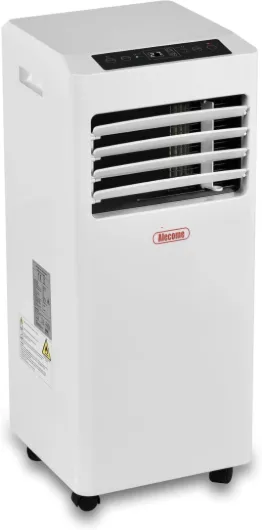
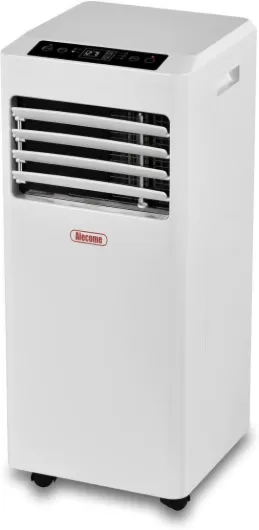
The Alecome R290 8000BTU is a compact tower‑style unit with listed dimensions of 70 cm (height) x 33.5 cm (width) x around 32.5–70 cm (depth, depending on how you read the spec line). Visually, it is the typical white plastic box with front air outlet louvers and a top‑mounted control panel. The form factor is clearly meant to slip next to a bed, desk or sofa without taking as much space as a big dehumidifier or window unit. Castors under the base allow you to roll it between rooms, which several buyers appreciate when moving it from bedroom to living room during the day.
Ergonomically, you get a simple LCD display and a remote control. Reviews mention that the instructions are clear and that the remote is easy to use, with basic controls for temperature, fan speed and modes (Cool, Dry, Fan). There is also a 24‑hour timer, handy if you want it to run until the early morning and then shut off automatically. The design is not trying to be fancy: no touch glass, no Wi‑Fi, no app. For many people that is actually a plus, as there is less to go wrong and less configuration.
One detailed reviewer goes into the airflow layout and points out some design compromises common to single‑hose portable ACs. They describe two airflows: the main one that takes room air, cools it across the evaporator and blows it back into the room; and a second one that pulls room air to cool the condenser and then pushes that hot air outside through the exhaust hose. The same reviewer flags three design weaknesses: the uninsulated hot exhaust hose radiating heat back into the room, the fact that indoor air is expelled outside (so warm air infiltrates from elsewhere to replace it), and the compressor being inside the space you are trying to cool, which inevitably adds some heat and noise.
In my opinion, those points are fair and apply to almost all single‑hose mobile ACs, not just this model. On the plus side, the Alecome includes both a rigid window board for sliding windows and a fabric "tent" for hinged windows, which gives more flexibility in European housing. On the minus side, you need to think a bit about placement: ideally, keep the hot exhaust hose as short and straight as possible and avoid routing it right past the cold air intake, otherwise you risk confusing the thermostat and wasting efficiency. If you are willing to tweak placement and accept the look of a hose and curtain at the window, the design is functional and easy to live with. If you want something that disappears visually and acoustically, a fixed split system remains far ahead.
Build quality, leaks and long‑term prospects
Durability is always tricky to judge for a relatively low‑profile brand like Alecome, especially with only a couple of dozen public reviews. There is a mention of a limited warranty in the spec sheet, but no duration is clearly stated in the product data. The unit is manufactured in China, like the vast majority of portable ACs, and uses a rotary/scroll type compressor, which is a standard choice in this segment. One of the more detailed buyers comments that they are pleased with the build quality and that the unit feels solid for the price, which is reassuring given the lack of a big brand name.
On the negative side, there is an isolated report of water leakage at the bottom even though the water outlet was closed. That suggests the condensate management system might be sensitive to placement, tilt or perhaps blockage. Since this complaint appears only once among the reviews, it looks more like a one‑off issue or installation mistake than a systematic flaw, but it is something to keep in mind. Using the supplied drain hose where possible and ensuring the unit is level should reduce the risk of this kind of problem.
Thermal design also has an impact on perceived durability. One reviewer notes via a thermal image that the bottom half of the casing gets warm because the compressor is inside the unit, which is normal for this architecture. They suggest that adding foil bubble insulation inside the housing or around the sides could reduce heat radiation. While that is more of a performance tweak than a durability fix, lower internal temperatures generally help electronics and plastics last longer. The fact that the hot exhaust hose is not insulated from the factory is more of an efficiency issue than a reliability one, but if the hose is kinked or overheated repeatedly, it could age faster.
In my opinion, for a mid‑range portable AC, the durability outlook is acceptable but not bulletproof. There is no wave of failures or horror stories in the comments, but also no long‑term feedback over multiple summers. If you treat it like a seasonal appliance—store it properly in winter, avoid rough handling of the hose and casters, and occasionally check the filters and drain—you can reasonably expect a few summers of service. Anyone wanting a decade‑plus lifespan with heavy daily use would be better off with a well‑known brand split system, but that is a different budget and installation story.
Noise, airflow and energy use: what to expect day to day
The performance picture is a mix of good cooling and decent efficiency with the usual compromises of portable air conditioners. The SEER of 18 and energy class A are strong points on paper, especially compared with older portable units that often sat in lower classes. Combined with the R‑290 refrigerant, this suggests that, for a given cooling output, it should draw less power than many older designs. One enthusiastic buyer explicitly calls it economical to run, although there are no hard kWh figures in the reviews, so that remains a qualitative impression rather than a measured value.
Noise is where opinions diverge a bit. Several comments call it "a bit noisy but no worse than a large fan" or compare it to typical hotel air conditioning that you sleep with on holiday. Another person simply says it is "so noisy" while still acknowledging strong temperature reduction. There is no decibel figure in the spec sheet, so expectations should be based on those descriptions: this is clearly not a silent device, and anyone extremely sensitive to noise might be bothered, especially at night. The presence of three fan speeds, including a sleep mode, should help reduce sound levels when full power is not needed.
Airflow and air management are also mentioned. One reviewer highlights that the hot exhaust hose can reach 36–37 °C and radiate heat into the room if it is long and uninsulated. They plan to replace it with an insulated hose to improve things. They also point out that single‑hose units remove some indoor air and expel it outside, which forces warm outside air to infiltrate to replace it. This is a known inefficiency of the format: a dual‑hose or split system would avoid that. On the other hand, the Alecome does at least include a window seal kit, which helps limit hot air coming back in through the window opening itself.
In my view, the performance is honest for the price and category: strong enough cooling for small to medium rooms, energy consumption that should be reasonable for summer use, but noise and airflow quirks that you need to accept up front. If you route the hose smartly, keep the seal kit tight and maybe add an aftermarket insulated hose, you can get closer to the theoretical performance. If you want whisper‑quiet operation with no compromise on efficiency, you are in the territory of fixed split systems, which cost more and require professional installation.
What this Alecome R290 8000BTU unit actually offers
This model is a portable, single‑block air conditioner with 8,000 BTU (about 0.6 ton) of cooling capacity, aimed at rooms up to roughly 20 m². The manufacturer lists a power draw of 2300 W, an energy efficiency class A and a SEER (Seasonal Energy Efficiency Ratio) of 18, which is quite respectable for a mobile unit. It only operates in cooling mode (no heating), but it does offer three fan speeds (high, low and sleep) and a thermostat adjustable between 16 °C and 32 °C. A 24‑hour timer is integrated and can be controlled either through the top LCD panel or via the supplied remote control.
The refrigerant is R‑290 (propane), which several buyers explicitly appreciate. One detailed review highlights R‑290 as one of the better refrigerants from an environmental perspective, and also points out that it is not an exotic or particularly toxic gas. Using R‑290 is now fairly common in newer portable units and usually goes with slightly lower global warming potential. That does not change how cold the air feels, but it matters if you pay attention to the environmental impact of your appliances.
On the practical side, the unit comes with castors (wheels) for easy mobility, a window seal kit and a water pipe / drain hose. The window kit is designed for sliding windows and comes with an extra "tent" style curtain adapter for hinged windows. Reviews mention that this curtain solution is a bit fiddly at first but workable once you figure out where to attach the Velcro so you can still use the window handle. Having these accessories in the box avoids extra purchases and makes it more plug‑and‑play for renters or offices.
Overall, the presentation is that of a straightforward, no‑nonsense portable AC: a white plastic tower around 70 cm high and roughly 33.5 x 32.5 cm in footprint, on wheels, with a top control panel and a rear exhaust port for the 15 cm hose. It is corded (no battery, no cordless option) and does not require an outdoor unit or complex installation. In my opinion, the feature set is standard but complete for this price range: remote, timer, basic modes (Cool/Dry/Fan) and the essentials to vent hot air out of a window. If you are looking for smart‑home integration or advanced air purification, this is not it; if you want simple cooling and dehumidification in summer, it checks the main boxes.
Cooling effectiveness in real rooms
On paper, 8,000 BTU (about 2.3 kW of cooling) is appropriate for rooms up to around 20 m², assuming standard ceiling heights and average insulation. The manufacturer claims it can cool down to 16 °C. Several Amazon buyers confirm that the unit can take bedrooms and living spaces from the mid‑20s down into the high teens over a few hours during warm days. One comment mentions a bedroom dropping from 25 °C to 19 °C in a matter of hours, another reports keeping a living room and kitchen comfortable during a 30 °C day.
One technically inclined reviewer even mentions seeing around 11 °C at the cold air outlet in their setup, which indicates the refrigeration cycle is working with a healthy temperature delta. That same person notes that the unit was able to chill a 25–30 m² bedroom effortlessly and felt it could likely handle even larger spaces, at least in moderate conditions. However, they also explain that the thermostat might be slightly fooled if the hot exhaust hose is routed too close to the intake, causing the machine to overcool compared to the setpoint. This is not a defect, just a placement detail to be aware of.
The unit also offers a Dry (dehumidification) mode, which is useful in muggy climates, especially at night when you might not need full cooling. There are not many detailed comments specifically about dehumidification performance, but one review explains that the system generally evaporates collected water and ejects it with the hot exhaust air, so you do not constantly have to empty a tank. A drain hose is provided for situations where gravity drainage is possible, which can marginally improve efficiency by avoiding re‑evaporation work.
In my opinion, the effectiveness is solid for its category, provided you match the unit to a realistic room size and accept the inherent limits of a single‑hose design. It is not meant to cool a whole large house, but for a bedroom, home office or small lounge it should deliver a clear temperature drop during heat waves. The positive 4.4/5 average and repeated mentions of rooms becoming "cool" or "staying cool all day" support that. If you try to cover a big open‑plan area in direct sun, you will reach the ceiling of what 8,000 BTU can do, but that is more about sizing than this specific product.
Pros
- Good cooling power for small to medium rooms (8,000 BTU, effective down to around 20 m²)
- Energy class A with R‑290 refrigerant, more eco‑friendly than older gases
- Complete package with remote, 24‑hour timer, castors, window seal kit and drain hose
Cons
- Noticeable noise level, often compared to a large fan or hotel air conditioning
- Single‑hose design reduces overall efficiency and can pull warm air into the home
- Isolated report of water leakage suggests drainage setup needs care
Conclusion
Analysis score
The Alecome R290 8000BTU portable air conditioner is a straightforward tool for people who want quick relief from summer heat without drilling walls or committing to a full mini‑split. It offers 8,000 BTU of cooling, a thermostat down to 16 °C, three fan speeds, a 24‑hour timer and a remote control, all in a compact, wheeled body. The use of R‑290 refrigerant and an energy class A rating are real plus points, and the included window seal kit and drain hose make the package fairly complete. Public reviews largely confirm that it cools bedrooms and small living rooms effectively, even during hotter days.
It is not perfect. Noise is clearly audible—think big fan or hotel AC level—and the single‑hose design has known efficiency drawbacks, especially if the exhaust hose is long, uninsulated or poorly routed. There is also at least one report of water leakage, which hints that you need to pay attention to drainage and placement. Build quality seems decent for the price, but this is still a budget‑friendly unit from a lesser‑known brand, so expectations on long‑term durability should stay realistic.
In my opinion, this model suits renters, flat dwellers and anyone who wants to cool a specific room during heat waves without calling an installer or spending on a split system. If you can live with some noise and the visual presence of a hose and window curtain, the comfort gain for the money looks strong. Those who are very sensitive to sound, want to cool large open spaces, or are planning a long‑term whole‑home solution should probably skip it and look at higher‑end dual‑hose or split units instead.