Summary
Analysis score
Average of the criteria rated below
Value for money: where this Dreo sits in the portable AC market
Design and usability: compact tower with smart controls
Everyday comfort: noise, controls and living with it
Build quality, maintenance and long‑term reliability
Cooling performance, noise and dehumidifying in real‑world feedback
What the Dreo AC515S actually offers on paper
Pros
- 12,000 BTU capacity effectively covers typical bedrooms and small to medium rooms around 300 sq ft
- Relatively quiet for a portable AC, with many buyers comfortable using it in bedrooms
- Smart features (Wi‑Fi app, Alexa/Google voice, remote, timer) make daily use and scheduling easier
Cons
- Modest SEER 6.1 efficiency and single‑hose design are less efficient than window or dual‑hose units
- Still subject to portable AC compromises: bulky footprint, window hose, and limited long‑term durability compared to fixed systems

Specifications
View full product page →| Brand | Dreo |
Portable AC that tries to be smart, quiet and low‑maintenance
The Dreo AC515S 12,000 BTU is a portable air conditioner that targets people who want solid cooling for a bedroom or small apartment without dealing constantly with drainage buckets and noisy compressors. On paper it combines several selling points that usually don’t come together at this price: app and voice control, a self‑evaporating “drainage‑free” cooling mode, relatively low noise around 46 dB, and a 3‑in‑1 design with cooling, fan and dehumidifier. With an average score of 4.4/5 from more than a thousand Amazon reviews, it clearly convinces most buyers, even if a few limits show up when you read the comments in detail.
What stands out immediately is the positioning: 12,000 BTU (ASHRAE) in a fairly compact body (about 14.4 x 17.3 x 28.1 inches) meant for rooms around 300 sq ft. Several buyers say they use it in small to medium bedrooms or upstairs areas that their central AC struggles to cool, and many describe a clear temperature and humidity drop. Noise also comes up a lot: people repeatedly call it quieter than other portable units they owned, even if it’s obviously not silent.
On the flip side, the spec sheet shows a modest SEER of 6.1, which is typical for portable ACs but far from efficient compared with mini‑splits or good window units. The single‑hose design is also a compromise: convenient to set up, but less efficient than dual‑hose systems in theory. And the “drainage‑free” promise has limits: Dreo itself states that above 85% humidity, you should expect to use the included drain hose.
In my opinion, this model is aimed at people who accept the usual trade‑offs of portable ACs but want something a bit more polished: easier app control, more tolerable noise, and less day‑to‑day fuss with water. It’s not a miracle machine, but the combination of specs and mostly positive feedback suggests a solid, practical option for cooling a bedroom, office, or workshop when a window unit or mini‑split isn’t possible.
Value for money: where this Dreo sits in the portable AC market
The exact price fluctuates, but the Dreo AC515S positions itself as a mid‑range portable AC: not an ultra‑budget unit, but not in the high‑end premium bracket either. For that segment, the feature mix is fairly generous: 12,000 BTU, smart app and voice control, quieter operation, self‑evaporating drainage‑reduction, and 3‑in‑1 modes. Many competing 12,000 BTU portables either skip Wi‑Fi and voice support, are louder, or don’t push the drainage‑free angle as strongly. The 4.4/5 rating from over 1,000 buyers suggests most people feel they got their money’s worth.
Energy efficiency is not a strong point, but that’s a general issue with portable ACs. The SEER of 6.1 is typical for this type of product but low compared with window units or mini‑splits. That means running costs will be higher per BTU of cooling than more permanent solutions. Interestingly, one review mentions monitoring their daily electric usage during a heat wave and being surprised that this unit “hasn’t added much” to their bill. That doesn’t turn it into a high‑efficiency system, but it shows that, in real homes, usage patterns and thermostat settings matter as much as lab ratings.
Where the value improves is in convenience and flexibility. If you rent, can’t install a window unit, or need to move cooling between rooms or even to a workshop, a portable AC is sometimes the only realistic solution. One buyer, after liking it in their home, moved a unit into a workshop and vented it through the wall, still satisfied with performance. In that context, paying a bit more than a basic fan or a no‑name portable AC can make sense, especially if you care about noise and smarter control.
In my opinion, the Dreo AC515S offers good but not spectacular value. If you compare only on raw BTU per dollar, there may be cheaper 12,000 BTU units. If you compare across all cooling technologies, a window unit or mini‑split will often give more efficient, quieter, long‑term cooling for similar or slightly higher cost, assuming you can install them. But if your constraints push you toward a portable, and you want one that is relatively quiet, app‑controlled, and less annoying in terms of drainage, this Dreo justifies its price for many users. The positive, detailed reviews from people using it daily in bedrooms back that up.
Design and usability: compact tower with smart controls
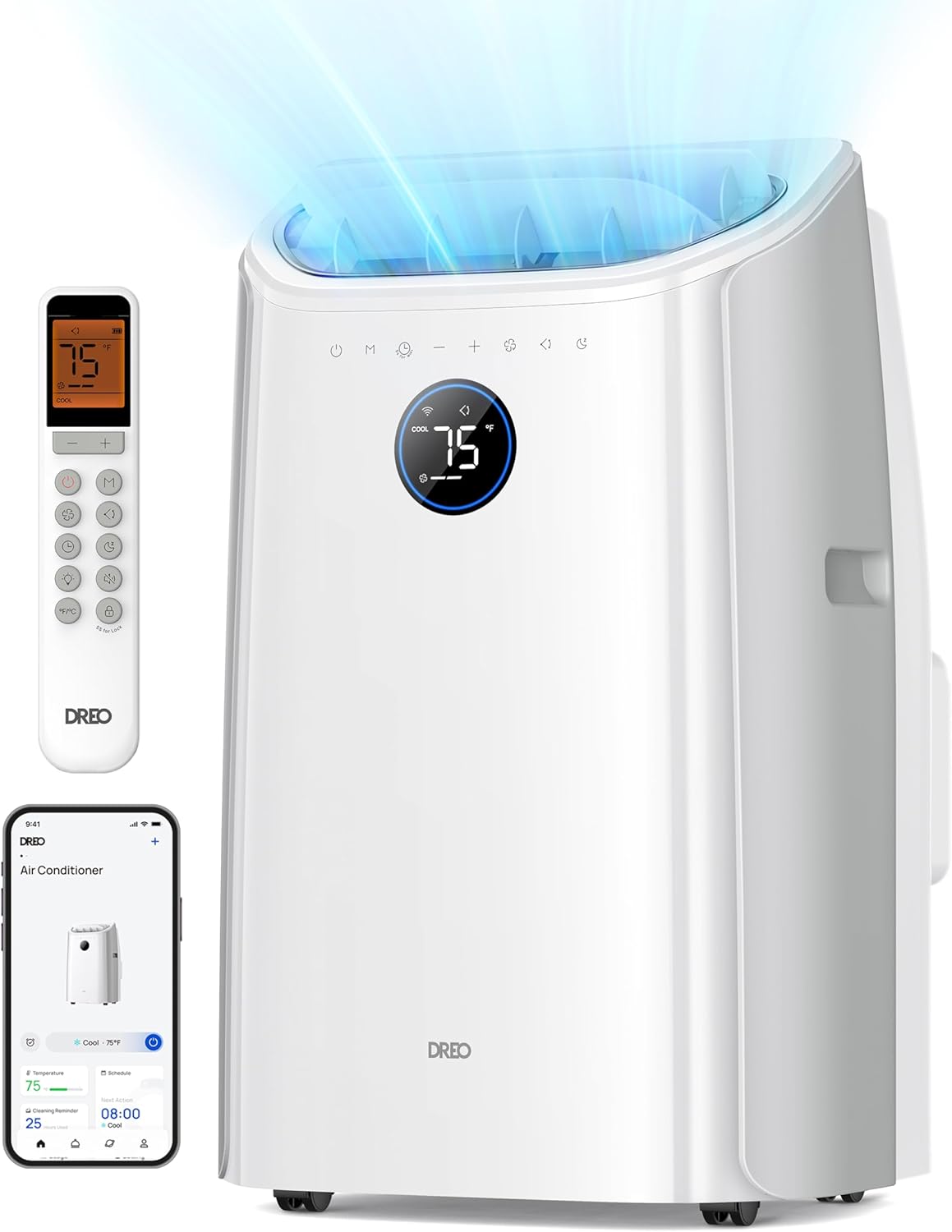
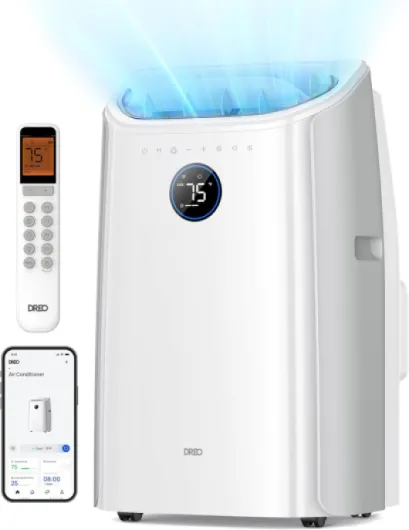
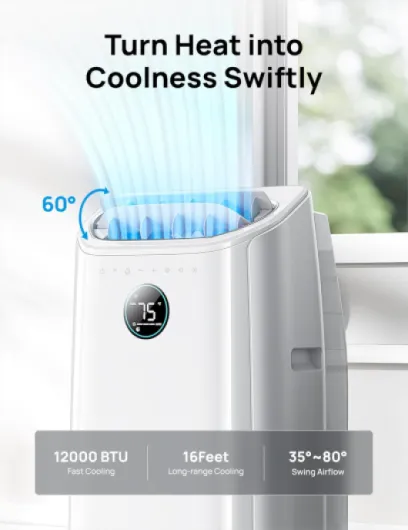
Design‑wise, the Dreo AC515S sticks to a fairly clean, modern tower look. Dimensions are 14.37" deep, 17.32" wide, and 28.13" high, so it’s not tiny, but for a 12,000 BTU portable AC it stays in a reasonable footprint. The white color is neutral enough to blend into most bedrooms or offices, and several buyers mention that it looks better than older, bulkier portable units they owned. Airflow is front‑facing, with louvers at the top section, which should help distribute cool air into the room rather than blasting straight at your feet.
Usability seems to be a strong point according to the reviews. People repeatedly say setup is straightforward: the included window kit makes it relatively simple to mount the exhaust hose into a standard window, even for users who describe themselves as not very handy. The controls are also highlighted: you get a large LED display on top, physical buttons, a remote control, and full app control. This redundancy is practical; if the app connection drops or guests are using the room, they can still adjust temperature and modes easily from the unit or remote.
The single‑hose design is a double‑edged sword. On the one hand, it keeps installation simpler: one hose, one window plate, less visual clutter. On the other hand, from a technical standpoint, single‑hose portable ACs are less efficient than dual‑hose models because they draw some air from the room to cool the compressor and then expel it outside, slightly pulling in hot air from elsewhere in the house. One reviewer even tried to blame outside odors on the single hose, while another pointed out that this is not how the system works. In my opinion, if you care more about ease of installation than squeezing out every bit of efficiency, this design choice is reasonable.
Overall, the design focuses on practical everyday use: easy window connection, clear display, and full range of controls (remote, app, voice). It’s not the most compact 12,000 BTU on the market, but for a typical 300 sq ft bedroom, the footprint is manageable, and the tower shape is less intrusive than wider, squatter units. If you need something ultra‑low profile or wall‑mounted, this won’t fit that need, but as a movable floor unit that doesn’t look too industrial, it does the job.
Everyday comfort: noise, controls and living with it
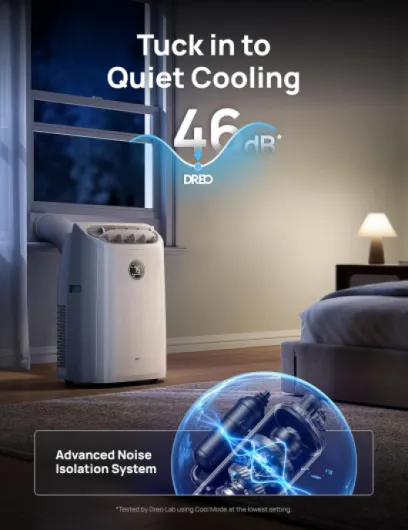
Comfort with a portable AC is not just about raw cooling; it’s about how tolerable it is to live with. Here, the Dreo AC515S does fairly well. Noise is the first comfort factor, and many reviews highlight that this unit is quieter than previous portable ACs they owned. One buyer compares it favorably to a box fan, saying it’s less noisy, especially at lower fan speeds. Another calls it “really quiet” and suitable for bedrooms. The 46 dB figure advertised likely refers to the quietest setting, so high cool at full blast will obviously be louder, but overall the impression from buyers is that the sound is more like a steady fan/white noise than a harsh mechanical racket.
Thermal comfort also gets good feedback. Users in problematic rooms—upstairs, south‑facing, poor central air vents—say the Dreo finally makes those spaces “sleepable.” One night‑shift worker with blackout curtains and a small vent from central AC reports that their 12x12 bedroom, which used to hover well above the house setpoint, becomes properly cool after installing this unit. Another user notes that in a humid climate, the combination of cooling and humidity reduction makes the air feel significantly more pleasant, not just colder. This tracks with the spec sheet: 12,000 BTU for 300 sq ft is a sensible pairing, not under‑specced.
Control comfort is another strong point. You can adjust settings by remote, app, voice, or on‑device buttons. Several buyers say they mostly use the remote from bed, while others like the app for pre‑cooling the room or checking status from elsewhere in the house. For people who hate getting up to tweak the thermostat or mode, this flexibility is a real quality‑of‑life boost. The 24h timer and scheduling also help avoid waking up cold in the middle of the night or wasting energy when nobody is home.
There are still some inherent portable AC compromises: you have a hose going to the window, you lose some window area, and you need to leave enough space around the unit for airflow. If someone expects completely silent, invisible cooling, this type of product simply won’t deliver. But for what it is, the Dreo AC515S seems to strike a good balance between cooling efficiency, tolerable sound level, and user‑friendly control, which explains why so many buyers specifically mention better sleep and more comfortable work conditions after installing it.
Build quality, maintenance and long‑term reliability
Durability is always tricky to judge from afar, but a few elements stand out. First, the rating: 4.4/5 from over 1,000 reviews is usually a sign that there aren’t widespread catastrophic failures. If many units died early or had major defects, the average would typically be dragged down more heavily. Among the reviews, there are buyers who come back months later to confirm that the unit still runs well. One person mentions using it for around 11 months in a bedroom, cooling most of the upstairs, and still calls it the best portable AC they’ve owned, with no mention of breakdowns, just routine filter cleaning.
Maintenance seems simple, which is important for longevity. The unit uses washable filters that buyers say are easy to remove and clean. Keeping those clean reduces strain on the compressor and improves airflow, so the fact that people actually do it without complaining about complexity is a good sign. The self‑evaporating system in cool mode should also reduce standing water inside the unit, which is often a weak point on cheaper portable ACs where water buildup can lead to mold or pump issues if not drained regularly.
Materials are not described in great detail, but as a plastic‑bodied portable AC from a mainstream brand, expectations should be moderate: decent but not premium. There’s a 1‑year standard warranty and mention of 24h customer service. That warranty duration is pretty typical for this category, not especially generous but not concerning either. Some competing brands offer longer coverage or extended plans at extra cost, so if warranty length is critical, this might be a point to compare.
In my opinion, the long‑term reliability picture is generally reassuring but not bulletproof. You have many users reporting months of solid use, including someone who even moved the unit to a workshop and ran venting and drain through a wall, still satisfied. At the same time, portable ACs as a class are more fragile than simple fans or window units because there’s more plumbing and electronics crammed into a movable shell. So if someone expects 10+ years of heavy use, a fixed mini‑split or high‑end window unit would be a safer bet. For a few summers of regular bedroom or office use, this Dreo looks reasonably trustworthy based on the feedback.
Cooling performance, noise and dehumidifying in real‑world feedback
On paper, the big selling point is the 12,000 BTU (ASHRAE) capacity for roughly 300 sq ft. In the reviews, a lot of buyers confirm that, in typical conditions, the unit cools bedrooms and medium spaces effectively. One person running it in a hot upstairs hallway and bedroom mentions it “quickly cools” the area and makes a clear difference in comfort, including humidity. Another user in a 12x12 south‑facing bedroom with poor central AC supply reports that the room, which used to sit around 74–75°F with the house at 68°F, finally becomes comfortable for sleep once this unit is running.
Noise is a frequent topic and generally a strong point. Dreo advertises a minimum noise level of 46 dB, helped by a compressor noise isolation system. Buyers often call it quieter than other portable ACs and even quieter than a typical box fan at comparable airflow. One review describes the sound as somewhere between a white noise machine and a fan, especially on higher speeds, and several say they can sleep with it running in the same room. Of course, it’s still a compressor‑based AC, so if someone expects near‑silence, they may be disappointed, but for portable standards the feedback is positive.
The dehumidifying effect is also highlighted. One user in a humid area (65–85% humidity) notes that the unit makes a “noticeable difference you can feel,” even when primarily used for cooling. Another mentions having a separate thermometer/hygrometer in the room and seeing both temperature and humidity drop when the AC runs. This matches the specs: the unit has a dedicated dehumidifier mode, but even the cooling mode will condense and remove some moisture. The brand claims the self‑evaporation and pump reduce drainage needs by up to 90% under 85% humidity, which lines up with buyers who say they never had to deal much with water in regular bedroom use.
Range‑wise, there are also reports of people using it beyond a single room. One buyer states that in a medium bedroom with the door open, the unit helps cool most of the upstairs, even allowing a dog to go in and out to the patio. That’s a good sign that the airflow and capacity are decent, but expectations should stay realistic: in my opinion, using it as a whole‑floor solution in a large house will push it beyond its sweet spot. For a single room or studio, though, the combination of cooling power, noise level, and basic dehumidification looks solid for the category.
What the Dreo AC515S actually offers on paper
The Dreo AC515S is a 12,000 BTU (ASHRAE) portable air conditioner running on 120 V, using R‑32 refrigerant. The brand advertises coverage around 300 sq ft, which matches a typical bedroom, small living room or office. The temperature range is adjustable between 65°F and 86°F, so you get enough flexibility for sleeping, working, or just taking the edge off in shoulder seasons. Form factor is classic tower‑style portable AC: roughly 28 inches tall, with a single exhaust hose that connects to a window kit included in the box.
This model is a 3‑in‑1 unit: cooling, fan, and dehumidifier. Several reviews say they mainly use cooling mode but do notice humidity dropping, even without explicitly enabling the dedicated dehumidify mode. Dreo highlights a “drainage‑free” cooling system that uses self‑evaporation and a high‑capacity pump to reduce manual drainage by up to 90% as long as humidity stays below about 85%. For more extreme humidity or dehumidifier mode, a drain hose is supplied so you can route water to a drain or outside.
Smart control is a clear selling point. The AC515S connects to Wi‑Fi and works with the Dreo app, Amazon Alexa, and Google Home. Buyers mention using the app to turn the unit on before coming home, change modes from bed, or apply firmware updates. There is also a physical remote and a large LED display on the unit itself, so you don’t depend on the phone for basic control. A 24‑hour timer and scheduling functions round out the feature set for people who want to automate cooling around sleep or work hours.
From a market standpoint, this model sits around the middle of Dreo’s portable line and ranks in the top 20 of Amazon’s portable AC category, with a 4.4/5 average from over 1,000 reviews. In my opinion, that combination of popularity and sustained rating over time suggests the product delivers what most users expect: it cools effectively for its size, is reasonably quiet, and the smart features are more than just a marketing line. It doesn’t pretend to be the most powerful or most efficient machine on the market, but it aims to be a well‑rounded, user‑friendly choice.
Pros
- 12,000 BTU capacity effectively covers typical bedrooms and small to medium rooms around 300 sq ft
- Relatively quiet for a portable AC, with many buyers comfortable using it in bedrooms
- Smart features (Wi‑Fi app, Alexa/Google voice, remote, timer) make daily use and scheduling easier
Cons
- Modest SEER 6.1 efficiency and single‑hose design are less efficient than window or dual‑hose units
- Still subject to portable AC compromises: bulky footprint, window hose, and limited long‑term durability compared to fixed systems
Conclusion
Analysis score
The Dreo AC515S 12,000 BTU portable AC comes across as a well‑rounded option for people who need flexible cooling in a bedroom, office, or small living area and can’t or don’t want to install a window unit or mini‑split. On paper it checks the right boxes: enough capacity for roughly 300 sq ft, a relatively low advertised noise floor around 46 dB, self‑evaporating cooling to reduce drainage hassle, and a full set of controls via remote, app, and voice. In the public reviews, buyers back this up with comments about faster cooling, better sleep in previously hot rooms, and noise that is quite tolerable for a bedroom.
It’s not perfect. The SEER 6.1 efficiency is standard for portable ACs but clearly behind more permanent systems, and the single‑hose design is less efficient than dual‑hose competitors in theory. You also have the usual portable compromises: a chunky unit on the floor and a hose in the window. In my opinion, this model suits renters, bedroom users, and workshop or office owners who value quietness and smart control over absolute efficiency. People who can install a good window unit or mini‑split and mainly care about long‑term energy savings might be better off looking elsewhere.
Overall, the combination of strong user feedback, practical features, and decent build puts the Dreo AC515S in a solid spot. It’s a sensible choice if you want a portable AC that feels a bit more modern and less annoying to live with than the basic, loud, bucket‑emptying units that give this category a bad reputation.