Summary
Analysis score
Average of the criteria rated below
Value for money: where the MOOKA KJ190L stands
Compact footprint and front intake: practical design for tight spaces
Essential oil function: nice idea, mixed execution
Build quality, filter lifespan, and long-term prospects
Noise, airflow, and day-to-day operation
What the MOOKA KJ190L actually offers
Filtration and real-world impact on dust, allergies, and odors
Pros
- Effective 3-stage HEPA and carbon filtration with good feedback on dust, allergies, and odors
- Quiet sleep mode (~20 dB advertised) and simple controls suitable for bedroom use
- Washable pre-filter and relatively inexpensive replacement filters keep running costs low
Cons
- No smart features or air quality sensor; fan speed must be adjusted manually
- Essential oil function reported as weak by at least one buyer and not a strong fragrance solution

Specifications
View full product page →| Brand | MOOKA |
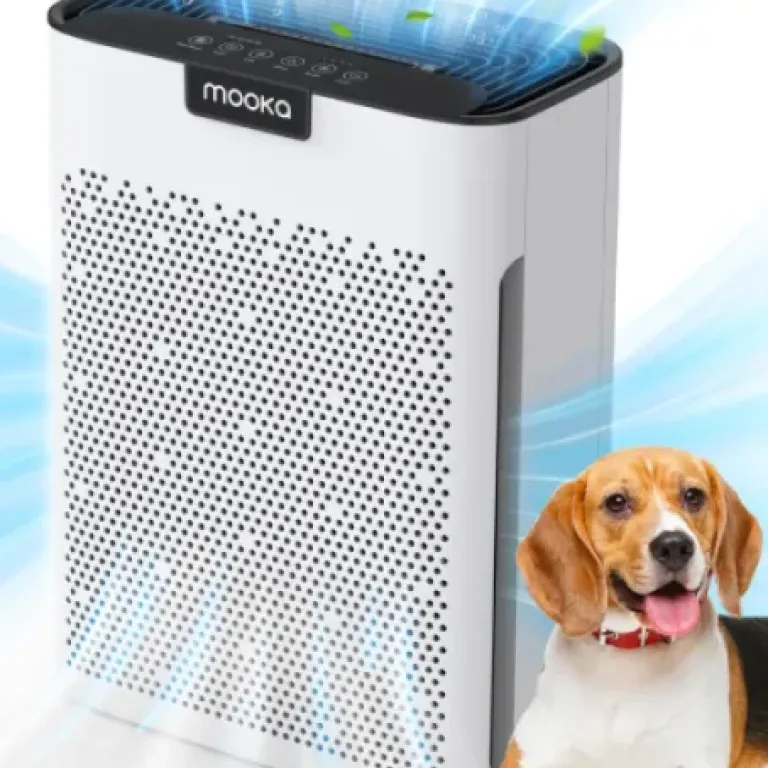
A budget air purifier aimed at pet owners and large rooms
The MOOKA KJ190L is marketed as an affordable air purifier that can handle big spaces and pet-related pollution. On paper it covers up to 2200 ft² per hour, uses a 3-stage HEPA-based filtration system, and adds a few lifestyle touches like an essential oil pad and child lock. The average Amazon rating sits around 4.5/5, which suggests that most buyers feel it gets the job done for typical home use, especially in living rooms and bedrooms.
Several reviews highlight two main expectations: dealing with pet hair/dander and reducing odors from dogs, cooking, and in one case even 3D printers. The spec sheet clearly targets that audience, with a wider dual-side air intake and extra activated carbon pellets. The brand also pushes the idea of low ongoing cost by pairing a washable pre-filter with relatively cheap replacement filters, which appeals to people who don’t want to spend a fortune on consumables.
From a safety and compliance angle, the unit checks the right boxes: CARB, ETL, DOE, and FCC certifications, with explicit mention of no ozone and no UV. For anyone who is cautious about ozone-generating purifiers, this is a key point. Noise is another big concern in this category, and the manufacturer claims 20 dB in sleep mode, which lines up with reviews that describe it as quiet enough for the bedroom on lower speeds.
It’s not positioned as a premium smart purifier with apps and air-quality sensors, but rather as a straightforward, plug-and-go machine. In my opinion, the interest here is clear: if the coverage claims are even partly realistic and the filter system holds up, the price-to-performance ratio looks solid for small apartments and pet-heavy homes that just want cleaner, less smelly air without complicated controls.
Value for money: where the MOOKA KJ190L stands
The KJ190L sits in a crowded segment of budget to mid-range air purifiers. The exact price can fluctuate, but it is clearly positioned as an affordable option, not a premium smart purifier. For that money, you get coverage advertised up to 2200 ft² per hour, a 3-stage HEPA and carbon filtration system, low-noise sleep mode, timer, child lock, and a simple essential oil feature. The Amazon rating of about 4.5/5 suggests that, for most buyers, the performance matches or exceeds what they expected at this price level.
Where the value really shows is in operating costs and practicality. The washable pre-filter reduces how often you need to replace the full cartridge, and several buyers point out that the filters last a long time and that replacements are relatively inexpensive. One reviewer in a heavy-use scenario only needed to consider replacement after close to a year, which is good longevity. Add to that the low energy consumption (0.63 kWh for 24 hours at max speed), and you have a device that doesn’t punish you on the electric bill even if you run it constantly.
On the flip side, you’re not getting advanced features like Wi‑Fi control, smartphone integration, or an auto mode with air quality sensors. Some competing models at higher prices offer real-time PM2.5 readings, color-coded air quality rings, and automatic fan adjustments. If those features matter to you, this MOOKA will feel basic. Also, the essential oil function seems underwhelming for at least one buyer, so it shouldn’t be a major factor in your purchase decision.
In my opinion, the value proposition is strong if your priorities are clean air, low noise on sleep mode, pet-hair handling, and low running costs. It’s less attractive if you want smart-home integration or very precise control and data about your air quality. For a straightforward, no-frills purifier that you set on a speed and mostly forget, the KJ190L looks like a solid deal, especially for pet owners and small to mid-size apartments.
Compact footprint and front intake: practical design for tight spaces
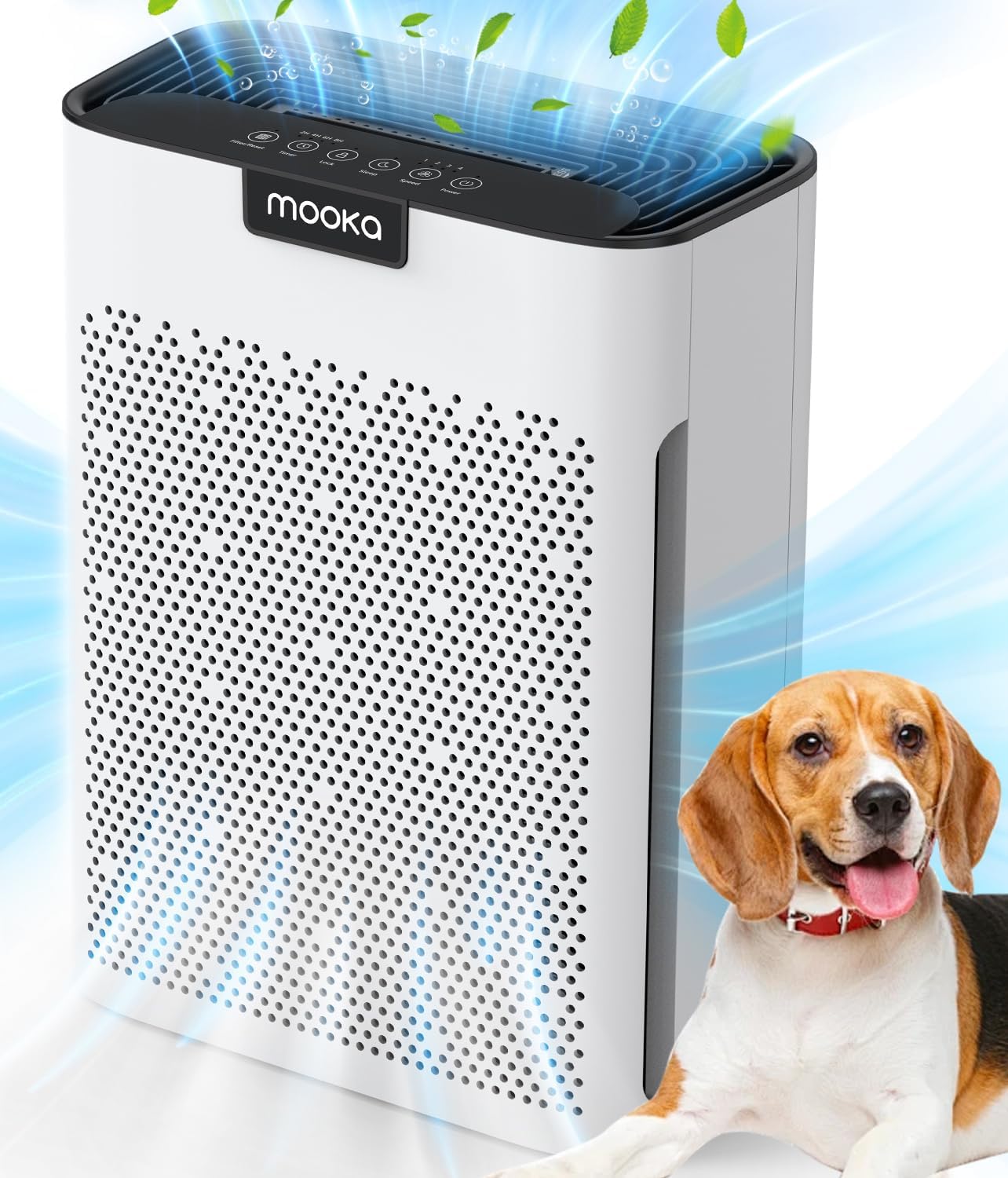
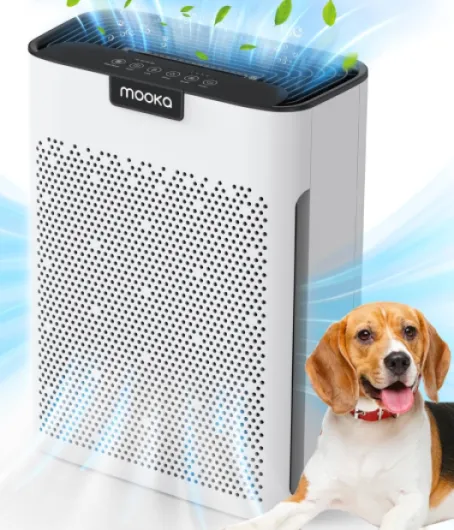
The MOOKA KJ190L goes for a compact rectangular design in white, with dimensions of 6.1" deep by 12.2" wide and 15.75" high. Several buyers mention that it’s fairly small and visually neutral, which makes it easy to place in a bedroom or living room without it dominating the space. One review specifically appreciates that the main air intake is on the front, allowing the unit to sit close to a wall without blocking airflow, which is handy in cramped rooms or near furniture.
The dual-side, wider intake design is one of the advertised selling points. Instead of just pulling air from the back or one side, it’s built to pull more air across the front and sides to better capture pet hair and dander. For households with dogs or cats that shed a lot, that layout should help the pre-filter load up with hair before it reaches the HEPA section. Buyers with multiple dogs note that the unit seems to grab hair and dander effectively, and some mention visibly cleaner air and less dust floating in the light.
The control panel on top is described as simple and easy to understand in the comments. There are touch buttons for power, fan speed, timer, sleep mode, filter reset, and child lock. There’s also a small compartment or pad on top for essential oils. The design stays away from glossy, fingerprint-magnet finishes and instead uses a more understated plastic shell, which people call "nice looking" and "solid". One reviewer notes that the casing feels high-quality for the price, which suggests MOOKA didn’t cheap out completely on exterior build.
In my opinion, the design is functional rather than flashy. Strengths: slim depth, front intake for wall placement, clear controls, and a look that blends into most interiors. Weak points: no wheels or handle for very easy moving (though at 6.7 lbs it’s light enough), and no display showing real-time air quality or exact fan speed. For the price range, that’s acceptable, but if you like lots of visual feedback and digital readouts, this unit will feel basic.
Essential oil function: nice idea, mixed execution
One of the extra features on the MOOKA KJ190L is its built‑in essential oil pad. The idea is simple: you add a few drops of essential oil to a cotton pad in a compartment on top, and the airflow spreads the scent through the room while the purifier runs. The brand gives some specific instructions: when using it the first time, you should moisten the cotton pad with more oil than usual and run the unit at maximum speed for a while to help the fragrance spread.
In practice, feedback on this fragrance feature is mixed. Some buyers are mainly focused on air cleaning and barely comment on the oil function, which usually means it’s a nice-to-have rather than the main reason for purchase. One reviewer does say that their only issue with the device is getting the essential oil function to work properly: they can’t really smell the oil even after adding it. That suggests the diffusion is either very subtle or not strong enough for people expecting a noticeable room fragrance.
There are no reports of oil leaking into the main filter or causing mechanical problems, which is always a concern when mixing oils and electronics. Still, there’s also no wave of positive comments saying "the aromatherapy feature is strong". The dominant feedback is about cleaning performance and noise, not scent. So it’s fair to see the essential oil pad as a secondary add‑on that some will use occasionally, but not as a replacement for a dedicated diffuser.
In my opinion, the fragrance function is a bonus rather than a core feature. If you buy this purifier mainly for essential oils, you may be disappointed by the subtle effect, judging from the one clear complaint and the general silence on the topic. If you just want the option to add a light scent sometimes and don’t care if it’s strong, then it’s a small extra that doesn’t hurt. The main value of this product is still its filtration, not its aromatherapy.

Build quality, filter lifespan, and long-term prospects
Durability for an air purifier is mostly about three things: build quality of the body and fan, availability and longevity of filters, and any recurring issues reported over months of use. The KJ190L is relatively new (first available May 2024), so there isn’t a huge multi-year history yet, but some reviews do mention several months to about a year of usage. One owner describes the casing as solid and high-quality for the price, and others note that it’s light but doesn’t feel flimsy. At 6.7 pounds, it’s easy to move without being so light that it seems cheap.
The filter system is where durability really shows. The washable pre-filter is meant to be cleaned periodically with water or a vacuum, capturing hair and larger dust to extend the life of the main HEPA and carbon layers. Buyers report that filters "seem to last pretty long" before needing cleaning or replacement. One detailed review from a demanding environment (dogs, 3D printers, lots of cooking) mentions that the filter only started to restrict airflow after about a year, which is quite respectable. Another buyer even purchased extra replacement filters in advance, planning to rotate them so they can wash and dry one while using another, though they haven’t needed to do that yet.
The brand offers a filter replacement reminder and sells official replacement filters on Amazon, which is crucial for long-term use. There are no widespread complaints in the comments about filters being impossible to find or overly expensive; one person actually calls the replacements comparatively cheap. That’s a good sign, because some air purifiers lock you into costly filters that double the total cost of ownership over a few years. Here, the combination of a washable pre-filter and affordable replacements suggests running costs will stay reasonable.
From a safety and reliability perspective, the CARB, ETL, DOE, and FCC certifications indicate that the unit meets certain electrical and emissions standards. MOOKA also advertises a 60-day no-reason return and lifetime support, which, while marketing-heavy, at least shows they expect the product to last beyond the first months. In my opinion, durability looks decent to good for the price bracket. There’s not enough long-term data to call it bulletproof, but the early signs—solid casing, long-lasting filters in tough conditions, easy access to replacements—are reassuring. As with any budget appliance, you’re not getting premium metal construction or industrial-grade fans, but for typical home use, it seems built to handle daily operation without major issues.
Noise, airflow, and day-to-day operation
Performance here is mostly about how the KJ190L behaves in daily use: noise levels, airflow strength, and ease of control. The manufacturer advertises 20 dB in sleep mode, which is extremely quiet on paper, comparable to a whisper or a very soft fan. Buyers generally support the claim that the lowest setting is quiet enough for sleeping. Several reviews explicitly say they can sleep very well with it running on low, and one mentions that even a baby or pet can rest comfortably while it operates in sleep mode.
At higher speeds, noise naturally increases. One buyer notes that it’s "a bit noisy on high" but adds that this actually helps their sleep because they already use a fan and sound machine. Another review compares the noise at low/medium speeds to a ceiling fan, which is a typical and acceptable level for most users. So, if you are sensitive to noise, you’ll probably stick to low or medium at night and use high during the day or when you need a faster clean-up.
The unit offers four fan speeds, and you choose manually; there’s no auto mode based on a sensor. Users say the controls are easy to use and intuitive, which is good for people who don’t want to fuss with settings. The timer (2/4/6/8 hours) is useful if you want it to run while you sleep or leave the house, and the child lock is reassuring for parents or people with curious pets. The filter replacement reminder light and reset are also mentioned as straightforward features: when the light comes on, you swap or clean the filter and hold the button for 3 seconds to reset.
Energy use is another aspect of performance. MOOKA claims that running at maximum wind speed for 24 hours consumes only 0.63 kWh, which is very low—roughly the same as a small LED TV or less. This means you can realistically run it almost continuously without seeing a big spike in your electricity bill. In my opinion, overall performance is balanced and practical: quiet enough on low, reasonably strong on high, simple controls, and low energy consumption. The main trade-off is the lack of automation and data: you won’t see air quality numbers or have the fan speed adjust itself, so you need to manage that manually.
What the MOOKA KJ190L actually offers
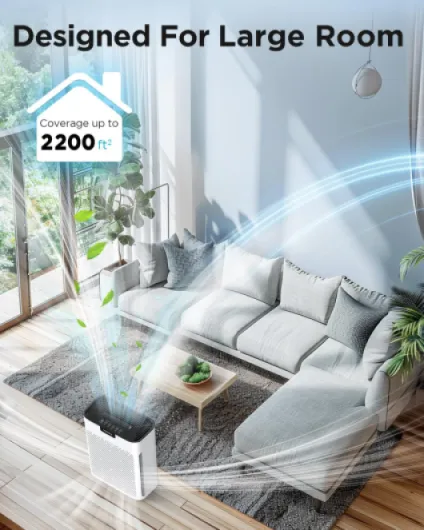
The KJ190L is a compact tower-style air purifier: about 6.1 x 12.2 x 15.75 inches and only 6.7 pounds. It is advertised for large rooms, with a stated capacity of up to 2200 ft² per hour. That wording usually means a high CADR relative to the size, but there’s no explicit CADR figure listed, so you have to take the coverage claim as indicative rather than precise. In practice, reviewers commonly mention using it in spaces around 700–1400 ft², which seems more realistic for thorough cleaning rather than just light circulation.
The filtration system is described as a 3-stage setup: a washable pre-filter for larger particles (hair, lint, big dust), a HEPA layer rated to catch particles down to 0.3 microns (pollen, fine dust, some allergens), and a carbon layer with more pellets than typical budget units to handle odors and VOCs. Buyers frequently report less dust buildup and a noticeable drop in pet and cooking smells, which suggests the filter stack does its core job reasonably well. One owner running it in a home with multiple dogs and several 3D printers reports that the filter lasted close to a year before airflow started to drop, which is long for this category.
Control-wise, it’s simple: 4 fan speeds, a timer (2/4/6/8 hours), sleep mode, filter replacement reminder, child lock, and an essential oil pad. There’s no Wi‑Fi, no app, and no built‑in air quality sensor, so you manually pick a speed instead of leaving it on auto. That keeps the interface straightforward but also means you have to pay attention to your environment and adjust as needed. For some, that’s a plus; for others used to fully automatic purifiers, it may feel basic.
In my opinion, the strong point of this presentation is a clear focus: pet homes wanting simple operation, large intake area, and low running cost. What’s missing are detailed performance metrics (CADR) and advanced smart features. If you want detailed air quality graphs on your phone and automatic speed control, this is not the right model. If you want a basic HEPA unit that you switch on and forget, the feature set makes sense and matches the price segment.
Filtration and real-world impact on dust, allergies, and odors
The KJ190L relies on a 3‑stage filtration system: washable pre-filter, HEPA filter capable of capturing particles as small as 0.3 microns, and an activated carbon layer with extra pellets to target odors and VOCs. On paper, this is the standard recipe for a modern home purifier aimed at smoke, dust, pollen, and pet-related pollutants. The manufacturer claims it can clean up to 2200 ft² per hour, which, if accurate even at a lower effective area, should give decent circulation in medium to large rooms.
Among the Amazon comments, multiple buyers report a noticeable improvement in air quality. One person using it in a large living space says they can feel the air is fresher and that pet odors are significantly reduced. Another buyer with seasonal allergies notes that their symptoms are substantially better at home when the purifier runs compared to their office or the outdoors. A different review mentions a clear decrease in visible dust in the air and on surfaces, which aligns with the HEPA filter doing its job.
Odor control gets positive feedback as well. People mention better smelling homes in general, less pet smell in bedrooms where dogs sleep, and less lingering cooking odor. One owner in a demanding environment (1–2 dogs, 3D printers, and heavy cooking) says it effectively captures odors and airborne particles, even in a 1400 ft² apartment, especially when combined with the furnace fan for circulation. That’s a good sign that the carbon layer is not just for show, even though it’s still a consumer-grade filter and won’t match industrial units.
In my opinion, the effectiveness is strong for its category and price, but with some caveats. There’s no detailed CADR data or lab numbers, so you’re relying on user reports and general HEPA behavior. For very large, open-plan homes, you might need more than one unit or to move it strategically. For typical apartments, bedrooms, and living rooms, the combination of positive reviews on allergies, dust, and odor suggests it delivers solid, real-world results for most users. It’s not a miracle solution for severe asthma or heavy smoke environments, but for everyday indoor air issues, it seems to get the basics right.
Pros
- Effective 3-stage HEPA and carbon filtration with good feedback on dust, allergies, and odors
- Quiet sleep mode (~20 dB advertised) and simple controls suitable for bedroom use
- Washable pre-filter and relatively inexpensive replacement filters keep running costs low
Cons
- No smart features or air quality sensor; fan speed must be adjusted manually
- Essential oil function reported as weak by at least one buyer and not a strong fragrance solution
Conclusion
Analysis score
The MOOKA KJ190L positions itself as a simple, budget-friendly air purifier that focuses on the essentials: HEPA filtration, odor reduction, and quiet operation, with a particular eye on pet owners. The spec sheet is sensible—3-stage filter with washable pre-filter, carbon for odors, claimed coverage up to 2200 ft² per hour—and the user feedback backs up the core promises. Buyers commonly report fresher air, less pet and cooking smell, and reduced dust and allergy symptoms, especially in typical apartment-sized spaces.
You don’t get smart features, air quality sensors, or detailed digital readouts, and the essential oil function seems more like a light extra than a strong selling point. But the noise levels on low, the straightforward controls, the front intake design, and the low energy use all add up to a practical everyday appliance. Filter lifespan and cost also look favorable, with several reviewers mentioning long service life and reasonably priced replacements.
In my opinion, this purifier suits people who want a no-nonsense unit for bedrooms, living rooms, or pet areas, who care more about actual cleaning than about apps and LEDs. Pet owners, allergy sufferers, and renters in small to mid-sized homes are the main winners here. Those who should probably skip it are users wanting deep integration with smart homes, automatic air quality management, or lab-grade performance data. For what it aims to do—quietly clean the air at a reasonable cost—the KJ190L earns a solid spot in the budget HEPA category.