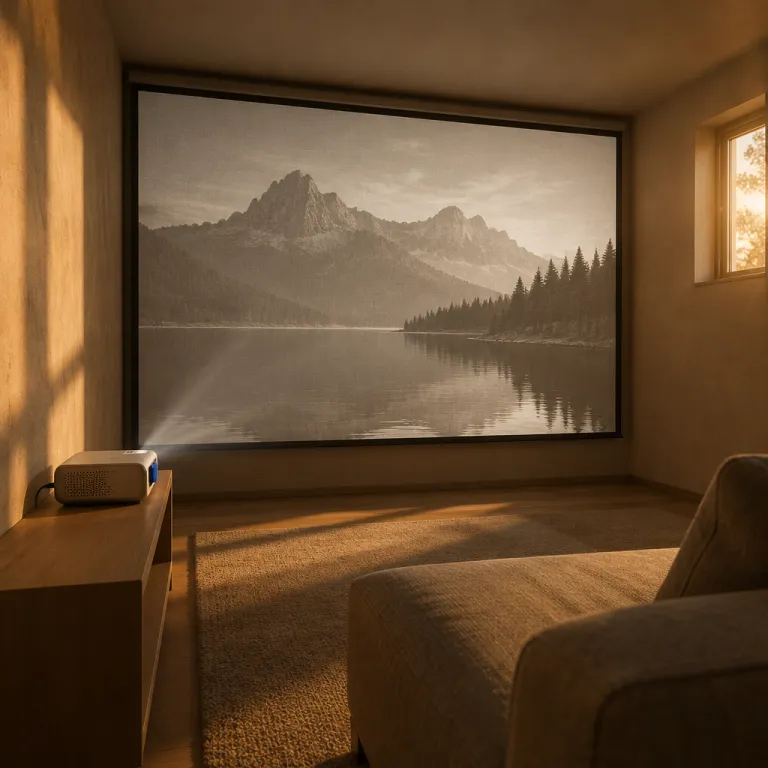
Finding the best home projector for small room setups starts with understanding distance and image size. In a compact living room or bedroom, you want a large cinematic picture without pushing the projector far back, so short throw and ultra short throw (UST) designs become essential for anyone chasing a big-screen experience in tight quarters. When you match throw distance, brightness, and noise levels correctly, a small space can feel like a refined private cinema.
The deep subject many buyers overlook is how throw ratio, brightness, and input lag interact in a tight environment. This matters when you compare different models that all claim to be the best home projector for small room use, yet behave very differently once placed on a shelf or TV stand. Understanding these technical details helps you avoid washed out images, fan noise, and motion blur that can ruin movie nights or gaming sessions.
In a small room, throw ratio is your first critical specification. A short throw projector with a ratio around 0.5 to 0.8, such as the BenQ TH671ST at about 0.69,[1] can create a 100 inch image from roughly 1.5 meters, which is ideal for many apartments seeking a compact home cinema projector for small room viewing. Ultra short throw models sit just centimetres from the wall and can still reach 100 inches or more, making them strong candidates when floor space is extremely limited but you still want a big-screen projector solution in a tight space.
Brightness is the second pillar, especially when you cannot fully darken the space. For mixed use living rooms, a baseline of around 3 000 ANSI lumens is recommended,[1] because this level helps maintain contrast and colour saturation under typical evening lighting and supports small room home theatre scenarios with ambient light. In darker bedrooms or dedicated media corners, you can accept lower brightness, but you still want enough output to keep the image punchy and to justify calling it the best home projector for small room movie nights.
The BenQ TH671ST is a strong example of a short throw model tailored to compact rooms. It offers 1080p resolution, around 3 000 ANSI lumens,[1] and a throw distance of roughly 1.5 meters for a 100 inch screen, which aligns closely with the requirements for the best home projector for small room gaming and streaming. Independent measurements typically place its input lag in the 16 ms to 20 ms range in fast modes,[2] which makes it attractive for console players who want responsive performance without dedicating a large room to their setup.
For buyers prioritising ultra short throw flexibility, the LG CineBeam S PU615U brings a different approach. This compact 4K UST triple laser projector can sit just a few centimetres from the wall, projecting a large image while occupying minimal space on a low cabinet, which is ideal when you want the best home projector for small room layouts that double as stylish living areas. At around 4.2 kilograms, it is also portable enough for renters who may move frequently yet still want a stable, premium viewing experience.
The LG CineBeam S PU615U is rated at about 500 ANSI lumens in its most accurate picture modes,[3] which suits darker rooms more than bright, sunlit spaces. In a small bedroom or carefully shaded living room, that brightness can still deliver a satisfying image, especially when paired with a good projection surface, making it a viable best home projector for small room candidate for film lovers who watch mainly at night. However, if you expect frequent daytime viewing with curtains open, you may prefer a brighter lamp based short throw model instead of this particular UST option.
At the premium end of ultra short throw, the Hisense PX3 Pro stands out as a living room focused choice. This 4K triple laser projector is designed to act almost like a replacement for a large television, with vivid colour and strong light output that supports the best home projector for small room ambitions in more open plan spaces. It is especially compelling for viewers who want a bright, punchy image for sports, films, and streaming without dedicating an entire wall to a traditional TV.
The Hisense PX3 Pro works particularly well when paired with an ambient light rejecting screen. This combination helps maintain contrast even when some lights remain on, which is important if your best home projector for small room scenario involves a multipurpose living area rather than a blackout media cave. Its triple laser engine also tends to provide rich colour volume, which enhances HDR content and makes animated films and games look especially vibrant.
Input lag and motion handling are crucial if you plan to game on your projector. The BenQ TH671ST is tuned with low input lag, making it a strong candidate for console and PC players who want the best home projector for small room gaming without noticeable delay between controller input and on screen action. While UST models like the Hisense PX3 Pro and LG CineBeam S PU615U can also support gaming, you should always check their game mode performance and any published latency figures if fast paced titles are a priority.
Fan noise becomes more noticeable in small rooms, because you sit closer to the projector. Lamp based short throw units can be slightly louder than some laser models, so if you are sensitive to noise, consider eco modes or UST designs that place the projector in front of you rather than behind your seating, which can help maintain the best home projector for small room experience without audible distraction. As a rough guide, look for manufacturer noise ratings around 28–30 dB in eco mode and under about 35 dB in standard mode,[1][2][3] and, when possible, listen to real world tests or showroom demos before deciding.
Screen choice is another factor that shapes your results. In a small room, a 90 to 100 inch diagonal often hits the sweet spot, providing immersion without overwhelming the wall or forcing you to sit uncomfortably close, which aligns with the idea of the best home projector for small room balance between scale and comfort. Fixed frame or tensioned pull down screens usually give better uniformity than bare walls, especially with UST models that are sensitive to surface imperfections.
Placement flexibility matters when furniture cannot be rearranged easily. Short throw projectors like the BenQ TH671ST can sit on a coffee table or wall shelf, while UST units such as the Hisense PX3 Pro and LG CineBeam S PU615U typically live on a low cabinet directly under the screen, which simplifies cable management and helps maintain a clean aesthetic for the best home projector for small room installations. Before buying, measure your available distances carefully and compare them with each model’s throw calculator or specification chart.
Lamp, LED, and laser light sources each bring different strengths. Traditional lamps often deliver high brightness at a lower upfront cost but require periodic replacement, while laser and LED engines promise longer life, faster startup, and more stable colour, which can be attractive for the best home projector for small room setups used daily. In compact spaces where heat buildup can be an issue, the efficiency of laser and LED systems may also help keep fan speeds, and therefore noise, under better control.
Smart features can simplify daily use in a small home. Models with integrated streaming platforms reduce the need for extra boxes and cables, which is helpful when your best home projector for small room arrangement relies on a narrow shelf or compact media console. Voice control, automatic keystone, and focus adjustments also make it easier for less technical users to maintain a properly aligned image.
When comparing the BenQ TH671ST, LG CineBeam S PU615U, and Hisense PX3 Pro, think about your primary use case. If you want bright, responsive gaming and mixed content in a modestly lit room, the BenQ TH671ST aligns closely with the best home projector for small room priorities of brightness and low input lag. If you prefer a sleek, furniture friendly UST solution with strong colour and a TV like presence, the Hisense PX3 Pro and LG CineBeam S PU615U offer compelling alternatives, especially in darker or more controlled lighting.
Budget also shapes what qualifies as the best home projector for small room in your situation. Short throw 1080p models like the BenQ TH671ST typically cost less than premium 4K UST projectors, yet still deliver a large, enjoyable image for films and games, which can be ideal for first time buyers. Higher end UST units such as the Hisense PX3 Pro and LG CineBeam S PU615U justify their price with advanced light engines, smart features, and living room friendly design.
To choose confidently, start by measuring your room and deciding on a target screen size. Then, match that with a suitable throw ratio, brightness level, and input lag profile, focusing on models like the BenQ TH671ST, LG CineBeam S PU615U, and Hisense PX3 Pro that are engineered for compact spaces and align with the idea of the best home projector for small room enjoyment. Finally, consider noise, smart features, and long term running costs so your new projector feels like a natural, enduring part of your home.
Throw distance and placement at a glance
| Projector | Type | Approx. throw ratio | Distance for ~100" image |
|---|---|---|---|
| BenQ TH671ST | Short throw | ~0.69:1[1] | ~1.5 m from screen |
| LG CineBeam S PU615U | Ultra short throw | UST (very low)[3] | Just a few cm from wall |
| Hisense PX3 Pro | Ultra short throw | UST (very low)[4] | Typically 20–40 cm from wall |
Quick comparison: projectors for small rooms
- BenQ TH671ST – Short throw 1080p; ~0.69 throw ratio; about 3 000 ANSI lumens; low input lag (~16–20 ms); generally the most affordable of the three.
- LG CineBeam S PU615U – 4K UST triple laser; sits centimetres from the wall; roughly 500 ANSI lumens in accurate modes; best suited to dark rooms and style focused setups.
- Hisense PX3 Pro – Premium 4K UST triple laser; high brightness suitable for living rooms; benefits greatly from an ALR screen; typically the highest priced but closest to a TV replacement.
Use case recommendations
- Best for gaming and mixed use in modest light: BenQ TH671ST.
- Best for dark, design led small rooms: LG CineBeam S PU615U.
- Best TV replacement in a bright living area: Hisense PX3 Pro with an ALR screen.
Small-room projector buying checklist
- Measure wall width and seating distance; target ~90–100" screen size.
- Match your room depth to each model’s throw ratio or UST distance.
- Choose brightness: around 3 000 ANSI lumens for lit living rooms, lower for dark bedrooms.
- Check input lag (under ~20 ms is ideal for serious gaming).
- Compare fan noise ratings and prefer quieter eco modes for close seating.
- Decide on lamp vs laser/LED based on usage hours and replacement costs.
- Confirm smart features and streaming apps you actually plan to use.
References
- [1] BenQ official product specifications and technical documentation for the TH671ST (brightness, throw ratio, noise ratings).
- [2] Independent lab and reviewer input lag measurements for the BenQ TH671ST game modes.
- [3] LG CineBeam S PU615U manufacturer specifications, user manuals, and picture mode brightness tests.
- [4] Hisense PX3 Pro technical sheets and independent lab test summaries covering UST distance and light output.