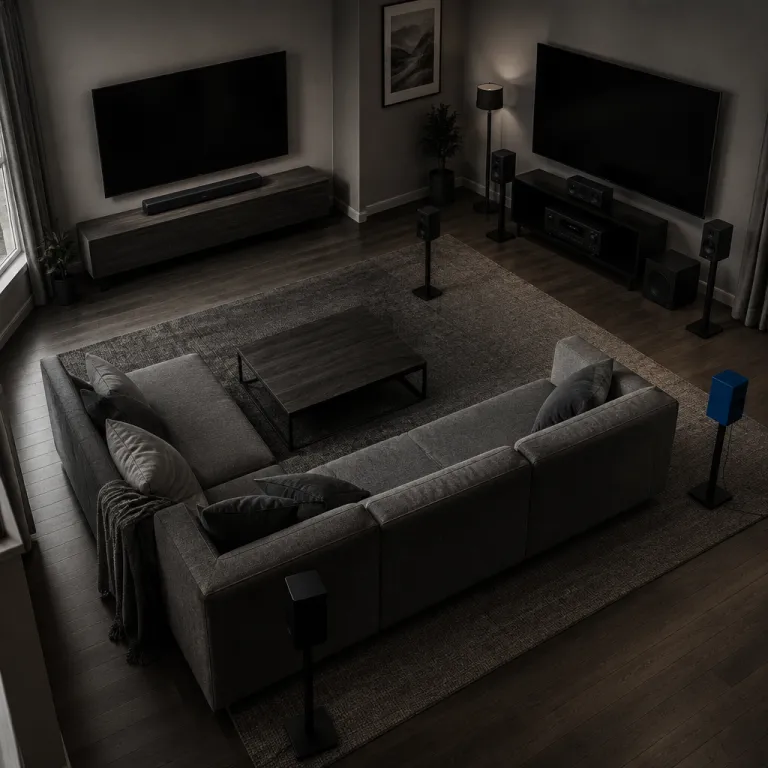
Soundbar vs home theater: which to buy for your room and lifestyle
Choosing between a soundbar and a full home theater system starts with your room. A careful look at your space, furniture layout, and viewing distance narrows the decision far more than any spec sheet can. For a small living room under about 20 m² (roughly 215 ft²), a compact soundbar often delivers enough impact without overwhelming the space or your neighbors.
Think about how you actually watch TV during a normal week. If you mainly stream series, news, sports, and casual movies, the soundbar‑versus‑surround‑system dilemma usually leans toward a quality bar with virtual surround and a wireless subwoofer. For film enthusiasts who schedule movie nights, dim the lights, and sit down for entire films, a full 5.1 or 7.1 home theater system creates a more enveloping and cinematic soundstage.
Noise constraints matter as much as room size when you compare options. In apartments with thin walls, a powerful multi‑speaker setup can be hard to enjoy at reference levels, so the choice often favors a soundbar with night mode and clear dialogue enhancement. In detached houses or well‑insulated homes, a calibrated home theater with separate speakers around the sofa can finally stretch its legs without constant volume anxiety.
Budget is another decisive filter before you even compare brands. Market surveys from retailers like Best Buy and Crutchfield show that midrange soundbars cluster around 250–400 USD, letting you significantly upgrade TV audio without a major investment. A typical 5.1 home theater package with an AV receiver, five speakers, and a subwoofer often sits closer to 1000–1300 USD. When you weigh a bar against a multi‑speaker rig, remember that cables, stands, and possible installation help add to the total cost of a surround setup.
Consider your tolerance for visible hardware and wires in the living room. A slim bar under the TV keeps the decision simple for design‑focused buyers who dislike speaker stands and cable runs. If you enjoy the look of bookshelf speakers and a substantial subwoofer, a home theater system can become part of the room’s aesthetic rather than visual clutter.
Audio performance: surround sound, clarity, and immersion compared
When you compare pure audio performance, the physics of multiple speakers still matter. The key difference is that a home theater uses several speakers placed around you, while a soundbar relies on acoustic tricks and processing from a single front unit (sometimes with wireless rears). This is why traditional 5.1 and 7.1 systems deliver more precise sound placement when effects move from behind you to the front.
One expert answer from the dataset states clearly, “Which gives better surround sound? Home theater offers true surround with multiple speakers around listener.” That sentence captures the heart of the soundbar‑versus‑home‑theater debate for movie lovers who care about directional effects and a convincing rear sound field. If you want to hear a car chase sweep convincingly from back left to front right, discrete rear speakers still win.
Modern Dolby Atmos soundbars narrow the gap by using upward‑firing drivers and advanced processing. In a medium room with a flat ceiling around 2.4–2.7 m high, an Atmos bar can reflect sound to create a surprisingly tall soundstage, which changes how you evaluate one‑box solutions for immersive formats. However, a full Atmos home theater with ceiling or height speakers still produces more accurate overhead effects for blockbuster films and gaming.
Dialogue clarity is another critical factor, especially for mixed content. Many soundbars include dedicated center channels or virtual center modes that keep voices anchored to the screen, which helps for everyday TV and streaming. A well‑calibrated home theater with a true center speaker, though, offers even better intelligibility at lower volumes, which benefits long viewing sessions and late‑night watching.
Music listening habits should also influence your decision, not just movies. If you stream playlists from services like Spotify or Apple Music, a good stereo soundbar can sound surprisingly refined at typical living‑room distances, making the choice less obvious for casual listeners. Audiophiles who sit in a defined sweet spot, however, usually prefer a home theater or at least a stereo pair with a subwoofer for more accurate imaging and dynamics.
For readers comparing other tech ecosystems, the way you evaluate audio performance here is similar to how you might compare different smartwatch lines in a comprehensive guide to comparing Garmin watches. You look beyond marketing names and focus on measurable differences like channel count, frequency response, and supported formats when deciding between a bar and a full surround system. That mindset keeps you grounded in real performance instead of just brand reputation.
Installation, wiring, and everyday usability in real homes
Setup complexity is often the deciding factor for busy households. For many buyers, the question becomes simple once they imagine running speaker cables under rugs or along walls. A single HDMI eARC cable from TV to soundbar, plus power, feels far less intimidating than wiring five or more speakers to an AV receiver.
The dataset includes a direct answer that reinforces this point, “Which is easier to install? Soundbar easier; fewer wires and components than home theater.” That statement reflects what I see repeatedly when helping friends choose their first serious audio upgrade. People who are not comfortable labeling speaker terminals and navigating receiver menus usually appreciate the plug‑and‑play nature of soundbars.
Wireless rear speakers and subwoofers reduce clutter but do not remove it entirely. Even when a home theater kit advertises wireless rears, each speaker still needs power, which means at least one outlet behind the sofa and careful cable routing. This reality shapes decisions in rental apartments and older homes. Soundbars with built‑in subwoofers avoid even that extra box, though they trade some low‑frequency power for simplicity.
Day‑to‑day usability also differs once the system is in place. With a soundbar, volume and power often sync with the TV remote through HDMI CEC, which makes life easier for families who want minimal remote juggling. Traditional home theater receivers can integrate with universal remotes or smart home systems, but they require more initial configuration and occasional troubleshooting.
Smart features and streaming integration now play a central role in many living rooms. A bar with built‑in Wi‑Fi, Bluetooth, and voice assistant support can double as a music hub, which nudges many users toward soundbars if they value quick casting from phones and tablets. Some modern AV receivers offer similar streaming features, yet their interfaces are often less intuitive than the streamlined apps bundled with premium bars.
If you already manage other smart devices, such as a connected thermostat tuned through a smart thermostat buying guide for efficient comfort at home, you probably appreciate clean integrations. That same mindset should guide your choice, especially when you plan to link audio with smart speakers, TVs, and automation routines. The fewer apps and remotes you need to juggle, the more often you will actually enjoy your system.
For security‑conscious households, the way you think about installation parallels choices in smart security, such as those outlined in a guide to choosing the right smart security system. You weigh ease of installation, wireless reliability, and long‑term maintenance in the same way when deciding between a simple bar and a more complex receiver‑based rig. A simpler system usually means fewer points of failure and less time spent troubleshooting.
Budget, value, and long term upgrade paths
Price alone does not tell the whole story, but it sets clear boundaries. With an average soundbar cost around 300 USD according to pricing from major retailers and brands like Samsung, Sony, and Vizio, you can step into significantly better audio than any built‑in TV speakers. A basic 5.1 home theater package, by contrast, often starts near 1000–1200 USD once you include an AV receiver and a decent subwoofer, as seen in entry‑level bundles from Denon, Yamaha, and Polk.
Think in terms of cost per year of use rather than just the sticker price. A well‑chosen soundbar that you keep for six or seven years can represent excellent value, especially if it supports HDMI eARC and major formats like Dolby Atmos and DTS:X. A modular home theater system may cost more initially, but you can upgrade individual components like the subwoofer or front speakers over time instead of replacing everything at once.
Hidden costs deserve attention before you commit. For home theater systems, speaker cables, stands, wall mounts, and potential professional calibration can add a few hundred euros or dollars to the total, which changes the real comparison for many households. Soundbars usually require only a single HDMI cable and perhaps a wall‑mount bracket, so accessory costs remain modest.
Resale value and flexibility also differ between the two approaches. Branded AV receivers and quality speakers often retain some value on the second‑hand market, which can soften the long‑term cost of choosing a component system. Soundbars depreciate faster, especially when new HDMI standards or audio formats appear, because you cannot swap out individual parts.
Energy consumption is another subtle but real factor in total cost of ownership. A compact bar with a modest subwoofer usually draws less power than a multi‑channel receiver driving several passive speakers, which slightly favors soundbars for heavy daily use. Over thousands of viewing hours, the difference may not be dramatic, but it contributes to both running costs and heat output in smaller rooms.
Finally, consider how your interests might evolve. If you enjoy tweaking settings, experimenting with speaker placement, and gradually upgrading gear, a home theater system offers a more satisfying playground, which can justify the higher initial outlay. If you prefer a set‑and‑forget solution that simply works every evening, a well‑chosen soundbar usually delivers better value for your time and money.
Room size, acoustics, and placement strategies
Room acoustics can make or break any audio system, regardless of price. In compact rooms under about 15 m², reflections from nearby walls often blur surround effects, which changes how you judge immersive sound. A good bar with controlled dispersion can sometimes sound cleaner than a cramped 5.1 setup with poorly placed rear speakers.
Medium‑sized living rooms between 15 and 30 m² offer more flexibility. Here, the decision depends heavily on seating layout and whether the sofa is against a wall or floating in the room, because rear speaker placement becomes critical for convincing surround. If your main seating is flush against the back wall, upward‑firing or side‑firing soundbar drivers may simulate rear effects more effectively than rears squeezed into corners.
Large open‑plan spaces introduce another set of challenges. Soundbars can struggle to fill wide rooms with even sound, especially when ceilings are high and reflective, which often tips the balance toward multi‑speaker systems with more power and directional control. In such spaces, using floor‑standing fronts and a capable subwoofer helps maintain impact at typical listening distances of 3 to 4 m.
Subwoofer placement deserves particular attention in both scenarios. With soundbars, the wireless subwoofer usually sits near the TV wall, which simplifies bass management but can create boomy spots if the sub is crammed into a corner. Home theater systems allow more freedom to place the subwoofer along a side wall or near the seating position, which can smooth bass response when combined with room‑correction tools.
Acoustic treatments and furnishings also influence your choice. Thick rugs, curtains, and bookshelves help tame reflections, which can make a home theater system shine and shift the decision toward multi‑speaker setups in treated rooms. Bare walls, hard floors, and large windows, on the other hand, often favor the more controlled dispersion of a soundbar until you invest in basic room treatment.
Finally, think about future changes to your space. If you plan to move from a small apartment to a larger home, starting with a bar now and later upgrading to a full home theater can be a sensible path, turning the choice into a staged decision rather than a one‑time commitment. Conversely, if you already live in your long‑term home, investing in a system tailored to that specific room will pay off every evening.
Use cases: movies, gaming, streaming, and everyday TV
Your primary content type should heavily influence your decision. For everyday TV, news, and talk shows, the question usually favors a soundbar with strong dialogue modes and automatic volume leveling. The simplicity of turning on the TV and having clear voices without extra steps matters more than absolute surround precision.
Movie enthusiasts who regularly watch action films, thrillers, and big‑budget series benefit more from a full surround setup. In that context, the debate leans toward home theater systems that can render subtle ambient sounds behind you and powerful effects across the room. The emotional impact of a well‑mixed soundtrack often depends on those rear and height channels working together.
Gamers face a slightly different set of priorities. Low latency, positional accuracy, and strong center‑channel performance are crucial, which means your choice should consider how each system handles console or PC connections and game‑specific audio modes. A good home theater with properly placed speakers can give competitive players a clearer sense of where footsteps or gunfire originate.
Streaming music and podcasts turn your TV area into a general entertainment hub. If you often play background playlists while cooking or working, a soundbar with integrated streaming services and multiroom support can be more convenient, which nudges lifestyle‑focused users toward bars. Home theater receivers can match these features but usually require more app juggling and configuration.
Households with mixed usage patterns should map out a typical week. If five evenings out of seven involve casual streaming and only one or two are dedicated movie nights, the practical answer often becomes a high‑quality soundbar with a capable subwoofer. For homes where film nights, gaming sessions, and critical listening dominate, a carefully chosen home theater system rewards the extra effort.
Finally, remember that no system exists in isolation. Your choice of TV, streaming box, game console, and even smart home platform all interact with your audio gear, so your decision should fit into a coherent ecosystem. Matching connection standards, supported formats, and control methods across devices will make your daily experience smoother and more enjoyable.
Key figures and statistics for choosing between soundbar and home theater
- Average soundbar cost sits around 300 USD according to typical market pricing from brands such as Samsung, Sony, LG, and Vizio, which makes it roughly one quarter the price of many entry‑level 5.1 home theater bundles.
- Average home theater cost for a 5.1 system is about 1200 USD based on market data from AV specialists like Denon, Yamaha, and Onkyo, reflecting the combined price of an AV receiver, five speakers, and a subwoofer.
- In small rooms under 20 m², a single soundbar can often provide sufficient volume and clarity at moderate listening levels, while a full home theater may rarely exceed half of its available power.
- Wireless rear speakers and subwoofers reduce visible cabling but still require power outlets near the seating area, which can limit placement options in older homes with fewer sockets.
- Home theater systems with multiple speakers around the listener deliver true surround sound, while soundbars rely on virtual processing and room reflections to simulate rear channels.
FAQ about soundbar vs home theater which to buy
Which gives better surround sound for movies and gaming ?
Home theater systems provide better surround sound because they use multiple speakers placed around the listener. This layout creates distinct rear, side, and front channels that soundbars can only simulate with processing. If immersive effects are your top priority, a 5.1 or 7.1 home theater is the stronger choice.
Is a soundbar enough for a small living room ?
Yes, a soundbar can be entirely sufficient in small rooms, especially under 20 m². The dataset confirms this with the statement, “Is soundbar enough for small rooms? Yes, soundbar can suffice in small spaces with limited budget.” In such spaces, a good soundbar with a subwoofer often sounds cleaner and more controlled than a cramped multi‑speaker setup.
Which option is easier to install and use daily ?
A soundbar is easier to install because it usually needs only power and a single HDMI eARC connection to the TV. Home theater systems require running speaker cables, connecting an AV receiver, and configuring channels, which takes more time and confidence. For households that value simplicity and minimal remotes, soundbars are generally more user‑friendly.
How should budget influence soundbar vs home theater which to buy ?
Budget strongly shapes your options because a capable soundbar starts around 300 USD, while a full 5.1 home theater often costs about 1200 USD including receiver and speakers. If your budget is limited, a midrange bar offers a clear upgrade over TV speakers without the complexity of a receiver‑based system. Higher budgets open the door to modular home theater setups that can be upgraded over time.
What matters more, room size or content type ?
Both matter, but room size usually comes first because it defines what is physically practical. In small or acoustically challenging rooms, a soundbar may perform better than a poorly placed home theater, even for movies. In larger, well‑arranged spaces, content type and your preference for immersion versus simplicity will guide whether you choose a bar or a full surround system.
Example models and quick comparison table
To make the trade‑offs more concrete, here are three popular options that illustrate the range from simple bar to full surround system. Prices are approximate street prices and may vary by retailer and region.
| Model | Type | Channels | Key formats | Typical price (USD) |
|---|---|---|---|---|
| Sonos Beam (Gen 2) | Compact soundbar | 3.0 (virtual Atmos) | Dolby Atmos, Dolby Digital | ~450 |
| Samsung HW‑Q800C | Soundbar + sub (optional rears) | 5.1.2 | Dolby Atmos, DTS:X | ~700 |
| Denon AVR‑S970H + 5.1 speaker pack | AV receiver + home theater speakers | 5.1 (expandable) | Dolby TrueHD, DTS‑HD, Atmos (with height speakers) | ~1200–1400 (bundle) |
These examples show how channel count, format support, and price scale as you move from a single bar to a full receiver‑based system.
Persona‑based recommendations: which setup fits you?
Small apartment dweller: Limited space, close neighbors, and simple TV habits usually point to a compact Dolby Atmos soundbar with a modest subwoofer. You get a big upgrade over TV speakers, easy installation, and less risk of disturbing others.
Busy family living room: Mixed content, multiple users, and a shared space favor a midrange bar with strong dialogue modes, HDMI eARC, and reliable streaming features. Add a wireless sub for movie nights and keep controls as simple as possible.
Dedicated home theater enthusiast: If you have a separate room, flexible speaker placement, and a passion for movies or gaming, invest in a 5.1 or 7.1 receiver‑based system with the option to add Atmos height channels later. The setup effort pays off in immersion and long‑term upgrade flexibility.